A–Z Glossary

executive function

Executive function is a set of thinking skills that helps children pause, control impulses, assess risk, and make decisions.

← Back to A–Z Glossary

Search results for: executive function

Can sleep affect baby intelligence myth

Can sleep affect baby intelligence myth

Why the myth sounds believable It is easy to see why this myth persists. Sleep is not passive; during sleep, the infant brain is organizing experience, strengthening some neural connections, and pruning others. That makes sleep feel like a direct builder of intelligence. Many parents also notice that a well-rested baby seems more alert, more […]

Understanding child behavior patterns

Understanding child behavior patterns

Behavior as developmental communication Child behavior is best understood as an observable output of a developing brain. Executive functions, including inhibitory control, working memory, cognitive flexibility, and planning, mature gradually from early childhood through adolescence. Emotional regulation also develops slowly and depends heavily on co-regulation: the adult’s ability to provide calm, predictable support while the […]

Why some children struggle to make friends

Why some children struggle to make friends

Friendship begins with repeated practice To understand why some children struggle, it helps to see how children make friends in the first place. Friendship is usually built through repeated small exchanges: noticing another child, joining play, responding to bids for attention, taking turns, and recovering after disagreement. These steps sound simple to adults, but for […]

Communication skills in children

Communication skills in children

What communication skills include in childhood In clinical terms, communication includes receptive language, expressive language, speech production, and pragmatics. Receptive language is what a child understands. Expressive language is what a child can say, sign, or otherwise convey. Pragmatics refers to the social use of language: taking turns, staying on topic, adjusting tone, and using […]

Conflict resolution skills children

Conflict resolution skills children

Why conflict resolution matters in childhood Conflict is not proof that a child is disrespectful or that a family is failing. In childhood, disagreement is often a normal sign that a child wants autonomy, fairness, or control over a limited resource. The developmental task is to move from impulse-driven reactions toward teaching conflict resolution skills […]

Problem solving in relationships kids

Problem solving in relationships kids

What relationship problem solving means for children Problem solving in relationships is more than telling children to be nice. It means helping them move from emotion to action without ignoring either one. A child has to notice the conflict, label the feeling, consider the other person’s point of view, and choose a response that protects […]

Handling peer conflicts children

Handling peer conflicts children

Why peer conflict is a normal part of childhood Children do not build friendship skills in a straight line. They test boundaries, misread intentions, want the same toy, or feel hurt by a comment and react quickly. In this sense, peer conflict is part of learning how to negotiate membership in a group. Developmental research […]

Common sibling conflicts explained

Common sibling conflicts explained

Why sibling conflict is so common Siblings live in close proximity, compete for time and attention, and often have uneven power depending on age, size, language skills, and impulse control. That combination makes conflict almost inevitable. A preschooler may not yet have the inhibitory control to wait, share, or tolerate frustration. An older child may […]

How peer influence affects children

How peer influence affects children

What peer influence means in childhood Peer influence is the process by which children are shaped by what other children think, say, and do. It includes direct pressure, but it also includes subtler forces such as imitation, social comparison, and the desire to fit in. A child may copy a classmate’s joke, dress style, opinion, […]

Positive vs negative peer influence

Positive vs negative peer influence

What peer influence means Peer influence is the way children change their thoughts, emotions, or behavior in response to classmates, teammates, friends, or online groups. It can happen directly, such as when a friend says, “Let’s do this,” or indirectly, when a child notices what their group praises, ignores, or punishes. Much of it is […]

Teaching independent thinking kids

Teaching independent thinking kids

What independent thinking really means Independent thinking means a child can pause, gather information, and form a reasoned view rather than simply copying the loudest voice or the first answer. It includes judgment, not just confidence. A child who thinks independently can say, in age-appropriate ways, “I am not sure yet,” “Why do you think […]

Digital communication skills kids

Digital communication skills kids

What digital communication skills mean for children Digital communication skills kids need are broader than knowing how to tap, swipe, or send an emoji. They include receptive language, expressive language, pragmatic language, social cognition, emotional regulation, attention control, and safety judgment. A child must learn not only what a message says, but how it may […]

Why play is important for children

Why play is important for children

Play is a core part of development In child development, play is best understood as active exploration. A child who stacks blocks, pretends to cook, chases a ball, or invents rules for a game is not simply passing time. The child is testing ideas, adjusting to feedback, and learning how actions lead to consequences. That […]

Balancing group and solo play

Balancing group and solo play

Why balancing play styles matters Play is not a single skill. In early childhood, it is a cluster of abilities that includes exploration, communication, imitation, problem-solving, and emotional regulation. A child who enjoys alone time may be practicing different skills from a child who thrives in a busy group, but both are learning. That is […]

Age appropriate independent activities

Age appropriate independent activities

Why independent activities matter Age-appropriate independence supports more than convenience for caregivers. It helps children develop executive functions: working memory, inhibitory control, cognitive flexibility, planning, and task persistence. These skills are neurologically immature in childhood and adolescence, so they are strengthened through repeated, meaningful practice rather than lectures alone. Independent tasks also support self-efficacy, the […]

Family activities with children

Family activities with children

Why shared activities matter Family activities work best when they do more than occupy time. A shared game, walk, or kitchen task gives children repeated practice in turn-taking, joint attention, and communication. In developmental terms, these are building blocks for social learning and executive function, the set of skills used for planning, shifting attention, and […]

Benefits of structured activities kids

Benefits of structured activities kids

What structured activities mean for kids Structured activities are organized experiences with a plan, a goal, and usually an adult or trained leader. Examples include sports practice, music lessons, clubs, guided art, scouting, dance, and many classroom-style enrichment programs. The structure may be simple, such as a predictable circle time, or more complex, such as […]

Balancing extracurriculars and free play

Balancing extracurriculars and free play

Why balance matters Children do best when their days include both guided learning and self-directed recovery. Extracurriculars can be energizing, but if they fill every afternoon, the child’s nervous system may remain in a state of high autonomic arousal. Over time, that can affect mood, attention, and the ability to shift between tasks. In practical […]

Too many activities and lack of free play children

Too many activities and lack of free play children

Why free play matters for child development Free play is not an empty slot on the calendar. For children, it is one of the main ways they rehearse social negotiation, motor planning, emotional regulation, and flexible thinking. In unstructured play, a child decides the rules, revises them, tolerates small disappointments, and learns how to stay […]

Arts crafts and music creative expression children

Arts crafts and music creative expression children

Why creative expression matters in childhood Children learn through action, repetition, and meaningful play. Arts, crafts, and music provide all three. When a child tears paper, shapes clay, shakes a rattle, or chooses colors for a drawing, they are practicing decision-making, cause-and-effect reasoning, and flexible thinking. These experiences also invite curiosity, which is an important […]

Encouraging creativity children activities

Encouraging creativity children activities

Why creativity matters in child development Creativity is often described as the ability to generate original and useful ideas. In children, it also includes curiosity, symbolic thinking, flexible attention, and the confidence to try something unfamiliar. These abilities are not separate from everyday development; they are woven into play, language, motor skills, and social learning. […]

Loose parts play: using everyday objects for creative play

Loose parts play: using everyday objects for creative play

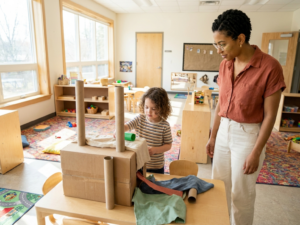
What loose parts play means Loose parts play means giving children everyday objects that can be moved, combined, stacked, sorted, carried, torn apart, and rebuilt. The key feature is not what the object is, but what the child can do with it. A cardboard tube may become a telescope, a bridge, a megaphone, or part […]

Building activities that develop planning and problem-solving skills

Building activities that develop planning and problem-solving skills

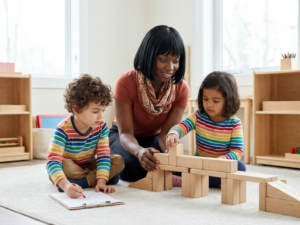
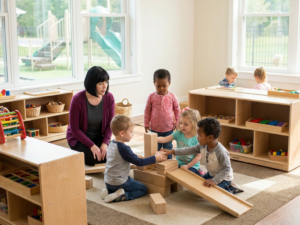
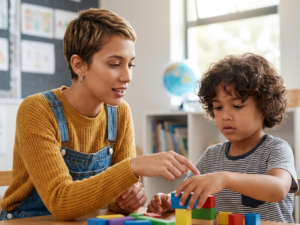
Why building activities support planning and thinking ahead Building activities are powerful because they ask a child to imagine an outcome before acting. A child has to choose pieces, predict what will happen, and notice whether the first idea works. That sequence is a form of planning, and it is closely tied to executive function […]

Building teamwork through play

Building teamwork through play

Why teamwork is learned most naturally in play Teamwork is not a single skill. It is a cluster of capacities: joint attention, receptive and expressive language, impulse control, theory of mind, frustration tolerance, flexible problem-solving, and the ability to repair a social rupture. Play brings these capacities together in a low-stakes but emotionally meaningful setting. […]

Underestimating child abilities and overconfidence risks

Underestimating child abilities and overconfidence risks

Two inaccurate estimates at opposite ends Underestimating a child means judging the child as less capable than available evidence suggests. An adult may assume that a preschooler cannot put on a coat, carry an unbreakable cup, explain a preference, or try an unfamiliar playground activity, and therefore complete the task automatically. The intention is often […]

Running away or leaving a safe area without permission

Running away or leaving a safe area without permission

What the behavior can mean The phrase covers several different patterns. A young child may wander because curiosity, limited danger awareness, and immature impulse control exceed their ability to follow boundaries. A child with autism, intellectual disability, attention-deficit/hyperactivity disorder, epilepsy, sleep disorders, communication difficulties, or sensory-seeking behavior may leave a safe area without fully understanding […]

When is a child ready to stay home alone

When is a child ready to stay home alone

There is no single age that fits every child Age provides context, but it cannot determine readiness by itself. The Nationwide Children’s Hospital notes that most children are not ready to stay home alone until at least age 12. This should be treated as a general developmental benchmark rather than a universal rule. A younger […]

Teaching children how to respond to unexpected phone calls or messages

Teaching children how to respond to unexpected phone calls or messages

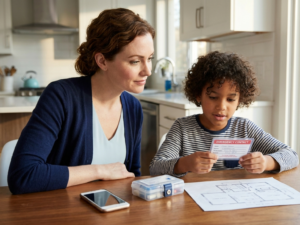
Why unexpected contact can be difficult for children Children are still developing executive functions such as inhibitory control, risk assessment, and delayed gratification. A message that promises a reward, claims that an account will be closed, or says that a loved one is in trouble can overwhelm these skills. Adolescents may also feel pressure to […]

Walking to school alone: readiness and safety planning

Walking to school alone: readiness and safety planning

Start with readiness, not a birthday Walking to school alone requires more than knowing the way. A child must sustain attention, inhibit impulses, interpret moving traffic, follow rules even when peers do not, and solve small problems without panicking. These executive function skills mature at different rates, so age is only a rough guide. Look […]

Common morning struggles and reducing stress children

Common morning struggles and reducing stress children

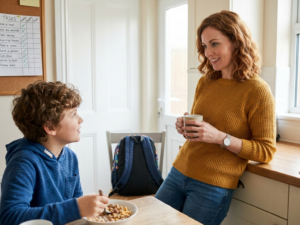
Why mornings can overwhelm children Children do not wake with adult-level planning skills already online. The prefrontal cortex, which supports working memory, sequencing, inhibition, and flexible problem-solving, is still developing throughout childhood and adolescence. A child who appears to be ignoring instructions may actually be struggling to hold several steps in mind: get dressed, eat, […]

Morning routine tips parents

Morning routine tips parents

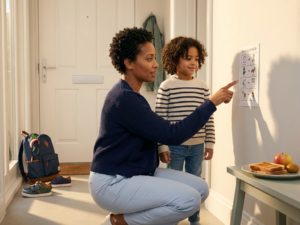
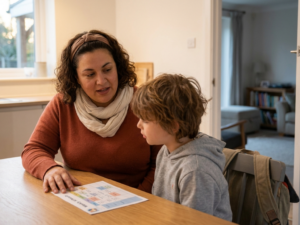
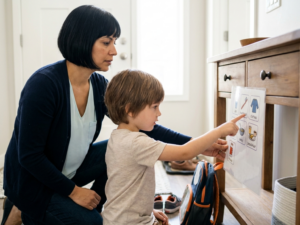
Start with a small, predictable sequence Children generally manage mornings more easily when the order of events is stable. A routine acts as an external scaffold for executive function, the group of cognitive skills involved in working memory, inhibition, planning, and shifting attention. A systematic review of research on routines and child development found that […]

Structuring evening time and transitioning from day

Structuring evening time and transitioning from day

Why evening transitions matter Evening is a biologic and behavioral transition, not just a clock time. During the day, children use substantial cognitive effort to follow instructions, inhibit impulses, manage peer interactions, and tolerate sensory stimulation. By late afternoon or evening, the prefrontal systems that support planning, impulse control, and flexible shifting may be relatively […]

Weekly routine planning children

Weekly routine planning children

Why weekly routines matter A weekly routine is the repeated structure that organizes a child’s life across school days, weekends, activities, family time, and rest. Research on child routines consistently points to the value of structure, predictability, and consistency for development, behavior, emotional regulation, and daily functioning. In practical terms, routines reduce the number of […]

Chores and responsibility habits children

Chores and responsibility habits children

Why chores support responsibility Chores give children repeated opportunities to connect effort with a visible outcome. Putting laundry in a basket, feeding a pet with supervision, or clearing a plate teaches that actions affect other people and the shared environment. Over time, these experiences can strengthen self-efficacy, meaning the child’s belief that they can manage […]

Common routine problems children

Common routine problems children

Recognizing child routine challenges Child routine challenges can occur at any age, although the form they take changes with development. Preschool children may protest transitions, insist on a particular sequence, or become overwhelmed when a preferred activity ends. School-age children may forget steps, lose materials, delay homework, or become emotionally dysregulated when asked to shift […]

Common mistakes in child routines

Common mistakes in child routines

Treating routines as rigid rules One common mistake is confusing predictability with inflexibility. A routine should provide a reliable sequence, not require every event to occur at exactly the same minute. Children need repeated cues, but they also need opportunities to learn that plans can change safely. Insisting on perfect adherence may increase conflict when […]

Too strict vs too flexible routines children

Too strict vs too flexible routines children

What a healthy routine is designed to do A routine is a repeated pattern that organizes important parts of the day, such as waking, meals, school or childcare, hygiene, play, family connection, and sleep. It differs from a rigid schedule because it emphasizes sequence and dependable expectations rather than exact timing at every moment. For […]

Flexible vs strict routine children

Flexible vs strict routine children

What flexible and strict routines look like A flexible routine has recurring anchors but does not require every event to happen at an exact time or in an identical way. For example, a child may have a consistent bedtime sequence—washing, changing, reading, and settling—while the start time shifts slightly on weekends or after an appointment. […]

How parents manage child routines

How parents manage child routines

What a child routine is and why parents use one A routine is a repeated sequence of activities that generally occurs in a familiar order. It may include waking, using the toilet, dressing, eating breakfast, leaving for school, returning home, completing homework, playing, bathing, reading, and going to sleep. A schedule usually emphasizes clock times, […]

Parent role in daily structure

Parent role in daily structure

What the parent’s role really involves Children do not begin life with mature executive functions. Attention regulation, working memory, inhibitory control, time awareness, and flexible problem-solving develop gradually. Parents temporarily supply some of this external organization by deciding what needs to happen, sequencing activities, gathering materials, and providing reminders. This is not a failure of […]

Building independence through routine

Building independence through routine

Why routine supports independence A routine creates a predictable sequence: what happens first, what comes next, and what signals completion. This predictability reduces the cognitive load associated with planning and remembering multiple steps. Instead of repeatedly asking an adult what to do, a child can gradually internalise the sequence and initiate more of it independently. […]

Too busy schedule and lack of structure issues children

Too busy schedule and lack of structure issues children

Why an overloaded schedule can become stressful Children need time not only for formal learning and organized activities, but also for sleep, meals, movement, relationships, recovery, and self-directed play. When every part of the day is assigned, the child may have few opportunities to decompress or process experiences. Repeated transitions between school, tutoring, sports, lessons, […]

Helping children follow routines and adjusting with age

Helping children follow routines and adjusting with age

Why routines help children develop A routine is a repeated sequence that organizes activities and expectations. It may be highly predictable, such as brushing teeth before bed, or loosely structured, such as completing homework sometime after school and before leisure. Research synthesized in a systematic review suggests that family routines become more differentiated and structured […]

Creating a weekday routine for children in two-household families

Creating a weekday routine for children in two-household families

Start with anchors, not identical households A useful routine begins with a small number of anchors: wake time, school or childcare, meals, homework or quiet time, personal care, connection with a caregiver, and bedtime. These anchors create temporal predictability, meaning the child can anticipate what usually happens next. The homes do not need to use […]

Helping children adjust when daily routines differ between homes

Helping children adjust when daily routines differ between homes

Why routine differences can feel stressful Routines reduce the number of decisions a child must make. Repeated sequences provide external structure while executive function—the capacity to plan, shift attention, remember instructions, and regulate behavior—is still developing. Moving between homes can temporarily increase the need for these skills. A child may need to remember different rules, […]

Fixing routine problems

Fixing routine problems

What counts as a routine problem? A routine problem occurs when a child repeatedly struggles with a familiar sequence that should be manageable with their current skills and support. Examples include forgetting steps in tooth-brushing, becoming stuck while dressing, refusing to leave for school, or needing prolonged adult prompting to begin homework. The problem may […]

Resetting a child’s routine after illness or a long school absence

Resetting a child’s routine after illness or a long school absence

Start with readiness, not the calendar The first question is whether the child is medically and functionally ready to resume education. A child may no longer have fever or vomiting but still be unable to sustain attention, walk between classrooms, manage personal care, or participate safely. Conversely, a child may be physically well but apprehensive […]

Teaching responsibility and daily tasks children

Teaching responsibility and daily tasks children

Why daily tasks matter for children Household tasks provide a natural context for learning responsibility. Putting toys away, placing laundry in a hamper, feeding a pet under supervision, preparing a school bag, or helping clear the table teaches that shared environments require shared contributions. The goal is not simply productivity. Children are learning that actions […]

Child school life overview by age

Child school life overview by age

Ages 3 to 5: building the foundations for school Preschool and the kindergarten-entry period are often focused less on formal academic achievement and more on readiness for group learning. Children practice separating from caregivers, following short sequences of instructions, taking turns, listening during group activities, using classroom materials safely, and communicating basic needs. Play remains […]

Starting kindergarten experience and first day expectations

Starting kindergarten experience and first day expectations

Why the kindergarten transition matters Kindergarten often introduces a longer day, a larger peer group, more formal expectations, and a new balance between teacher-directed and child-directed activity. Children must learn where to put belongings, how to request help, when to use the bathroom, how to move between activities, and how to participate in a group. […]

Adjusting to kindergarten routine and social adaptation

Adjusting to kindergarten routine and social adaptation

Why kindergarten adjustment can feel demanding Kindergarten combines several developmental tasks that may previously have occurred separately. A child may need to wake earlier, dress within a time limit, travel to school, separate from a caregiver, attend to group directions, wait for turns, use classroom materials appropriately, manage toileting and meals more independently, and shift […]

Extracurricular life in school

Extracurricular life in school

What extracurricular life in school means Extracurricular activities are organized experiences that take place outside the core academic timetable. They may be offered by the school, community organizations, sports clubs, libraries, arts programs, or youth groups. Some are competitive and performance-oriented, while others emphasize exploration, cooperation, creativity, service, or enjoyment. A chess club, school orchestra, […]

Peer interaction teamwork and friendships impact

Peer interaction teamwork and friendships impact

Why peer interaction matters in childhood Peer interaction provides a developmentally meaningful setting in which children learn skills that are difficult to acquire through instruction alone. A child who joins a game must notice other people’s intentions, communicate a preference, tolerate an unexpected change, and adjust behavior to preserve the shared activity. These repeated exchanges […]

School success factors children explained

School success factors children explained

What school success means School success is broader than achieving high marks. It may include acquiring literacy and numeracy, participating in lessons, attending regularly, developing executive functions, forming relationships, managing frustration, and becoming increasingly independent. A child may be progressing meaningfully even when their attainment is not yet at the expected level. Academic achievement is […]

Reducing pressure in school life

Reducing pressure in school life

Understanding school pressure as a biopsychosocial stressor School pressure is best understood as a biopsychosocial stressor: it affects biology, thoughts, emotions, behavior, family life, and social belonging. A child may look “lazy” or “unmotivated” when, in fact, their nervous system is overloaded. Stress activates the hypothalamic-pituitary-adrenal axis and sympathetic nervous system, increasing cortisol, heart rate, […]

Questions parents should ask during a parent-teacher conference

Questions parents should ask during a parent-teacher conference

Prepare for a focused, collaborative conversation Before the conference, review recent assignments, school communications, report cards, attendance information, and any notes your child has shared. Write down two or three priorities. These might include reading fluency, mathematics, organization, separation distress, frequent headaches before school, conflict with peers, or difficulty completing homework. Prioritizing helps you use […]

Helping children set realistic academic goals after receiving grades

Helping children set realistic academic goals after receiving grades

Begin with emotional safety, not immediate problem-solving Before discussing targets, help the child regulate the emotional impact of the grade. A low mark may activate shame, threat perception, or fear of disappointing a caregiver. Even a high mark can create pressure if the child believes that future approval depends on repeating it. A calm conversation […]

Organizing long-term school projects without last-minute panic

Organizing long-term school projects without last-minute panic

Start by making the assignment concrete Before putting dates on a calendar, help the child understand what the finished project must contain. Read the instructions together and identify the required product, format, length, research expectations, presentation requirements, rubric, materials, and submission method. Ask the teacher for clarification early if any part is ambiguous. Uncertainty consumes […]

Helping children manage several teachers and different class expectations

Helping children manage several teachers and different class expectations

Why several teachers can feel overwhelming Changing teachers requires a child to repeatedly reset their expectations. One teacher may permit quiet questions during independent work, while another may expect students to raise a hand. One classroom may prioritize speed and completion; another may emphasize showing every step. Even when each approach is reasonable, the combined […]

Teaching children how to ask for an extension responsibly

Teaching children how to ask for an extension responsibly

Why this skill matters An extension request gives a child a practical way to respond when circumstances interfere with a commitment. It can prevent last-minute panic, incomplete work, dishonest explanations, or avoidance of communication. The deeper lesson is that responsible people notice a problem, communicate it promptly, propose a plan, and follow through. Children also […]

What to do when a child hides unfinished schoolwork

What to do when a child hides unfinished schoolwork

Begin with calm curiosity When you find an unfinished worksheet in a drawer, backpack, or under a bed, pause before confronting the child. A strong reaction can unintentionally confirm the child’s fear that disclosure will lead to humiliation, punishment, or an intense argument. Regulate your own response first, then choose a private moment for conversation. […]

Typical school day and classroom environment children

Typical school day and classroom environment children

The rhythm of a typical school day A school day usually begins before formal instruction. Children arrive, store belongings, greet adults and peers, read posted instructions, choose morning work, or settle into a brief routine. This opening period may look simple, but it demands executive function: sequencing, inhibitory control, working memory, and emotional regulation. A […]

Healthy technology habits children

Healthy technology habits children

Technology habits are developmental, not moral Healthy technology routines for children begin with a realistic view of child development. Children are still building inhibitory control, reward sensitivity, attention shifting, and emotional self-regulation. Digital media is designed to be stimulating, immediate, and easy to continue, so a child who protests when a game or video ends […]

Teaching responsible and balanced screen use

Teaching responsible and balanced screen use

Start With Health, Not Guilt Teaching responsible screen use works best when the starting point is health rather than blame. Children are drawn to screens because digital media is stimulating, social, rewarding, and often designed to hold attention. That does not make a child weak or a parent careless. It means families need a structured […]

Balancing family and technology

Balancing family and technology

Technology is part of family life Family technology balance begins with an honest premise: digital media is not simply an outside threat entering the home. It is often woven into caregiving, education, employment, entertainment, safety, and social connection. A child may use a tablet for school reading, a messaging app to coordinate a sports pickup, […]

Technology behavior patterns children

Technology behavior patterns children

Patterns are communication Technology behavior patterns in children are rarely about the device alone. A child who cries when a tablet is removed, rushes through homework to play a game, or becomes irritable after videos may be communicating fatigue, anxiety, sensory overload, boredom, social pressure, or difficulty with transitions. Understanding child behavior patterns means asking […]

Child refuses screens too much gaming and conflicts

Child refuses screens too much gaming and conflicts

Why Screen Refusal Feels So Intense When a child refuses to stop gaming, the reaction may look disproportionate from the outside: yelling, bargaining, crying, threats, or physical resistance over a device. Clinically, it helps to view this as a transition problem plus a reward-regulation problem. Video games provide immediate feedback, novelty, social connection, and intermittent […]