
Intro
Building routines for children is less about creating a perfect timetable and more about giving daily life a predictable rhythm. For a child’s developing brain, predictable sequences reduce uncertainty, support emotional regulation, and make transitions easier. When children know what usually comes next, they can spend less energy scanning for surprises and more energy learning, playing, cooperating, and recovering from stress.
Many caregivers try routines only after mornings, meals, screen time, or bedtime become exhausting. That is completely understandable. The good news is that routines can be built gradually, adjusted for temperament and neurodevelopmental needs, and kept flexible enough for real family life. A useful routine is not rigid control; it is a repeated pattern that helps both adults and children feel more secure.
Highlights
Routines help children feel safe, comfortable, and more in control because daily events become easier to predict.
Start with a few anchor points, such as wake time, meals, play, and bedtime, before adding more detailed steps.
Visual reminders, simple language, and small child responsibilities can improve cooperation without relying on constant adult prompting.
Consistency matters, but flexibility is healthy; routines should adapt to illness, travel, developmental stage, and family stress.
Persistent sleep, feeding, behavioral, anxiety, or developmental concerns should be discussed with a qualified healthcare professional.
Why routines matter for the developing brain
Children are not simply smaller adults. Their prefrontal cortex, the brain region involved in planning, inhibition, working memory, and flexible problem-solving, is still maturing. This means that many children cannot reliably organize time, remember multi-step instructions, or shift smoothly from one activity to another without adult scaffolding. Routines act as an external executive function: they place repeated decisions into a predictable sequence.
Predictability can also lower emotional arousal. When a child knows that bath comes before pajamas, and pajamas come before books, the transition to sleep may feel less like an abrupt loss of control. This is one reason schedules and routines are often associated with feelings of safety, comfort, and cooperation. They help children understand expectations before conflict begins.
Routines also support learning through repetition. A child who clears a plate after meals, places shoes by the door, or chooses a bedtime book is practicing memory, motor planning, responsibility, and autonomy. Over time, these small habits become less effortful because they are encoded as familiar patterns.
Start small: choose anchor points first
A common reason routines fail is that families try to redesign the whole day at once. Instead, begin with anchor points: events that already happen most days. These often include waking, meals or snacks, outdoor play or movement, rest time, homework or reading, hygiene, and bedtime.
Choose one or two high-stress periods and build from there. If mornings are chaotic, focus only on the first hour of the day. If bedtime leads to repeated negotiations, begin with the final 30 to 45 minutes before sleep. A small routine that is repeated consistently is more powerful than an elaborate chart that no one can maintain.
- Identify the difficult time of day: morning, after school, dinner, screen shutdown, or bedtime.
- Write down what already happens, in the order it usually happens.
- Remove unnecessary steps where possible, especially when children are tired or hungry.
- Link one action to the next, such as breakfast, teeth, clothes, backpack.
- Practice the same order for one to two weeks before adding complexity.
For younger children, keep the sequence brief. A toddler may manage two or three steps. A preschooler may follow a picture routine with four or five steps. School-aged children can gradually take responsibility for longer routines, especially if expectations are visible and rehearsed.
Make routines visible, concrete, and child-friendly
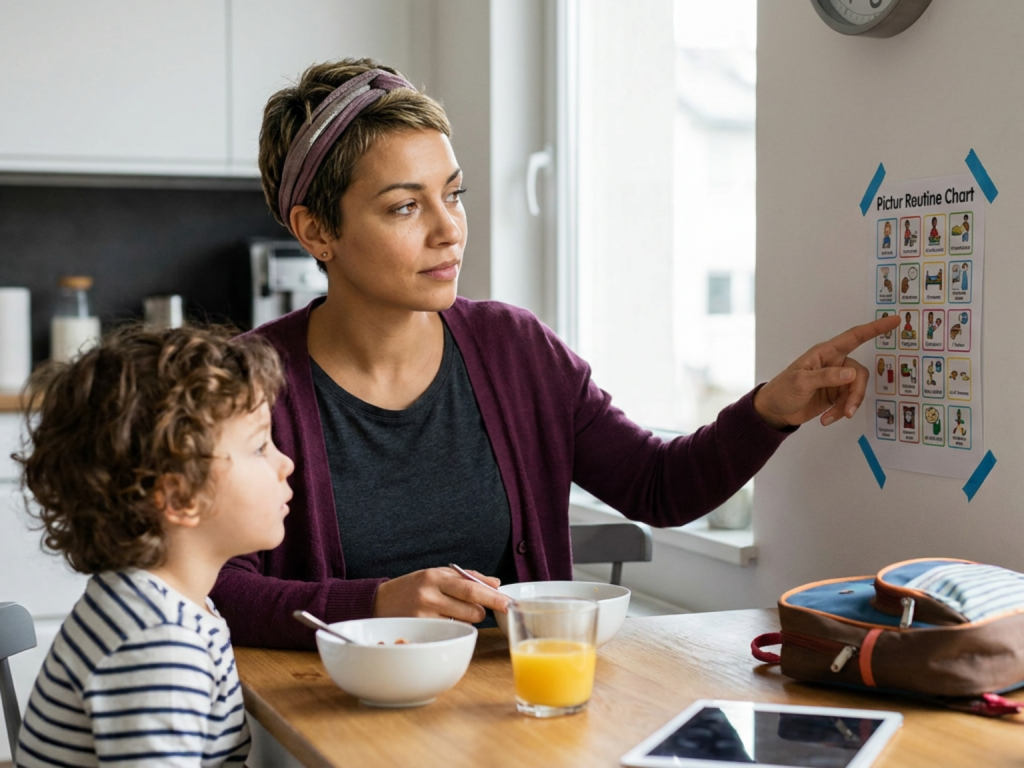
Children often struggle with abstract time. Phrases such as “soon,” “later,” or “in a little while” may not be meaningful, especially for toddlers and preschoolers. Concrete cues are usually more effective. A visual schedule, picture chart, checklist, timer, or simple sequence on the refrigerator can reduce repeated verbal reminders.
Use language that describes what to do rather than what not to do. “Put the blocks in the basket” is easier to act on than “stop making a mess.” For children who become overwhelmed, break tasks into smaller components: “feet in shoes” before “get ready to leave.”
Visual routines may include drawings, photographs, icons, or objects. They do not need to be beautiful or expensive. The goal is shared understanding. You can point to the chart and say, “We did pajamas. Next is teeth. Then story.” This shifts the routine from a parent-versus-child demand into a predictable plan the child can follow.
- Use pictures for non-readers and checkboxes for emerging readers.
- Keep charts at the child’s eye level.
- Offer limited choices inside the routine, such as “blue cup or green cup?”
- Give a transition warning before changes: “Five more minutes, then we clean up.”
- Let children move a marker, flip a card, or tick a box to build ownership.
Build routines around regulation, not just obedience
Routines work best when they respect physiology. Hunger, fatigue, overstimulation, pain, constipation, sleep debt, and acute illness can all reduce a child’s capacity to cooperate. A child who melts down every day at 5 p.m. may not need a stricter lecture; they may need a snack, decompression, sensory quiet, or an earlier bedtime.
Think of each routine as a regulation plan. Morning routines are easier when clothes and bags are prepared the night before. After-school routines often work better when they begin with food, movement, or quiet connection before homework. Bedtime routines are more effective when screens stop early enough to allow downshifting and when the sequence is calm and repetitive.
A regulation-focused routine might look like this: arrival home, snack, 15 minutes of movement or quiet play, homework in short segments, then free time. For a younger child, it might be: dinner, bath, pajamas, two books, lights dim, caregiver goodnight phrase. The repeated order matters more than the exact minute on the clock.
This approach does not mean avoiding limits. It means setting limits in a way the nervous system can manage. Clear routines can reduce power struggles because expectations are introduced before emotions peak.
Use positive reinforcement without turning everything into a reward
Positive reinforcement means noticing and strengthening helpful behavior. It does not have to mean prizes, candy, or constant praise. Many children respond well to specific acknowledgment: “You put your shoes by the door; that helps our morning.” This tells the child exactly what worked and why it matters.
For some children, especially when a routine is new, a simple progress chart can help. The chart should emphasize practice rather than perfection. For example, a child might place a sticker after completing the bedtime sequence, but the deeper goal is to make the sequence familiar. Over time, fade external rewards and rely more on mastery, connection, and natural outcomes.
- Describe the behavior: “You came to the table when the timer rang.”
- Connect it to the routine: “That helped dinner start calmly.”
- Use encouragement more than evaluation: “You remembered the next step.”
- Keep rewards modest and temporary if you use them.
- Avoid removing affection, food, sleep, or needed comfort as consequences.
If a routine breaks down, treat it as information. Was the instruction too complex? Was the transition too abrupt? Was the child hungry, tired, anxious, or seeking connection? Problem-solving usually works better than shame.
Common routines and how to structure them
Different parts of the day require different levels of structure. The best routines are short enough to remember, predictable enough to reduce conflict, and flexible enough for real life.
Morning routine: Prepare as much as possible the night before. Keep the sequence consistent: toilet, clothes, breakfast, teeth, shoes, bag. If your child is slow to start, use music, a visual checklist, or a “first-then” statement: “First clothes, then breakfast.”
Mealtime routine: Predictable meals and snacks can reduce grazing and help children recognize hunger and fullness cues. A routine might include handwashing, sitting at the table, trying familiar and new foods without pressure, clearing plates, and a calm transition away from the table. If feeding is highly stressful, growth is a concern, or there is choking, gagging, vomiting, severe restriction, or suspected allergy, consult a pediatric clinician.
Screen-time routine: Screens often become difficult because stopping is harder than starting. Decide in advance when screens are available, what content is allowed, and what happens afterward. Use transition warnings and pair screen shutdown with a predictable next activity, such as snack, outdoor play, bath, or reading.
Homework or reading routine: Many school-aged children need decompression first. Use a consistent location, short work intervals, and breaks. If homework takes far longer than expected, causes intense distress, or reveals major attention, learning, vision, hearing, or language concerns, consider discussing this with the school and a healthcare or educational professional.
Bedtime routine: A calming bedtime sequence is one of the most valuable routines. Keep it predictable: wash, pajamas, teeth, books, brief connection, lights out. If insomnia, snoring, breathing pauses, restless sleep, nightmares, or daytime sleepiness are persistent, seek medical guidance rather than assuming it is purely behavioral.
Adjust routines for age, temperament, and additional needs
Routines should grow with the child. Toddlers need short, sensory-friendly routines with adult help. Preschoolers often enjoy visual charts, songs, and small jobs. School-aged children can participate in planning and may benefit from checklists, calendars, and responsibility for belongings. Adolescents still need predictable expectations, but they also need increasing autonomy and respectful negotiation.
Temperament matters. Some children transition quickly; others need more warning, more repetition, or more recovery time. Children with neurodevelopmental differences, anxiety, sensory processing challenges, chronic medical conditions, or trauma histories may need routines that are especially explicit, visual, and co-regulating. This is not a failure of discipline. It is an adaptation to the child’s nervous system and functional capacity.
When a routine changes, preview the change early. You might say, “Tomorrow Grandma will take you to school. The morning steps are the same, but Grandma will drive.” For children who rely heavily on predictability, a change card or simple calendar can reduce distress.
It is also appropriate to involve professionals when needed. Pediatricians, child psychologists, occupational therapists, speech-language pathologists, sleep clinicians, dietitians, and school support teams can help identify barriers and tailor strategies. Professional input is especially important when routine problems are severe, persistent, or associated with safety risks, developmental regression, weight changes, sleep-disordered breathing, self-injury, or major family impairment.
Keep routines consistent, flexible, and humane
Consistency means children can generally predict what will happen and what adults expect. It does not mean every day must be identical. Illness, travel, visitors, parental work schedules, and emotional overload will sometimes disrupt the plan. When routines break, return to them without blame.
A humane routine leaves room for connection. If a child is distressed, the goal is not to force the chart at all costs. Sometimes the most effective step is to pause, name the feeling, offer brief comfort, and then return to the next small action. For example: “You are upset that playtime ended. I’ll sit with you for a minute. Then we will put the cars in the bin.”
Review routines regularly. Ask: Is this still age-appropriate? Is it reducing stress? Is the child gaining independence? Are we expecting too much at a biologically difficult time of day? The best routines are living tools. They create predictability, but they also evolve as children grow.
When to seek extra support
- Consult a pediatrician if sleep problems, feeding difficulties, weight concerns, or daytime fatigue persist.
- Seek urgent help if a child’s behavior creates immediate safety risks, self-harm concerns, or danger to others.
- Discuss developmental regression, loss of skills, or sudden major behavior changes with a healthcare professional.
- Ask for professional guidance if anxiety, sensory distress, or school refusal severely disrupts daily routines.
- Do not use routines to restrict necessary food, sleep, medication, medical care, or emotional comfort.
Tools & Assistance
- Create a simple visual routine chart for one stressful time of day.
- Use a timer or song to signal transitions before they happen.
- Prepare morning items the night before: clothes, bag, shoes, lunch, and forms.
- Schedule a pediatric visit for persistent sleep, feeding, behavioral, or developmental concerns.
- Coordinate with teachers or childcare providers so expectations are consistent across settings.
FAQ
How long does it take for a child to adjust to a new routine?
Many children need one to two weeks of consistent practice, and some need longer. Keep the first routine small, repeat the same sequence, and expect setbacks during illness, fatigue, or family stress.
Should routines be based on the clock or on a sequence of events?
For many children, especially younger ones, sequence is easier than clock time. “Dinner, bath, pajamas, books, bed” is often more meaningful than exact times, though consistent wake and sleep times can help.
What if my child refuses every step of the routine?
Reduce the routine to fewer steps, use visual cues, offer limited choices, and check for hunger, fatigue, anxiety, or sensory overload. If refusal is intense or persistent, consider professional guidance.
Are rewards necessary for routines?
Not always. Specific praise, connection, and a sense of mastery may be enough. Temporary charts can help introduce a new habit, but the goal is to fade rewards as the routine becomes familiar.
How flexible should routines be?
Flexible enough to accommodate illness, travel, special events, and emotional needs, but predictable enough that the child understands the usual order of the day.
Sources
- HeadStart.gov — The Importance of Schedules and Routines
- Raising Children Network — Routines: positive behaviour strategy
- Children's Health — How to create a daily routine for kids
Disclaimer
This article is for general educational purposes and is not a substitute for medical, psychological, or developmental assessment. Consult a qualified healthcare professional for concerns about your child’s sleep, feeding, behavior, development, or safety.















Please log in to leave a comment.