
Intro
Play is one of the most natural ways children learn how to belong to a group. In a game, a child can practice waiting, negotiating, sharing attention, recovering from disappointment, and noticing another person’s ideas without the pressure of a formal lesson.
For medically literate caregivers and professionals, play can also be understood as a developmentally appropriate context for executive function, social cognition, emotional regulation, and communication. It is not a cure for developmental, behavioral, or mental health concerns, but when chosen thoughtfully, play can support teamwork skills in a warm and observable way.
Highlights
Teamwork grows when children repeatedly practice shared goals, flexible roles, communication, and repair after conflict.
Cooperative play can support executive functions such as inhibition, working memory, cognitive flexibility, and planning.
Adults help most when they scaffold lightly: naming emotions, clarifying rules, and encouraging repair rather than taking over.
Play should be adapted for age, temperament, neurodevelopmental profile, sensory needs, and physical safety.
Why teamwork is learned most naturally in play
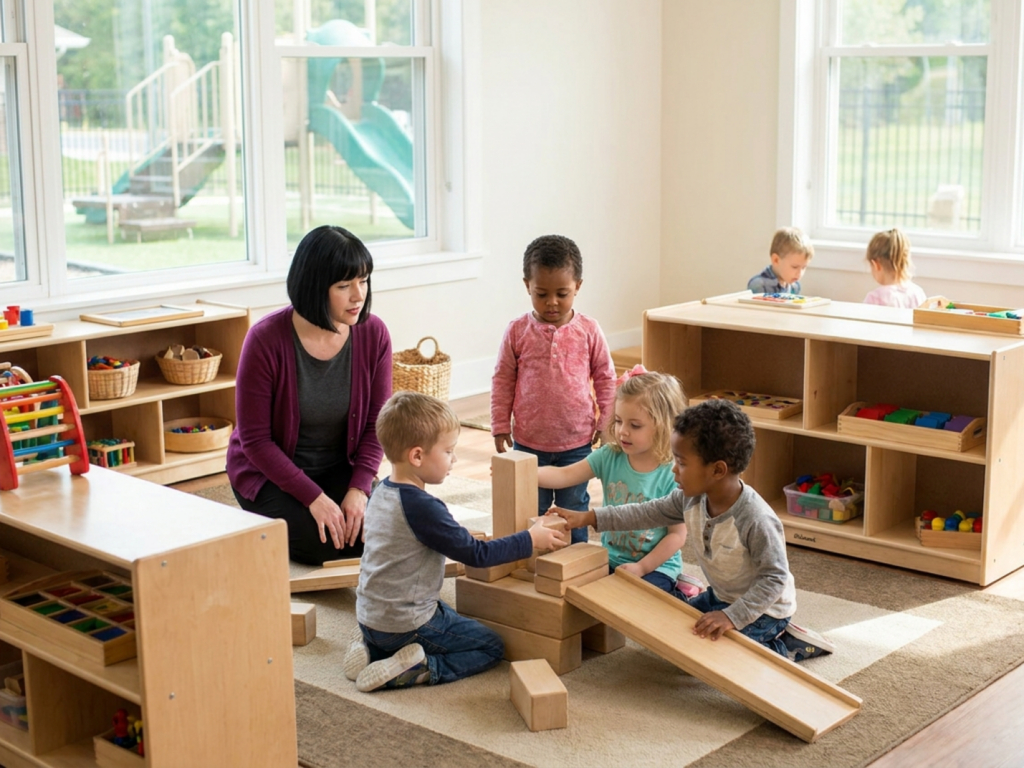
Teamwork is not a single skill. It is a cluster of capacities: joint attention, receptive and expressive language, impulse control, theory of mind, frustration tolerance, flexible problem-solving, and the ability to repair a social rupture. Play brings these capacities together in a low-stakes but emotionally meaningful setting. A child who helps build a block city, passes a ball in a group game, or coordinates moves in a cooperative board game is practicing the neurocognitive foundations of collaboration.
In child development, play also provides immediate feedback. If a child grabs all the pieces, the game slows down. If they listen, others contribute. If they become upset and recover, the group can continue. This feedback is often more powerful than adult lectures because it is embedded in motivation and shared enjoyment.
Research on team-based play in adults and older participants has shown that playful tasks can improve team flow, cohesion, communication, and performance. Although child play is developmentally distinct, the same broad mechanisms are relevant: shared goals, communication, interpersonal trust, problem solving, and role clarification. For children, these mechanisms are especially important because the prefrontal networks that support self-regulation are still maturing.
The core ingredients of cooperative play
Cooperative play works best when it contains a clear shared goal and enough structure for children to understand what to do. This does not mean every activity needs rigid rules. In fact, both structured games and open-ended play can build teamwork if the child can see how individual actions affect the group.
Useful ingredients include:
- A shared objective: building one tower together, completing a puzzle, making a pretend restaurant, or helping all players reach the finish line.
- Visible roles: one child gathers pieces, another plans, another checks stability, and roles can rotate.
- Turn-taking: children practice inhibitory control by waiting and working memory by remembering what happens next.
- Communication: children ask, explain, protest, clarify, and negotiate.
- Repair opportunities: disagreement is not failure; it is the place where teamwork becomes real.
In early childhood, cooperative play in preschool children may look brief and messy. A few minutes of shared attention, a short negotiation, or a tolerated turn can still be meaningful progress. In school-age children, cooperative games can become more strategic, with children discussing plans, adapting to setbacks, and reflecting on what helped the group succeed.
Matching play to the child’s developmental stage
Teamwork expectations should align with developmental capacity. Toddlers often engage in parallel play, playing near other children while gradually noticing and imitating them. They may not yet sustain cooperative goals for long. A caregiver can support teamwork by narrating simple social cues: “You both want the red block. Let’s find a way.” This helps build social language without expecting adult-like negotiation.
Preschool children are ready for more symbolic and socio-dramatic play. Pretend kitchens, clinics, shops, construction sites, and animal rescue games allow children to take roles, use language flexibly, and practice perspective-taking. This is a rich period for play-based social-emotional learning, especially when adults help children name feelings and choose repair strategies.
School-age children often benefit from rule-based games, sports, cooperative building challenges, scavenger hunts, and multiplayer problem-solving tasks. These activities strengthen planning, divided attention, and cognitive flexibility. They also make fairness more explicit, which can lead to conflict but also to deeper learning. Adolescents may connect strongly through team video games, drama, robotics, music ensembles, or sports, where belonging and shared competence are powerful motivators.
Age is only one variable. Temperament, sleep, hunger, sensory sensitivity, language profile, motor skills, anxiety, trauma history, and neurodevelopmental differences all influence how a child participates. A child who avoids group play may not be “defiant”; they may be overloaded, unsure how to enter, or worried about failure.
Board games, movement games, pretend play, and digital games
Different play formats build different teamwork muscles. Cooperative board games are useful because the rules are visible and the pace can be slowed. Children can practice planning, turn-taking games for children, and joint decision-making. Positive psychological board game research in team settings suggests that structured playful experiences can improve togetherness, communication, and team flow, particularly when the activity encourages reflection rather than mere competition.
Movement games, such as parachute games, relay challenges, obstacle courses, and ball-passing activities, add proprioceptive and vestibular input. They can be especially helpful for children who learn through their bodies. These games also teach timing, anticipation, and shared rhythm. Safety matters: rules should reduce collision risk, and children with motor coordination difficulties, asthma, cardiac conditions, or other medical considerations may need individualized guidance from appropriate healthcare professionals.
Pretend play supports symbolic thinking and perspective-taking. A child pretending to be a patient, chef, firefighter, teacher, or veterinarian experiments with social roles and scripts. Adults can enrich the play by adding cooperative problems: “The animal shelter has too many puppies. How can the team help?” This invites planning without turning play into a lesson.
Digital games deserve nuance. Randomized research on team video games has found that short team-based gaming experiences can improve subsequent team performance in some contexts, with cohesion and flow measured as relevant variables. However, benefits depend on the game design, communication demands, time limits, child age, content, sleep impact, and family values. Digital games are not automatically harmful or helpful; they are tools that require boundaries, co-play when possible, and attention to emotional arousal.
How adults can scaffold without taking over
Adult scaffolding during play means providing just enough support for children to do slightly more than they could do alone. The adult is not the director of every move; they are a calm nervous system nearby. This matters because children learn teamwork through active participation, not by watching adults solve every disagreement.
Helpful scaffolding includes:
- Previewing: “This game works best when everyone gets a turn and the team decides together.”
- Naming the group goal: “You are trying to make one bridge that all the cars can cross.”
- Reflecting communication: “I heard Maya suggest a roof. Did everyone hear that idea?”
- Supporting regulation: “Your body looks frustrated. Let’s pause, breathe, and choose what to say next.”
- Prompting repair: “The tower fell and both of you are upset. What could help the team restart?”
It is often more effective to praise process than outcome: “You listened to each other,” “You changed the plan when it did not work,” or “You invited him back into the game.” These comments reinforce teamwork skills through play rather than only winning, speed, or perfection.
Adults should also model disagreement respectfully. If a child sees that conflict can be repaired, they become less afraid of social mistakes. Repair language can be simple: “I did not like that,” “Can I have another turn?” “I am sorry I grabbed it,” or “Let’s try again.” Over time, these scripts become internal tools.
Supporting children with different needs and profiles
Some children need adaptations to access teamwork. A child with expressive language delay may participate better with visual choices, gestures, picture cards, or a role that does not require long verbal explanations. A child with autism spectrum differences may benefit from predictable rules, reduced sensory load, explicit role descriptions, and permission to take breaks. A child with attention-deficit/hyperactivity traits may need shorter rounds, movement-based roles, and immediate feedback. A child with anxiety may need a familiar partner before joining a larger group.
Inclusive teamwork does not mean forcing identical participation. It means preserving dignity and belonging while adjusting the task. For example, in collaborative building activities, one child may design, another may gather materials, another may test stability, and another may decorate. Each contribution is real.
Observe for patterns rather than isolated moments. Many children have difficult days. Medical, developmental, or psychological consultation may be helpful if a child persistently cannot engage in peer play, has frequent aggressive outbursts, shows extreme distress with routine game demands, loses skills, has major language or motor concerns, or is excluded repeatedly despite adult support. Developmental screening for play concerns can help identify whether further evaluation is appropriate.
Caregivers should avoid using play as a diagnostic test at home. Instead, notes about what happens during play can be valuable information for pediatricians, developmental-behavioral clinicians, occupational therapists, speech-language pathologists, psychologists, or educators.
Turning conflict into teamwork practice
Conflict during play is expected. The goal is not to eliminate it, but to keep it safe and teach repair. When children argue over rules, materials, roles, or fairness, they are practicing social problem-solving under emotional load. This is where executive function and emotional regulation during play intersect.
A useful adult sequence is pause, protect, name, guide, and return. Pause the action before it escalates. Protect bodies and materials. Name the problem neutrally: “Two people want to choose the next card.” Guide options: “You can vote, take turns, or choose randomly.” Then return responsibility to the children when safe: “Which plan will your team try?”
If a child becomes dysregulated, the immediate priority is co-regulation, not moral instruction. A child in a high-arousal state may have limited access to language, working memory, and perspective-taking. After the child is calmer, a brief reflection can help: “What happened? What did your body feel? What could you try next time?”
Repeated conflict that includes bullying, humiliation, coercion, dangerous aggression, or persistent exclusion needs adult intervention. Teamwork is not built by asking a vulnerable child to tolerate harm. Psychological safety is the foundation of collaboration.
Simple ways to start at home, school, or clinic
Start small. Choose one cooperative activity and one teamwork goal. For example, the goal might be “ask before taking,” “wait for two turns,” “use one repair phrase,” or “listen to one teammate’s idea.” Keep the activity short enough that success is possible.
Examples include building a marble run together, making a shared obstacle course, cooking a simple snack as a team, completing a cooperative puzzle, creating a pretend hospital for stuffed animals, or playing a digital game where players must communicate to solve a problem. Afterward, ask one reflective question: “What helped the team?” or “What should we change next round?”
In classrooms or therapeutic settings, small groups often work better than large ones. Assign rotating roles so one child is not always the leader and another is not always the helper. In family settings, siblings may need adult support because old patterns can override the rules of the game.
Teamwork through play is most effective when it is repeated, warm, and realistic. Children do not need perfect cooperation. They need many chances to try, fail safely, repair, and feel the pleasure of doing something together.
When to seek extra support
- Consult a pediatric or developmental professional if play distress is persistent, intense, or worsening.
- Seek urgent help if play involves serious aggression, self-injury, threats, or unsafe behavior.
- Do not assume avoidance of group play is behavioral; sensory, language, motor, anxiety, or medical factors may contribute.
- Children with chronic medical conditions may need activity modifications before vigorous movement games.
- Persistent loss of previously acquired social, language, or play skills warrants prompt professional evaluation.
Tools & Assistance
- Keep a brief play observation log noting triggers, strengths, communication, and recovery.
- Use cooperative board games, shared building materials, pretend-play props, and turn cards.
- Ask a pediatrician about developmental screening if peer play is consistently difficult.
- Coordinate with teachers, occupational therapists, speech-language pathologists, or psychologists when needed.
- Create predictable play routines with short rounds, clear roles, and calm repair scripts.
FAQ
Is competitive play bad for teamwork?
Not necessarily. Competitive games can teach fairness and resilience, but children also need cooperative games where success depends on helping one another.
What if my child always wants to lead?
Use rotating roles and praise flexible leadership, such as listening, inviting ideas, and helping the group succeed rather than controlling every choice.
Can video games build teamwork?
Some team-based digital games can support communication and cohesion, especially with age-appropriate content, time limits, and active collaboration. They should not replace sleep, movement, outdoor play, or face-to-face interaction.
How long should teamwork play last?
Short, successful practice is often better than long sessions. For young or easily dysregulated children, even 5 to 10 minutes of cooperative play may be valuable.
When should I worry about my child’s play skills?
Consider professional guidance if your child persistently cannot join play, has extreme distress, frequent aggression, marked language or motor concerns, regression, or repeated peer exclusion.
Sources
- Springer — A Playful Way to Promote Team Flow: Evaluation of a Positive Psychological Board Game for Team Building
- PubMed Central — Team Building Through Team Video Games: Randomized Controlled Trial
- Oxford Academic — Recipe for Success: The Effect of Dyadic Communication and Cooperative Gameplay on Subsequent Non-gaming Task Performance
Disclaimer
This article is for informational purposes only and does not diagnose or treat any condition. Consult a qualified healthcare professional for concerns about a child’s development, behavior, mental health, or activity safety.
















Please log in to leave a comment.