
Intro
Preschool group play can be joyful, noisy, and emotionally complicated all at once. A child may build a tower with friends one minute, then cry because someone changed the plan the next. This is not a failure of character; it is a normal part of the developing nervous system learning social communication, inhibitory control, perspective-taking, and emotional regulation.
Cooperative play is often described as the most socially complex stage of early play. It usually emerges gradually during the preschool years, with wide individual variation. Some children move easily into shared pretend games, while others need more adult scaffolding, sensory support, language help, or time to observe before joining.
Highlights
Cooperative play involves shared goals, roles, materials, and rules, not simply playing near other children.
Preschoolers are still developing executive function, language, motor planning, and emotional regulation, so conflict during group play is expected.
Adults can support group play by modeling language, structuring routines, and helping children repair social ruptures rather than shaming them.
Persistent difficulty with peer play may reflect many factors, including temperament, language delay, sensory processing differences, anxiety, or broader neurodevelopmental concerns.
What cooperative play means in preschool
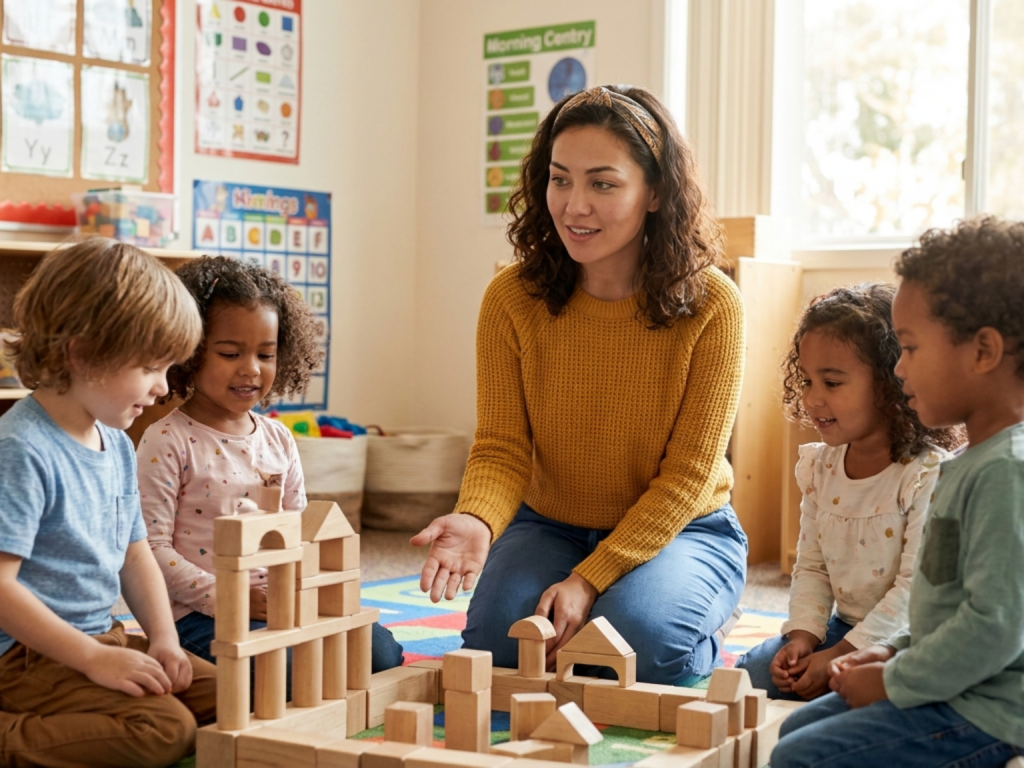
Cooperative play is play in which children interact around a shared purpose. They may build a pretend restaurant, create a block city, care for stuffed animals in an animal hospital, invent rules for a chasing game, or work together to plant seeds in a classroom garden. The defining feature is not perfect harmony. It is the presence of social coordination: children notice one another, exchange ideas, negotiate roles, share materials, and adapt to a common play script.
Developmental frameworks often describe play as progressing from unoccupied behavior and solitary play to onlooker, parallel, associative, and cooperative play. These are not rigid steps that every child completes on a strict timetable. A preschooler may engage in rich cooperative pretend play in the morning and then prefer solitary play after a tiring lunch. Context, fatigue, hunger, sensory load, language demands, and the familiarity of peers all influence how socially complex play becomes.
In cooperative play, a child uses multiple neurodevelopmental systems at once. Receptive and expressive language help the child understand instructions and contribute ideas. Executive function supports waiting, shifting plans, and remembering rules. Social cognition helps the child infer what a peer wants. Motor coordination supports building, drawing, running, or manipulating shared toys. Emotional regulation allows the child to tolerate frustration when the group’s plan differs from their own.
How group play skills typically emerge
Many toddlers first play beside one another, using similar toys without a shared plan. This parallel play is valuable; it allows children to observe peers, imitate actions, and become comfortable in a social space. During the preschool period, children often begin associative play, where they talk, exchange toys, or copy each other but may not yet maintain a unified goal. Cooperative play develops when those interactions become more organized and intentional.
Common early signs include offering a toy to a peer, copying another child’s idea, joining a simple pretend sequence, or accepting a brief role such as patient, doctor, chef, driver, or baby. Over time, children may sustain longer themes, coordinate multiple roles, and negotiate changes: “You be the firefighter, and I will drive the truck.” These skills are closely connected to play-based preschool learning because children practice vocabulary, early numeracy, memory, categorization, and flexible thinking inside shared activities.
Progress is rarely smooth. A child who can take turns in a structured board game may struggle in open-ended pretend play because the rules are less visible. Another child may manage a small group of two but become dysregulated in a busy classroom. Adult expectations should match the child’s developmental level, not only their chronological age. Short, successful interactions often build more social confidence than long play periods that end in repeated conflict.
Core skills children practice during cooperative play
Cooperative play is sometimes described as “just play,” but it is cognitively and emotionally demanding. A preschooler must hold their own idea in mind while also monitoring what others are doing. This is an early form of shared attention and reciprocal communication. It supports school readiness in early childhood because group learning later depends on listening, waiting, participating, and adjusting to others.
Important group play skills include:
- Joint attention: looking, pointing, showing, or talking about the same object or idea with another person.
- Turn-taking: waiting briefly, anticipating another child’s action, and returning to the shared sequence.
- Role flexibility: accepting that a peer may want to be the doctor, builder, teacher, or leader sometimes.
- Communication repair: trying again when a message is misunderstood, such as using a gesture, shorter phrase, or adult help.
- Conflict resolution: learning simple scripts such as “Can I have it when you are done?” or “Let’s trade.”
- Emotion regulation: managing disappointment, excitement, and frustration without becoming unsafe.
These abilities overlap with preschool executive function skills, including impulse control, working memory, and cognitive flexibility. A child who grabs a toy may not be intentionally unkind; they may be acting faster than their inhibitory control can manage. Supportive correction helps the brain learn: “You wanted the truck. Grabbing scared him. Let’s ask, then wait.”
The adult role: scaffolding without taking over
Preschool children benefit from adults who act as calm interpreters, not constant directors. Scaffolding means providing just enough help for the child to succeed, then gradually stepping back. Too little support may leave children overwhelmed; too much can prevent them from practicing negotiation and problem-solving.
Useful adult strategies include narrating what is happening, offering choices, and translating social cues. For example: “Maya is holding the cup. She is still using it. You can ask for a turn or choose the spoon.” Adults can also model inclusive language: “We need one more firefighter. Who wants that job?” In group settings, visual schedules and simple picture cues may help children understand the sequence of play, clean-up, snack, and transitions.
It is also helpful to prepare the environment. Fewer toys with clearer purposes can sometimes reduce conflict, while duplicate high-interest items may be useful for children who are still learning to share. Small groups are often easier than large groups. Sensory-sensitive children may need a quieter corner, predictable routines, or movement breaks before joining peers. Children with limited expressive language may participate more successfully when adults accept gestures, signs, picture communication, or short phrases as valid social bids.
When conflict occurs, the goal is repair. Adults can label feelings, state the limit, and guide a replacement behavior: “You are angry that the tower fell. I will not let you hit. You can stomp your feet here, then we can ask if Sam wants to rebuild.” This protects safety while preserving the child’s dignity.
Activities that encourage cooperative play
The best cooperative activities are simple, concrete, and flexible. They do not require preschoolers to share abstract goals for long periods. A shared project gives children a reason to communicate while keeping their hands busy.
Examples include:
- Block construction: children build a bridge, zoo, road, or house together, with adults helping assign roles if needed.
- Pretend care routines: a toy clinic, animal hospital, baby nursery, or veterinary office encourages empathy, sequencing, and language.
- Gardening or nature play: children take turns digging, watering, sorting leaves, or checking plant growth.
- Cooking-style pretend play: a café or grocery store supports roles, counting, requesting, and turn-taking.
- Cooperative art: a shared mural, collage, or cardboard box project allows parallel participation within one group product.
- Movement games: parachute play, obstacle courses, or follow-the-leader games help children coordinate bodies and rules.
Adults can make these activities easier by using brief, predictable language: “First choose a job, then build, then show the group.” Preschoolers often do better when rules are visible and repeated. For children who become anxious or controlling, adults can introduce small flexibility challenges, such as changing one part of the pretend story while keeping the rest familiar.
Supporting children who struggle with group play
Difficulty with cooperative play does not automatically mean a child has a disorder. Some children are shy, slow-to-warm, highly imaginative in solitary play, or simply tired by peer interaction. Others may struggle because of hearing differences, speech-language delays, motor coordination challenges, sensory processing differences, sleep problems, family stress, anxiety, trauma exposure, or neurodevelopmental conditions. The pattern, persistence, intensity, and effect on daily functioning matter.
Helpful observations include whether the child shows interest in peers, how they communicate wants, whether they understand simple group routines, how they respond to transitions, and whether aggression or withdrawal occurs mainly in specific settings. A child who plays well with one familiar cousin but not in a loud classroom may need environmental support. A child who rarely responds to social bids across settings may need closer developmental evaluation.
Families can ask preschool teachers for concrete examples rather than global labels. Instead of “does not share,” ask: “What happens before the conflict? Which toys are involved? Can the child use words with adult prompting? How long can they stay in a two-child activity?” This kind of developmental surveillance and screening helps identify whether support should focus on language, sensory regulation, social coaching, behavior patterns, or classroom structure.
If concerns persist, consider discussing them with a pediatrician or qualified child development professional. Depending on the concern, a speech-language pathology evaluation, occupational therapy evaluation for preschoolers, developmental-behavioral pediatric assessment, audiology evaluation, or early childhood mental health clinician may be appropriate. Seeking guidance is not about blaming the child or parent; it is a way to understand what support the child’s nervous system needs.
Measuring progress in a realistic way
Research on preschool social play emphasizes that play can be observed and described systematically. Structured tools may examine the type of play, level of peer engagement, communication, cooperation, and social participation. In daily life, families and educators can use simpler observation without turning play into a test.
Look for small gains: the child watches peers for longer, tolerates another child nearby, accepts one turn, uses a word instead of grabbing, returns to the group after a break, or repairs a conflict with adult help. These are meaningful signs of growth. For some children, the first goal is not sustained cooperative play but comfortable proximity, shared attention, and safe communication.
Progress also depends on adult consistency. A child learns faster when home and preschool use similar phrases, expectations, and calming strategies. For example, everyone might use “my turn, your turn,” “ask before taking,” and “hands are for helping.” When adults respond predictably, the child spends less cognitive energy guessing the rules and more energy practicing social participation.
Finally, remember that play should remain emotionally safe and enjoyable. Cooperative play is not a performance standard. It is a developmental pathway through which children learn that other people have ideas, feelings, and plans that can connect with their own.
When to seek extra guidance
- Consult a pediatrician if loss of previously acquired social, language, or play skills occurs.
- Seek urgent help if play conflicts involve frequent serious injury, unsafe aggression, or self-injury.
- Ask for developmental guidance if a child rarely responds to social bids across familiar settings.
- Consider hearing, speech-language, occupational therapy, or developmental evaluation when communication or sensory barriers interfere with peer play.
- Do not use punishment, humiliation, or forced sharing as the main strategy for persistent play difficulties.
Tools & Assistance
- Ask the preschool teacher for specific observations about peer play, triggers, and successful supports.
- Use short play scripts such as "Can I have a turn?" and "Let’s trade."
- Create small-group activities with clear roles, such as block building, pretend clinic, or gardening.
- Discuss persistent concerns with a pediatrician, speech-language pathologist, occupational therapist, or early childhood mental health professional.
FAQ
At what age should preschoolers show cooperative play?
Many children begin showing cooperative play during the preschool years, often around ages 3 to 5, but timing varies. Brief cooperative moments can appear before sustained group play.
Is it a problem if my child prefers playing alone?
Not always. Solitary play can be healthy and creative. Concern increases if the child rarely notices others, cannot tolerate peers nearby, loses skills, or struggles across settings.
Should adults force children to share?
Forced sharing often increases distress. It is usually more effective to teach turn-taking, waiting, trading, asking, and using duplicate materials when developmentally appropriate.
Can cooperative play help with learning?
Yes. Group play supports language, attention, memory, flexible thinking, early problem-solving, emotional regulation, and school readiness skills.
When should I ask for a professional evaluation?
Consider evaluation if peer play difficulties are persistent, intense, unsafe, associated with language or sensory concerns, or interfering with preschool participation and family life.
Sources
- National Center for Biotechnology Information/PubMed Central — Development of a Social Play Evaluation Tool for Preschool Children
- WebMD — Cooperative Play
- ScienceDirect Topics — Cooperative Play - an overview
Disclaimer
This article is for general educational purposes and is not a diagnosis or treatment plan. Consult a qualified healthcare or child development professional for concerns about your child’s development, behavior, or safety.














Please log in to leave a comment.