
Intro
Play is often described as children’s “work,” but it is also one of their most powerful social learning environments. In play, children practice reading faces, negotiating roles, waiting, repairing misunderstandings, and managing disappointment in a way that feels meaningful rather than abstract.
For medically literate readers, social learning through play can be understood as a developmentally responsive interaction between neurodevelopment, executive function, language, attachment, emotional regulation, and peer experience. It is not a cure for developmental or mental health concerns, but it can be a protective, skill-building context when supported by sensitive adults.
Highlights
Play gives children repeated, low-stakes opportunities to practice cooperation, communication, empathy, and flexible thinking.
Adult-supported play is most helpful when it is responsive rather than controlling: the adult scaffolds, models language, and helps children recover from conflict.
Different play types support different skills, from parallel play in toddlers to cooperative play and socio-dramatic play in preschool and early school years.
Persistent distress, social withdrawal, aggression, or loss of skills should be discussed with a pediatrician or qualified child development professional.
Why play is a social brain laboratory
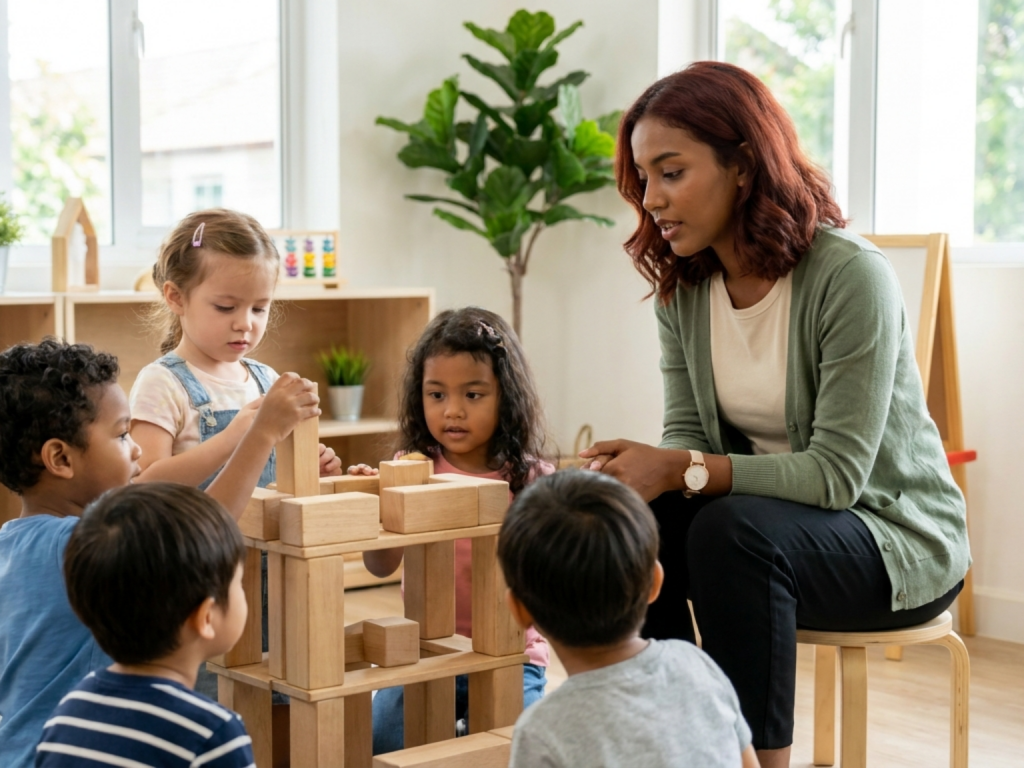
Social learning through play occurs because play places children inside real-time social situations with emotional meaning. A child building a block tower with another child must coordinate attention, interpret intention, tolerate frustration, communicate a plan, and adapt when the tower falls. These are not isolated “soft skills”; they involve language networks, executive functions, sensory processing, emotional regulation systems, and developing theory of mind, the ability to understand that other people have thoughts and feelings that may differ from one’s own.
Research on game-based learning in early childhood suggests that structured playful learning can improve social skills such as cooperation, communication, and empathy. One review reported a positive effect on social skills, with an effect size of g = 0.38, indicating a modest but meaningful benefit across study conditions. The evidence also suggests that the value of play is not limited to recreation; it can be an intentional educational and developmental tool when embedded in high-quality environments.
Children do not learn social competence from instruction alone. A child may be told to “share,” but sharing becomes understandable when they experience wanting a toy, seeing another child’s disappointment, receiving adult support, and discovering that turn-taking can preserve the play relationship. This is why How children learn social skills is closely tied to lived interaction, repetition, and emotionally safe practice.
Developmental pathways: from parallel play to cooperation
Social play changes with age and neurological maturation. Infants begin with reciprocal exchanges such as smiling, vocal turn-taking, imitation, and peekaboo. These early interactions are simple on the surface, but they build joint attention, affective attunement, and the expectation that communication can change another person’s behavior.
Toddlers often engage in parallel play, playing beside rather than directly with another child. This is not a social failure; it is a normal bridge between solitary exploration and interactive peer play. During this period, toddlers may imitate peers, protest when objects are taken, and rely heavily on adults for co-regulation before self-regulation. How toddlers learn through play includes sensory exploration, imitation, movement, and repeated routines that help them predict social patterns.
Preschoolers increasingly enter associative and cooperative play. They begin to create shared goals, assign roles, and negotiate rules: “You be the doctor, I’ll be the patient,” or “Let’s make a zoo.” Preschool social skills 3 to 5 years often include entering play, staying with a theme, using language to solve conflict, and beginning to understand another child’s point of view. School-age children add more complex rule-based games, team identity, fairness judgments, humor, loyalty, and moral reasoning.
It is important to interpret social play in the context of temperament, language development, sensory preferences, culture, neurodevelopmental profile, and opportunity. Some children need longer observation time before joining; others need movement before they can settle into a group. Support should match the child’s developmental stage rather than force adult expectations too early.
Types of play that build social-emotional learning
Different forms of play exercise different social capacities. Socio-dramatic or pretend play is especially rich for perspective-taking. When children act as a parent, shopkeeper, firefighter, baby, veterinarian, or teacher, they practice emotional scripts, symbolic thinking, and flexible identity-taking. Integrating social-emotional learning through play is powerful because children can rehearse fear, care, separation, anger, rescue, and repair within a safe narrative frame.
Cooperative play, including shared construction, group art, and team problem-solving, builds planning, negotiation, and division of roles. Cooperative play and group play skills preschool children may involve learning how to ask to join, accept another child’s idea, tolerate not being first, and recover after a disagreement. These moments can look messy, but they are often the very moments in which learning is occurring.
Rule-based games support inhibitory control, working memory, cognitive flexibility, and fairness. Games such as memory matching, movement games, board games, and turn-taking card games require children to hold rules in mind, wait, cope with losing, and respond to others’ emotional reactions. Puzzle games may be particularly useful for cognitive development, while broader game-based learning can support social-emotional outcomes when children interact, communicate, and collaborate.
Physical play, including chase, obstacle courses, dance, and rough-and-tumble play when safe and consensual, helps children read bodily cues and modulate arousal. Adults can teach consent language such as “pause,” “too rough,” and “my turn.” Sensory play with sand, water, clay, or loose parts can also support shared attention and calm engagement, especially for children who need hands-on regulation before verbal negotiation.
The adult role: scaffolding without controlling
Children benefit most when adults create a safe play ecology and then provide just enough support. In developmental terms, this is scaffolding: the adult temporarily supports a skill that the child cannot yet perform independently. Effective scaffolding is not the same as directing every move. If adults solve every conflict, assign every role, or require constant sharing, children may lose the opportunity to practice autonomy and social problem-solving.
Helpful adult strategies include observing before intervening, narrating emotions, modeling language, and offering limited choices. For example: “You both want the red truck. Sam is holding it now. Mia, you can ask for a turn or choose the blue truck while you wait.” This language supports emotional labeling, impulse control, and mental state understanding without shaming either child.
Adults can also use “sportscasting,” a neutral description of what is happening: “The tower fell, and you both look surprised. Leo is laughing, and Noor looks upset.” This helps children connect facial expression, body state, and social meaning. Emotion vocabulary in children develops through many such moments, especially when adults name feelings accurately and calmly.
When conflict escalates, the adult’s first task is safety and co-regulation. A dysregulated child has limited access to reflective problem-solving because stress physiology can narrow attention and increase reactive behavior. After the child is calmer, adults can guide repair: checking on the other child, returning an item, rebuilding together, or using words to clarify intention. The goal is not forced apology but meaningful reconnection.
Designing play environments that include more children
An inclusive play environment reduces barriers before difficulties occur. Predictable routines, clear physical boundaries, accessible materials, and a balance of active and quiet spaces can help children with different regulatory profiles. A classroom or home play area with too many toys may create competition and overstimulation; too few materials may limit imagination and shared engagement. Open-ended materials, such as blocks, fabric, figurines, boxes, and art supplies, often invite collaboration because there is no single correct outcome.
Small-group preschool activities can be especially useful for children who are overwhelmed by large groups. A three-child building challenge, a paired pretend-play scenario, or a short cooperative movement game may provide enough peer contact without excessive social load. For children with language delays, visual supports, gestures, picture choices, or modeled phrases can make participation more accessible.
Adults should also consider cultural values around independence, cooperation, adult authority, emotional expression, and physical play. Social competence is not identical across families or communities. Some children are raised to speak directly; others are encouraged to observe first. A sensitive approach respects family context while still supporting core capacities such as safety, reciprocity, empathy, and communication.
In medical or therapeutic contexts, play can also be a window into functioning. Clinicians may observe joint attention, symbolic play, flexibility, frustration tolerance, sensory responses, language pragmatics, and caregiver-child reciprocity. However, play observations should be interpreted cautiously and never in isolation. Developmental surveillance and screening may be appropriate when concerns persist, but diagnosis requires qualified professional assessment.
Supporting children who struggle with social play
Some children find social play unusually difficult. Reasons may include delayed language, anxiety, sensory processing differences, attention difficulties, trauma exposure, sleep problems, hearing impairment, visual impairment, neurodevelopmental differences, or limited prior peer experience. A child who grabs toys may not be “mean”; they may lack impulse control or the words to negotiate. A child who avoids peers may be overwhelmed, unsure how to enter play, or protecting themselves from repeated social failure.
Support begins with curiosity. Adults can ask: What happens before the difficulty? Is the child hungry, tired, overstimulated, or confused by the rules? Does the child do better with one peer than in a group? Are transitions hard? Does the child understand the language being used? Patterns matter more than single incidents.
Practical supports include rehearsing entry phrases such as “Can I play?” or “What are you making?”, using visual timers for turns, pairing the child with a compatible peer, and practicing role-playing social skills outside the heat of conflict. Stories, puppets, and pretend scenarios can help children rehearse flexible responses: “What could the bear do if the rabbit says no?”
Adults should avoid labeling a child as manipulative, antisocial, spoiled, or bad. Such labels can obscure treatable or supportable needs. At the same time, compassion does not mean ignoring harmful behavior. Biting, hitting, exclusion, coercive play, or repeated intimidation require calm, firm limits and adult follow-up. If social challenges are intense, persistent, associated with developmental regression, or causing significant impairment, families should consult a pediatrician, child psychologist, speech-language pathologist, occupational therapist, or early intervention service as appropriate.
Making play-based social learning part of daily life
Social learning through play does not require expensive toys or elaborate programs. It can happen while setting the table, pretending to run a grocery store, building with cushions, playing a short board game, caring for dolls, making obstacle courses, or telling collaborative stories. The central ingredients are shared attention, emotional safety, flexible roles, and enough time for children to try, fail, repair, and try again.
Families and educators can build a simple rhythm: observe the child’s interest, join briefly, add language or a small challenge, and then step back. For example, if a child is lining up toy animals, an adult might say, “The animals are waiting for the bus. Who gets on first?” This introduces sequencing, perspective-taking, and narrative without taking ownership of the play.
After play, brief reflection can consolidate learning. Questions such as “What worked well when you built together?” or “How did you know your friend was upset?” help children link experience to social understanding. Reflection should be short and warm, not an interrogation.
Above all, play should remain relational and humane. Children learn social skills best when they feel safe enough to experiment and connected enough to care about the outcome. Through supported play, they gradually internalize the capacities that make friendship, cooperation, empathy, and community possible.
When to seek professional guidance
- Persistent social withdrawal, loss of previously acquired social or language skills, or minimal response to social engagement should be discussed with a healthcare professional.
- Frequent aggression, severe tantrums during play, or behavior that puts the child or others at risk warrants timely guidance.
- Concerns about hearing, speech-language development, sensory processing, anxiety, trauma, attention, or autism-related social communication differences should not be dismissed as “just behavior.”
- If a child’s play difficulties significantly affect preschool, school, family life, or peer relationships, ask about developmental screening or referral.
Tools & Assistance
- Use short emotion labels during play, such as “frustrated,” “excited,” “worried,” and “proud.”
- Create small-group play opportunities with predictable routines and a calm adult nearby.
- Offer open-ended materials such as blocks, pretend-play props, art supplies, and sensory bins.
- Ask a pediatrician, early intervention program, school psychologist, or child development specialist for support if concerns persist.
FAQ
Is solitary play a problem?
Not necessarily. Solitary and parallel play can be developmentally normal, especially in younger children or children who need time to warm up. Concern increases if avoidance is persistent, distressing, or paired with communication or developmental concerns.
Should adults force children to share?
Forced sharing can increase distress. It is usually better to teach turn-taking, waiting, asking, and repair while respecting that children need practice and adult co-regulation.
Are digital games useful for social learning?
Some game-based learning can support cooperation and communication, especially when interactive and guided. Screen-based play should be age-appropriate, balanced with physical and face-to-face play, and discussed with a clinician if there are concerns.
What if my child always wants to control the play?
This may reflect temperament, anxiety, rigidity, language limitations, or limited practice with flexibility. Adults can gently model choices, role-switching, and compromise. Seek professional advice if rigidity is intense or impairing.
Sources
- National Institutes of Health (NIH) / PubMed Central — Game-based learning in early childhood education
- Taylor & Francis Online / Journal of Research in Childhood Education — Integrating Social-Emotional Learning Through Play
- Northwestern Iowa Community College (NWCIowa) / NW Commons — Social and Emotional Skills Develop Through Play-Based Learning
Disclaimer
This article is for informational and educational purposes only and does not replace medical, developmental, or mental health advice. Consult a qualified healthcare professional for concerns about a child’s development, behavior, or safety.

















Please log in to leave a comment.