
Intro
Teething can be a demanding season: babies want to chew, caregivers want to soothe, and the toy aisle offers dozens of rings, keys, mitts, beads, silicone shapes, and cooling products. A well-chosen teething toy can provide counter-pressure on sore gums, but because infants explore with their mouths and have immature airway-protective reflexes, safety details matter.
This guide reviews how to evaluate teething toys using a practical, medically cautious approach. It focuses on choking and strangulation hazards, materials, cooling practices, cleaning, supervision, and when symptoms should prompt a call to a pediatrician or dentist.
Highlights
Choose teethers that are age-appropriate, intact, easy to clean, and too large to fit completely into a baby's mouth.
Avoid teething jewelry, loose beads, long cords, magnets, button batteries, and products with detachable small parts.
Use cold, not frozen, comfort items; frozen teethers can injure delicate oral tissues.
Inspect teething toys before every use and discard anything cracked, sticky, torn, leaking, or difficult to sanitize.
Teething should not cause severe illness; fever, lethargy, dehydration, breathing concerns, or persistent symptoms deserve medical advice.
Why teething toys need special scrutiny
Teething toys are used at the intersection of comfort, oral exploration, and rapid infant development. Babies may bite, suck, twist, and pull on a teether repeatedly, often while drooling heavily. That combination can stress seams, loosen parts, and introduce microbes. Unlike many toys, teethers are intentionally placed in the mouth, so the margin for design or maintenance problems is smaller.
Regulators treat many teethers and teething toys as children’s products subject to safety requirements. In the United States, the Consumer Product Safety Commission describes toy safety obligations that include compliance with federal rules and applicable toy standards. In Canada, Health Canada’s guidance for children’s toys and related products discusses mechanical and physical requirements intended to reduce hazards such as choking, puncture, and strangulation. These rules are not a substitute for caregiver judgment, but they explain why reputable manufacturers test size, strength, labeling, and age grading.
A useful mindset is to ask: could this toy block the airway, break into pieces, wrap around the neck, injure the mouth, expose the baby to chemicals of concern, or become contaminated? If the answer is uncertain, choose a simpler product.
Choking, airway, and small-part hazards
Choking prevention is the central safety issue. A teething toy should be large enough that it cannot fit fully into the baby’s mouth or lodge at the back of the throat. It should not have detachable caps, beads, decorative pieces, squeakers, plugs, or soft fragments that can separate with chewing. Babies with emerging incisors can apply surprising bite force, and a product that looks sturdy when new may fail after repeated use.
- Reject toys with loose or removable parts unless the manufacturer clearly states they are designed and tested for the child’s age group.
- Avoid long, narrow projections that could reach too far into the mouth and trigger gagging or injury.
- Do not use teethers attached to necklaces, long cords, pacifier strings, crib rails, car seats, or stroller straps unless the attachment is short, purpose-designed, and used exactly as labeled.
- Keep older siblings’ toys away from teething infants; small blocks, beads, magnets, and battery-powered pieces are not safe mouthing objects.
Magnets and button batteries deserve special caution. If swallowed, magnets can attract across loops of bowel, and button batteries can cause severe tissue injury. A teether should not contain accessible magnets or battery compartments; if a toy has electronics, it is not an ideal teething object.
Materials: what labels can and cannot tell you
Many caregivers look for labels such as BPA-free, phthalate-free, PVC-free, latex-free, food-grade silicone, or natural rubber. These terms can be helpful, especially because Seattle Children’s Hospital recommends considering phthalate-free, PVC-free, and BPA-free toys, but labels are not a complete safety guarantee. A safer product still needs appropriate shape, durability, cleanability, and age grading.
Common teether materials include silicone, natural rubber, firm plastic, fabric, and wood. Silicone can be durable and easy to wash if it is a single molded piece. Natural rubber may be pleasantly flexible but can degrade, become sticky, or trigger concern in families avoiding latex-related exposures. Wood should be smooth, sealed with a child-safe finish, and free of splinters. Fabric teethers may absorb saliva and require frequent laundering.
Be cautious with heavily scented products, painted surfaces that chip, unknown marketplace brands, and items marketed more as accessories than infant safety products. If the manufacturer does not provide an age range, cleaning instructions, material information, or safety labeling, that absence is a reason to pause.
Cooling teethers without injuring gums
Cool pressure can be soothing for localized gum tenderness during teething. A chilled teething ring, a clean cool damp washcloth, or a solid silicone teether placed in the refrigerator can provide safe teething comfort measures for many babies. The key word is chilled, not frozen.
Frozen teethers can become hard enough to bruise the gingiva, irritate oral mucosa, or worsen discomfort. Gel-filled or liquid-filled teethers also require extra vigilance: if they crack or leak, they should be discarded immediately. Do not boil, microwave, or freeze a product unless the manufacturer’s instructions specifically allow it. Heat can distort plastics and silicone, while freezing can make materials brittle.
For babies who are eating solids, caregivers sometimes use mesh or silicone feeders with chilled foods. These require close supervision, correct food texture, and careful cleaning because food particles can lodge in seams. They are feeding tools as much as teething tools, so discuss age readiness and choking prevention with a pediatric clinician if unsure.
Cleaning, storage, and replacement
Teething toys move between hands, floors, diaper bags, high chairs, and mouths. Saliva and milk residue can support microbial growth, especially in crevices. Cleaning should be routine, not occasional.
- Follow the manufacturer’s cleaning instructions; some products tolerate dishwashers or steam sterilizers, while others do not.
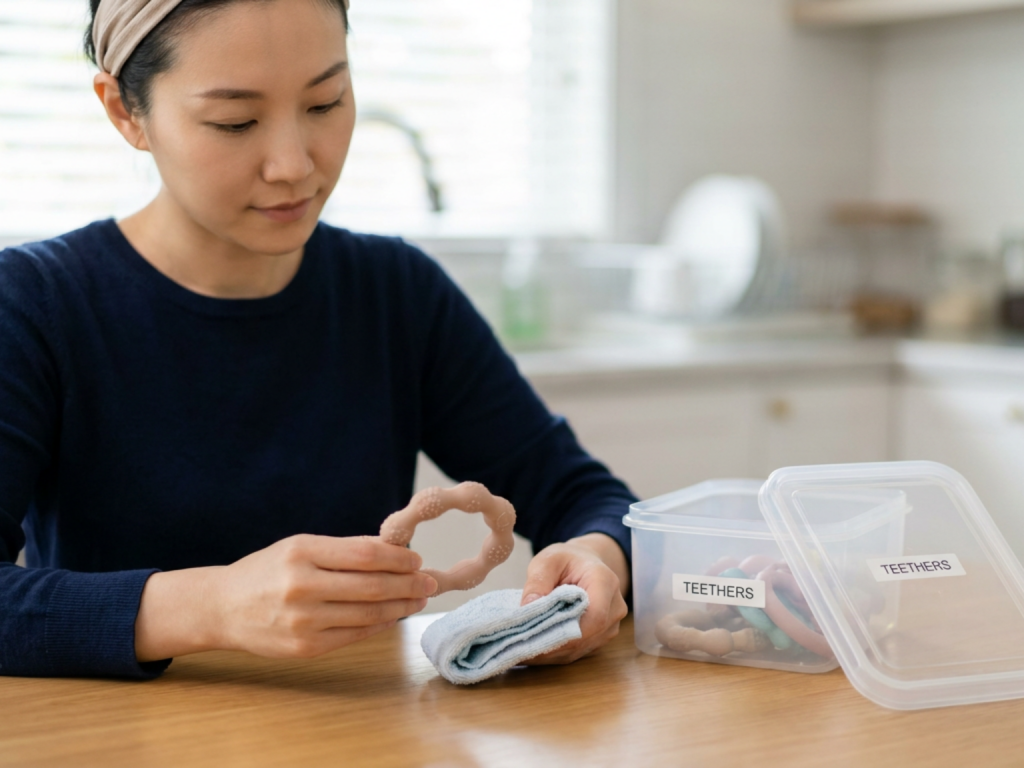
- Wash solid teethers with warm water and mild soap, rinse well, and air-dry completely before storage.
- Launder fabric teethers frequently and dry them thoroughly to reduce mold risk.
- Store clean teethers in a covered container rather than loose at the bottom of a bag.
- Inspect before each use for cracks, tears, punctures, peeling, discoloration, stickiness, trapped water, odor, or loose seams.
If water can enter a hollow toy and cannot drain fully, mold can develop inside. For that reason, many caregivers prefer one-piece teethers without holes or internal cavities. Replacement is not wasteful when a product has become damaged; it is a safety step.
Teething jewelry and wearable products
Teething necklaces, bracelets, anklets, and bead-based accessories are popular, but they raise serious safety concerns. Wearable products can break and release beads, or they can tighten around the neck, wrist, or ankle. Amber teething necklaces are sometimes promoted with pain-relief claims, but caregivers should be cautious about any product that relies on an unproven medical effect while introducing choking or strangulation hazards.
If an adult wears a chewable pendant while holding the baby, it should be used only under direct supervision and kept away during sleep, car-seat use, unsupervised play, and any time the adult is not actively controlling it. A baby should not sleep wearing or near teething jewelry. No comfort strategy is worth an avoidable airway risk.
Supervision and matching the toy to the baby
Even a high-quality teether is not a set-and-forget item. Supervision means being close enough to intervene if the baby gags persistently, breaks a piece, stuffs the toy too far back, or becomes tangled in an attachment. This is especially important for babies who are newly rolling, crawling, pulling to stand, or combining chewing with active movement.
Age labels matter because oral size, motor control, bite strength, and developmental behavior change quickly in the first year. A newborn teether may not be durable enough for an older infant with erupted teeth. A toy intended for a toddler may have shapes or features that are unsuitable for a younger baby. Common baby safety risks also change as infants gain mobility and start reaching siblings’ belongings, bags, and furniture surfaces.
Watch for Signs baby is teething, such as increased chewing, drooling, and localized gum discomfort, but avoid attributing every change to tooth eruption. Teething symptoms versus illness can overlap with infections, feeding problems, or other concerns. Contact a healthcare professional if a baby has high or persistent fever, marked lethargy, breathing difficulty, poor fluid intake, fewer wet diapers, persistent vomiting or diarrhea, mouth lesions, facial swelling, or inconsolable crying.
Buying checklist for safer teething toys
When comparing products, simpler is often safer. A single-piece, age-labeled, easy-to-clean teether from a reputable manufacturer is usually preferable to a complex toy with decorative parts.
- Confirm the product is intended for the baby’s current age and developmental stage.
- Choose a size and shape that cannot lodge in the airway or reach deep into the throat.
- Prefer one-piece construction without beads, cords, batteries, magnets, plugs, or removable caps.
- Look for clear material information and consider BPA-free, PVC-free, and phthalate-free options.
- Read cleaning and temperature instructions before chilling, sterilizing, or dishwashing.
- Check recall information if buying secondhand, receiving hand-me-downs, or using an older product.
Caregivers do not need to buy many teethers. A small rotation of clean, intact, well-designed items is easier to inspect and maintain than a drawer full of products with different instructions.
When to stop using a teething toy
- Discard any teether that is cracked, torn, sticky, leaking, splintered, moldy, or missing a part.
- Do not use frozen-solid teethers on infant gums unless a clinician specifically advises otherwise.
- Keep teething jewelry, loose beads, magnets, and button batteries away from babies.
- Never attach a teether to a crib, car seat, stroller, or the baby's neck with a long cord.
- Seek medical advice for severe pain, high fever, dehydration signs, breathing concerns, or symptoms that do not fit typical teething.
Tools & Assistance
- Manufacturer age label and cleaning instructions
- National consumer product recall databases
- Pediatrician or family doctor for symptoms that seem more than teething
- Pediatric dentist for questions about oral development and gum care
- Small covered container for clean teethers when away from home
FAQ
Are silicone teethers safer than plastic teethers?
Not automatically. A one-piece silicone teether can be a good option, but safety depends on age grading, size, durability, absence of small parts, and cleanability. Some firm plastic teethers may also be appropriate if they meet safety requirements and are used as directed.
Can I put a teething toy in the freezer?
Use the refrigerator instead unless the manufacturer's instructions specifically allow freezing. Frozen teethers can become too hard and may irritate or injure delicate gums.
How often should teething toys be cleaned?
Clean them after routine use, after dropping on the floor, after contact with food or pets, and whenever visibly soiled. Dry them fully before storage, especially fabric or hollow products.
Are teething necklaces safe?
Necklaces and bead-based products can create choking and strangulation risks. Babies should not wear teething jewelry, especially during sleep, car-seat use, or unsupervised time.
When should I call a clinician instead of assuming it is teething?
Call for high or persistent fever, lethargy, dehydration signs, breathing problems, repeated vomiting or diarrhea, facial swelling, mouth lesions, inconsolable crying, or any symptom that worries you.
Sources
- U.S. Consumer Product Safety Commission — Toy Safety Business Guidance
- Health Canada — Industry Guide to Health Canada's Safety Requirements for Children's Toys and Related Products
- Seattle Children's Hospital — Toy Safety - Seattle Children's Hospital
Disclaimer
This article is for general educational purposes and does not replace medical, dental, or emergency care. Consult a qualified healthcare professional for concerns about your baby's symptoms, development, or product safety needs.














Please log in to leave a comment.