
Intro
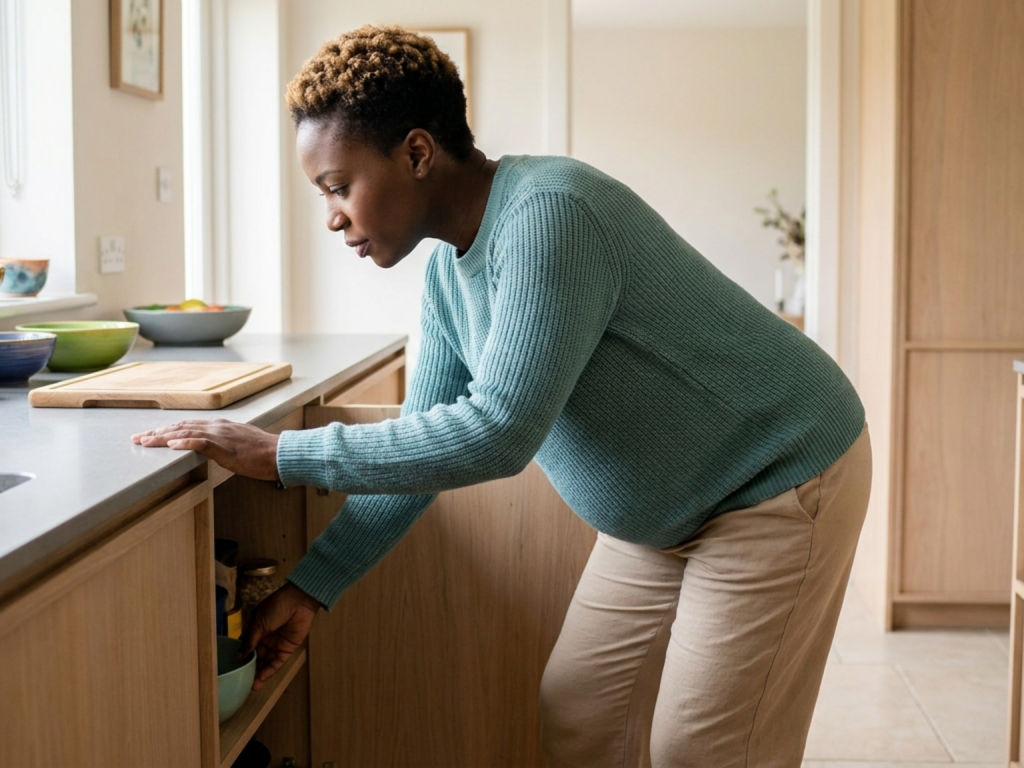
In most pregnancies, bending over is allowed and is part of ordinary movement, not something that must be avoided by default. What changes is how you bend, how long you stay in that position, and whether your body is giving you signs that the movement is becoming difficult or unsafe.
Pregnancy alters balance, joint laxity, abdominal shape, and circulation, so a movement that once felt effortless may now require more caution or a different technique. This article explains when bending is usually fine, how to make it more comfortable, and which warning signs mean you should pause and contact a healthcare professional.
Highlights
Bending over is usually acceptable in a normal, uncomplicated pregnancy, but comfort and balance should guide the movement.
The main concerns are not the bend itself, but dizziness, pain, loss of balance, breathlessness, and pressure on the abdomen or pelvis.
Simple mechanics, such as bending at the hips and knees and keeping objects close to your body, can reduce strain.
Some pregnancy complications require individualized advice, especially if bending triggers bleeding, contractions, or pelvic pain.
If a movement feels wrong, it is reasonable to stop, modify, and ask your obstetric clinician for guidance.
In most pregnancies, yes, but the details matter
For many pregnant people, bending over to tie a shoe, load a washer, pick up a dropped item, or garden is still fine. Major organizations such as the NHS, Mayo Clinic, and ACOG all support continuing regular movement during pregnancy when it is done with appropriate precautions. That same principle applies to bending: the motion itself is not automatically harmful.
What matters is whether the bend is controlled, whether it compromises your balance, and whether it causes symptoms such as pain or lightheadedness. A shallow bend to reach a counter is very different from a deep forward fold while holding a heavy object. In other words, pregnancy does not usually ban bending, but it often changes the technique you need.
If you are generally healthy and have an uncomplicated pregnancy, a gentle bend at the hips and knees is often a reasonable way to manage everyday tasks. If you already have pelvic pain, back pain, bleeding, or a history of obstetric complications, the answer may be more individualized and should come from your maternity clinician.
Why bending can feel harder as pregnancy progresses
As pregnancy advances, your center of gravity shifts forward, your lumbar spine often increases its curve, and the growing uterus changes how your abdomen supports movement. Hormonal changes also increase ligamentous laxity, which is why many people feel less stable in positions that involve forward flexion or quick transitions. None of this means bending is forbidden; it means the body is working with a different mechanical setup.
Some people also notice that bending increases reflux, shortness of breath, pelvic pressure, or a pulling sensation in the lower abdomen. In early pregnancy, nausea or fatigue may make repeated bending unpleasant. In later pregnancy, the issue is more often balance, compression, and the amount of effort needed to get back upright. These are practical reasons to modify the movement, not necessarily signs of harm.
If bending causes pain that is sharp, one-sided, or persistent, that deserves attention. Mild muscular discomfort from reaching or lifting is common, but pelvic girdle pain, pubic symphysis pain, and low-back pain can all be aggravated by repeated flexion. A clinician or pelvic health physical therapist can help you work out whether the motion should be changed, reduced, or temporarily avoided.
Safer ways to bend for daily tasks
Most of the time, the goal is not to stop bending altogether. The goal is to reduce strain and keep your balance. A few small adjustments can make a large difference, especially as the abdomen grows.
- Bend at the hips and knees rather than rounding deeply through the waist.
- Keep the object close to your body when lifting so the load is not far in front of you.
- Avoid twisting while bent; turn your whole body instead.
- Use support from a counter, wall, chair, or stable surface if you feel unsteady.
- Rise slowly from a bent position to reduce dizziness or a sudden drop in blood pressure.
- Exhale during effort rather than holding your breath, which can increase abdominal pressure.
- Change level by kneeling, squatting partially, or using a one-knee position instead of repeated deep forward bends.
Household tools can also help. A reacher, stool, or organizer placed at waist height can reduce the need for repeated floor-level bending. These are simple examples of safe lifting techniques in pregnancy, and they are often more effective than trying to power through discomfort. If a task can be moved to a higher surface or done in smaller steps, that is usually the safer option.
When to pause and ask for medical advice
There is a difference between ordinary discomfort and warning signs. Stop the activity and contact your healthcare professional if bending or getting back upright triggers bleeding, fluid leakage, regular contractions, significant abdominal pain, severe back pain, or new pelvic instability. Dizziness, fainting, chest pain, or marked shortness of breath are also reasons to stop and seek medical assessment.
The same warning signs during prenatal exercise apply to bending in daily life. If a movement makes you feel faint, shaky, or unable to catch your breath, do not treat that as a normal stretch or strain. Step away, sit or lie down if needed, and get advice if the symptom does not resolve quickly or if it recurs.
Later in pregnancy, reduced fetal movement after a concerning episode, or any symptom that feels clearly out of pattern for you, should also be discussed with a clinician. If you are unsure whether a symptom is serious, it is safer to call your maternity provider than to assume it is harmless.
Special situations that need extra caution
Some pregnancies need more individualized rules. If you have placenta previa, significant cervical shortening, preterm labor risk, severe anemia, blood pressure problems, or a history of pregnancy complications, your clinician may advise you to modify certain positions or activities. The same is true if you already have pronounced pelvic girdle pain, sciatic-type symptoms, or a musculoskeletal condition that makes flexion uncomfortable.
In these situations, the question is not simply whether you can bend over, but how much, how often, and under what conditions. A clinician may recommend limiting deep bending, avoiding heavy lifting, or using positional supports. For some people, a pelvic health physical therapist can assess movement patterns and suggest lower-impact prenatal alternatives that are easier on the joints and pelvic floor.
Extra caution is also sensible when bending is combined with another stressor, such as carrying a toddler, moving boxes, standing on a slippery surface, or working in a cramped space. The more variables you add, the more likely the movement is to challenge balance. Slowing down and reorganizing the task can be just as important as the bend itself.
Bending during exercise and everyday activity
Bending is not only a household movement; it can also appear in workouts, yoga, gardening, and work tasks. If you were already active, pregnancy usually does not require you to stop moving. Instead, the focus shifts to maintaining moderate-intensity exercise in pregnancy with modifications that fit your changing body and any obstetric precautions.
Many people do well with lower-impact prenatal alternatives when forward bending becomes awkward. Examples include supported squats, wall-assisted hip hinges, stationary cycling, walking, swimming, and modified yoga. These options reduce impact and may be easier to tolerate if your abdomen feels crowded or your balance feels less reliable. If you are doing pregnancy-safe strength training, range of motion, load, and tempo can often be adjusted so that the exercise remains comfortable.
A useful rule is that you should be able to move without breath-holding, without a sense of strain in the pelvis, and without symptoms such as dizziness or bleeding. If a particular exercise uses a lot of deep flexion, or if it feels different from your normal effort in a bad way, it is reasonable to stop and ask a qualified professional for a modification.
Get urgent medical advice if you have
- Vaginal bleeding, fluid leakage, or regular cramping or contractions
- Severe abdominal, pelvic, or back pain that is new or worsening
- Dizziness, fainting, chest pain, or significant shortness of breath
- A sudden loss of balance or a fall
- Reduced fetal movement or any symptom that feels alarming to you
Tools & Assistance
- Ask your obstetrician, midwife, or family doctor whether you have any movement restrictions.
- See a pelvic health physical therapist if bending is causing pelvic, pubic, or low-back pain.
- Use a stable stool, reacher, or waist-height storage to reduce floor-level bending.
- Review trusted pregnancy exercise guidance from the NHS, Mayo Clinic, or ACOG.
FAQ
Can I bend over in the first trimester?
Usually yes, if you feel well and do not have a pregnancy complication that changes the advice. Fatigue and nausea may make it unpleasant, but the bend itself is not generally forbidden.
Is bending over harmful to the baby?
Ordinary bending is not typically harmful in an uncomplicated pregnancy. The main issues are your comfort, balance, and whether the movement triggers warning signs such as pain, bleeding, or dizziness.
Why do I feel dizzy when I bend over and stand up?
Pregnancy can affect blood pressure and circulation, so a quick change in position may make you lightheaded. Moving slowly and rising gradually can help, but recurrent dizziness should be discussed with a clinician.
What if bending causes pelvic pain?
Pelvic pain can signal that the movement needs modification. A maternity clinician or pelvic health physical therapist can help determine whether the motion should be changed or limited.
Should I stop bending if I am exercising?
Not necessarily. Many exercises can be modified. If a bend causes breath-holding, loss of balance, or warning signs during prenatal exercise, it is wise to stop and seek advice.
Sources
- Mayo Clinic — Exercise During Pregnancy
- NHS — Pregnancy and exercise
- American College of Obstetricians and Gynecologists — Exercise during pregnancy
Disclaimer
This article is for general information only and does not replace personalized medical advice. If you have symptoms, a pregnancy complication, or uncertainty about movement restrictions, contact your obstetric clinician promptly.
















Please log in to leave a comment.