
Intro
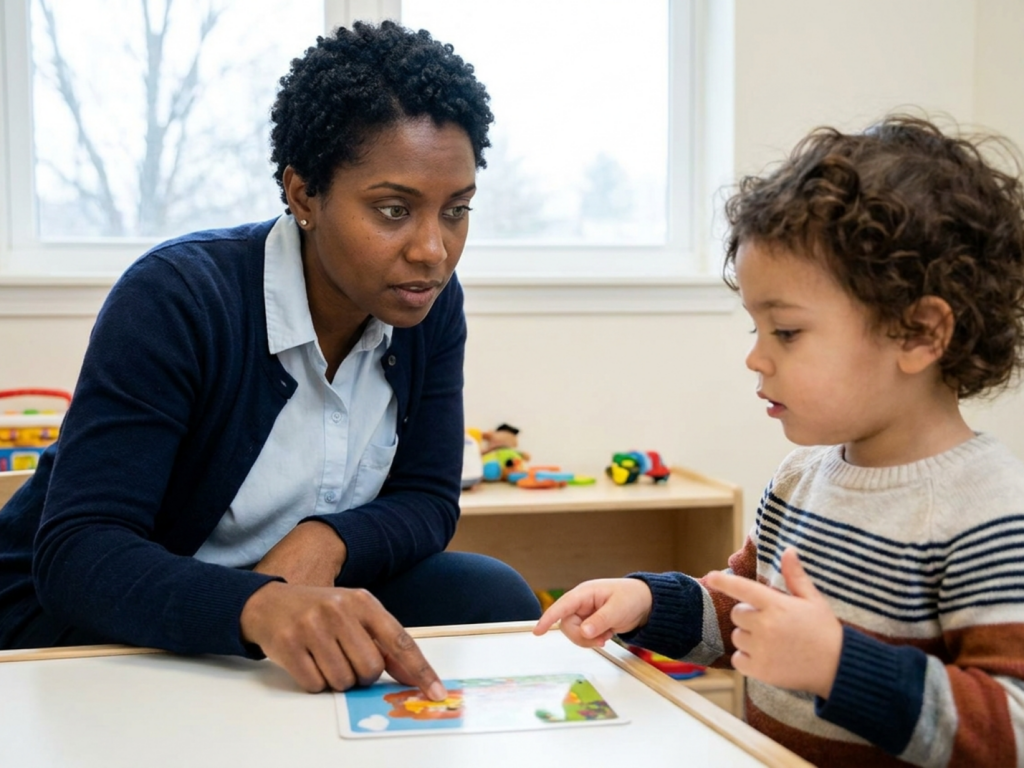
Children communicate long before they can explain themselves in full sentences. Facial expression, eye gaze, posture, gesture, touch, and timing all carry meaning, and adults often underestimate how much children are already reading from these signals. In everyday life, nonverbal communication helps children ask for help, join play, show interest, and understand the social world around them.
This article explains how nonverbal communication develops, how children use it to make social inferences, and why patterns can look different in autism and other developmental profiles. It is written for families and professionals who want a careful, practical overview without jumping to conclusions.
Highlights
Nonverbal communication is a major part of early social life, not a backup for speech.
Children use gaze, gesture, facial expression, and posture to understand other people and guide their own behavior.
Some children, including children with autism, may show differences in pointing, showing, eye gaze, and joint attention.
Caregivers can support communication by noticing subtle cues, slowing interactions, and responding consistently.
Persistent concerns deserve professional assessment for communication concerns rather than guesswork.
What nonverbal communication means in childhood
Nonverbal communication refers to the messages children send and receive without relying on spoken language alone. It includes eye contact, gaze shifts, facial expression, body orientation, posture, vocal quality, gestures such as pointing or showing, and the use of space and touch. In practice, these signals are often combined with speech rather than replacing it. A toddler may say “mine” while reaching, a preschooler may point while looking back at a caregiver, and an older child may lean away to signal discomfort before saying a word.
For children, nonverbal communication is not a minor detail. It is part of social cognition, emotional expression, and relationship-building. Adults often respond to these cues automatically, but children are learning how they work. Over time, they begin to understand that a smile can invite play, crossed arms may signal refusal, and a pause can mean uncertainty or a request for help.
Because these signals are so context-dependent, it is best to interpret them cautiously. A single gesture does not tell the whole story. Looking at the child’s age, situation, sensory load, and relationship with the listener gives a more accurate picture of what the child is trying to communicate.
How children read faces, gaze, posture, and gesture
Young children do not only produce nonverbal signals; they also read them. Research shows that children as young as 5 and 6 years can use nonverbal cues to infer which adult is more in charge in an interaction. They can make these judgments not only from live or videotaped exchanges, but even from still images. That finding matters because it shows that children are actively extracting social information from posture, gesture, and other visible cues.
This kind of inference is part of early social reasoning. A child may notice who stands still, who gestures more confidently, or who others orient toward. They may then use those cues to decide whom to follow, where to sit, or which peer seems to control a game. These judgments are not always correct, but they are developmentally important. Children are learning to connect appearance, behavior, and social meaning.
Gaze is especially powerful. Joint attention, which means sharing focus on the same object or event with another person, is one of the clearest nonverbal foundations of early communication. When a caregiver follows a child’s gaze or point, the child learns that attention can be shared. That shared attention becomes a bridge to language, turn-taking, and later conversation.
Age patterns and early social reasoning
Nonverbal communication changes quickly across early childhood. Infants rely heavily on facial expression, voice prosody, and body rhythms. Toddlers start using intentional gestures such as pointing, giving, and showing. Preschoolers become more skilled at coordinating gaze, gesture, and speech, especially in social play. By school age, children can often adjust their nonverbal behavior to fit the setting, such as lowering their voice in a quiet classroom or using a look to communicate during a game.
These changes are not simply about getting older. They reflect growing executive function, social learning, and language development. Children begin to understand that an expression can be sincere, teasing, or strategic depending on the context. They also become better at reading other people’s intentions and at noticing mismatch, such as when someone says “I’m fine” but looks upset.
Development is variable, though. A child who uses fewer gestures than peers at age 2 may still make progress, especially if receptive language, hearing, motor planning, sensory processing, and social engagement are all considered together. That is why developmental context matters more than any single milestone. Professionals usually look at patterns over time, not isolated moments.
Nonverbal communication in autism and developmental variation
Studies of young children with autism show that nonverbal communication can look different in early development. In one study of 2- and 3-year-old children with autism, researchers examined behaviors such as pointing, showing, eye gaze, and hand-directed communication. Another study reported deficits in joint attention and lower communication frequency in young children with autism, especially around requesting and social interaction. These findings are important because they highlight how nonverbal communication can reveal early developmental differences.
Importantly, these differences are not simply about whether a child is speaking. A child may have words but still struggle to use eye gaze, gesture, or shared attention in socially meaningful ways. Another child may communicate needs effectively in one setting but show much less social signaling in a noisy or unfamiliar environment. Nonverbal communication is therefore best understood as part of social communication in children, not as a single yes-or-no skill.
For families, the goal is not to label a child based on one behavior. The goal is to notice whether communication feels reciprocal, whether the child can share attention, and whether gestures or gaze are used consistently across situations. If concerns persist, a speech-language evaluation, developmental assessment, or other professional assessment for communication concerns can help clarify the picture.
How caregivers can support nonverbal communication
Support starts with attention. When adults notice a child’s look, point, reach, or change in posture, they can respond in ways that confirm the child has been understood. That response may be as simple as naming what the child is looking at, waiting a moment longer, or helping the child complete a gesture. These small interactions teach that communication works and that the child’s signals matter.
Calmer, slower exchanges often help. Children who are overwhelmed may use fewer words and more body-based cues, so co-regulation before self-expression can be useful. This means helping the child feel safe enough to communicate rather than demanding verbal answers immediately. In practical terms, that may include lowering background noise, moving to a quieter space, or giving the child extra time to process.
Visual supports for emotional communication can also be useful when words are limited. Pictures, choices, gestures, and modeled expressions help children show preferences and feelings. Active listening with children matters too: looking at what the child is doing, not only what the child is saying, can reveal the real message. Caregivers often benefit from watching for patterns such as consistent avoidance, repeated pointing, or a child who looks to an adult only when unsure. Over time, these patterns can guide supportive routines and, when needed, intervention planning.
When to seek professional input
It is reasonable to ask for help when a child’s nonverbal communication seems very limited, inconsistent, or hard to interpret across settings. Concerns may include rarely pointing or showing, limited eye gaze, minimal joint attention, little interest in shared play, or a noticeable drop in communication frequency. A change after illness, stress, hearing problems, or family disruption also deserves attention.
Professional evaluation does not mean something is definitely wrong. It means the child’s communication can be reviewed in a structured way. Depending on the situation, this may involve hearing assessment, speech-language assessment, developmental evaluation, or broader pediatric review. For some children, especially those with complex needs, the most helpful plan combines family observations, school input, and clinical observation.
Early support can be valuable even when the diagnosis is not yet clear. The purpose of assessment is to understand how the child communicates now and how to strengthen those skills in realistic daily routines. Families should feel encouraged, not blamed. Many children make meaningful gains when adults notice the signal, slow down, and respond consistently.
When not to wait
- Seek prompt evaluation if a child loses previously used gestures, eye contact, or other communication skills.
- Do not assume a child is being oppositional when communication is quiet, limited, or hard to read.
- If hearing, speech, social interaction, or behavior concerns cluster together, ask for a professional review.
- A child who rarely shares attention or never uses gestures to communicate may benefit from early assessment.
- Sudden changes after illness, injury, or major stress should be discussed with a clinician.
Tools & Assistance
- Pediatrician or primary care visit for developmental discussion
- Speech-language pathology evaluation
- Hearing assessment for communication concerns
- Developmental or neurodevelopmental assessment
- Early intervention or school-based support services
FAQ
What are the main nonverbal communication skills in children?
Common skills include eye gaze, facial expression, pointing, showing, posture, body orientation, and shared attention.
Does limited pointing always mean a disorder?
No. Children vary, and context matters. Persistent or broad concerns should be discussed with a professional rather than assumed.
Why is joint attention so important?
Joint attention helps children share focus with others, which supports social learning, language growth, and later conversation.
Can a child communicate nonverbally even if they have words?
Yes. Many children rely on gesture, gaze, and posture alongside speech, especially when tired, stressed, or excited.
When should families ask for assessment?
When communication feels consistently limited, regresses, or does not fit the child’s age and setting, evaluation is appropriate.
Sources
- National Library of Medicine, PubMed Central — Children Use Nonverbal Cues to Make Inferences About Social Roles and Dominance
- National Library of Medicine, PubMed — Nonverbal Communication in Two- and Three-Year-Old Children with Autism
- National Library of Medicine, PubMed — Nonverbal Communication Skills in Young Children with Autism
Disclaimer
This article is for educational purposes only and does not replace individualized medical, developmental, or speech-language evaluation. If you are concerned about a child’s communication, speak with a qualified healthcare professional.
















Please log in to leave a comment.