
Intro
School life between ages 10 and 12 often feels bigger, louder, and more emotionally charged than earlier childhood. Many children are moving from upper elementary school toward middle school, while their brains, bodies, friendships, and self-image are changing quickly.
This stage can be exciting and stressful at the same time. A supportive adult presence helps preteens build independence without feeling abandoned, and helps families distinguish normal developmental friction from concerns that deserve professional guidance.
Highlights
Ages 10 to 12 bring stronger abstract thinking, more complex schoolwork, and a growing need for organization.
Friendships become central to daily school experience, and peer approval can strongly affect mood, confidence, and motivation.
Privacy, self-consciousness, and identity exploration are common, but preteens still need warm adult structure.
Sleep, nutrition, physical activity, and screen habits can noticeably affect school performance and emotional regulation.
Bullying, persistent anxiety, declining grades, or major behavior changes should prompt early communication with the school and healthcare professionals.
The changing preteen learner
Between 10 and 12 years, children are no longer learning only by memorizing facts or following simple instructions. Many are developing stronger executive functions: planning, inhibition, working memory, and cognitive flexibility. These abilities are still immature, which is why a preteen may understand a long-term project but still forget the due date, lose the rubric, or start the night before.
Cognitively, many children in this age range can compare ideas, understand cause and effect more deeply, work with fractions, read longer age-appropriate books, and discuss fairness or rules with more nuance. They may enjoy competition, clubs, sports, and group tasks because school is becoming a place to test competence as well as to learn content.
At the same time, early adolescent neurodevelopment can make performance inconsistent. A child may be articulate and logical in one moment, then emotionally overwhelmed by a small correction in the next. This does not mean they are manipulative or lazy. It often reflects a nervous system that is becoming more sophisticated but is not yet fully regulated. Adults can help by separating the skill problem from the character judgment: “You need a better plan for remembering assignments” is more useful than “You are careless.”
Independence with structure
Preteens usually want more privacy, more say in choices, and more respect from adults. They may question authority, experiment with different styles or interests, and become self-conscious about being treated like a “little kid.” This is a healthy movement toward identity formation, but it does not remove the need for adult scaffolding.
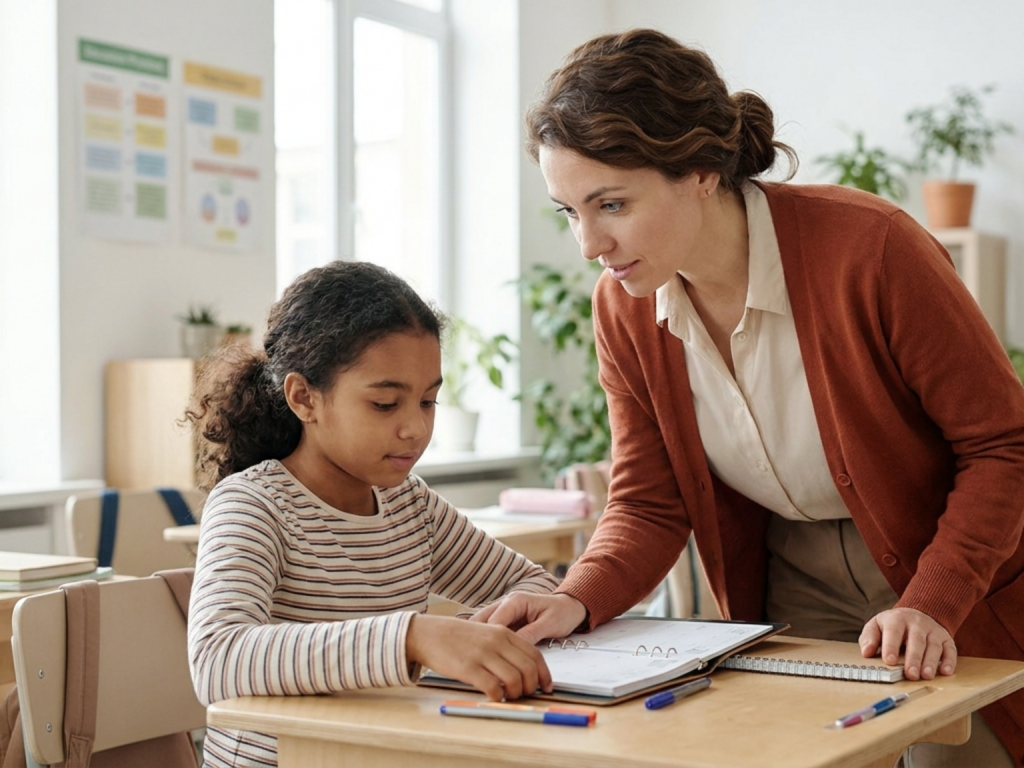
Supported independence in preteens works best when adults gradually transfer responsibility while keeping predictable guardrails. For school, that may mean the child packs their own bag, checks a planner, and emails a teacher with guidance from a parent, while the adult still monitors patterns and steps in when the system is not working.
- Use a visible weekly calendar for tests, activities, and project deadlines.
- Choose a consistent homework location with fewer digital distractions.
- Review the school portal together at set times rather than constantly monitoring it.
- Let the preteen help design routines so they feel ownership.
- Praise process skills such as starting early, asking for help, and correcting mistakes.
Homework organization for preteens should be concrete. Many children benefit from color-coded folders, a checklist for the backpack, a planner, or a digital assignment tool approved by the school. The goal is not perfection; it is building repeatable habits that reduce daily conflict and anxiety.
Friendships, belonging, and classroom confidence
For many 10- to 12-year-olds, the social part of school can feel as important as the academic part. Peer relationships and school motivation are closely connected: a child who feels accepted may participate more, while a child who feels excluded may avoid school, underperform, or complain of headaches or stomachaches.
Friendships at this age often become more selective and emotionally intense. Some children prefer same-gender groups; others form mixed friendships or shift between groups. Jealousy, comparison, secrets, and loyalty tests may appear. These experiences are common, but they can still hurt deeply. Adults should avoid dismissing social pain as “drama.” To a preteen, friendship conflict can affect appetite, sleep, concentration, and self-worth.
Helpful conversations are curious rather than interrogating. Instead of “Who was mean today?” try “Who did you sit with?” or “Was there any part of the day when you felt left out or included?” This opens the door without forcing disclosure. Parents and caregivers can also teach perspective-taking: “What do you think your friend may have been feeling?” and boundary-setting: “You can be kind without doing something that makes you uncomfortable.”
School staff should be involved when social conflict becomes repeated, targeted, humiliating, threatening, or power-imbalanced. Bullying is not a normal friendship problem. Early adult action helps protect mental health and the learning environment.
Emotions, self-consciousness, and puberty at school
Many preteens become more aware of their bodies, clothing, voice, athletic ability, academic ranking, and social status. Puberty may begin for some children in this age range, while others are not yet showing visible changes. This uneven timing can increase embarrassment, comparison, and worry. A child may refuse to change for physical education, avoid raising a hand, or become upset about comments that adults see as minor.
Emotional regulation is still developing. The limbic system, involved in threat detection and emotional salience, can react strongly, while prefrontal regulatory circuits are still maturing. In everyday school life, this may look like tears after feedback, irritability after a group project, or shutting down when a task feels too hard.
Adults can reduce shame by using calm, specific language. For example: “It looked like the noise in class was too much today. Let’s think about what helps your body reset.” This keeps the focus on coping skills rather than blame. Some preteens benefit from a quiet break plan, school counselor check-ins, or teacher-supported strategies for transitions.
Privacy also matters. Discuss body changes, hygiene, menstruation, erections, acne, and deodorant respectfully and without teasing. If a child has pain, severe mood changes, intense body distress, persistent fatigue, or concerns about pubertal timing, families should consult a pediatrician or qualified healthcare professional.
School routines, sleep, food, and movement
Daily physiology strongly affects classroom functioning. Sleep protection in preteens is especially important because insufficient sleep can worsen attention, memory consolidation, emotional reactivity, and impulse control. A 10- to 12-year-old who seems oppositional in the morning may actually be chronically sleep-deprived or overstimulated at night.
Consistent wake times, a predictable bedtime routine, and reduced evening screen exposure can support circadian rhythm stability. Many families also find that an after-school decompression period helps. Some preteens need 20 to 40 minutes to eat, move, or be quiet before starting homework. This is not avoidance if it is time-limited and predictable.
Preteen nutrition also matters for learning. Regular meals and snacks help maintain glucose availability for the brain and can reduce irritability. A balanced school lunch with protein, fiber-rich carbohydrates, healthy fats, and fluids is more supportive than relying heavily on sugary drinks or low-nutrient snacks. Children with restrictive eating, food insecurity, gastrointestinal symptoms, or rapid weight changes should be assessed by appropriate professionals.
Physical activity in preteens supports mood, sleep quality, cardiometabolic health, and attention. Organized sports can be valuable, but movement does not have to be competitive. Walking, biking where safe, dancing, playground time, martial arts, or active chores can all help. The key is balancing activity with rest so school life does not become a cycle of exhaustion.
Screens, digital schoolwork, and online social pressure
Digital tools are now part of school life: assignments, grades, teacher messages, classroom platforms, and research may all happen online. The challenge is that the same device may also deliver games, group chats, social comparison, and late-night notifications. Digital social life in preteens can intensify friendship stress because conflicts follow the child home and may feel impossible to escape.
Families can set limits without making screens the center of every argument. A clear media plan might define where devices charge overnight, which apps are allowed on school nights, when homework technology is used in a shared space, and what to do if a child receives cruel, sexual, threatening, or confusing messages.
Screen time is not only about minutes; content, timing, and emotional effect matter. A preteen who becomes more anxious, withdrawn, sleep-deprived, secretive, or distressed after online interactions may need closer support. Adults should avoid shaming the child for mistakes online. Instead, emphasize safety, repair, and help-seeking: “If something happens online that scares you, you will not be in trouble for telling me.”
Because heavy or dysregulated screen use can be associated with anxiety, depressed mood, sleep problems, and school avoidance, persistent concerns should be discussed with a pediatrician, mental health clinician, or school counselor.
When school stress needs extra support
Some stress is expected during the transition from later childhood to early adolescence. New teachers, more homework, changing bodies, and shifting friendships can all cause temporary worry. However, ongoing distress deserves attention, especially when it affects functioning across school, home, sleep, eating, or relationships.
Possible warning patterns include persistent school refusal, frequent unexplained physical complaints, sudden grade decline, major personality change, intense perfectionism, repeated panic-like episodes, withdrawal from friends, aggressive behavior, self-harm talk, or signs of bullying. These signs do not prove a specific diagnosis, but they indicate the child needs careful listening and support.
Start with collaborative communication. Ask the preteen what feels hardest, contact the teacher for observations, and consider the school counselor as a bridge. If learning problems are suspected, families can ask the school about evaluation pathways. If mood, anxiety, trauma, attention, neurodevelopmental differences, or medical symptoms are concerns, a pediatrician or qualified clinician can help guide next steps.
The most protective message is: “You do not have to manage school alone.” Preteens need adults who respect their growing independence while staying emotionally available, observant, and steady.
When to seek help promptly
- Talk with a healthcare professional if school avoidance, anxiety, low mood, or irritability persists or worsens.
- Contact school staff immediately if bullying, threats, harassment, or unsafe online behavior is suspected.
- Seek urgent help if a child talks about self-harm, wanting to disappear, or not wanting to live.
- Ask for medical guidance with rapid weight change, severe fatigue, chronic headaches, abdominal pain, or sleep disruption.
- Do not assume declining grades are laziness; consider learning, attention, emotional, social, and medical factors.
Tools & Assistance
- A weekly school planner or shared family calendar
- Scheduled teacher or school counselor check-ins
- A calm homework routine with short breaks and device boundaries
- Pediatrician visit for persistent physical, sleep, mood, or developmental concerns
- A family media plan for school devices, social apps, and nighttime charging
FAQ
Is it normal for a 10- to 12-year-old to care more about friends than schoolwork?
Yes, friendships often become highly important at this age. The goal is to support healthy peer connection while keeping routines and expectations for schoolwork clear.
How much should parents monitor homework?
Most preteens still need structure, but not constant control. Review planners, portals, and routines at predictable times, then gradually let the child take more responsibility.
What if my child suddenly says they hate school?
Listen for the reason before reacting. Academic difficulty, bullying, friendship conflict, sleep problems, anxiety, or puberty-related embarrassment can all appear as school refusal or anger.
Are mood swings at this age always puberty?
No. Puberty can contribute, but sleep loss, stress, peer conflict, screen use, learning difficulties, medical issues, and mental health conditions can also affect mood. Seek professional guidance if symptoms persist or impair daily life.
Sources
- Kaiser Permanente — Your Child at 10 to 12 Years
- CHOC Children’s Hospital of Orange County — Growth & Development: 6 to 12 Years (School Age)
- Emerging Minds — Child development: Pre-teens (9-12 years old)
Disclaimer
This article is for informational purposes only and does not diagnose or treat any condition. Consult a pediatrician, mental health professional, or school specialist for concerns about a child’s health, learning, or safety.















Please log in to leave a comment.