
Intro
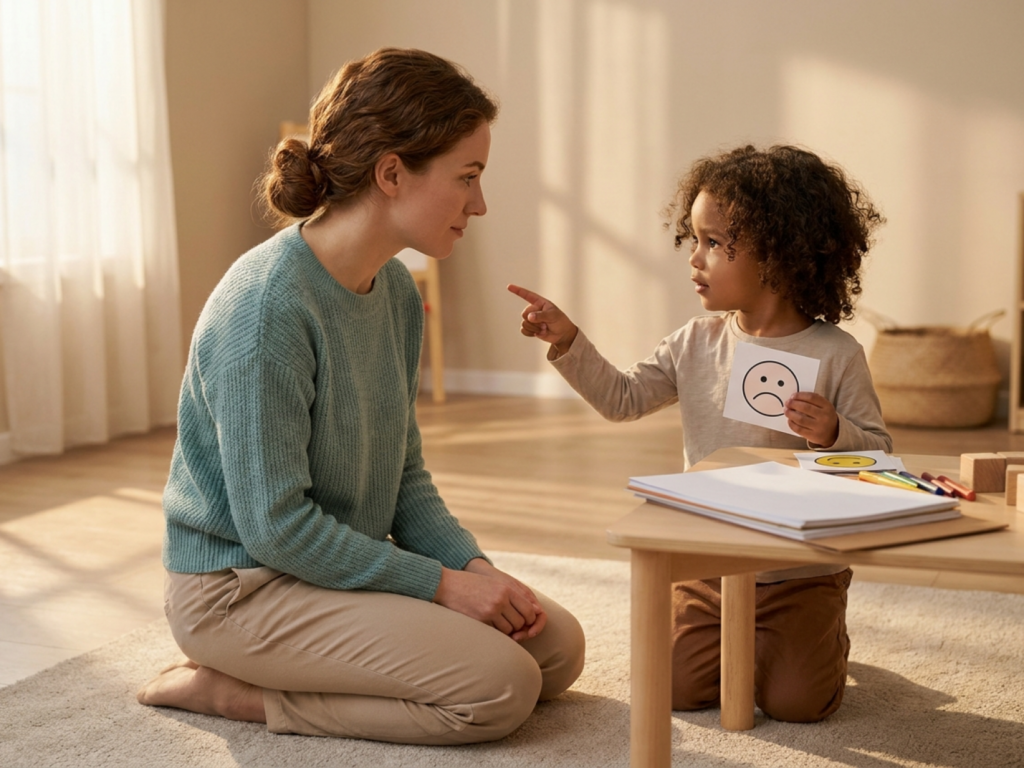
Children communicate feelings long before they can describe them in words. A newborn's cry, an infant's gaze, a toddler's gesture, and an older child's explanation are all meaningful forms of emotional communication. Understanding these signals helps caregivers respond sensitively while supporting the gradual development of language, emotional awareness, and self-regulation.
Emotional expression is shaped by developmental stage, temperament, relationships, culture, sensory experiences, and the demands of a particular situation. A supportive approach does not expect children to communicate like adults. Instead, it observes the whole child, interprets behavior in context, and creates repeated opportunities for safe, respectful communication.
Highlights
Children communicate emotions through facial expression, vocal tone, posture, movement, gestures, play, behavior, and words.
Responsive caregiver-child interaction supports mutual regulation and gradually strengthens a child's ability to identify and manage feelings.
A child's facial expression may not fully represent the intensity, meaning, or cause of an emotion.
Emotion coaching works best when adults acknowledge feelings while maintaining clear, consistent boundaries.
Persistent or marked communication changes warrant discussion with a pediatrician or another qualified healthcare professional.
What emotional expression means
Emotional expression is the observable communication of an internal affective state. It may include a smile, crying, laughter, silence, changes in voice, avoidance, physical closeness, repetitive movement, aggressive behavior, imaginative play, drawing, or a direct statement such as “I am worried.” Expression is not identical to emotion itself: the same feeling can be communicated in different ways, and the same behavior can arise from different emotional states.
Research on affective social competence describes emotional communication as a broad, multimodal capacity. Children gradually learn to express their own emotions, recognize emotions in other people, interpret social situations, and adjust communication to the relationship and context. These abilities are interconnected. For example, a child who notices a caregiver’s concerned tone may seek reassurance, while a child who cannot yet label frustration may communicate it through crying or refusal.
Adults can therefore ask, “What might this behavior be communicating?” rather than assuming that behavior is deliberately oppositional. This does not mean permitting unsafe conduct. It means separating the child’s emotional experience from the behavior used to express it, then teaching a safer alternative.
Development from infancy to school age
Infants communicate through organized patterns of arousal, gaze, facial movement, vocalization, body movement, and crying. These signals help caregivers identify needs and respond. Early communication is relational: the infant’s state affects the adult, the adult’s response changes the infant’s state, and the interaction continues through mutual regulation. Soothing, contingent responses can help an infant move from distress toward calm, although no caregiver can prevent every episode of crying or dysregulation.
During the toddler period, emotional intensity often increases as mobility, autonomy, and desire for control expand faster than expressive language and inhibitory control. A toddler may point, pull an adult’s hand, repeat a word, scream, throw an object, or cling when unable to convey a need. Such episodes are common in early development, but their meaning depends on frequency, duration, triggers, recovery, safety, and the child’s overall functioning.
Preschool children typically acquire more emotion vocabulary and begin to use pretend play, stories, drawings, and simple explanations to communicate internal experiences. They still rely heavily on adults for co-regulation before self-regulation becomes more consistent. School-age children can often describe causes, anticipate other people’s reactions, and use coping strategies, but fatigue, pain, transitions, social stress, or overwhelming sensory input may temporarily reduce these skills. Development is uneven rather than linear.
Read the whole communication signal
Facial expressions provide useful information, but they should be interpreted alongside voice, body, behavior, language, and context. Studies of children’s prototypic facial expressions show that children communicate emotions through multiple channels, including the face, voice, and body. In real-life interactions, a child may look neutral while speaking tensely, smile when embarrassed, laugh during nervousness, or turn away because direct eye contact feels overwhelming. Adult expectations about what an emotion should look like can therefore lead to inaccurate interpretations.
Observation is most informative when it is specific and nonjudgmental. Consider what happened immediately before the behavior, what the child did, how others responded, and what helped the child recover. Note patterns across settings rather than drawing conclusions from one incident. A child who becomes quiet in a noisy classroom but communicates comfortably at home may be responding to sensory or social demands; a child who has stopped using previously acquired words may need prompt professional evaluation.
Useful questions include:
- What emotion or physical state might be present: fear, frustration, sadness, excitement, fatigue, pain, hunger, or overload?
- Is the child trying to obtain help, escape a demand, connect with another person, or communicate a preference?
- Does the expression match the situation, or could the child be masking, confused, or unable to explain the feeling?
- What communication method is easiest for this child at this moment: words, gesture, drawing, movement, or a visual choice?
Build emotional literacy through everyday interaction
Emotional literacy is the developing ability to notice bodily states, identify feelings, understand possible causes, communicate needs, and recognize that emotions can change. It is taught most effectively during ordinary routines rather than only during a crisis. Adults can use simple, accurate language: “Your fists are tight and your voice is loud. You may be frustrated because the game ended.” The phrase “may be” leaves room for correction and teaches that the child is the expert on their experience.
Emotion words should be concrete and varied. In addition to happy, sad, and angry, children can learn worried, disappointed, proud, lonely, relieved, jealous, confused, excited, and overwhelmed. Books, puppets, pretend play, music, and drawings can provide emotional distance, allowing a child to explore difficult experiences without being questioned directly. Adults can model their own communication in a measured way: “I feel disappointed, so I am going to take a short pause and try again.” This demonstrates that emotions are acceptable while harmful actions remain limited.
Validation is not agreement with every interpretation or permission for unsafe behavior. A balanced response might be: “You are angry that your sister took the toy. I will not let you hit. You can say, ‘My turn next,’ or we can move away and calm your body.” Specific choices are usually more useful than demands to calm down. After the child has recovered, briefly revisit what happened and practice the preferred communication method.
Co-regulation, relationships, and communication access
Children develop regulation within relationships before they can reliably regulate independently. Co-regulation includes an adult’s calm presence, predictable routines, appropriate physical and emotional availability, and help identifying what is happening. During distress, long explanations may exceed the child’s processing capacity. A low voice, fewer words, reduced stimulation, and a clear safety boundary may be more effective. Once arousal decreases, conversation and problem-solving become more accessible.
Communication access is equally important. A child may understand more than they can say, or may communicate more effectively through gestures, pictures, sign language, writing, or an augmentative and alternative communication system. These methods do not represent a failure of speech; they can reduce frustration and support participation while spoken language develops or when speech is not the child’s most reliable modality. Adults should accept all meaningful communication and avoid forcing eye contact, immediate verbal responses, or public emotional disclosure.
Communication skills development is influenced by hearing, vision, language exposure, neurodevelopment, cognition, motor abilities, sleep, stress, and the quality of social interaction. Caregivers and educators can coordinate vocabulary and response strategies across settings. A speech-language pathologist, pediatrician, psychologist, occupational therapist, or other professional may help assess communication needs, depending on the concern. The appropriate support should be individualized rather than based on a single behavior or comparison with peers.
Supporting children during strong emotions
When a child is highly aroused, prioritize safety and connection before teaching. Move unsafe objects, create physical space, and supervise siblings or peers as needed. Use a short statement that names the limit and the available support: “I will keep everyone safe. I am here. We can talk when your body is calmer.” Avoid threats, humiliation, forced apologies, or repeated questioning in the peak of distress. These responses can increase arousal and may teach the child to hide rather than communicate emotions.
Once calm, help the child reconstruct the sequence without assigning blame. Identify the trigger, the body signals, the communication attempt, the adult response, and a practical alternative for next time. A calm-down plan might include a named adult, a quiet space, paced breathing suitable for the child’s age, water, movement, sensory accommodations, or a visual sequence of steps. The plan should be practiced when the child is regulated and reviewed after successful use.
Preventive support can include advance warnings before transitions, adequate sleep and meals, predictable routines, opportunities for movement, limited simultaneous instructions, and explicit teaching of turn-taking and repair. In classrooms, visual supports and private check-ins may help a child communicate without becoming the focus of group attention. Consistency matters, but flexibility is also necessary when illness, family stress, trauma exposure, or an unfamiliar environment changes the child’s capacity.
When to seek professional guidance
Variation in emotional expression is expected, and developmental milestones are not rigid deadlines. Professional advice is appropriate when concerns are persistent, worsening, occur across settings, interfere with learning or relationships, or create a safety risk. Examples include very limited response to social communication, inability to communicate basic needs, frequent severe episodes with prolonged recovery, marked withdrawal, persistent fear or sadness, unexplained aggression, significant sleep or appetite changes, or a loss of previously acquired communication or social skills.
Evaluation may consider hearing and vision, language comprehension and expression, developmental history, mental health, medical conditions, sleep, medications, sensory processing, family circumstances, and the demands of the environment. A pediatrician can coordinate developmental surveillance and referrals. Depending on the presentation, assessment may involve a speech-language pathologist, child psychologist, developmental-behavioral pediatrician, occupational therapist, or school-based team.
Seek urgent help when a child is at immediate risk of harming themselves or another person, has severe confusion or loss of awareness, has a sudden major behavioral change with possible medical symptoms, or cannot be kept safe. Caregivers should share concrete observations, including onset, frequency, triggers, settings, recovery time, and strategies already tried. This information supports a more accurate and compassionate assessment.
When safety or assessment cannot wait
- Seek urgent assistance if a child may seriously harm themselves or another person.
- Promptly discuss loss of acquired language, social skills, or other developmental abilities with a healthcare professional.
- Do not assume that persistent withdrawal, fear, aggression, or emotional distress is simply a phase.
- Sudden emotional or communication changes accompanied by concerning physical symptoms require medical attention.
- Avoid physical punishment, shaming, or forcing a child to disclose feelings before they are ready.
Tools & Assistance
- A brief observation log recording triggers, communication signals, context, duration, and recovery
- Emotion picture cards, feeling thermometers, or visual choice boards
- A practiced calm-down plan shared by caregivers and educators
- Hearing, developmental, or speech-language assessment when communication concerns persist
- A pediatrician, child mental health professional, or school support team for coordinated guidance
FAQ
Why does my child express anger through behavior instead of words?
Strong arousal can temporarily reduce access to language and impulse control. The child may also lack the vocabulary, processing ability, or communication support needed to explain the trigger. Validate the feeling, maintain safety limits, and practice alternative communication after the child is calm.
Should adults correct a child's emotional expression?
Adults should not punish feelings, but they should set clear limits around unsafe actions. Acknowledge the emotion, describe the boundary, and offer a safer way to communicate the need.
Is limited eye contact evidence that a child is not communicating?
No. Eye contact varies by child, culture, relationship, sensory profile, and situation. Assess communication broadly, including gestures, words, shared attention, play, body orientation, and response to others.
When should I ask for a communication assessment?
Ask a pediatrician or speech-language professional when a child has persistent difficulty understanding or expressing messages, communicating needs, participating socially, or using previously acquired skills. Concerns across settings or with safety implications deserve prompt attention.
Sources
- PubMed — Emotional development through the lens of affective social competence
- PubMed Central (NIH) — Children's Prototypic Facial Expressions during Emotion
- PubMed — Emotions and emotional communication in infants
Disclaimer
This article provides general educational information and is not a diagnosis or a substitute for individualized medical, developmental, psychological, or speech-language advice. Consult a qualified healthcare professional about concerns regarding a child's emotional expression, communication, development, or safety.


















Please log in to leave a comment.