
Intro
Preschoolers often feel emotions with a force that can surprise adults. Their limbic system can react quickly, while the prefrontal networks that support impulse control, flexible thinking, and verbal problem-solving are still immature. This means a child may genuinely want comfort, connection, or help, yet communicate through crying, grabbing, hiding, yelling, or refusal.
Highlights
Emotional expression is a teachable skill, not a personality flaw. Preschoolers need repeated, calm coaching to connect body sensations, feeling words, and safe actions.
Validation does not mean permissiveness. Adults can accept the feeling while still setting firm, predictable limits on unsafe or hurtful behavior.
Play, stories, drawing, music, puppets, and daily check-ins help young children practice emotional language before they are overwhelmed.
Persistent, severe, or escalating emotional difficulties deserve professional input, especially when safety, sleep, speech-language development, trauma, or family stress may be involved.
Why emotional expression is hard in the preschool years
Preschool emotional expression sits at the intersection of neurodevelopment, language, temperament, attachment, sensory processing, and family context. A 3- to 5-year-old may understand many words but still lack the executive functioning needed to pause, name a feeling, consider consequences, and choose an appropriate response. In stressful moments, arousal can outpace language. The result may look like defiance, but it is often a sign that the child’s regulation capacity has been exceeded.
Medically, it helps to distinguish emotion from behavior. Anger, fear, jealousy, sadness, and excitement are internal affective states. Hitting, screaming, running away, or throwing toys are behaviors. The goal is not to eliminate difficult feelings; it is to help the child express them in developmentally appropriate and safe ways. This distinction protects the child from shame while still allowing adults to set boundaries.
Young children also rely heavily on interoception, the perception of internal body signals. A preschooler may feel a racing heart, tight muscles, hot cheeks, or a “wiggly” stomach without knowing these sensations are linked to frustration, anxiety, or excitement. Teaching body cues gives children an earlier warning system. When adults say, “Your fists are tight and your voice is loud; your body may be telling us you feel angry,” they translate physiology into language.
Teach the five building blocks of emotional intelligence
A practical framework for helping preschoolers express emotions includes five teachable abilities: noticing emotional cues in themselves and others, understanding what caused the feeling, labeling it accurately, expressing it in a context-appropriate way, and regulating the intensity. These abilities do not emerge from one conversation. They are built through hundreds of brief, supportive interactions.
Start with recognition. During calm moments, point out facial expressions, posture, tone of voice, and body sensations. “You are smiling and jumping. That looks excited.” “Your shoulders are down and you are quiet. I wonder if you feel disappointed.” Avoid turning every observation into a quiz; narration is often less stressful than interrogation.
Next, help with cause and consequence. Preschoolers benefit from simple cause-and-effect language: “You felt sad because the block tower fell,” or “When you shouted close to Maya’s face, she moved away because it scared her.” This helps children connect feelings, events, and social impact without implying that the feeling itself is wrong.
Then build labeling. Use a broad but manageable vocabulary: happy, sad, mad, scared, worried, frustrated, proud, embarrassed, jealous, lonely, calm, and excited. Accurate labels matter because “mad” and “scared” may require different adult responses. Finally, pair expression with regulation: “You can say, ‘I’m mad,’ stomp your feet on the floor, or squeeze a pillow. I won’t let you hit.” This is the core of emotion coaching for preschoolers.
Validate feelings while holding firm limits
Validation is often misunderstood. It is not agreement with the child’s demand, and it is not surrendering the boundary. Validation means the adult communicates, “Your internal experience makes sense to me, and I can help you handle it safely.” This reduces shame and helps the child’s nervous system settle enough to learn.
A useful formula is: name the feeling, connect it to the situation, state the limit, and offer a safe alternative. For example: “You are angry because screen time ended. I will not let you throw the tablet. You can stomp on the mat or ask for a hug.” Another example is: “You wanted the red cup and feel disappointed. The red cup is dirty. You can choose blue or green.”
Preschoolers need limits that are brief, concrete, and consistent. Long explanations during high arousal can overload working memory. Save teaching for after the child is calmer. During the peak of distress, use fewer words, a lower voice, and a safe physical environment. If a child is aggressive, block gently when needed, move dangerous objects, and supervise closely. Avoid mocking, threatening abandonment, or labeling the child as “bad,” because these responses can intensify dysregulation and impair trust.
After the episode, repair. A repair conversation is short and non-shaming: “That was hard. You were very mad. Hitting hurt Sam. Next time, you can say, ‘Move please,’ or come get me.” Repair teaches accountability without confusing the child’s worth with the behavior.
Use play, stories, and daily check-ins
Play is the native language of early childhood. Many preschoolers can express feelings more easily through a puppet, a drawing, a song, or a pretend character than through direct questioning. A puppet can say, “I feel left out,” and the child may respond with empathy, problem-solving, or a disclosure of similar feelings. This indirect approach lowers defensiveness and allows rehearsal.
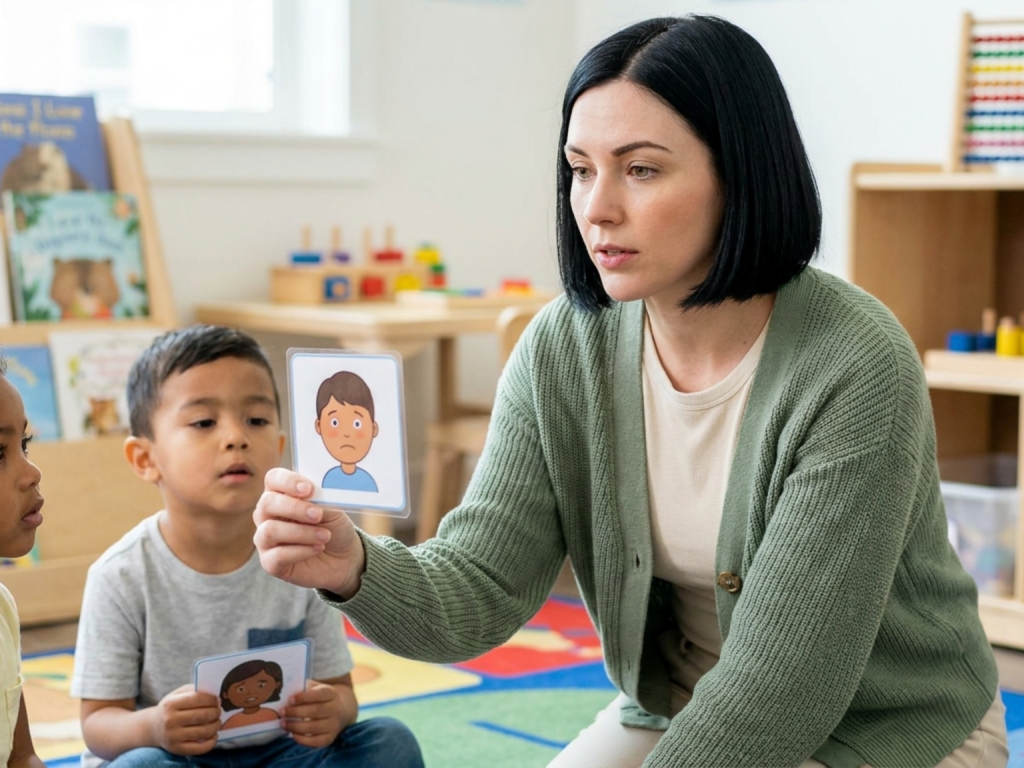
Daily emotional check-ins normalize feelings before there is a crisis. A simple routine might ask, “What color is your feeling today?” or “Show me with your face how your body feels.” Some classrooms use a mood meter or pictures of children’s names placed near emotion images. At home, families can use a small set of emotion cards on the refrigerator. The aim is not to make the child perform emotional insight perfectly; it is to make feeling-talk ordinary.
Books and stories also build emotional literacy. Pause during a story and wonder aloud: “She is hiding behind the chair. Maybe she feels shy.” “He lost his toy. What could he do with that sad feeling?” These moments teach perspective-taking, a foundation for empathy. Drawing can help children externalize feelings: “Can you draw what mad looks like?” Music and movement can help children discharge energy safely: slow music for calming, marching for anger, or stretching for worry.
For children who resist talking, offer choices. “Do you want to point, draw, whisper, or show me with your body?” Communication is broader than speech, and honoring multiple modes can reduce pressure.
Model the emotional behavior you want to see
Preschoolers learn regulation by watching adults regulate. An adult who says, “I am frustrated, so I am going to take three slow breaths before I answer,” provides a live demonstration of self-monitoring, impulse control, and repair. This does not require perfect calm. In fact, appropriate adult repair after irritation may be especially powerful: “I used a loud voice. That may have scared you. I am sorry. I will try again calmly.”
Modeling should be specific and visible. Instead of silently coping, narrate a few steps: “My body feels tight. I need a sip of water.” “I am disappointed that the park is closed. I can feel sad and make a new plan.” These statements teach that emotions are manageable physiological and psychological states, not emergencies that must control behavior.
Adults should also praise appropriate expression. Praise works best when it identifies the skill: “You told me you were jealous instead of grabbing the toy. That was helpful.” “You used your words to ask for space.” Specific praise strengthens neural and behavioral pathways for future use.
When adults are under chronic stress, it becomes much harder to respond calmly. Sleep deprivation, financial stress, postpartum mood symptoms, family conflict, or caregiver burnout can reduce patience and emotional availability. Seeking support is not a failure; it is part of creating the child’s regulatory environment. If emotional episodes at home are frequent, intense, or damaging relationships, Preschool behavior solutions may include parent coaching, routines, and developmentally appropriate behavior plans.
Build a calm-down plan before the storm
Calming strategies are most effective when practiced outside moments of distress. A child who has rehearsed slow breathing during play is more likely to access it when frustrated. Keep strategies concrete and sensory-based. Examples include smelling an imaginary flower and blowing out a candle, counting slowly to 10, pushing palms together, squeezing a stuffed animal, taking a drink of water, asking for a break, or going to a cozy corner.
A calm-down space should not be a punishment area. It can include soft seating, emotion pictures, books, sensory objects, and simple visual reminders. The message is: “This is where bodies go to feel safe and ready,” not “This is where bad children go.” Some children need co-regulation before self-regulation; they may calm best with an adult nearby, a predictable phrase, rhythmic breathing, or gentle proximity.
Visual routines can prevent emotional overload. Many outbursts occur during transitions, hunger, fatigue, sensory stimulation, or uncertainty. A picture schedule, countdown warning, or first-then statement can reduce threat perception: “First shoes, then playground.” For children with transition difficulties in preschoolers, consistency across home and classroom can be particularly helpful.
When strong emotions escalate into Preschool tantrums and emotional outbursts, prioritize safety and reduce verbal demands. Afterward, return to skill-building. Ask, “What did your body tell you first?” and “What can we try next time?” Over time, this turns each episode into data rather than a moral failure.
When emotional expression may need extra support
Wide variation is normal in preschool emotional development, but some patterns deserve professional guidance. Consider speaking with a pediatrician, developmental-behavioral pediatrician, child psychologist, early childhood mental health clinician, or speech-language pathologist if emotional expression difficulties are persistent, severe, or impairing. Examples include frequent aggression that does not improve with consistent support, self-injury, prolonged inconsolable episodes, loss of previously acquired skills, extreme separation distress, major sleep disruption, or emotional reactions that interfere with preschool participation or family functioning.
Medical and developmental factors can contribute. Hearing problems, speech-language delays, autism spectrum traits, attention-regulation differences, anxiety, trauma exposure, sleep disorders, constipation, pain, medication effects, and sensory processing differences can all affect emotional expression. A careful assessment can help identify what support the child needs without rushing to label the child.
It is also worth seeking help when caregivers feel afraid of the child, frequently lose control, or feel unable to keep siblings safe. Evidence-informed parent-child interventions, classroom consultation, developmental screening, and family support can reduce escalation and improve communication. The goal is not to pathologize normal preschool intensity. The goal is to match the child and family with tools that protect safety, connection, and developmental progress.
When to seek urgent or professional help
- Seek urgent help if a child is at immediate risk of serious self-injury or harming others.
- Consult a pediatric clinician if emotional outbursts are escalating, prolonged, or disrupting sleep, eating, preschool, or family safety.
- Ask for evaluation if there is regression in language, social engagement, toileting, or play skills.
- Consider hearing, speech-language, sleep, pain, trauma, and sensory factors when emotional expression suddenly worsens.
- If caregivers feel overwhelmed or afraid they may respond harshly, seek support promptly from healthcare or crisis resources.
Tools & Assistance
- Daily emotion check-in using pictures, colors, or a mood meter
- Emotion coaching script: name the feeling, validate, set the limit, offer a safe action
- Play-based practice with puppets, drawing, music, and story characters
- Calm-down plan with breathing, counting, movement, and a safe sensory space
- Pediatric or early childhood mental health consultation when concerns persist
FAQ
Should I tell my preschooler to stop crying?
It is usually more helpful to validate the feeling and guide the behavior. For example: “You are sad. I am here. You can cry, and I will help you use gentle hands.”
What if my child says “I hate you” when upset?
Treat it as a strong emotional signal, not a literal adult-style statement. You can say, “You are very angry. I will listen when you use safe words. I will not let you hit.”
Are tantrums always a sign of a disorder?
No. Tantrums can be common in the preschool years. Professional input is appropriate when episodes are very frequent, dangerous, prolonged, worsening, or impair daily life.
How many feeling words should a preschooler know?
There is no exact required number. A useful goal is steady growth from basic words like happy, sad, mad, and scared toward more precise words such as frustrated, proud, worried, and disappointed.
What should teachers and parents do if they use different approaches?
Share simple language and agree on a few consistent strategies, such as the same calm-down phrase, emotion visuals, and safe alternatives to hitting or yelling.
Sources
- National Association for the Education of Young Children — Teaching Emotional Intelligence in Early Childhood
- Raising Children Network — Understanding and managing emotions: children and teenagers
- Kids Mental Health Foundation — Helping Kids Express Emotions Appropriately
Disclaimer
This article is for educational purposes only and is not a diagnosis or treatment plan. Consult a qualified healthcare professional for concerns about a child’s development, behavior, safety, or mental health.
















Please log in to leave a comment.