
Intro
Physical development in childhood is a dynamic, highly individualized process. From the first attempts to lift the head to coordinated running, drawing, climbing, and self-care, children gradually build strength, postural control, balance, coordination, and fine motor precision.
Milestones are helpful reference points, not rigid deadlines. A child’s progression is shaped by neurologic maturation, temperament, opportunities for movement, health conditions, nutrition, sleep, and family environment. When concerns arise, timely discussion with a pediatric clinician can help distinguish normal variation from patterns that may benefit from developmental evaluation or supportive therapy.
Highlights
Physical milestones usually progress from head control to trunk stability, sitting, crawling or other mobility, standing, walking, and increasingly complex coordination.
Gross motor, fine motor, language, cognitive, and social-emotional development are interconnected, so a delay in one area may warrant a broader developmental review.
Milestone charts are screening guides rather than diagnostic tools; children may reach skills at different ages and still develop typically.
Early surveillance, standardized screening, and prompt referral when needed can improve access to physical, occupational, or developmental support.
Understanding physical development as a developmental continuum
Physical development refers to the maturation of the body and nervous system that allows a child to control posture, move through space, use the hands, and participate in daily activities. It includes gross motor skills, such as rolling, sitting, crawling, standing, walking, running, jumping, and climbing, and fine motor skills, such as reaching, grasping, transferring objects, stacking blocks, using utensils, scribbling, and manipulating small objects.
Milestones are commonly grouped into developmental domains: gross motor, fine motor, language, cognitive, and social-emotional. Although these categories are useful clinically, real children do not develop in separate compartments. For example, improved trunk stability helps an infant free the hands for reaching and exploration. Better hand control supports feeding, play, and problem-solving. Mobility changes how a child interacts socially, communicates needs, and learns about distance, danger, and cause and effect.
Progression typically follows predictable neurodevelopmental principles. Control often emerges from the head downward, called cephalocaudal development, and from the center of the body outward, called proximodistal development. This is why head control and trunk stability generally precede refined finger movements. However, the exact timing is variable. A milestone chart provides a population-based guide, not a verdict on a child’s potential.
Infancy: head control, rolling, sitting, and early mobility
During the first year, physical development is especially visible. Newborns have limited voluntary motor control and rely heavily on primitive reflexes. Over the following months, infants gradually gain antigravity strength, visual-motor coordination, and postural stability. Early skills may include briefly lifting the head while prone, turning the head, bringing hands toward the mouth, and kicking both legs.
As neck and trunk control improve, many infants begin to push up on the forearms, roll from belly to back or back to belly, and reach more intentionally. Sitting develops in stages: first with support, then with hands propped forward, and eventually independently. Independent sitting is important because it changes the infant’s view of the world and allows both hands to be used for play.
Later in infancy, children may pivot on the belly, creep, crawl on hands and knees, scoot, or use another pattern of floor mobility. Some children crawl traditionally, while others move in different ways before walking. Pulling to stand, cruising along furniture, lowering from standing, and taking supported steps reflect increasing lower-extremity strength, balance reactions, and confidence. Families often focus on walking, but the quality of transitions, symmetry of movement, and ability to explore safely are also meaningful.
Caregivers can support infant physical development with supervised tummy time when the baby is awake, safe floor play, opportunities to reach for toys, and avoidance of prolonged time in restrictive devices. Sleep positioning should still follow safe sleep guidance; prone positioning for play is different from placing an infant prone for sleep.
Toddler years: walking, climbing, balance, and independence
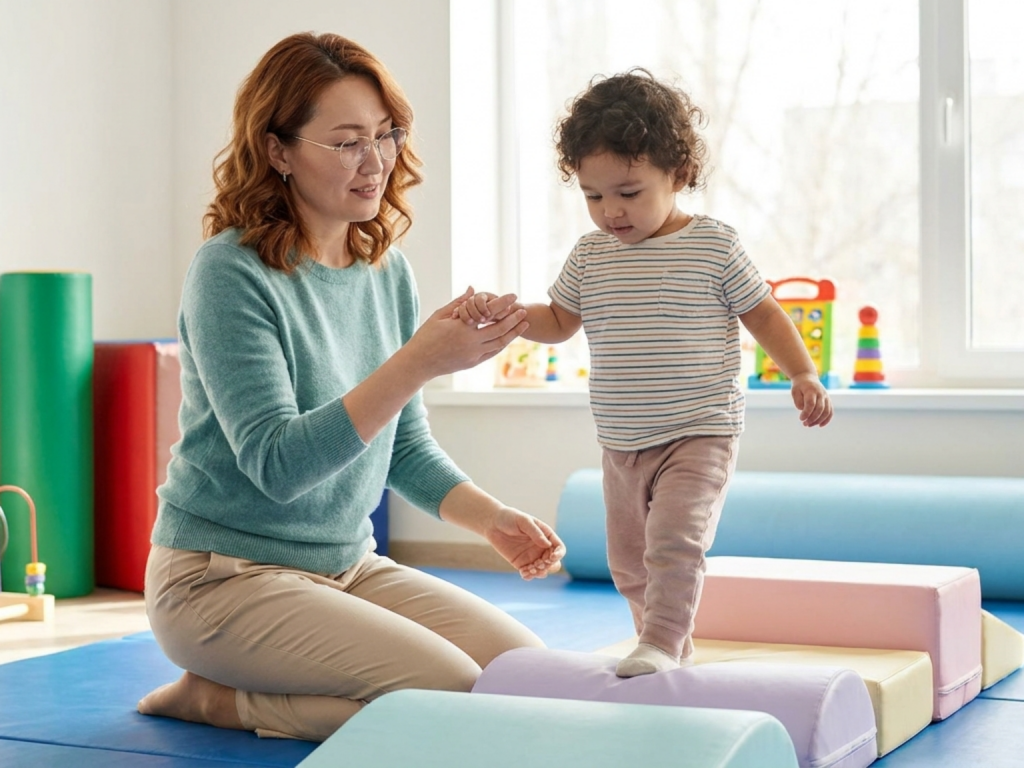
The toddler period is marked by rapid expansion of mobility. Once walking emerges, gait is usually wide-based and unsteady at first. Over time, toddlers develop better balance, shorter pauses between steps, improved arm swing, and more controlled stopping and turning. They begin to squat to pick up objects, stand again without falling, climb onto furniture, walk up steps with assistance, and eventually run with increasing coordination.
These motor achievements are closely linked to independence. A toddler who can walk across a room can choose toys, approach caregivers, resist transitions, and explore boundaries. This is developmentally appropriate but can be exhausting for families. Safe environments become essential: anchored furniture, stair gates when appropriate, close supervision near water, and removal of choking or poisoning hazards allow movement without unnecessary risk.
Fine motor progress is also substantial. Toddlers typically become more skilled at using a pincer grasp, releasing objects voluntarily, stacking blocks, turning pages, using a spoon with spills, and scribbling. Hand preference may appear inconsistently, but a strong, fixed hand preference before about 18 months can sometimes raise concern for asymmetric motor function and is worth mentioning to a clinician.
Variation remains common. Some children walk earlier, while others walk later but progress steadily. Clinicians pay attention not only to the age at which a skill appears but also to trajectory: whether skills are advancing, whether both sides of the body are used similarly, whether tone seems unusually stiff or floppy, and whether acquired skills are being lost.
Preschool progression: coordination, endurance, and refined motor planning
From about 3 to 5 years, children usually become more coordinated, energetic, and purposeful in movement. Gross motor skills may include jumping with both feet, pedaling a tricycle, climbing playground equipment, balancing briefly on one foot, hopping, catching a large ball, and navigating stairs with alternating feet. These abilities require strength, vestibular and proprioceptive processing, motor planning, and practice.
Fine motor skills also become more precise. Preschoolers often progress from broad scribbling to copying simple lines and shapes, building taller block towers, using child-safe scissors with supervision, dressing with assistance, and feeding with increasing control. These tasks depend on shoulder stability, wrist positioning, finger strength, bilateral coordination, and visual-motor integration.
Physical development at this age should not be viewed only through sports or performance. Play is the central training ground. Running games, dancing, climbing, throwing, building, pretend play, puzzles, and art activities all contribute to motor competence. Children who are cautious, sensory-sensitive, or less interested in active play may need gentle encouragement rather than pressure. The goal is to create repeated, enjoyable opportunities for movement.
Preschool development is also when coordination differences may become more noticeable. A child may avoid playground equipment, tire quickly, fall often, struggle with utensils, or become frustrated with dressing tasks. These observations do not establish a diagnosis, but they can guide a conversation with a pediatrician, physical therapist, occupational therapist, or developmental specialist.
Healthy variation versus concerning patterns
Milestone progression has a normal range. Prematurity, illness, hospitalization, temperament, cultural caregiving practices, and opportunity for floor play can influence timing. For children born preterm, clinicians often use corrected age during infancy and early toddlerhood when interpreting milestones. This adjustment can prevent unnecessary alarm while still allowing careful monitoring.
At the same time, some patterns deserve prompt professional attention. These include loss of previously acquired motor skills, marked asymmetry in limb use, persistent stiffness or marked hypotonia, poor feeding with weak coordination, inability to hold the head up as expected, lack of independent sitting or mobility well beyond typical ranges, or not bearing weight when developmentally expected. Repeated falls can be normal in early walkers, but persistent clumsiness with functional limitation may need assessment.
Developmental concerns are best approached with curiosity rather than blame. Caregivers may notice subtle issues before they are evident in a brief clinic visit. Videos of the child moving, notes about when skills appeared, and examples of daily challenges can be helpful. A clinician may perform a physical and neurologic examination, review growth and nutrition, assess hearing or vision when relevant, and recommend standardized developmental screening.
It is important to avoid self-diagnosis based on a single milestone. A child who is late in one skill may be progressing well overall, while another child who meets a headline milestone may still show quality-of-movement concerns. Professional evaluation focuses on the whole child, including function, trajectory, neurologic signs, and family context.
Supporting motor skills at home and in community settings
Caregivers can foster physical development through safe, responsive, and varied movement experiences. Infants benefit from supervised awake tummy time, side-lying play, reaching for toys at midline, and time on firm surfaces where they can move freely. Toddlers and preschoolers benefit from daily active play, outdoor exploration when possible, climbing opportunities appropriate to their ability, dancing, ball play, and tasks that build hand skills.
Useful strategies include:
- Offer floor time and active play every day, matched to the child’s age and medical needs.
- Place toys slightly out of reach to encourage rolling, pivoting, crawling, or cruising without creating distress.
- Use everyday routines, such as dressing, feeding, bathing, and cleanup, as opportunities for coordination and independence.
- Limit prolonged containment in seats, swings, or carriers when the child is awake and could safely move.
- Choose supportive shoes for outdoor walking, while allowing safe barefoot play indoors when appropriate for balance and foot feedback.
- Celebrate effort and exploration rather than comparing siblings or peers.
Children with medical complexity, neuromuscular conditions, congenital differences, or developmental delays may need individualized guidance. In these situations, the safest activities and positioning strategies should be tailored by the child’s healthcare team. Physical therapy and occupational therapy can be particularly helpful for building strength, coordination, adaptive skills, and caregiver confidence.
Developmental surveillance, screening, and early support
Developmental surveillance is the ongoing process of monitoring a child’s progress at health visits and through caregiver concerns. Screening uses standardized tools at recommended ages or whenever concerns arise. These processes are not meant to label children unnecessarily; they are designed to identify children who may benefit from further evaluation, early intervention, or therapy services.
Early support matters because the developing nervous system is adaptable. When a delay or motor difference is identified, intervention may focus on strengthening, postural control, mobility, hand function, feeding skills, sensory-motor integration, or safe participation in home and childcare routines. The plan depends on the child’s needs and should be coordinated with pediatric clinicians and qualified therapists.
Families sometimes worry that seeking evaluation will create stigma. In practice, assessment often provides reassurance, practical strategies, and a clearer path forward. If services are recommended, they can usually be integrated into play and daily routines. For many children, the aim is not to accelerate development artificially but to remove barriers, support function, and help the child participate more comfortably.
A supportive approach recognizes both science and emotion. Milestones can bring joy, anxiety, pride, and uncertainty. Caregivers do not need to interpret every sign alone. When questions persist, asking for a developmental review is a reasonable and proactive step.
Seek professional advice promptly if you notice
- Loss of a previously acquired motor skill or clear developmental regression.
- Marked stiffness, persistent floppiness, or strong asymmetry in arm or leg use.
- Poor head control, feeding difficulty, or concerns about breathing, swallowing, hearing, or vision.
- No steady progress over time, even if a single milestone seems close.
- Any caregiver concern that feels persistent or difficult to explain.
Tools & Assistance
- Keep a dated milestone and movement observation log for pediatric visits.
- Record short videos of crawling, walking, hand use, or concerning movements to share with clinicians.
- Ask the pediatrician about standardized developmental screening and early intervention referral when concerned.
- Consult licensed pediatric physical or occupational therapy services if recommended.
- Create safe daily opportunities for supervised floor play, outdoor play, and fine motor practice.
FAQ
What if my child reaches milestones later than other children?
Some variation is normal. What matters is the overall pattern, steady progress, and quality of movement. Discuss concerns with a pediatric clinician.
Is crawling required before walking?
Many children crawl, but some use other mobility patterns before walking. A clinician can assess whether the pattern is functional and symmetric.
When should I worry about frequent falling?
New walkers fall often. Persistent falls, weakness, asymmetry, pain, regression, or difficulty keeping up with peers should be reviewed professionally.
Can I help motor development without special equipment?
Yes. Supervised floor play, reaching games, climbing practice, ball play, dressing routines, and drawing activities can all support development.
Who evaluates physical developmental delays?
A pediatrician often starts the evaluation and may refer to early intervention, pediatric physical therapy, occupational therapy, neurology, or developmental specialists.
Sources
- MedlinePlus Medical Encyclopedia — Developmental milestones record
- Children's Hospital of Richmond at VCU — Gross motor skills: birth to 5 years
- StatPearls, NCBI Bookshelf, NIH — Developmental Milestones
Disclaimer
This article is for informational purposes only and does not replace medical evaluation, diagnosis, or treatment. Consult a qualified healthcare professional for concerns about a child’s development.

















Please log in to leave a comment.