
Intro
Toddlerhood is a period of remarkable social-emotional growth. Between 1 and 3 years, children move from depending heavily on familiar caregivers for regulation to experimenting with independence, empathy, pretend play, cooperation, and early friendships. This growth is exciting, but it can also look messy: tantrums, possessiveness, separation distress, and sudden shifts between wanting help and refusing it are common.
Milestones are best understood as patterns, not rigid deadlines. Temperament, language development, sleep, health, family stress, culture, caregiving routines, and opportunities to play with others all shape how social skills emerge. If you feel concerned, you do not need to wait and worry alone; a pediatrician, health visitor, developmental specialist, or early intervention service can help you interpret what you are seeing.
Highlights
Social development in toddlers is closely linked with attachment, language, emotional regulation, and play.
Many toddlers show early empathy, such as noticing when another person is hurt, before they can reliably share or take turns.
Pretend play and symbolic play become increasingly important by the third year and often reveal how children understand relationships.
Aggression, tantrums, and possessiveness can be developmentally expected, but persistent or severe concerns deserve professional guidance.
Why toddler social development matters
Social development is not just about being friendly. In early childhood, it reflects how the brain integrates attachment, communication, sensory processing, motor skills, cognition, and stress regulation. A toddler who brings you a toy, checks your face before exploring, imitates sweeping the floor, or protests when a caregiver leaves is practicing core social-emotional skills.
Secure relationships are a major foundation. When caregivers respond predictably to distress, hunger, fear, curiosity, and joy, toddlers gradually learn that other people can be safe sources of comfort. This trust supports exploration. A child may venture away to investigate a toy, then return for reassurance, a pattern sometimes described as using the caregiver as a secure base.
Early bonding begins long before toddlerhood, often in the first hours and weeks of life through feeding, comforting, eye contact, voice, touch, and immediate skin-to-skin contact when medically appropriate. However, attachment is not a single moment or a perfect-parenting test. It is built through repeated repair: the caregiver notices, responds, misreads sometimes, tries again, and helps the child settle.
Because toddlers have immature prefrontal regulatory systems and rapidly developing language, their social behavior is uneven. A 2-year-old may hug a crying peer one day and push the same peer the next. This inconsistency does not mean the child lacks kindness; it often means the child’s impulses, fatigue, hunger, and communication skills are still catching up with social understanding.
Social milestones around 12 to 18 months
From 12 to 18 months, toddlers often become more purposeful social partners. Many point, show objects, bring items to caregivers, and use gestures or early words to request help. They may look toward a trusted adult in uncertain situations, a behavior related to social referencing. They also often imitate everyday actions, such as pretending to talk on a phone, feeding a doll, or wiping a surface.
Separation anxiety may be prominent during this period. A toddler who cries at daycare drop-off or clings when a parent leaves the room is showing awareness of attachment and object permanence, not simply being difficult. Predictable goodbye routines can help: a brief cuddle, a clear statement that the caregiver will return, and a calm handoff are usually more supportive than sneaking away.
Early empathy can begin to appear around this age. Some toddlers notice when another person is upset and may stare, pat, bring a comfort object, or become distressed themselves. This is not mature perspective-taking; it is an emerging capacity to register another person’s emotional state. Caregivers can support it with simple language: “She fell down. She is sad. Let’s be gentle.”
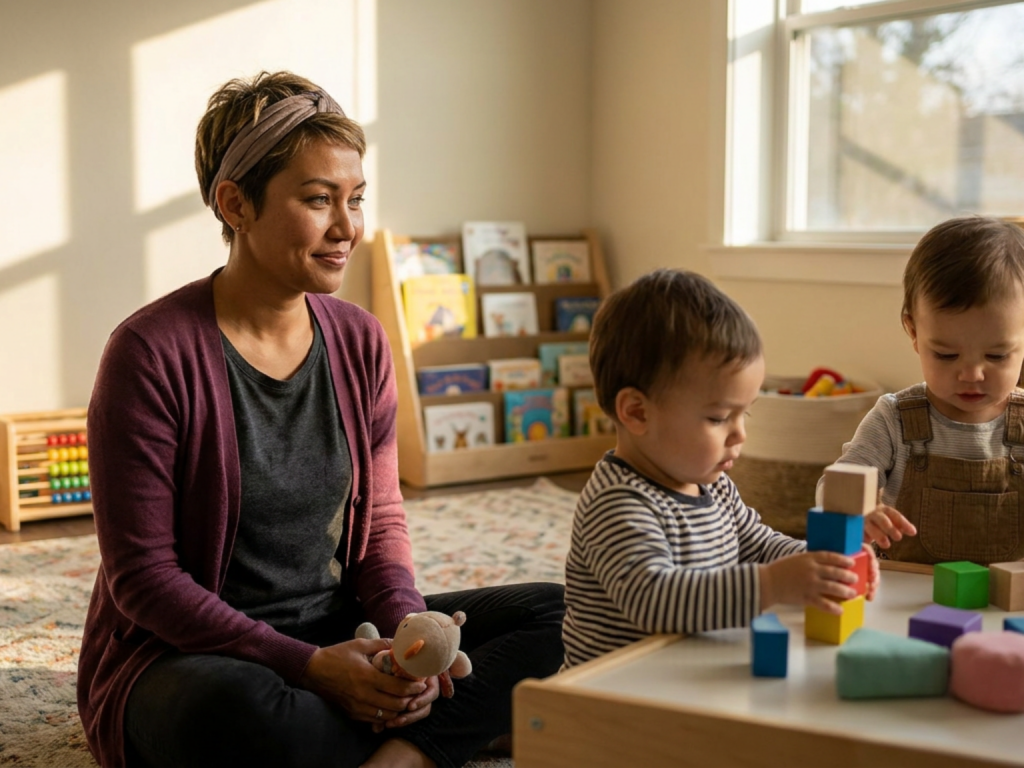
At this stage, independent play and parallel play are common. A toddler may sit near another child and use similar toys without true cooperation. Sharing is limited because ownership, impulse control, and time concepts are still immature. Rather than demanding, “Share now,” it is often more helpful to narrate and structure: “You have the truck. Sam is waiting. When the timer rings, Sam can have a turn.”
Social milestones around 18 to 24 months
Between 18 and 24 months, toddlers commonly show a stronger sense of self. They may say “mine,” resist help, insist on choices, and become frustrated when adults set limits. This autonomy is developmentally meaningful. The child is discovering personal agency while still needing close co-regulation from adults.
Language growth can reduce some frustration, but it can also increase negotiation. Toddlers may use names for familiar people, request preferred activities, protest transitions, and express basic needs more independently. Many begin labeling feelings when adults model the words: mad, sad, scared, happy, tired, or excited. Emotional vocabulary helps convert raw arousal into communicable experience.
Peer interest usually increases, though play may remain brief and physical. A toddler may follow another child, laugh during chase games, imitate a peer’s actions, or become upset when a toy is taken. Turn-taking is beginning, especially in simple routines like rolling a ball back and forth, but it requires adult scaffolding. Toddlers do better when the rules are concrete, short, and repeated.
Tantrums are also common in this window. They are often triggered by fatigue, hunger, transitions, sensory overload, communication barriers, or a blocked goal. During a tantrum, reasoning is usually less effective than safety, calm presence, and minimal language. After the child settles, a caregiver can briefly label the event and model repair: “You were angry because the cup was blue. You cried and threw it. Cups are not for throwing. Let’s try again.”
Social milestones around 24 to 30 months
From 24 to 30 months, pretend play becomes more organized. Children may feed stuffed animals, put a doll to sleep, make animal sounds in a farm scene, or assign roles such as “baby,” “doctor,” or “cook.” This play matters because it lets toddlers practice social scripts, emotional themes, and problem-solving in a low-risk way.
Symbolic play also expands. A block may become a phone, a box may become a car, and a spoon may become an airplane for feeding a toy. These substitutions show cognitive flexibility and are closely tied to social imagination. The child is beginning to understand that one object, action, or person can represent something else.
Empathy is still immature but often more visible. A toddler may offer a toy to a crying child, call for an adult when someone is hurt, or repeat comforting phrases they have heard. They may also laugh or continue playing when another child is upset, especially if they are overstimulated or unsure what happened. Caregivers can avoid shaming while still guiding: “He is crying. The push hurt. We can help by giving space and using gentle hands.”
This is a useful age for practicing small social routines: greeting a familiar neighbor, saying goodbye, helping clean up, waiting for a short turn, and choosing between two acceptable options. The goal is not perfect manners. The goal is repeated, supported practice in noticing others, communicating needs, and recovering from conflict.
Social milestones around 30 to 36 months
By 30 to 36 months, many toddlers engage in more complex pretend play and early cooperative play. They may act out family routines, medical visits, shopping, cooking, or caregiving scenes. Some begin planning play with another child: “You be the dog,” “I drive,” or “Baby is sleeping.” These exchanges are often brief and may still require adult help, but they show growing social cognition.
Children in this period may better understand that behavior affects other people. They may anticipate that grabbing will upset a peer or that helping will please an adult, although impulse control remains limited. Aggression such as hitting, biting, kicking, or throwing may still occur, particularly under stress. Developmentally, the work of the third year includes gradually mastering aggression, using words or gestures instead, and learning early cooperation.
Friend preferences may appear. A toddler may talk about a familiar child, look forward to seeing them, imitate them, or feel sad when they leave. These early friendships are often based on shared routines and enjoyable play rather than stable mutual understanding. Caregivers can strengthen connection by talking about friends, looking at photos, or creating a simple “friend book” with names and familiar activities.
By the third birthday, many children can participate in simple group routines, follow brief social rules with reminders, and show pride in helping. Still, regression is common during illness, sleep disruption, a new sibling, moving, family stress, or changes in childcare. A child who suddenly clings or has more tantrums may be communicating that their regulatory load has exceeded their current capacity.
How caregivers can support healthy social growth
Supportive caregiving does not require constant entertainment. Toddlers benefit from warm responsiveness, clear limits, predictable routines, and opportunities to practice with patient adults nearby. The most therapeutic social tool in daily life is often a calm caregiver who can name feelings, hold boundaries, and reconnect after conflict.
Helpful strategies include:
- Label emotions in real time. Use concise phrases such as “You are disappointed,” “That was surprising,” or “You wanted more time.”
- Model the behavior you want. Toddlers learn through imitation. Demonstrate gentle touch, waiting, apologizing, helping, and repairing mistakes.
- Offer controlled choices. “Red cup or green cup?” supports autonomy without overwhelming the child.
- Use play to explore feelings. Puppets, dolls, blocks, and pretend scenarios can help a child practice frustration, comfort, separation, and reunion.
- Follow the child’s lead sometimes. Joining their play without taking over supports confidence and reciprocal interaction.
- Prepare for transitions. Give simple warnings, visual cues, songs, or routines before leaving a park or stopping a preferred activity.
Discipline is most effective when it is developmentally realistic. Long lectures, sarcasm, threats, or expecting a toddler to “know better” often exceed the child’s regulatory capacity. Short, consistent limits work better: “I won’t let you hit. I’m moving the truck. You can stomp your feet or squeeze this pillow.”
Caregivers also deserve compassion. Supporting toddler emotions can be exhausting, especially when adults are sleep-deprived, working under pressure, or carrying their own stress. If you find yourself frequently overwhelmed, it is appropriate to seek support from a pediatric clinician, mental health professional, parenting program, or trusted community resource.
When to ask for professional guidance
Variation is wide, and a single delayed or absent behavior does not automatically indicate a disorder. Still, early consultation can be valuable because developmental support works best when concerns are addressed promptly. A pediatrician can review hearing, vision, sleep, neurologic history, language development, family context, and autism-related social communication signs when relevant.
Consider seeking guidance if a toddler rarely seeks comfort from familiar caregivers, does not show interest in people, loses previously acquired social or language skills, has very limited eye contact or gestures, does not respond to their name consistently, or shows minimal imitation or pretend play by the later toddler period. Also ask for help if aggression is frequent, severe, injurious, or not improving with consistent support.
Other reasons to consult include extreme feeding or sleep disruption affecting regulation, persistent inconsolability, marked sensory distress, or caregiver concern that something feels different. Parents and caregivers are careful observers. You do not need to prove that a problem is serious before asking questions.
Assessment should be collaborative and nonjudgmental. The goal is not to label a toddler hastily, but to understand the child’s strengths, needs, environment, and developmental trajectory. Depending on the concern, support may include parent coaching, speech-language evaluation, occupational therapy, early childhood mental health consultation, or early intervention services.
Seek timely advice if you notice these concerns
- Loss of previously acquired words, gestures, play skills, or social engagement.
- No consistent response to name or very limited use of gestures such as pointing by the toddler period.
- Little interest in familiar caregivers or peers, especially when paired with limited communication.
- Aggression that causes injury, is escalating, or does not improve with consistent support.
- Caregiver exhaustion, fear of harming the child, or inability to cope safely during tantrums.
Tools & Assistance
- Keep a brief milestone and behavior diary to discuss with the pediatrician.
- Use simple emotion words during daily routines and play.
- Arrange short, supervised play opportunities with familiar children.
- Ask your child’s clinician about early intervention if concerns persist.
- Use predictable goodbye, sleep, meal, and transition routines.
FAQ
Should a 2-year-old be able to share?
Some 2-year-olds can take brief turns with help, but spontaneous sharing is still emerging. Adult structure, timers, and simple language are usually needed.
Is it normal for toddlers to hit or bite?
It can occur because impulse control and language are immature. However, frequent, severe, injurious, or escalating aggression should be discussed with a healthcare professional.
When does pretend play usually appear?
Simple pretend play may appear in the second year and often becomes more symbolic and organized between 24 and 36 months.
What if my toddler prefers adults to other children?
Many toddlers feel safer with adults and only gradually engage peers. If there is very limited social interest overall or you are concerned, ask your child’s clinician for guidance.
Sources
- National Center for Biotechnology Information (NCBI) / MedlinePlus — Developmental Stages of Social Emotional Development in Children
- Michigan Department of Health and Human Services (MI Kids Matter) — Social & Emotional Development Milestones for Toddlers (1 - 3 Years)
- ZERO TO THREE — 24-36 Months: Social-Emotional Development
Disclaimer
This article is for general educational purposes and is not a medical diagnosis or treatment plan. Consult your child’s healthcare professional for concerns about development, behavior, or safety.


















Please log in to leave a comment.