
Intro
Preschool learning skills development is not about pushing young children to perform like older students. It is about helping the developing brain build language, attention, memory, problem-solving, motor coordination, social understanding, and confidence through warm relationships and well-designed experiences.
Highlights
High-quality preschool experiences can support early language, literacy, mathematics, social-emotional growth, and school readiness.
Young children learn best through a balanced approach: responsive play, explicit teaching, guided exploration, routines, and rich conversation.
Development varies widely at ages 3 to 5, so concerns should be discussed with pediatric, developmental, vision, hearing, or speech-language professionals rather than managed by guesswork.
Families can strengthen learning at home through reading, counting, movement, pretend play, sleep routines, nutrition, and emotionally safe interactions.
What preschool learning skills include
Preschool learning skills development refers to the broad set of abilities children usually build between about 3 and 5 years of age. These skills are neurodevelopmental, meaning they emerge as the brain’s language networks, sensory systems, motor pathways, attention circuits, and social-emotional systems mature. A child may be advanced in one area and still need support in another, which is common and not automatically a sign of a disorder.
Core domains include receptive language, or understanding words and directions; expressive language, or using words, gestures, and sentences to communicate; early literacy, such as recognizing print, rhymes, and story structure; early numeracy, including counting, sorting, comparing, and noticing patterns; fine and gross motor skills; executive functions such as working memory and inhibitory control; and social-emotional learning. These domains are tightly connected. For example, a child who can label feelings may be better able to stay engaged during a group activity, while a child with stronger hand strength may find drawing and early writing less frustrating.
School readiness is broader than knowing letters and numbers. Preschool school readiness skills also include curiosity, persistence, the ability to follow routines, participation in shared activities, and comfort asking for help. Children develop these skills through repeated, supported experiences rather than through pressure or long periods of seatwork.
How preschoolers learn best
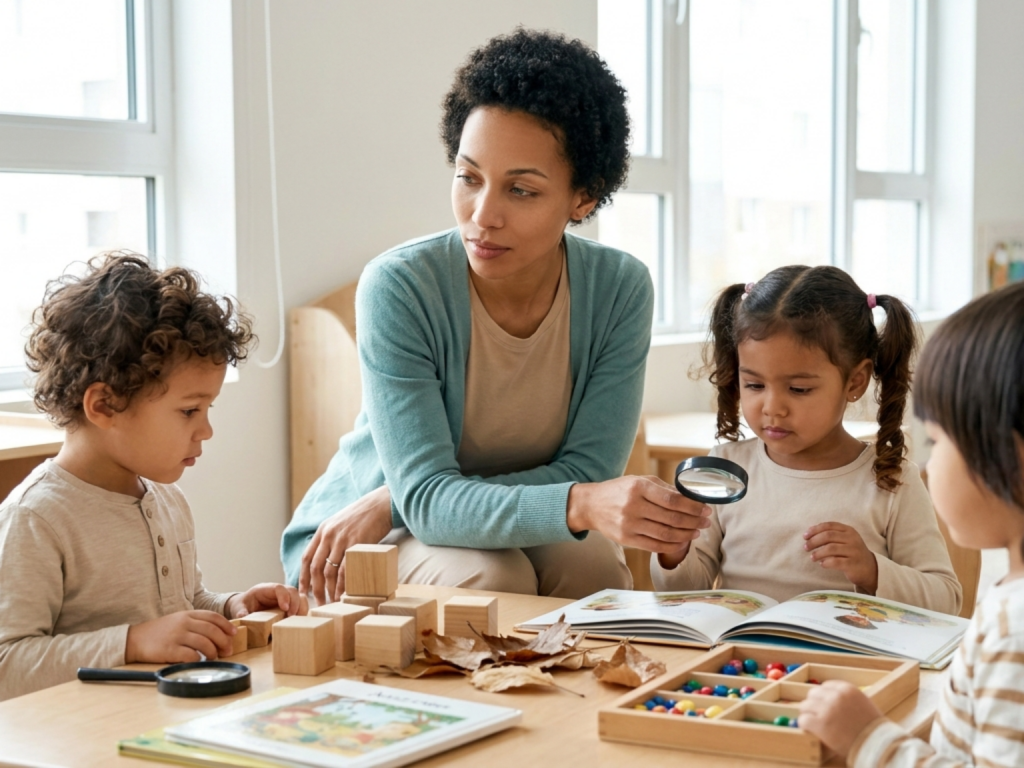
Preschoolers learn through active engagement. Their brains are especially responsive to experiences that are meaningful, emotionally safe, repeated, and connected to real life. Play is not separate from learning; it is one of the primary ways children test hypotheses, practice language, negotiate roles, strengthen motor planning, and develop symbolic thinking.
At the same time, research supports the value of intentional teaching. In studies of preschool science learning, children receiving instructional approaches made stronger gains in science vocabulary and concepts than children in control conditions, with explicit instruction showing especially high outcomes. This does not mean preschool should become rigid or worksheet-based. Rather, children benefit when adults clearly introduce concepts, model language, ask open-ended questions, and then let children manipulate materials, explore, repeat, and explain their thinking.
Helpful teaching strategies include:
- Scaffolding: offering just enough help for the child to succeed, then gradually reducing support.
- Modeling: showing how to solve a puzzle, hold scissors, calm the body, or ask a peer to play.
- Expansion: building on what a child says, such as responding to “big truck” with “Yes, the big red truck is carrying blocks.”
- Predictable routines: using consistent sequences so children can anticipate what comes next and devote more cognitive energy to learning.
- Choice within structure: letting children choose between appropriate activities while keeping clear boundaries.
High-quality preschool education is most effective when it is developmentally appropriate, relational, language-rich, and responsive to each child’s cultural and family context.
Language, literacy, and communication growth
Language is a foundation for nearly every other learning skill. In preschool, children typically expand vocabulary rapidly, use longer sentences, understand multi-step directions, ask many “why” and “how” questions, and begin telling stories with a beginning, middle, and end. They also learn pragmatic language, which means using communication socially: taking turns in conversation, adjusting tone, repairing misunderstandings, and interpreting facial expressions or gestures.
Early literacy grows from these language experiences. Children benefit from being read to daily, seeing adults use written language, recognizing environmental print, hearing rhymes, clapping syllables, and talking about characters and events. The goal is not to force independent reading before the child is ready, but to build phonological awareness, print awareness, narrative comprehension, and motivation to engage with books.
Families and educators can support communication by narrating daily activities, pausing for the child to respond, asking questions that require more than yes or no, and validating attempts to communicate. If a child’s speech is difficult for unfamiliar listeners to understand, if vocabulary seems very limited, if the child rarely combines words, or if there is a loss of previously acquired language, it is appropriate to discuss this with a pediatrician and consider a speech-language pathology evaluation. Hearing and vision assessment is also important because sensory differences can directly affect language, attention, and classroom participation.
Early math, science, and problem-solving
Preschool math is more than reciting numbers. Children develop quantitative reasoning when they compare sizes, match objects, sort by color or shape, count with one-to-one correspondence, recognize small quantities, create patterns, understand position words, and use measurement language such as longer, heavier, full, or empty. These concepts are strongest when embedded in everyday experiences: setting the table, sharing snacks, building towers, measuring ingredients, or sorting laundry.
Science learning begins with observation, prediction, testing, and explanation. A child may notice that ice melts, a plant bends toward light, or a ramp changes how fast a toy car moves. Adults can strengthen this learning by introducing precise vocabulary, inviting predictions, and encouraging children to describe what changed. Explicit instruction can be especially useful when it gives children the words and categories needed to organize what they observe.
Problem-solving also includes cognitive flexibility. Preschoolers practice trying a different puzzle piece, changing a block structure that keeps falling, or negotiating a new rule in pretend play. Adults can help by thinking aloud: “That did not fit. Let’s turn it and try another way.” This teaches persistence without shame. When a child becomes frustrated, the adult’s calm support protects learning by reducing stress and helping the child return to the task.
Executive function, attention, and self-regulation
Executive functions are higher-order cognitive skills that support learning and behavior. In preschool, the most relevant are working memory, inhibitory control, cognitive flexibility, and planning. These abilities depend on developing prefrontal networks and are strongly influenced by sleep, stress, temperament, relationships, and the classroom environment.
A preschooler’s attention span is naturally variable. Many children can focus for longer periods when an activity is hands-on, socially engaging, and matched to their developmental level, but may struggle with long verbal instructions or passive waiting. Visual schedules can help children understand routines and transitions. Short directions, movement breaks, and concrete demonstrations often work better than repeated verbal correction.
Preschool emotional regulation is central to learning. A child who is overwhelmed by noise, conflict, hunger, fatigue, or separation anxiety may have difficulty accessing language and reasoning skills in that moment. Supportive adults can co-regulate by naming feelings, lowering stimulation, offering choices, and practicing calming strategies when the child is not already distressed. Preschool social-emotional learning includes recognizing emotions, taking turns, repairing conflicts, tolerating disappointment, and developing empathy. These skills are teachable, but they develop gradually and require many repetitions.
If attention, impulsivity, aggression, withdrawal, sensory distress, or transition difficulties are frequent, intense, or impairing across settings, families may benefit from developmental surveillance and screening. The goal is not to label a child unnecessarily, but to understand needs early and match support appropriately.
Motor, sensory, and adaptive skills
Motor development supports classroom independence and confidence. Gross motor skills include running, jumping, climbing, balancing, throwing, and catching. Fine motor skills include using crayons, scissors, utensils, buttons, zippers, blocks, beads, and early writing tools. These skills depend on muscle strength, coordination, proprioception, visual-motor integration, and practice.
Preschoolers vary widely in motor readiness. Some children love drawing and cutting, while others avoid these tasks because hand strength or coordination is still emerging. Play-based practice is often more effective than repetitive drills. Examples include squeezing play dough, using tongs, painting on vertical surfaces, building with small blocks, pouring water, and tearing paper for collage.
Sensory processing can also affect learning. A child who is highly sensitive to sound, touch, movement, or visual stimulation may appear inattentive or resistant when the environment is overwhelming. Another child may seek movement constantly in order to stay regulated. Occupational therapy evaluation may be helpful when sensory or motor challenges interfere with dressing, feeding, play, safety, or participation. Medical issues such as vision problems, hearing differences, sleep disorders, chronic constipation, anemia, or pain can also present as learning or behavior difficulties, so persistent concerns should be discussed with a healthcare professional.
Home routines that support learning
Families do not need expensive materials to support preschool learning. The most powerful home practices are often simple, consistent, and relational. Talking, reading, singing, cooking, walking outdoors, sorting household objects, and telling stories all build neural connections. Children also learn from seeing adults manage frustration, solve problems, and repair mistakes.
Daily reading is one of the most efficient supports for language and early literacy. Ask the child to predict what will happen, describe pictures, retell the story, or connect the book to their own life. During meals, count pieces of fruit, compare cup sizes, or talk about textures and categories. Healthy meals for preschoolers can support attention and energy, especially when meals and snacks include adequate protein, fiber-rich foods, healthy fats, and iron-containing foods as appropriate for the family’s dietary pattern.
Sleep is another learning tool. Insufficient sleep can impair attention, emotional regulation, memory consolidation, and impulse control. A predictable bedtime routine, reduced evening screens, and a calming sleep environment may help many children. Physical activity also matters; active play supports motor development, mood regulation, and readiness to sit for short learning tasks.
Screen media should be used thoughtfully. High-quality, age-appropriate content can be a shared learning opportunity when an adult watches and discusses it with the child. However, screens should not replace sleep, active play, conversation, outdoor time, or face-to-face interaction.
When to seek guidance and how support helps
Because preschool development is variable, a single difficulty does not necessarily indicate a medical or developmental condition. Still, early support can be very helpful when concerns persist. Families may seek advice if a child has lost skills, rarely uses words to communicate, does not respond consistently to sound or name, avoids eye contact in a way that concerns caregivers, cannot participate in play with peers, has frequent intense meltdowns, seems unusually clumsy, struggles with feeding or self-care, or is not progressing despite supportive practice.
Validated developmental screening tools can help identify whether a child needs a more detailed evaluation. Screening is not a diagnosis. It is a structured way to decide whether further assessment may be useful. Depending on the concern, a pediatrician may recommend hearing or vision testing, speech-language evaluation, occupational therapy evaluation, developmental-behavioral pediatrics, psychology, early childhood special education, or other services.
High-quality preschool programs can improve early literacy, mathematics, language, and social-emotional readiness, with evidence suggesting especially meaningful benefits for children facing socioeconomic adversity. Research summaries also associate strong preschool programs with reduced need for later special education or grade retention. The best support is collaborative: caregivers, teachers, and clinicians sharing observations, respecting family priorities, and focusing on practical strategies that help the child participate, communicate, and enjoy learning.
Seek professional advice promptly if
- A child loses language, motor, social, or self-care skills they previously had.
- Speech is very limited, difficult to understand, or not progressing over time.
- Hearing, vision, sleep, feeding, pain, or neurologic concerns may be affecting learning.
- Behavior, anxiety, aggression, withdrawal, or sensory distress prevents participation at home or preschool.
- Caregivers or teachers have persistent concerns despite supportive routines and practice.
Tools & Assistance
- Schedule a pediatric well-child visit to discuss learning and developmental concerns.
- Ask about hearing and vision assessment when attention or language concerns appear.
- Request validated developmental screening tools through a pediatric office or early childhood program.
- Use a shared home-school notebook to track sleep, transitions, communication, and learning progress.
- Consult speech-language, occupational therapy, psychology, or developmental specialists when recommended.
FAQ
Should my preschooler already know letters and numbers?
Some preschoolers do, but readiness varies. More important foundations include language, curiosity, listening, play skills, counting concepts, fine motor practice, and enjoyment of books.
Is play really enough for learning?
Play is essential, but children often benefit most from play combined with intentional adult guidance, rich vocabulary, routines, and brief explicit teaching.
When should I worry about attention problems?
Variable attention is normal in preschool. Seek guidance if inattention or impulsivity is intense, persistent across settings, unsafe, or preventing learning and relationships.
Can preschool help children who are behind?
High-quality preschool can support language, literacy, math, and social-emotional skills. Some children also need targeted evaluation or therapy, depending on the concern.
Sources
- National Institutes of Health / PubMed Central — Preschool Children's Science Learning: Instructional Approaches and Developmental Gains
- Foundation for Child Development — Investing in Our Future: The Evidence Base on Preschool Education
- Learning Policy Institute — What Does the Research Really Say About Preschool Effectiveness?
Disclaimer
This article is for informational purposes only and does not diagnose or treat medical, developmental, or psychological conditions. Consult a qualified healthcare professional for concerns about a child’s development or learning.












Please log in to leave a comment.