
Intro
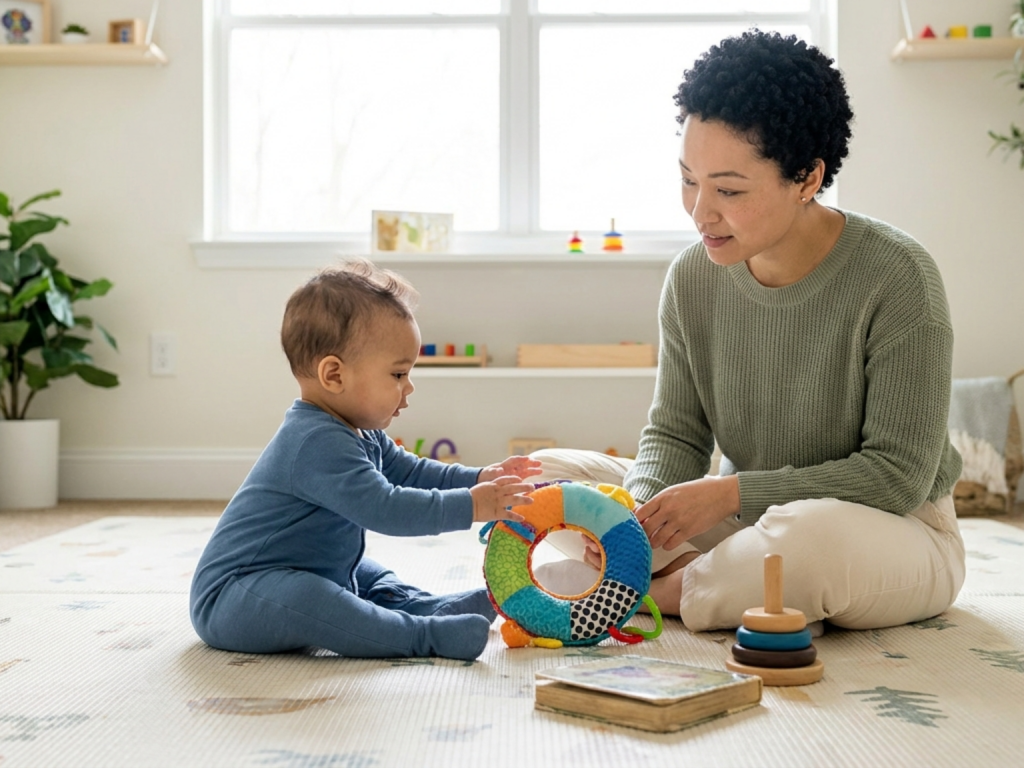
Play is one of the earliest ways babies learn about their bodies, relationships, and surroundings. A caregiver’s voice, a shared smile, a textured cloth, or time spent reaching toward a toy can support emerging motor, sensory, language, cognitive, and social-emotional abilities.
Development does not follow a perfectly uniform timetable. The most useful play is responsive, enjoyable, and adapted to a baby’s current abilities, temperament, medical needs, and tolerance. The ideas below are general educational guidance rather than a developmental assessment.
Highlights
Everyday interactions such as talking, singing, cuddling, and copying facial expressions are meaningful developmental experiences.
Play should progress from face-to-face social interaction and sensory exploration toward reaching, movement, problem-solving, and early pretend play.
Short, repeated periods of play are usually more appropriate than trying to keep a baby engaged for a long, structured session.
A caregiver’s responsive interaction helps a baby practise attention, communication, emotional regulation, and social reciprocity.
Safety, supervision, and respect for signs of fatigue or overstimulation are essential during every stage.
Why play matters across development
Play is not separate from learning in infancy; it is a primary context in which learning occurs. Through repeated, motivating experiences, babies practise postural control, visual attention, grasping, vocalisation, anticipation, and social engagement. The American Academy of Pediatrics describes play as supporting several interacting domains, including cognitive development, language, social-emotional competence, and self-regulation.
Early play is often sensorimotor: a baby looks, listens, mouths safe objects, kicks, reaches, and notices what happens next. These experiences help build an understanding of cause and effect. When a caregiver responds to a babble, pauses for a reply, or imitates a movement, the infant also experiences early language reciprocity and the foundations of conversational turn-taking.
Later, play becomes increasingly purposeful. A baby may search for a partially hidden object, transfer a toy between hands, crawl toward an interesting item, or repeat an action because it produces a sound. During the second year, symbolic and pretend elements begin to emerge, such as feeding a doll or pretending to talk on a toy telephone. These behaviours reflect expanding memory, representation, communication, and social understanding.
Newborn to approximately 3 months: connection and sensory regulation
In the newborn period, the most developmentally appropriate play is usually calm, brief, and relational. Hold your baby securely at a comfortable distance and speak or sing in a slow, expressive voice. Pause regularly so the baby has time to look, move, vocalise, or change facial expression. These pauses support back-and-forth interaction and allow the caregiver to notice the infant’s cues.
During alert periods, place a baby on their back on a firm, clear surface and offer a simple object or your face within the visual field. Move slowly from side to side to encourage visual tracking. You can also gently describe routine care, such as dressing or bathing, using repeated words. Narration gives language to predictable experiences without requiring a formal lesson.
When awake and directly supervised, short periods of tummy time can support development of the neck, shoulder, and trunk muscles. Start with brief intervals on a firm floor, on a caregiver’s chest, or across the caregiver’s lap, depending on tolerance. Stop when the baby is distressed or fatigued and try again later. Tummy time is for awake, supervised play; babies should always be placed on their backs for sleep.
At this stage, a baby may become overwhelmed by prolonged eye contact, loud sounds, rapid movement, or too many objects. Turning away, hiccupping, yawning, fussing, or changes in breathing pattern can signal a need for a pause. Sensitive pacing supports regulation more effectively than trying to maintain constant stimulation.
Approximately 3 to 6 months: reaching, grasping, and social exchange
As visual control and upper-limb movement become more coordinated, place a lightweight, age-appropriate toy within reach and allow the baby to attempt to contact it. A toy that is slightly to one side may encourage head turning, reaching, and weight shifting. Give the infant time to solve the movement rather than immediately placing the object in the hand.
Offer safe objects with different shapes and textures for supervised exploration. Babies may inspect objects by looking, touching, shaking, and mouthing; this is an important form of sensory learning. Items should be large enough not to present a choking risk, intact, washable, and free from detachable parts, loose cords, magnets, and button batteries.
Social games such as copying sounds, smiling in response to smiles, and taking turns making vocalisations can strengthen early communication. Songs with predictable pauses invite participation. Simple nursery rhymes accompanied by gentle hand movements may support attention, auditory pattern recognition, and anticipation.
Read sturdy board or cloth books together even if the baby cannot yet understand the story. Point to pictures, label familiar objects, and respond to the baby’s gaze or vocalisation. Shared reading is an interactive experience rather than a test of comprehension. Let the baby touch and turn pages when developmentally able.
Approximately 6 to 9 months: movement, object permanence, and cause and effect
Many babies become more mobile during this period, although the sequence and timing of skills vary. Provide supervised floor play on a clear, stable surface where the baby can roll, pivot, sit, reach, and eventually move toward desired objects. Place a favourite toy just beyond easy reach to encourage problem-solving, but keep the challenge achievable and avoid frustration.
Peek-a-boo is a particularly useful game because it combines social enjoyment with the developing understanding that a person or object continues to exist when temporarily out of sight. Begin with your face, then hide a toy partly beneath a cloth and invite the baby to find it. Keep the cloth away from the face and stop if the baby becomes distressed.
Cause-and-effect activities can be simple. A baby may shake a rattle, bang two soft objects together, drop a toy from a high chair, or press a large, safe button to produce a sound. Describe the action using concise language: “You shook it,” or “It fell down.” Repetition supports attention, memory, motor planning, and early concepts of agency.
Containers, stacking cups, and large blocks can encourage grasping, releasing, transferring, and early spatial reasoning. Demonstrate one action, then allow the baby to explore. The goal is not to complete a construction but to create opportunities for experimentation and shared attention.
Approximately 9 to 12 months: communication and purposeful problem-solving
As babies pull to stand, cruise, crawl, or move in other ways, make space for safe exploration. Place stable objects at an appropriate height for supported standing, secure furniture, and keep hazardous items inaccessible. Movement play can include crawling through a large open box, reaching for toys from different positions, or moving between a caregiver and a familiar object.
Strengthen communication by responding to gestures, sounds, and emerging words as meaningful attempts to connect. If the baby points toward a cup, you might say, “Cup. You want the cup.” This models vocabulary while acknowledging the communicative intent. Offer simple choices, such as two safe toys, and wait for a look, reach, or gesture.
Hide a toy under one of two containers and invite the baby to search. Use household routines as play: place laundry into a basket together, imitate wiping a table, or hand over safe objects while naming them. These activities support joint attention, imitation, categorisation, and understanding of familiar sequences.
Picture books can now include more participation. Ask where a familiar animal is, pause before a repeated phrase, and imitate animal sounds if the baby enjoys it. Avoid turning questions into performance demands. Warm responsiveness and shared attention are more important than whether the baby gives the expected answer.
Approximately 12 to 24 months: imitation, movement, and early pretend play
During the second year, toddlers often show increasing independence, mobility, and interest in imitation. Provide opportunities to push or pull a stable toy, carry lightweight objects, build and knock down large blocks, scribble with appropriate washable materials, and place large pieces into simple puzzles. These activities exercise coordination, planning, visual-spatial reasoning, and persistence.
Early pretend play may involve giving a stuffed animal a drink, putting a toy to bed, stirring an empty bowl, or speaking into a toy phone. Join the child’s idea and add a small amount of language: “The bear is thirsty. Here is the cup.” Symbolic play supports representation, vocabulary, emotional understanding, and flexible thinking.
Movement games can include dancing to music, stopping and starting, walking along a clear path, or kicking a large soft ball. Let the child choose the pace and provide close supervision around stairs, water, traffic, and unstable surfaces. Active play should complement, not replace, sleep, meals, quiet connection, and unstructured exploration.
Offer simple creative experiences such as water painting with a clean brush, transferring water between containers during supervised bath play, or exploring safe household textures. Avoid small loose materials that may be swallowed. At this age, language remains embedded in interaction: describe what the child is doing, expand short phrases, and allow time for a response.
Adapting play to the individual baby
Developmental stages are useful guides, not rigid assignments. Babies differ in temperament, sensory preferences, muscle tone, medical history, communication style, and opportunities for practice. An activity can be adjusted by changing the position, distance, duration, amount of assistance, or sensory intensity. For example, a baby who tires quickly may benefit from several one-minute movement opportunities rather than one longer session.
For babies born preterm, clinicians may recommend considering corrected age when interpreting some developmental expectations. The appropriate approach depends on gestational age, health history, and current function. Babies with neuromuscular, visual, hearing, genetic, or other medical conditions may need individualised guidance from a paediatrician or relevant therapist.
Observe both engagement and recovery. A baby who looks toward a toy, reaches, smiles, vocalises, or repeats an action is offering useful information about interest. A baby who repeatedly turns away, becomes rigid, cries, loses coordination, or cannot settle may need less stimulation or a break. Responsive caregiver interaction means adjusting the activity based on these signals rather than following a fixed script.
Discuss concerns with a healthcare professional if you notice loss of previously acquired skills, persistent difficulty feeding or breathing, unusual lethargy, marked asymmetry of movement, limited response to sound or visual interaction, or ongoing concerns about communication, movement, or social engagement. Early advice can clarify whether monitoring, screening, or referral is appropriate.
Safety reminders
- Supervise babies continuously during floor play, water play, and any activity involving objects.
- Keep small parts, balloons, cords, magnets, button batteries, plastic bags, and fragile or sharp items away from babies.
- Do not use weighted sleep products, loose bedding, or soft objects in the sleep space; follow current safe-sleep guidance from a qualified healthcare source.
- Stop an activity if the baby shows distress, breathing difficulty, colour change, unusual limpness, or marked fatigue and seek appropriate medical advice.
- Use age-appropriate equipment and check toys regularly for damage, detachable components, or recall notices.
Tools & Assistance
- A firm, clear floor space for supervised movement play
- A small selection of washable, age-appropriate toys without small detachable parts
- Board books, cloth books, songs, and familiar household objects used safely
- A daily observation note for questions about skills, cues, and activities to discuss at health visits
- Paediatric, health visitor, occupational therapy, physiotherapy, or speech and language services when clinically indicated
FAQ
Does my baby need expensive educational toys?
No. Responsive conversation, singing, books, safe household objects, and opportunities to move can provide rich learning experiences. The quality of the interaction and the fit with the baby’s abilities matter more than the price or complexity of a toy.
How long should a play session last?
There is no universal duration. Follow the baby’s alertness and cues. Several brief periods may be more effective than one prolonged session, especially for young infants or babies who fatigue easily.
Should I practise a skill my baby has not reached yet?
You can offer an appropriate opportunity without forcing the movement. Place objects within a manageable reach, provide supervised positions recommended for the baby, and let the child lead. Avoid pulling a baby into a position they cannot control.
When should I ask about developmental progress?
Raise questions during routine health visits or sooner if you notice regression, persistent asymmetry, reduced responsiveness, feeding or breathing concerns, or a strong concern that something is not progressing as expected. A clinician can assess the whole child and recommend appropriate follow-up.
Sources
- American Academy of Pediatrics — The Power of Play: A Pediatric Role in Enhancing Development in Young Children
- NHS — Baby and toddler play ideas
- UNICEF Parenting — 21 learning activities for babies and toddlers
Disclaimer
This article provides general educational information and does not diagnose conditions or replace advice from a paediatrician or other qualified healthcare professional. Seek professional guidance for individual developmental or safety concerns.














Please log in to leave a comment.