
Intro
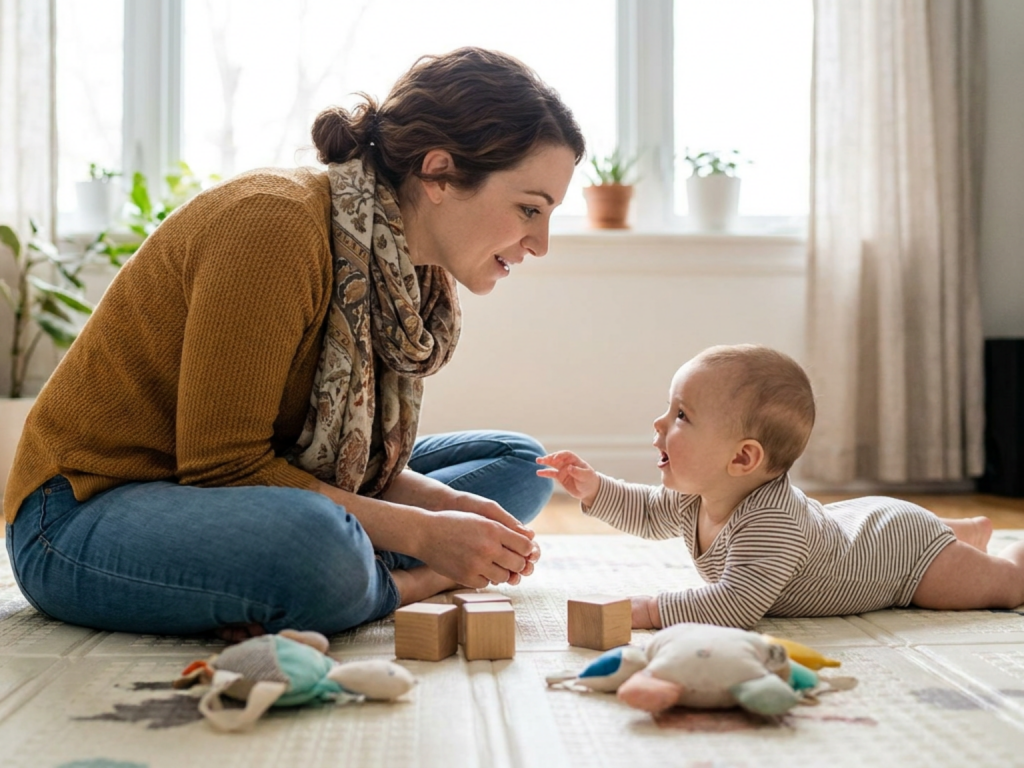
Play is not just a pleasant break in a baby’s day. It is one of the main ways infants practice regulation, communication, movement, and early problem-solving while building the neural connections that support later learning. For babies, even very simple interactions—peekaboo, singing, reaching for a toy, or back-and-forth facial expressions—can be developmentally rich when an adult responds warmly and predictably.
This article explains how play supports development across the first years of life, why responsive caregiving matters so much, and how families can think about play in a practical, low-pressure way. The goal is not to create perfect activities, but to understand what makes play meaningful for infant brain development, emotional security, and early learning.
Highlights
Play helps babies build core life skills such as attention, self-regulation, and flexible problem-solving. These are not separate from play; they are often learned through play.
Responsive interaction matters as much as the toy or activity. A baby learns most when an adult notices cues, follows the baby’s lead, and stays emotionally available.
Play can reduce stress when it feels safe and predictable. That sense of safety supports exploration, curiosity, and resilience.
Simple, everyday moments count as play. Talking, singing, reaching, rolling, copying sounds, and sharing eye contact can all support development.
Different ages invite different kinds of play, but the basic principle stays the same: warm, repeated, back-and-forth interaction builds the developing brain.
Play as a basic developmental activity
In infancy, play is not separate from learning; it is one of the main mechanisms of learning. When a baby kicks, grasps, mouths a toy, watches a caregiver’s face, or repeats a sound, the brain is practicing sensorimotor integration—the coordination of sensation, movement, and perception. These repeated experiences help organize early neural pathways and support later skills such as attention, language, and problem-solving.
Developmental science also shows that play is most powerful in the context of responsive relationships. A baby does not need elaborate equipment to benefit. What matters is that the adult notices what the baby is interested in, responds contingently, and makes the interaction feel safe and enjoyable. This is why a simple game of peekaboo can be so rich: it combines anticipation, social reciprocity, and emotional regulation in one small exchange.
How play builds the brain
Babies’ brains are shaped by experience, especially repeated experiences that are emotionally meaningful. During play, babies encounter patterns, differences, and cause-and-effect relationships. For example, shaking a rattle and hearing a sound teaches the baby that action can produce a predictable result. Reaching for a ball and watching it roll away introduces early concepts of space, object movement, and persistence.
These experiences support executive function, a group of mental skills that includes working memory, inhibitory control, and cognitive flexibility. In infancy, executive function is still emerging, but play lays the groundwork. A baby who practices turning toward a voice, waiting briefly for a return smile, or trying again after missing a toy is already rehearsing the beginnings of attention control and persistence.
Harvard’s developmental science work emphasizes that complex interactions during play help build the brain because they combine repetition, novelty, and emotionally supportive relationships. The baby is not only being entertained; the baby is actively constructing early learning systems.
Play and emotional regulation
One of play’s most important contributions is helping babies practice regulation. Regulation means the ability to manage arousal, distress, and attention. Infants do not regulate themselves fully on their own; they learn regulation through co-regulation with caregivers. In play, that can look like an adult slowing down the interaction when a baby seems overstimulated, pausing for a turn, or calming the baby after an exciting burst of activity.
This is part of why play can be both stimulating and soothing. A familiar song, repetitive bouncing, or a gentle hiding-and-finding game can help babies experience predictable patterns. Predictability lowers stress, and lower stress makes it easier for babies to explore. In other words, play is not only about excitement; it is also about feeling safe enough to be curious.
When babies repeatedly experience playful interactions in which distress is noticed and soothed, they begin to form expectations that the world is manageable and that relationships are reliable. That sense of safety is foundational for resilience.
Play, attachment, and social learning
Play is one of the earliest places where babies learn social rules. Through face-to-face games, imitation, and turn-taking, infants discover that other people respond to them. A caregiver who copies a baby’s vocalization or pauses for the baby to take a turn is teaching the basic structure of communication: I act, you respond, I respond again.
This back-and-forth interaction supports attachment because it gives the baby repeated evidence of caregiver availability and emotional attunement. It also builds social cognition, including the ability to notice intention, anticipate response, and read emotional tone. Babies are highly sensitive to tone of voice, facial expression, and timing, so playful interaction becomes a rich social classroom.
Start Early and ZERO TO THREE both emphasize that play supports relationships, not just individual skill acquisition. In practical terms, that means a baby benefits more from a warm, engaged adult than from a stack of “educational” toys used without interaction. The relationship is the active ingredient.
How play supports language
Language development begins long before a child speaks in sentences. In infancy, babies learn the rhythm of language through hearing words in emotionally meaningful exchanges. During play, adults naturally label objects, describe actions, and repeat sounds. That repetition helps babies map words to experiences and start building vocabulary.
Even very young infants benefit from conversational timing. When an adult responds to coos or babbles as if they are meaningful communication, the baby learns that sounds can carry social power. This is an early form of language reciprocity. As babies grow, songs, nursery rhymes, finger plays, and simple naming games extend this learning by combining sound, rhythm, memory, and motor action.
Language-rich play does not require constant talking. Sometimes the most developmentally useful moment is a pause after a babble, giving the baby space to answer. That pause teaches turn-taking and helps the baby become an active participant in communication rather than a passive listener.
How play supports movement and sensory development
Play is also a major driver of motor development. Reaching, rolling, crawling, pulling to stand, and later walking are all supported by opportunities to move freely and safely. These movements strengthen muscle control, balance, and coordination while helping the baby learn how the body behaves in space.
Sensory play matters too. Babies learn through touch, sight, sound, and movement. Different textures, sounds, and visual contrasts help the nervous system refine how it processes information. This is one reason why simple floor play can be so effective: the baby can see hands, track objects, shift weight, and explore objects at a self-paced level.
Age-appropriate play suggestions from infant development organizations often emphasize very simple activities: tummy time while awake, reaching for soft toys, moving between positions, and exploring safe household objects under supervision. These activities support both gross motor and fine motor development without needing expensive gear.
What responsive play looks like at different ages
Play changes as babies grow, but responsiveness remains the central principle. In the early months, babies often benefit from short, calm interactions: eye contact, singing, gentle movement, and brief sensory experiences. As they become more alert and coordinated, they may enjoy repeated sounds, grasping toys, and watching moving objects. Later, they often seek more active games, imitation, and exploration.
Responsive play means following the baby’s cues. If the baby looks away, fusses, arches, or becomes still and quiet, the adult may need to slow down or stop. If the baby leans in, smiles, kicks, or vocalizes, that is often an invitation to continue. This cue-based approach helps prevent overstimulation and respects the baby’s developmental state.
For families with preterm infants or babies with medical complexities, developmental timing can vary. In those situations, caregivers should use the baby’s individual cues and seek guidance from the child’s clinician or developmental specialist as needed. The goal is not speed, but fit.
Play does not need to be elaborate
One of the most reassuring messages from early childhood research is that high-quality play is usually simple. A caregiver’s voice, face, hands, and attention are often more important than a special toy. Household routines can become playful learning moments when adults are present and responsive.
Examples include singing during diaper changes, naming body parts during dressing, rolling a ball back and forth, making sounds and pausing for a reply, or offering a safe object for the baby to grasp and explore. These interactions are small, but they are repeated many times across the day, and repetition is exactly what young brains need.
Families should also remember that tired, hungry, or overstimulated babies may not be able to engage in play for long. Short, positive interactions are often better than forcing activity. Play is most supportive when it feels mutual and manageable for both baby and caregiver.
When to seek guidance
Most differences in play preference or pace are normal. Babies vary widely in temperament, alertness, and interest. However, it is reasonable to discuss concerns with a healthcare professional if a baby consistently avoids interaction, seems unusually hard to engage, shows very limited movement or vocalization for age, or loses previously seen social or motor skills.
Caregivers should also seek advice if they are unsure whether a baby’s behavior is typical, especially if there were complications at birth, prematurity, or medical concerns affecting development. Pediatric clinicians, early intervention programs, and developmental specialists can help interpret what is being seen in context and guide next steps without rushing to conclusions.
Play is a developmental window, but it is not a diagnostic test. If something feels off, trust that instinct and ask for professional input.
When to get help
- A baby is persistently difficult to engage in social interaction.
- A baby seems unusually floppy, stiff, or limited in movement.
- A baby loses skills that were previously present.
- A baby shows signs of distress with most interaction and cannot settle.
- A caregiver is worried about hearing, vision, feeding, or overall development.
Tools & Assistance
- Pediatrician or family doctor for developmental questions
- Local early intervention services for infants and toddlers
- Developmental screening at well-child visits
- Speech-language, occupational, or physical therapy when indicated
- Trusted caregiver education from infant development organizations
FAQ
Does play really matter in the first year of life?
Yes. In infancy, play is a major pathway for learning regulation, movement, social reciprocity, and early language, especially when an adult responds warmly and consistently.
Do babies need special toys to benefit from play?
No. Simple, safe objects and everyday interactions are often enough. The adult’s responsiveness is usually more important than the toy itself.
How long should baby play sessions last?
There is no single ideal length. Short, positive bursts are often best, especially for young babies or babies who tire easily. Follow the baby’s cues.
Can play help with stress?
Yes. Predictable, comforting play can lower stress and support co-regulation, which helps babies feel safe enough to explore and learn.
What if my baby is not interested in play?
Babies vary in temperament and state. If the lack of interest is persistent or worrying, bring it up with a healthcare professional for guidance.
Sources
- Start Early — The Power of Play: Unlock Developmental Benefits for Your Child
- ZERO TO THREE — The Power of Play
- Harvard Center on the Developing Child — Play in Early Childhood: The Role of Play in Any Setting
Disclaimer
This article is for educational purposes only and does not replace individualized medical advice. If you have concerns about your baby’s development, feeding, behavior, or safety, please consult a qualified healthcare professional.
















Please log in to leave a comment.