
Intro
Children learn conflict resolution the way they learn many other social skills: through repeated modeling, practice, and gentle correction. When children argue over turns, toys, rules, or fairness, the goal is not to suppress disagreement but to help them move from impulse to cooperative problem-solving.
Research in preschool and primary school settings suggests that children can be taught specific steps for peaceful problem-solving, and that structured practice improves knowledge, retention, and use of the procedure. Social-emotional learning also matters: skills such as emotional regulation, self-awareness, respect for others, and assertive communication support healthier conflict handling.
Highlights
Conflict is normal in childhood; the skill to teach is how to recover constructively, not how to avoid every disagreement.
Young children often need explicit steps, repeated practice, and calm adult coaching before they can resolve disputes independently.
Emotional regulation, self-awareness, and assertive communication are closely tied to better conflict resolution.
Persistent aggression, fear, or communication problems deserve professional attention rather than blame.
Why conflict resolution matters in childhood
Conflict is not proof that a child is disrespectful or that a family is failing. In childhood, disagreement is often a normal sign that a child wants autonomy, fairness, or control over a limited resource. The developmental task is to move from impulse-driven reactions toward teaching conflict resolution skills that are calm, repeatable, and cooperative.
When adults coach children through disputes, they are not just fixing one argument. They are building social learning, frustration tolerance, and the ability to stay engaged long enough to solve a problem. That matters because repeated practice helps children generalize the same steps to playground disputes, sibling conflict, and classroom teamwork.
Studies in young children show that conflict resolution can be taught in structured ways, and that school-based programs can improve knowledge, retention, and real-world use of the procedure. In other words, children do not simply pick it up by chance; they often need explicit instruction, repetition, and a predictable script.
What children need to learn first
Before a child can negotiate, the child has to notice what is happening inside and outside the body. That means recognizing the trigger, naming the feeling, and understanding the other person’s point of view. Emotion labeling for children can be especially useful here, because a child who can say “I feel mad” is less likely to communicate only through grabbing, yelling, or shutting down.
Strong conflict resolution also depends on social communication in children. This includes using words for needs, listening for another person’s message, and making a clear request without attack. Primary school research links emotional regulation, self-awareness, respect for others, and assertive communication with better conflict handling. These abilities sit close to executive function, because the child must hold a rule in mind, pause an impulse, and choose a more effective action.
When adults treat these as teachable skills rather than personality traits, children usually show more confidence and less shame. They can learn that conflict is information: something is too hard, too unfair, or too confusing, and it needs a better plan.
How adults can coach the moment
During a real disagreement, the adult’s job is to lower the emotional temperature first. In practice, co-regulation before self-regulation means the adult stays calm enough to lend the child a steady nervous system until the child can think again. That might include a lower voice, a pause, or a brief move to a quieter space.
- Describe the problem in neutral words.
- Use active listening with children by reflecting the child’s message before correcting it.
- Help each child say what they want and what they can accept.
- Offer two or three fair options instead of a yes/no standoff.
- End with a short repair plan and a practice phrase for next time.
These steps work best when adults model them consistently. A child who hears, “I can see why you are upset” followed by “Let’s find a fair turn-taking plan” gets a script that can be reused. The goal is not perfect politeness during stress; it is movement from emotional flooding toward workable problem-solving.
Practice that fits the child's age
For toddlers and preschoolers, conflict resolution is mostly about turn-taking, simple choices, and immediate adult support. A child may not yet manage a long negotiation, but the child can learn to wait, ask, trade, and use a simple phrase such as “my turn next.” In this stage, frustration tolerance and co-regulation matter more than a detailed discussion.
In kindergarten and primary school, children can do more: they can learn to identify the problem, state feelings, suggest two solutions, and check whether the solution is fair. One study of a kindergarten curriculum found that children who received conflict resolution training improved in knowledge, retained the procedure better, and used it more often. That is encouraging because it shows that structured practice can become part of everyday classroom behavior.
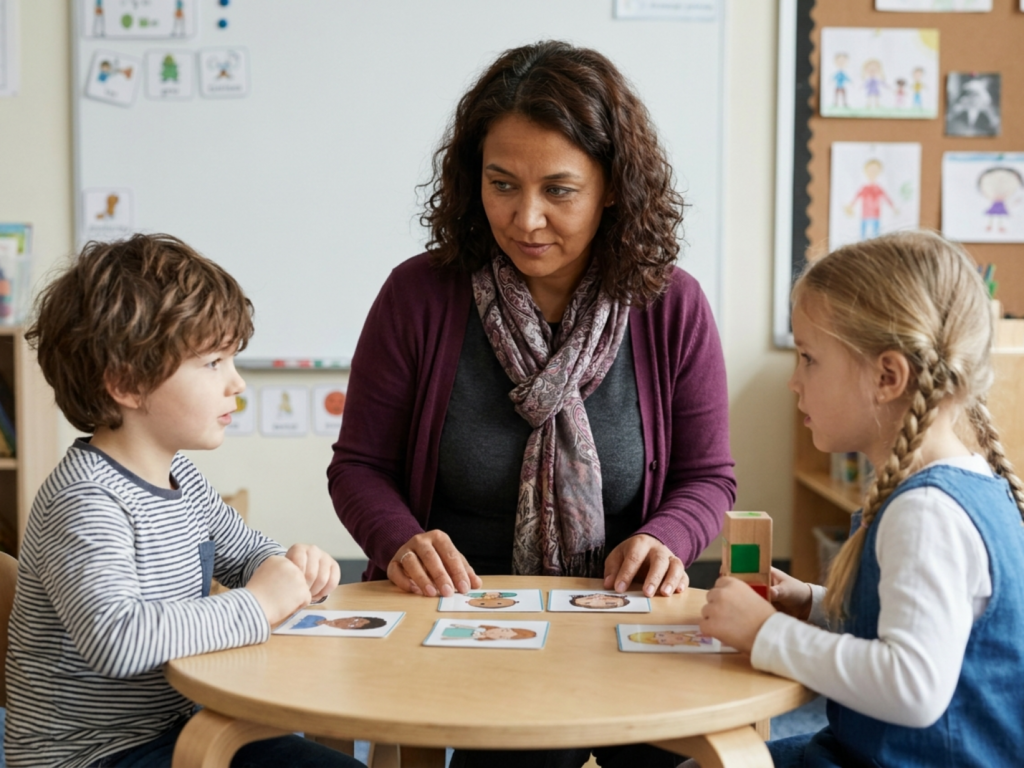
Play is useful at every age. Role-play with blocks, dolls, cards, or simple scripts allows children to rehearse peer conflict resolution strategies when they are calm. The more the steps are practiced outside the pressure of a real argument, the easier it is for a child to recall them during school or sibling conflict.
When conflict may need extra support
Most childhood conflict is ordinary, but some patterns deserve closer attention. If arguments are frequent, intense, or end in hitting, biting, destroying property, or persistent fear, the problem may be bigger than a simple lapse in manners. If a child cannot follow even very simple repair steps, or if every disagreement turns into a shutdown, that can signal that the child needs more help with regulation, language, or the stress response.
Sometimes the barrier is not willpower but communication. A child with speech-language difficulties, hearing concerns, learning differences, anxiety, or a high baseline of arousal may struggle to process social cues quickly enough to resolve conflict well. In those situations, it is reasonable to ask a pediatrician, school team, or mental health professional for guidance rather than trying to solve the pattern alone.
It is also important to watch for bullying, social exclusion, or repeated power struggles that make one child feel unsafe. Conflict resolution skills are only useful when both sides can participate and when adults are making the environment emotionally and physically safe.
Helping children repair and try again
Repair is where the skill becomes durable. After calm returns, children can review what happened, what each person needed, and what would be different next time. This is one reason repair after a parent-child argument matters so much: children learn that mistakes do not end the relationship and that conflict can be followed by reconnection.
A simple repair conversation may include an apology, a statement of the problem, and one concrete plan. For example: “I took the toy. You were upset. Next time I will ask first.” The wording does not need to be perfect. What matters is that the child practices accountability, empathy, and a specific next step.
Adults can reinforce progress by praising the behavior, not the personality: “You waited your turn,” “You used words instead of grabbing,” or “You came back to solve it.” Over time, this strengthens the habit of responding with reflection rather than escalation. If conflict remains severe despite steady coaching, a professional assessment can help identify the best supports for the child and family.
When to seek extra help
- Seek urgent help if conflict includes injury, threats, weapons, or fear of immediate harm.
- Consult a healthcare or mental health professional if aggression is frequent, severe, or escalating.
- Ask about speech, hearing, language, learning, or attention concerns if communication seems limited.
- Do not force problem-solving while a child is highly distressed; calm first, then coach.
Tools & Assistance
- Pediatrician or family doctor
- School counselor or teacher conference
- Child psychologist or licensed therapist
- Speech-language pathologist
- School social-emotional learning program
FAQ
At what age can children start learning conflict resolution?
Very early. Preschoolers can learn turn-taking, naming feelings, and simple repair phrases with adult support.
Is arguing always a problem?
No. Disagreement is normal. Concern rises when conflict becomes frequent, aggressive, fearful, or disruptive to daily life.
What if my child cannot calm down first?
Start with co-regulation: stay calm, lower stimulation, and keep language simple. If this remains difficult, seek professional advice.
Should school and home use the same approach?
Yes. Consistent language and repeated practice help children remember and use the same steps across settings.
Sources
- PubMed — Teaching children to resolve conflicts cooperatively
- PubMed — Effects of conflict resolution training integrated into a kindergarten curriculum
- PubMed — Teaching Socio-Emotional Competencies Among Primary School Students
Disclaimer
This article is for educational purposes only and is not a substitute for medical or mental health evaluation, diagnosis, or treatment. If a child's conflict patterns are severe, persistent, or unsafe, consult a qualified healthcare professional.















Please log in to leave a comment.