
Intro
Conflict is a normal part of childhood, not a sign that a child is “bad” or that adults have failed. Children argue over toys, rules, attention, fairness, space, and belonging because their brains are still developing the language, executive function, emotional regulation, and perspective-taking needed to solve problems calmly.
Teaching conflict resolution and negotiation skills helps children move from impulsive reactions toward safer, more flexible social behavior. The goal is not to make children avoid all disagreement; it is to help them recognize emotions, communicate needs, listen to others, repair harm, and seek adult help when safety or power imbalance is involved.
Highlights
Children learn conflict skills gradually through modeling, co-regulation, repeated practice, and emotionally safe adult guidance.
Emotional understanding is strongly linked with more constructive peer conflict strategies, especially as children mature.
Negotiation is not about children always compromising; it is about identifying needs, limits, safety concerns, and fair options.
Adults can teach skills without shaming by describing behavior, naming emotions, explaining impact, and guiding repair.
Persistent aggression, fear, withdrawal, or sudden behavioral change should prompt consultation with a pediatrician, mental health clinician, or school support team.
Why conflict skills matter in child development
Conflict resolution is a neurodevelopmental skill set. It draws on language processing, inhibitory control, working memory, cognitive flexibility, social cognition, and affect regulation. A young child who grabs a toy may not yet have the verbal fluency to say, “I was still using that,” or the prefrontal control to pause before acting. A school-age child may understand rules but still struggle when embarrassment, jealousy, or fatigue activates a strong stress response.
Effective teaching begins with the assumption that behavior communicates a need or a lagging skill. This does not mean unsafe behavior is allowed. It means adults respond with warmth and structure: stop harm, help the child regain physiological calm, then teach the missing skill. This approach is closely aligned with positive discipline strategies, which emphasize safety, limits, and learning rather than humiliation or fear.
Conflict skills also protect peer relationships. Children who can explain a problem, listen to another viewpoint, and attempt repair are more likely to maintain friendships and participate successfully in classrooms, teams, and family routines. These skills support emotional regulation, empathy, and self-advocacy across development.
Start with safety, trust, and co-regulation
Children negotiate best when their nervous system is not in fight, flight, or freeze mode. Before asking a child to problem-solve, adults should create psychological and physical safety. If children are hitting, threatening, cornering, or destroying property, separate them calmly and briefly. Use a low voice, simple words, and predictable limits: “I will not let anyone get hurt. We will talk when bodies are calm.”
Co-regulation before self-regulation is essential, especially in toddlers, preschoolers, children with developmental delays, and children under high stress. Co-regulation means the adult lends calm through proximity, tone, predictable routines, and clear boundaries until the child can re-engage. A “cool-off” period is not a punishment when it is used to restore regulation; it is a developmental bridge.
Trust matters because children are more willing to reflect when they do not expect ridicule or automatic blame. Adults can say, “I want to understand what happened,” rather than “Who started it?” This reduces defensive arousal and supports more accurate recall. Children who use signing, augmentative communication, or limited spoken language still need access to conflict repair; adults can offer pictures, gestures, sentence starters, or yes-no choices.
Teach emotion vocabulary and perspective-taking
Research on children’s emotional comprehension shows that emotional understanding is related to the strategies children use in peer conflict. As children grow, they tend to use more positive strategies and fewer negative ones, and emotional comprehension appears to support this shift. In practical terms, children who can identify feelings such as frustration, disappointment, embarrassment, worry, or exclusion are better equipped to explain the problem without immediately attacking.
Emotion vocabulary in children should be taught during calm moments as well as after conflict. Adults can narrate everyday experiences: “You looked disappointed when the game ended,” or “He may have felt left out when the group ran ahead.” This is not mind-reading; it is hypothesis-building. Children learn that behavior has emotional context and that more than one person’s feelings can be valid at the same time.
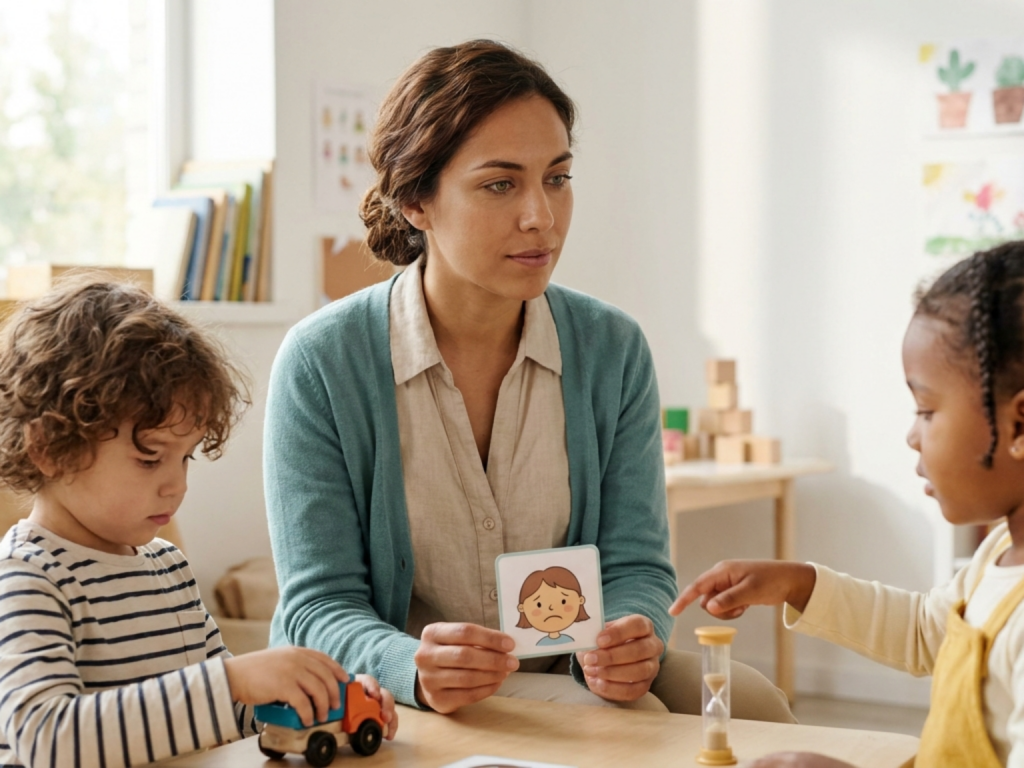
Perspective-taking can be practiced with questions that are concrete and non-accusatory: “What did you want?” “What do you think she wanted?” “What happened next?” “What could each person try?” For younger children, dolls, drawings, or role-playing social skills may work better than abstract conversation. The adult’s goal is to widen the child’s mental map from “me versus them” to “two people with needs and choices.”
A practical mediation sequence adults can use
A consistent sequence helps children know what to expect. First, pause the conflict and ensure safety. Second, allow a cool-off period if emotions are too intense. Third, invite each child to describe what happened without interruption. Fourth, reflect the feelings and needs you hear. Fifth, help the children brainstorm solutions. Sixth, choose a plan and check whether it feels safe and fair enough to try.
Adults can use a three-step teaching approach during this process. Name the behavior and emotion: “You pulled the marker because you were angry that it was not your turn.” Explain the impact: “When you pulled it, the paper tore and your friend felt upset.” Guide an alternative: “Next time you can say, ‘I want a turn when you are done,’ or ask me for help.” This connects behavior, cause-and-effect reasoning, and replacement behavior.
Useful mediation phrases include:
- “Tell us what happened from your view.”
- “What were you hoping would happen?”
- “What did you hear the other person say?”
- “What are two possible solutions?”
- “What can you do to repair this?”
Repair may involve returning an item, rebuilding a block structure, apologizing when genuine, giving space, or making a new agreement. Forced apologies are often less useful than supported repair, because the child may learn performance rather than empathy.
Negotiation skills children can practice
Negotiation is a structured way to solve a disagreement when more than one acceptable outcome exists. Children need to learn that negotiation does not apply to safety rules, consent, medical needs, or adult protective limits. A child may negotiate which pajamas to wear, how to divide turns, or what game to play first; a child may not negotiate whether to wear a seat belt or whether hitting is allowed.
Teach negotiation as a sequence: state the problem, name your need, ask about the other person’s need, suggest options, choose one, and review. A child-friendly script is: “I want ___. You want ___. Maybe we can ___.” For example, “I want the red truck. You want the red truck. Maybe I use it for five minutes, then you use it.” Timers, visual turn cards, and written agreements can reduce memory load and perceived unfairness.
Children also need language for boundaries: “I am not done,” “Please stop,” “I do not like that,” “I need space,” and “I need an adult.” These phrases are not rude when said respectfully; they are self-advocacy. Teaching negotiation alongside boundary-setting prevents children from believing they must always give in to keep the peace.
Match expectations to age and developmental readiness
Developmental readiness matters. Toddlers often need simple limits, redirection, and adult-modeled phrases because their impulse control and expressive language are limited. Preschoolers can begin to identify emotions, take turns with support, and choose between two solutions. School-age children can discuss fairness, intention, accidents, and repair in more detail. Adolescents can negotiate autonomy, responsibilities, privacy, and peer conflict with more abstract reasoning, although stress can still temporarily reduce judgment.
How children learn social skills depends on repeated experience in real relationships. A single lecture rarely changes behavior. Children benefit from rehearsal during calm times: acting out common conflicts, practicing tone of voice, and reviewing what worked after a disagreement. Visual supports may help children with language delays, autism-related social communication differences, attention difficulties, anxiety, or learning differences, but individual needs vary.
Adults should also consider context. Hunger, sleep deprivation, sensory overload, pain, trauma reminders, bullying, and inconsistent routines can all lower a child’s capacity for flexible problem-solving. If a child repeatedly cannot use skills that seem developmentally expected, the answer is not simply “try harder.” It may be time to assess stressors, communication needs, school environment, sleep, or mental health with qualified professionals.
Model repair, accountability, and forgiveness carefully
Children study adult conflict closely. When adults interrupt, threaten, mock, or refuse repair, children often imitate those patterns. When adults pause, apologize, clarify, and return to connection, children learn that conflict can be survivable. A powerful model is: “I raised my voice. That may have scared you. I am sorry. I will try again more calmly.” This teaches accountability without collapsing the adult role.
Forgiveness should be handled with care. Children can be encouraged to move forward after repair, but they should not be pressured to forgive immediately, hug, or resume closeness when they feel unsafe. Repair is the responsibility of the person who caused harm; forgiveness is an internal process that cannot be demanded. This distinction is especially important in cases of bullying, coercion, sibling aggression, or unequal power.
Conflict repair in school-age children often improves when adults revisit the event later: “What helped?” “What made it harder?” “What will we try next time?” This reflective loop strengthens metacognition, the ability to think about one’s own thinking and behavior. Over time, children internalize the process and need less adult mediation.
When to seek extra support
Many childhood conflicts are developmentally typical, but some patterns deserve closer attention. Consider speaking with a pediatrician, school counselor, child psychologist, developmental-behavioral pediatrician, speech-language pathologist, or occupational therapist if conflict is frequent, intense, unsafe, or associated with functional impairment. Examples include repeated physical aggression, threats of serious harm, cruelty to animals, severe withdrawal after peer conflict, panic symptoms, school refusal, persistent social isolation, or sudden behavioral change.
Professional support may also help when a child has difficulty understanding language, reading social cues, tolerating sensory input, shifting attention, or recovering after frustration. These challenges are not moral failures. They may reflect developmental, emotional, neurological, environmental, or medical factors that require individualized assessment.
Adults should seek urgent help if there is risk of serious injury, self-harm, abuse, domestic violence exposure, or a child expressing intent to harm themselves or someone else. In those situations, safety planning and professional guidance are more appropriate than ordinary negotiation practice.
When conflict needs immediate adult action
- Separate children immediately if there is hitting, choking, weapon use, threats, or unsafe restraint.
- Do not force a child to negotiate with someone who is bullying, coercing, or intimidating them.
- Seek professional guidance for sudden severe aggression, self-harm statements, or marked withdrawal.
- Consider medical or developmental evaluation when language, sensory, sleep, pain, or attention issues seem to intensify conflict.
- Call local emergency services or crisis resources if there is imminent danger.
Tools & Assistance
- Use a calm-down space with sensory supports, not as a shaming punishment.
- Create visual turn-taking cards, timers, or simple problem-solving charts.
- Practice role-play scripts during calm moments rather than only during conflict.
- Coordinate with teachers or childcare staff so children hear consistent language.
- Consult a pediatrician, school counselor, child psychologist, or developmental specialist when conflict is unsafe or impairing daily life.
FAQ
At what age can children learn conflict resolution?
Even toddlers can begin with simple phrases, turn-taking, and adult co-regulation. More independent negotiation usually develops gradually through preschool and school age as language and executive function mature.
Should adults make children apologize?
A sincere apology can be valuable, but forced apologies often teach performance. Focus first on safety, understanding impact, and concrete repair.
What if one child always gives in?
Teach boundary language and self-advocacy. Negotiation should not mean pleasing others at the expense of safety, consent, or reasonable needs.
How can teachers manage repeated classroom conflicts?
Use predictable mediation steps, name emotions, explain impact, teach replacement behaviors, and document patterns. Involve families and support staff if conflicts persist or affect learning.
When is conflict more than normal childhood behavior?
Seek guidance if conflict involves serious aggression, fear, bullying, sudden behavior change, school refusal, severe anxiety, or impairment in friendships, learning, or family life.
Sources
- PMC (PubMed Central) — The influence of children's emotional comprehension on peer conflict resolution strategies
- Nebraska Extension Publications — Helping Children Resolve Conflict
- NAEYC (National Association for the Education of Young Children) — A Three-Step Approach to Help Children Navigate Conflict
Disclaimer
This article is for general educational purposes and is not a medical or mental health diagnosis or treatment plan. Consult a qualified healthcare professional for concerns about a child’s behavior, safety, development, or emotional health.


















Please log in to leave a comment.