
Intro
Positive discipline is a way of guiding children that combines warmth, structure, and skill-building. It does not mean being permissive or ignoring unsafe behavior; it means responding to behavior in ways that teach self-regulation, empathy, problem-solving, and respect for limits.
Highlights
Positive discipline works best when adults are both kind and firm: emotionally connected, but clear about boundaries.
Children’s behavior is strongly shaped by development, stress physiology, sleep, hunger, communication skills, and the consistency of adult responses.
Nonviolent discipline strategies can reduce coercive cycles, parental stress, verbal hostility, and corporal punishment while supporting an authoritative parenting style.
A child who repeatedly struggles with aggression, defiance, anxiety, sleep disruption, learning problems, or regression may need professional assessment rather than stronger discipline.
What positive discipline is
Positive discipline is a structured approach to behavior guidance that emphasizes connection, clear expectations, and teaching. It sits closest to an authoritative parenting style: high warmth combined with high, developmentally appropriate structure. This differs from authoritarian control, which relies heavily on fear, harsh punishment, or obedience without explanation, and from permissive parenting, which offers warmth but few reliable limits.
From a developmental and neurobiological perspective, discipline is not simply a moral issue. Young children have immature prefrontal cortical systems involved in impulse control, planning, and emotional inhibition. Their limbic stress responses can become activated quickly, especially during fatigue, hunger, sensory overload, transitions, or social frustration. Positive discipline recognizes that behavior is communication, but it also recognizes that children need adults to hold limits when safety, respect, or routines are at stake.
Research on positive discipline programs suggests that parent education can reduce authoritarian subcomponents such as verbal hostility and corporal punishment, and may also reduce parental stress and permissive responses. The practical implication is important: adults do not have to choose between being loving and being firm. The most effective discipline often sounds calm, specific, and brief: “I will not let you hit. You are angry. You can stomp your feet or ask for help.”
Start with the relationship, then set the limit
Children are more likely to cooperate when they feel emotionally safe with the adult setting the boundary. This does not mean negotiating every rule. It means that the adult first regulates their own tone, posture, and words so the child can process the instruction. A dysregulated adult nervous system often amplifies a dysregulated child nervous system.
A useful sequence is connect, name, limit, redirect. For example: “You wanted the toy. You are frustrated. I cannot let you grab it. You can ask for a turn or choose another toy.” This approach validates the emotion without approving the behavior. Validation is not agreement; it is a way of lowering threat so the teaching part of the brain can come back online.
Connection also happens outside conflict. Daily positive attention, even five to ten minutes of child-led play, reading, or conversation, can reduce attention-seeking behavior. For toddlers, positive attention for toddlers is especially powerful because attention is one of their main social rewards. For older children, connection may look like listening without immediate correction, asking about school stress, or noticing effort rather than only outcomes.
Make expectations concrete and developmentally realistic
Many discipline problems begin with expectations that are too vague or too advanced for the child’s developmental stage. “Behave,” “be good,” or “stop acting like that” requires the child to infer what the adult means. A more effective instruction is short, observable, and positively framed: “Feet on the floor,” “Use a quiet voice,” “Hold my hand in the parking lot,” or “Put the tablet on the counter.”
Development matters. Toddler behavior management tips often focus on prevention, redirection, and simple choices because toddlers have limited impulse control and limited language. Preschool children may understand rules but still struggle with transitions, frustration tolerance, and peer conflict. School-age children can participate more in problem-solving, family rules, and repair after conflict. Behavior management school age strategies often include collaborative routines, reward systems for specific behaviors, and coaching self-monitoring skills.
It is also helpful to check whether the child has the prerequisite skill. A child who melts down during homework may be avoiding a task because of anxiety, executive function difficulty, vision problems, language delay, dyslexia, or sleep deprivation. In that situation, escalating consequences may worsen distress without addressing the underlying barrier. Discipline should ask, “What skill is missing?” as well as, “What limit is needed?”
Use kind and firm limits
Kindness without firmness can become inconsistent; firmness without kindness can become intimidating. Positive discipline aims for both. A firm limit is predictable, brief, and enforceable. A kind limit avoids humiliation, threats, and global labels such as “lazy,” “bad,” or “manipulative.” Children internalize the emotional meaning of discipline, not just the rule.
Effective limits often include three elements: the rule, the reason, and the action the adult will take. For example: “Screens are off at 7:30 because your body needs sleep. If the tablet is not on the charger, I will put it there.” The adult’s action should be something the adult can control, not a demand for instant emotional compliance.
Consequences work best when they are related, respectful, and reasonable. If a child spills water after ignoring a cup rule, helping wipe the table is a logical consequence. If a child uses a toy to hit, the toy can be put away temporarily. Long, unrelated punishments often teach resentment or avoidance rather than responsibility. Physical punishment should be avoided; it can model aggression, increase fear, and does not teach replacement skills.
Teach replacement behaviors
A common discipline mistake is telling children what not to do without teaching what to do instead. “Stop yelling” is less useful than “Use a normal voice and say, ‘I need help.’” “Do not hit” needs a replacement: move away, use words, squeeze a pillow, ask an adult, or take a break. The replacement behavior must be simple enough to use during stress.
Practice outside the heat of conflict is crucial. During calm moments, adults can role-play asking for a turn, losing a game, entering a classroom, or handling a sibling taking a toy. This is not artificial; it is behavioral rehearsal, similar to practicing any other skill before performance demands rise.
Specific praise strengthens replacement behaviors. Instead of “Good job,” try “You were angry and kept your hands safe,” or “You started your homework after one reminder.” Praise should be genuine and focused on effort, strategy, cooperation, or self-control. Some children, especially those with anxiety or neurodevelopmental differences, may dislike public praise; quiet recognition may work better.
Prevent predictable problems
Prevention is not indulgence; it is good clinical reasoning applied to family life. If a behavior reliably occurs before dinner, during screen transitions, in noisy stores, or after poor sleep, the antecedent matters. The Antecedent-Behavior-Consequence model can help adults identify what happens before the behavior, what the child does, and what follows. Patterns often reveal modifiable triggers.
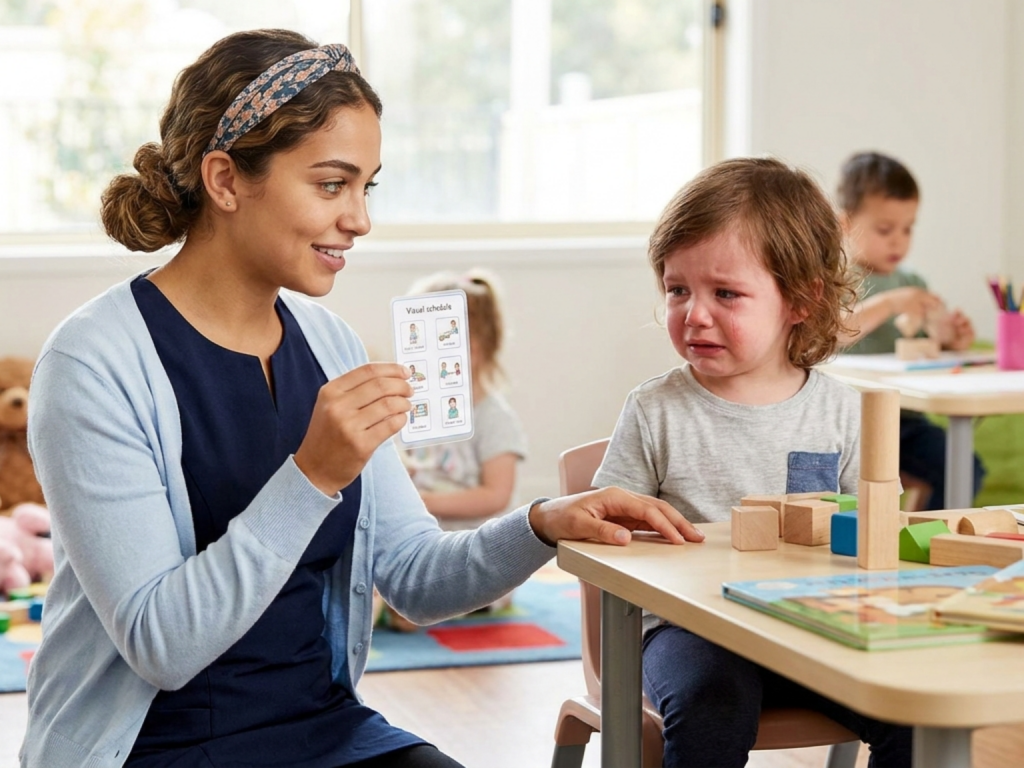
Useful prevention strategies include predictable routines, visual schedules, warnings before transitions, snacks before long errands, and reducing unnecessary choices when a child is tired. Predictable toddler routines can lower stress by making the next step visible and familiar. For preschool and school-age children, a morning checklist or bedtime sequence can reduce repeated verbal reminders.
Choices can support autonomy, but they should be bounded. “Do you want pajamas first or teeth first?” is usually better than “Are you ready for bed?” when bedtime is not optional. For some children, too many choices increase cognitive load. The goal is to offer meaningful control inside non-negotiable boundaries.
Respond to defiance without entering a power struggle
Defiance often escalates when adults and children become locked into a control contest. Defiance in preschool children may reflect normal autonomy, fatigue, language frustration, sensory overload, or difficulty shifting attention. In older children, it may also reflect stress, embarrassment, anxiety, learning difficulty, family conflict, or inconsistent limits.
When a child refuses, keep the instruction brief and repeat it calmly once if needed. Then follow through with the planned adult action. Long lectures can become fuel for escalation. For example: “It is time to leave. You can walk to the door or I can help you.” If the child does not move, the adult calmly helps, without adding shame or debate.
Planned ignoring may be appropriate for minor attention-seeking behaviors that are not unsafe or destructive, such as whining after a clear answer has been given. It should be paired with prompt attention to the desired behavior: “Thank you for using your normal voice.” Planned ignoring is not appropriate for aggression, self-injury, bullying, elopement, significant property destruction, or signs of severe distress.
Use repair, not shame
After conflict, children need a path back into connection. Repair teaches accountability without defining the child by the behavior. A repair conversation is short, calm, and specific: “What happened? Who was affected? What can you do to make it better? What can we try next time?” Younger children may need the adult to provide options.
Repair can include apologizing, returning an item, helping clean up, drawing a kind note, practicing the skill again, or making a plan. The goal is not forced remorse. Forced apologies can become performative if the child is still dysregulated. It is often more effective to wait until the child is calm enough to think.
Adults also model repair. Saying, “I yelled. That was not okay. I am going to take a breath and try again,” teaches emotional responsibility more powerfully than demanding perfection from the child. Positive discipline does not require parents to be endlessly calm; it requires adults to return to calm and repair when they miss the mark.
Know when to seek professional help
Positive discipline is not a substitute for medical, developmental, or mental health care when a child’s behavior suggests an underlying concern. Families should consult a pediatrician, developmental-behavioral specialist, psychologist, child psychiatrist, occupational therapist, speech-language pathologist, or school-based team when behavior is persistent, impairing, unsafe, or associated with regression.
Red flags include frequent aggression that causes injury, self-harm statements or behaviors, repeated running away or unsafe climbing, severe sleep disruption, loss of previously acquired skills, extreme anxiety, trauma symptoms, persistent school refusal, restrictive eating with weight or growth concerns, or behavior changes after a head injury, seizure-like episode, medication change, or major psychosocial stressor. These situations call for assessment, not blame.
Families should also seek help when caregivers feel close to losing control. Parental stress is clinically relevant. Support can include parent-management training, Parent-Child Interaction Therapy, family therapy, school behavior planning, developmental evaluation, and practical respite. Asking for help is not a failure of discipline; it is part of protecting the child and the family system.
When to get help urgently
- Seek urgent help if a child talks about self-harm, wants to die, or behaves in a way that could seriously injure themselves or someone else.
- Contact a healthcare professional promptly for sudden, severe behavior change, regression, confusion, seizure-like episodes, or behavior change after head injury.
- Do not use physical punishment, threats of abandonment, humiliation, or withholding basic needs as discipline.
- If you feel you may hurt your child, place the child somewhere safe and contact emergency services, a crisis line, or another trusted adult immediately.
- Persistent aggression, school refusal, extreme anxiety, or major sleep disruption should be discussed with a pediatrician or child mental health professional.
Tools & Assistance
- Create a short list of household rules stated as observable behaviors.
- Use a daily routine chart for predictable high-stress times such as mornings and bedtime.
- Track antecedents, behavior, and consequences for one week before changing a plan.
- Ask the child’s teacher or childcare provider what strategies are already working in that setting.
- Consult a pediatrician or licensed child mental health professional when behavior is unsafe, persistent, or impairing.
FAQ
Does positive discipline mean there are no consequences?
No. Positive discipline uses consequences that are related, respectful, and reasonable, while avoiding fear, humiliation, and physical punishment.
What should I do during a tantrum?
Keep the child safe, reduce stimulation when possible, use few words, and hold the limit calmly. Teaching and problem-solving usually work better after the child is calm.
Is timeout a positive discipline strategy?
It depends on how it is used. A brief, calm break for safety or regulation may help some children, but isolation, shaming, or long punitive timeouts can worsen distress.
When should behavior concerns be evaluated?
Seek evaluation when behavior is unsafe, persistent, causes major impairment at home or school, includes regression, or occurs with significant anxiety, sleep problems, learning concerns, or developmental delays.
Sources
- PubMed Central (National Institutes of Health) — Effectiveness of Positive Discipline Parenting Program on Authoritative Parenting Style
- MU Extension (University of Missouri) — Positive Discipline in Child Care
- Nurturing Parenting — 7 Effective Strategies for Positive Discipline: A Nurturing Approach
Disclaimer
This article is for general educational purposes only and does not diagnose, treat, or replace care from a qualified healthcare professional. Seek medical or mental health advice for persistent, unsafe, sudden, or impairing behavior concerns.

















Please log in to leave a comment.