
Intro
Single parenting can be loving, purposeful, and resilient, but it can also concentrate many responsibilities into one adult’s day: caregiving, income, transport, school communication, emotional containment, household management, and crisis planning. When support is limited, the cumulative load can affect sleep, mood, cardiovascular stress physiology, immune function, and family routines. Needing help is not a personal failure; it is a predictable response to a high-demand caregiving environment.
This article focuses on practical, evidence-informed ways to reduce strain and strengthen support. It is written for medically literate readers, so it uses terms such as allostatic load, executive function, depressive symptoms, and trauma-informed care, with brief explanations. It does not diagnose or prescribe treatment. If you or your child has persistent distress, safety concerns, or symptoms affecting daily functioning, consult qualified healthcare, mental health, social care, or legal professionals.
Highlights
Single parenting stress often comes from role overload, financial pressure, time scarcity, and social isolation rather than from parenting ability.
Effective coping usually combines problem-focused action, emotional regulation, routines, and external support from trusted people or services.
Informal networks, community programs, schools, municipalities, and nonprofit organizations can reduce practical burden and caregiver isolation.
Parent wellbeing and child wellbeing are connected, but repair, predictability, and compassionate support can buffer stress over time.
Understanding the load of single parenting
Single parenting is not one uniform experience. A parent may be widowed, separated, divorced, parenting by choice, co-parenting inconsistently, or managing a household while the other parent is absent because of work, illness, incarceration, migration, or conflict. The common feature is that one adult often carries a disproportionate share of daily responsibility.
From a health perspective, the issue is not simply being busy. Chronic caregiving pressure can increase allostatic load, meaning the cumulative physiological wear that develops when the stress-response system is repeatedly activated. This can appear as sleep fragmentation, headaches, gastrointestinal symptoms, irritability, impaired concentration, higher anxiety, or feeling emotionally numb. These experiences do not automatically mean a psychiatric disorder is present, but they are meaningful signals that the system needs support.
Research on single mothers during the COVID-19 pandemic identified stressors such as financial insecurity, increased caregiving demands, disrupted routines, reduced social contact, and difficulty accessing services. Although the pandemic was unusual, many of these stressors resemble everyday pressures in single-parent families: limited backup care, unpredictable work schedules, and the mental burden of making most decisions alone.
Start with a realistic definition of coping
Coping does not mean staying calm all the time or handling everything independently. A more medically realistic definition is this: coping is the set of behaviors, relationships, and cognitive strategies that reduce harm, preserve functioning, and help the family recover after stress. Some coping is problem-focused, such as arranging childcare or applying for benefits. Some is emotion-focused, such as breathing exercises, journaling, prayer, peer conversation, or therapy. Some is meaning-focused, such as reminding yourself that a difficult season is not the whole story of your family.
Research from One Parent Families Scotland found that single parents often cope by accepting the reality of a problem, making plans, and taking active steps. Acceptance here does not mean resignation. It means reducing the energy spent arguing with reality so that energy can be redirected toward practical action. For example, “I cannot create more hours today, but I can decide which two tasks are essential and which can wait.”
A useful framework is to ask three questions: What can be changed today? What can be supported by someone else? What must be tolerated temporarily with the least harm possible? This separates solvable problems from chronic pressures and prevents every difficulty from feeling like a personal emergency.
Build a support network before a crisis
Support works best when it is specific. Many people say, “Let me know if you need anything,” but a stressed parent may not have the executive function to identify, negotiate, and schedule help. Instead, create a short list of practical requests that can be offered to trusted people.
- School pickup once a month or in emergencies.
- A shared supermarket trip or meal batch-cooking session.
- Two hours of childcare while you attend an appointment or rest.
- Help completing forms for benefits, housing, childcare subsidies, or school services.
- A check-in call at a predictable time each week.
A support network does not have to be large. One reliable neighbor, one school contact, one relative, one peer group, and one professional contact may be more useful than a broad but vague social circle. Building support system single parent planning can include a written emergency list, consent forms for school pickup where appropriate, spare medication instructions if your child has medical needs, and backup transport options.
It is also reasonable to create boundaries around unhelpful support. Advice that increases shame, pressure, or conflict is not the same as assistance. Trauma-informed support emphasizes safety, choice, collaboration, trust, and empowerment. You are allowed to seek people and services that respect your autonomy and your child’s dignity.
Use routines to reduce decision fatigue
Single parents often experience decision fatigue because many small choices accumulate: meals, clothing, transport, homework, bills, appointments, screen time, and discipline. Stable routines for single parents are not about perfection; they reduce cognitive load so that fewer decisions need to be made under stress.
Start with anchor points rather than a rigid schedule. Anchor points are predictable events that organize the day: wake-up, meals, school departure, homework or quiet time, bath, bedtime, and one weekly planning moment. If the entire day cannot be structured, protect the two most biologically important anchors: sleep and food. Sleep affects emotional regulation, insulin sensitivity, immune function, and attention. Regular meals help prevent irritability and energy crashes in both adults and children.
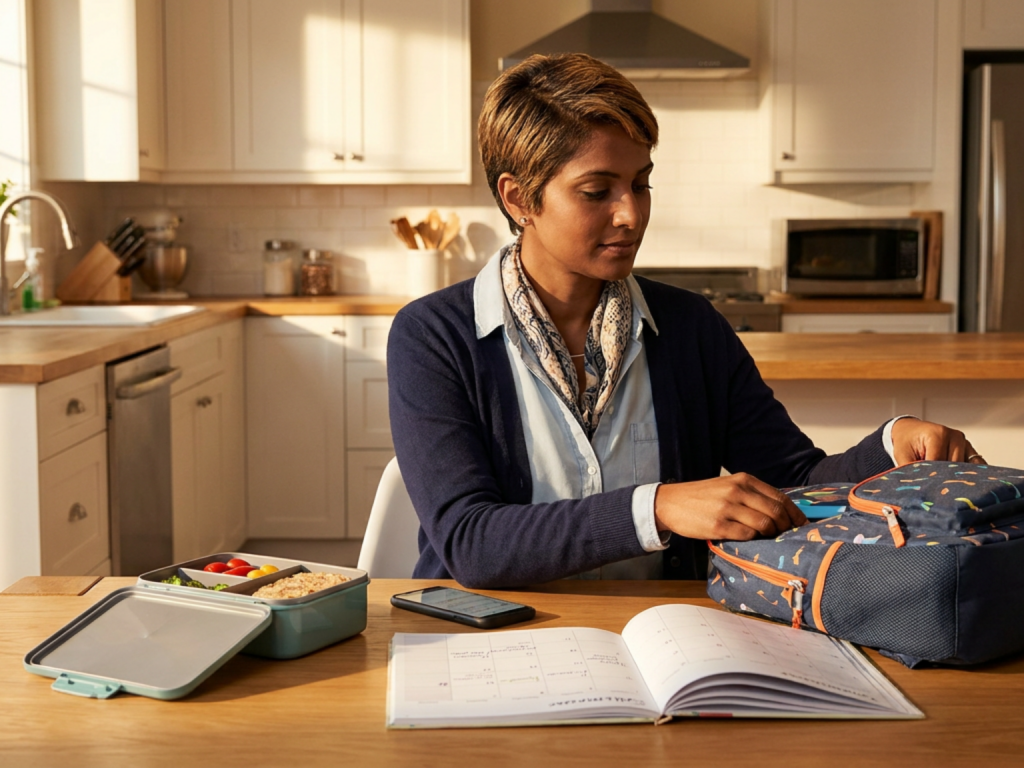
Low-effort routines for overwhelmed parents may include keeping duplicate essentials in a bag, using a weekly meal template, setting automatic bill reminders, preparing school items the night before, or using a visible checklist for children. The goal is not to become highly efficient at all times; it is to make ordinary days require less nervous-system activation.
Support your mental health without waiting for collapse
Many single parents delay help until symptoms are severe because they fear judgment, cost, lack of time, or consequences for custody or employment. Early support is often easier and more effective than crisis intervention. Consider speaking with a primary care clinician, therapist, counselor, social worker, health visitor, community nurse, or employee assistance provider if stress is persistent, sleep is severely disrupted, or you notice ongoing panic, low mood, intrusive thoughts, anger outbursts, or loss of pleasure.
Single parent stress and burnout can present as emotional exhaustion, cynicism, reduced patience, somatic symptoms, or feeling detached from your child even though you love them. These signs deserve compassionate attention. They do not mean you are a bad parent. They may mean your caregiving demands exceed your current resources.
Professional support may include assessment, psychoeducation, psychotherapy, social prescribing, parenting support, financial or housing referral, domestic abuse advocacy, or medical evaluation for symptoms such as thyroid disease, anemia, perinatal mood disorders, substance use concerns, or sleep disorders. A healthcare professional can help distinguish stress responses from conditions that need targeted care.
Use formal resources as part of the plan
Formal support can be as important as informal support. The qualitative study of single mothers during the pandemic highlighted help from municipalities and nonprofit organizations, alongside family and friends. Depending on location, resources may include childcare subsidies, food support, school meal programs, housing advice, legal aid, transportation assistance, parenting classes, mental health services, and community-based family support programs.
If asking for help feels difficult, try approaching it as a systems issue rather than a character issue. Many single-parent households face structural pressures: high childcare costs, unstable work hours, housing insecurity, and limited paid leave. Services exist because families are not meant to absorb these pressures alone.
Schools and early childhood settings can be key partners. Teachers, school nurses, counselors, and family liaison workers may notice changes in a child’s attendance, behavior, concentration, or mood. Sharing relevant information can help them respond with appropriate support rather than assuming noncompliance. For example, you might say, “We are going through a high-stress period, and mornings are difficult. Please let me know if there are changes in behavior or learning, and I would appreciate information about any school-based family resource referrals.”
Communicate with children in age-appropriate ways
Children do not need adult-level details about finances, conflict, legal issues, or parental distress. They do benefit from calm, age-appropriate honesty. A simple message might be: “Things are stressful right now, but the adults are working on it. You are loved, and this is not your fault.” This reduces the risk that children will fill gaps with self-blame.
Children also learn coping by observing repair. If you raise your voice, miss a school event, or become distracted, a repair statement can be powerful: “I was overwhelmed earlier and spoke sharply. I am sorry. I am working on calming down, and you did not cause my stress.” Parent-child repair after conflict helps restore emotional safety and models accountability.
Watch for child stress signals such as sleep changes, regression, stomachaches, headaches, school refusal, clinginess, irritability, withdrawal, or declining academic function. These signs are nonspecific and do not establish a diagnosis, but they may indicate that the child needs more support from caregivers, school staff, or pediatric and mental health professionals.
Create a safety-first plan for high-stress moments
Every parent has moments when stress spikes. A safety-first reset for overwhelmed parents is a brief plan for preventing harm when the nervous system is overloaded. It should be simple enough to use when thinking is impaired.
- Place the child in a safe location if age-appropriate, such as a crib, bedroom, or supervised space.
- Step away for a few minutes if it is safe to do so, and use slow breathing, cold water on hands, or grounding through the senses.
- Text or call a trusted person with a prewritten message such as, “I am at my limit and need a check-in now.”
- Delay nonurgent discipline until you are regulated.
- If there is risk of harm to yourself, your child, or someone else, contact emergency services or a crisis line immediately.
This kind of plan is not pessimistic. It is preventive care. Just as families plan for fever, asthma, or food allergies, they can plan for acute emotional overload.
When to seek urgent help
- Any thoughts of harming yourself, your child, or another person require immediate emergency or crisis support.
- Seek professional help promptly if depression, anxiety, panic, substance use, or sleep loss is impairing daily functioning.
- If there is domestic abuse, coercive control, stalking, or unsafe co-parenting, contact specialized advocacy or emergency services.
- A child with persistent withdrawal, self-harm talk, severe aggression, school refusal, or major sleep or appetite changes should be assessed by a qualified professional.
- Do not stop prescribed medication or start new medication or supplements for stress without consulting a healthcare professional.
Tools & Assistance
- Create a one-page emergency plan with contacts, school pickup permissions, medical information, and backup childcare.
- Ask one trusted person for one specific task this week rather than making a general request for help.
- Contact school, pediatric, community, or social care staff to ask about family resource referrals.
- Use a weekly planning routine that identifies essentials, deferrable tasks, and one recovery activity.
- Schedule a primary care or mental health appointment if stress symptoms persist or worsen.
FAQ
Is it normal to feel overwhelmed as a single parent?
Yes. Feeling overwhelmed is common when one adult carries many caregiving, financial, and logistical roles. Persistent distress, impaired sleep, or loss of functioning should be discussed with a healthcare or mental health professional.
What is the most useful first coping step?
Choose one immediate pressure point and make it more specific. For example, instead of “I need help,” try “I need school pickup next Tuesday” or “I need help completing this childcare subsidy form.”
How can I protect my child from my stress?
Predictable routines, reassurance that the stress is not the child’s fault, and repair after conflict are protective. If your child shows persistent emotional, behavioral, or physical stress signs, seek professional guidance.
Are support groups helpful?
They can be. Structured peer-support groups may reduce isolation, normalize common struggles, and share practical strategies. Choose groups that feel respectful, safe, and solution-focused.
When should I consider therapy or counseling?
Consider professional support if stress is ongoing, you feel emotionally depleted, you are frequently irritable or tearful, trauma is being reactivated, or symptoms are affecting parenting, work, sleep, or relationships.
Sources
- PubMed Central — Stressors and coping strategies among single mothers during the COVID-19 pandemic: A qualitative study
- COPE — Advice for single parents
- One Parent Families Scotland — Coping strategies: how single parents in Scotland deal with problems
Disclaimer
This article is for general informational purposes only and is not a medical, mental health, legal, or social care diagnosis or treatment plan. Consult qualified professionals for advice tailored to your family, especially if safety or significant symptoms are present.


















Please log in to leave a comment.