
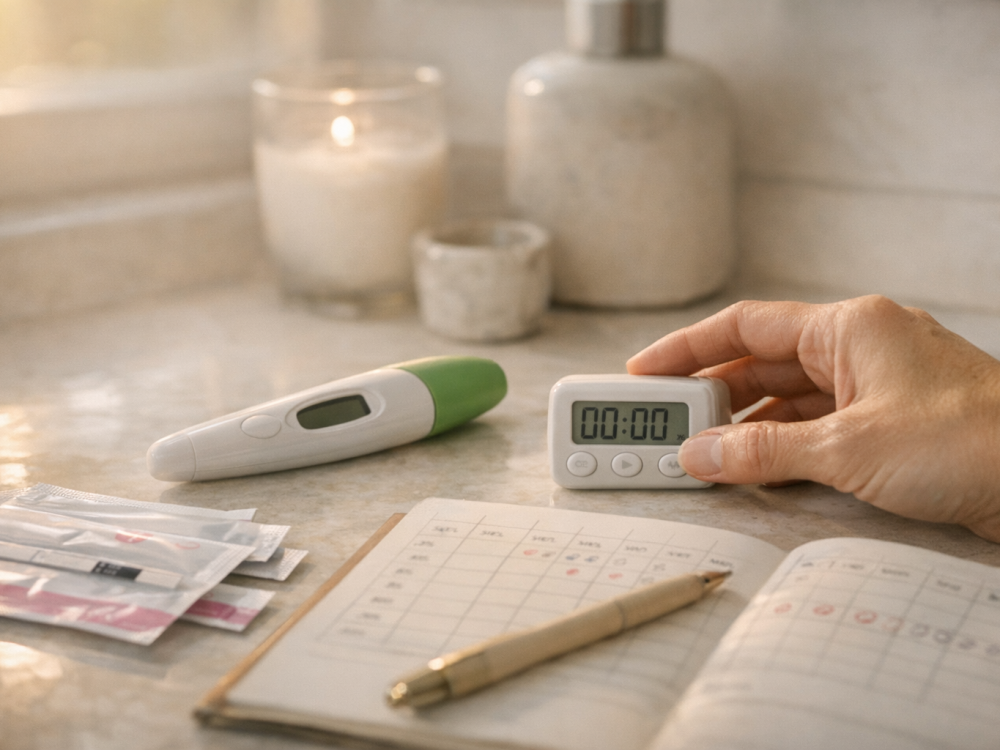
Intro
Ovulation tests can be emotionally reassuring, frustrating, or both. When you are trying to conceive, a faint line, a flashing symbol, or a missed positive can feel disproportionately important. Medically, however, ovulation predictor kits are best understood as tools that detect a hormonal signal: the urinary luteinizing hormone, or LH, surge that usually precedes ovulation.
Accuracy depends on several layers: the test’s ability to detect LH, the timing of urine testing, the clarity of result interpretation, and individual cycle physiology. Digital tests and strip tests often measure the same biological event, but they differ in how results are read, how much user interpretation is required, and sometimes which hormones they incorporate.
Highlights
A positive ovulation test usually means an LH surge has been detected; it does not prove that ovulation definitely occurred.
Digital tests may reduce interpretation errors because they display a clear result rather than requiring comparison of line darkness.
Strip tests can be accurate and cost-effective, but faint lines, variable urine concentration, and timing mistakes can cause confusion.
The LH surge typically occurs before ovulation, but the interval varies; many people ovulate about 24–36 hours after surge onset.
Repeated positives, no positives, or confusing patterns are common in irregular cycles and should be discussed with a healthcare professional if persistent.
How ovulation tests work
Most at-home ]] tests detect in urine. LH is produced by the pituitary gland and rises sharply before . This LH surge helps trigger final maturation and release of the oocyte from the dominant follicle. Because sperm can survive in fertile for several days and the egg is viable for a much shorter period after , detecting the pre-ovulatory LH rise can help time intercourse or insemination.
Traditional strip or line tests usually show a control line and a test line. The control line confirms the test functioned. For many line tests, the result is considered positive only when the test line is as dark as, or darker than, the control line. A faint test line is not automatically positive, because low levels of LH may be present throughout the cycle.
Digital tests use an optical reader or electronic interpretation system to convert the test chemistry into a displayed result, such as a symbol or words. Some digital products detect LH only, while others also track urinary metabolites to estimate additional fertile days before the LH surge. The key practical difference is that digital devices remove much of the subjective judgment involved in comparing line intensity.
Digital vs strip ovulation tests: what accuracy really means
When people ask whether digital tests are more accurate than strips, they may be asking two different questions: analytical accuracy and user accuracy. Analytical accuracy refers to whether the test chemistry detects LH at the intended threshold. User accuracy refers to whether the person using the test performs it correctly and reads the result correctly.
A study published in Fertility and Sterility compared a digital ]] test with three popular line tests and found much higher agreement in interpretation for the digital test. This supports an important real-world point: digital tests may reduce false interpretation caused by ambiguous line darkness, even if both formats are designed to detect the LH surge.
Strip tests can still be very useful. They are inexpensive, easy to repeat, and helpful for people who need to test more than once daily or over a longer window. However, they require careful attention to instructions, urine concentration, test timing, lighting, and the manufacturer’s definition of a positive. Digital tests are typically more expensive but may be less stressful for people who find line progression confusing.
A balanced way to compare them is:
- Digital tests: clearer readout, less subjective interpretation, often more expensive, may use proprietary algorithms.
- Strip tests: lower cost, useful for frequent testing, require line comparison, more vulnerable to user-read error.
- App-read strip tests: may standardize line assessment, but lighting, camera quality, and brand-specific thresholds can still affect interpretation.
LH surge timing and the fertile window
The LH surge usually precedes . Many people ovulate approximately 24–36 hours after the beginning of the surge, although the timing can vary. Some may ovulate sooner after a positive test, while others may have a longer interval. The surge itself can be short, lasting less than a day, or more prolonged, lasting two days or more.
This is why testing frequency matters. If you test once daily and have a brief surge, you may miss it. Some people find that testing once daily is enough, especially with predictable cycles. Others, particularly those with short surges or prior missed positives, may benefit from testing twice daily during the expected , for example late morning and evening, while following the product instructions.
For conception timing, the most fertile days are generally the days leading up to ]] and the day of ]]. A is often a cue to have that day and the following day, if that fits your circumstances. However, it is not necessary to wait for a positive test before having if fertile is present or if you are already in the estimated .
It may help to combine LH testing with cycle history, cervical mucus observations, and, if desired, . LH tests predict possible ; can help retrospectively suggest that has occurred, because raises resting temperature slightly.
False positives: when a positive test may not mean ovulation
A positive test indicates that urinary LH has reached the test’s positive threshold. It does not guarantee follicle rupture, egg release, or adequate luteal afterward. In most ovulatory , an LH surge is followed by , but there are exceptions.
Possible reasons for a misleading positive include:
- Polycystic ovary syndrome, or PCOS: Some people with PCOS have higher baseline LH or multiple LH rises, which can make OPKs harder to interpret.
- Multiple surge attempts: The body may mount an LH rise but not ovulate, then try again later in the cycle.
- Perimenopause or diminished ovarian reserve: Hormonal variability can make cycle signals less predictable.
- Recent pregnancy loss, pregnancy, or hCG exposure: Some test systems may cross-react or be affected by related hormonal states.
- Fertility medications: Trigger injections containing hCG or other treatments can er test interpretation; follow your clinician’s instructions.
If you repeatedly see positive tests for many days, get positives very early or very late without a clear pattern, or have that are highly irregular, it is worth discussing this with an OB-GYN, reproductive endocrinologist, or other qualified clinician. The goal is not to assume something is wrong, but to avoid relying on a tool that may not match your hormonal pattern.
False negatives: why you may never see a positive
Not seeing a positive test can be discouraging, but it does not always mean you did not ovulate. One common explanation is simply missing the surge. If your LH rise is brief and you test once daily, the peak may occur between tests. Urine dilution can also lower LH concentration below the detection threshold, particularly if you drink large amounts of fluid before testing.
Other contributors include testing too early or too late in the cycle, using first-morning urine when a specific product recommends another time, not holding urine long enough, reading the test outside the instructed time window, or using expired or improperly stored tests. With strip tests, a result may also be misread if the test line is close to positive but not quite as dark as the control line.
Cycle variability matters too. Stress, illness, travel, sleep disruption, significant weight change, and intense exercise can shift later than expected. If you start testing based on a typical 28-day cycle but your is delayed to day 20 or later, you may stop testing before the surge occurs.
If you have no positive tests across several , longer than 35 days, very short cycles, absent periods, or symptoms suggesting endocrine concerns, medical evaluation can be helpful. Clinicians may use cycle history, serum progesterone, ultrasound monitoring, thyroid testing, prolactin assessment, androgen evaluation, or other tools depending on the situation.
Best practices for more reliable results
Small technique changes can make testing much more informative. Always follow the instructions for your specific brand, because thresholds, urine timing, and interpretation windows differ.
- Start testing before the expected . Use your shortest recent cycle as a guide if your cycles vary.
- Test at a consistent time. Many people test late morning to evening, but follow the product guidance.
- Avoid over-diluting urine. Try not to drink excessive fluids in the couple of hours before testing if the instructions recommend concentrated urine.
- Read results within the stated window. Evaporation lines or delayed changes can mislead.
- Record results with cycle day and symptoms. Note cervical mucus, bleeding, medications, illness, and intercourse timing.
- Consider twice-daily testing near the expected surge. This can help if you suspect a short LH surge.
For strip tests, good lighting and consistent comparison are important. A faint line usually reflects baseline LH and is typically negative unless the instructions say otherwise. For digital tests, avoid ejecting or inspecting the strip to reinterpret it unless the manufacturer specifically allows that; the device algorithm is intended to be the result.
Putting ovulation tests in context
s are useful, but they are not a complete fertility evaluation. They do not assess tubal patency, sperm parameters, uterine factors, egg quality, luteal phase adequacy, or whether intercourse timing is the only barrier. They also do not confirm pregnancy.
For many couples and individuals, OPKs are most helpful when used as part of a calm, repeatable timing strategy rather than as a daily verdict. If increases anxiety, it is reasonable to simplify: focus on intercourse every 1–2 days during the estimated fertile window, use cues, or take breaks from when needed.
Seek individualized guidance sooner if you are 35 or older and have been trying for 6 months, under 35 and trying for 12 months, have known reproductive conditions, irregular or absent periods, recurrent pregnancy loss, significant pelvic pain, or a partner known sperm concerns. If you are using fertility medications, rely on your clinic’s monitoring plan rather than over-the-counter results alone.
When to be cautious
- A positive ovulation test predicts an LH surge, not guaranteed ovulation.
- Fertility medications, especially trigger injections, can make home test results misleading.
- PCOS and irregular cycles can cause repeated positives, missed surges, or unclear patterns.
- Persistent absence of positive tests across several cycles warrants professional advice.
- Do not use ovulation tests as contraception unless guided within a validated fertility awareness method.
Tools & Assistance
- Cycle tracking app or paper chart for LH results, bleeding, and cervical mucus
- Ovulation predictor kits matched to your budget and comfort with line interpretation
- Basal body temperature thermometer for retrospective ovulation pattern tracking
- Appointment with an OB-GYN or reproductive endocrinologist for persistent irregularity or infertility concerns
- Semen analysis and fertility evaluation when timing appears adequate but conception is delayed
FAQ
Are digital ovulation tests more accurate than strips?
They may be more accurate in practical use because they reduce interpretation errors. Strip tests can also be reliable, but comparing line darkness can be subjective.
Does a positive ovulation test mean I am ovulating right now?
Not necessarily. It means an LH surge has been detected. Ovulation often follows within about 24–36 hours, but timing varies and ovulation is not guaranteed.
Why do I get faint lines on ovulation strips every day?
LH can be present at low levels throughout the cycle. On many strip tests, a faint test line is negative unless it is as dark as or darker than the control line.
Can I miss my LH surge?
Yes. Some surges are short. Testing once daily, testing at the wrong time, or using diluted urine can lead to a missed positive.
Should I test twice a day?
Twice-daily testing may help if your surge is brief or you have previously missed positives. It is usually most useful during the few days when ovulation is expected.
Sources
- PubMed / Fertility and Sterility — Comparison of a digital ovulation test with three popular line ovulation tests
- Clearblue — Ovulation Tests: Digital Tests, Sticks and Kits
- Cleveland Clinic — How (and Why) to Use At-Home Ovulation Tests To Get Pregnant
Disclaimer
This article is for informational purposes only and does not replace medical advice, diagnosis, or treatment. Consult a qualified healthcare professional for personalized fertility or menstrual-cycle guidance.















Please log in to leave a comment.