
Intro
Back labor can feel intense, discouraging, and difficult to escape because the pain often concentrates in the sacrum, lower back, and pelvis rather than easing fully between contractions. For many laboring people, the hands-and-knees position offers a simple, low-technology way to change pelvic mechanics, reduce pressure, and regain a sense of control.
This article explains why hands-and-knees may help, how it is commonly used during back labor, and when extra caution or clinical guidance is needed. It is not a substitute for individualized advice from your midwife, obstetrician, anesthesiology team, or labor nurse.
Highlights
Hands-and-knees can reduce persistent low back pain in labor and is generally acceptable for many people, including some with low-dose epidural analgesia when staff can support safe movement.
The position may help back labor by reducing sacral pressure, encouraging pelvic mobility, and supporting more favorable fetopelvic alignment.
Cat-cow pelvic tilts, forward leaning, and sacral counterpressure can be combined with hands-and-knees for additional comfort.
Position changes should be individualized, especially with epidural analgesia, continuous fetal monitoring, mobility limits, or concerns about fetal status.
Understanding back labor and posterior pressure
Back labor usually refers to contraction pain that is felt most strongly in the lower back, sacrum, or tailbone area. It may be continuous or may intensify dramatically with each contraction. One common contributor is an occiput posterior fetal position, in which the back of the baby’s head is oriented toward the pregnant person’s spine. This can increase pressure on the sacrum and pelvic nerves, although back pain in labor can also occur for other reasons, including pelvic anatomy, ligament tension, fetal station, or normal contraction patterns.
For a medically literate reader, the key concept is fetopelvic relationship: the dynamic fit between the fetus, pelvis, soft tissues, and uterine force. Labor is not simply a passenger moving through a fixed tube. The pelvic inlet, midpelvis, outlet, sacrum, coccyx, pelvic floor, and maternal posture all interact. A position that relieves pressure at one point in labor may become less effective later, and that is normal.
Hands-and-knees is valuable because it changes where weight is borne. Instead of the sacrum being compressed against a bed, the abdomen can hang forward and the pelvis can move more freely. This may reduce direct posterior pressure and give the baby more room to rotate from posterior toward anterior alignment. It is not a guaranteed method for rotation or pain relief, but it is a reasonable, commonly used, nonpharmacologic pain strategy when clinically appropriate.
Why hands-and-knees may relieve back labor
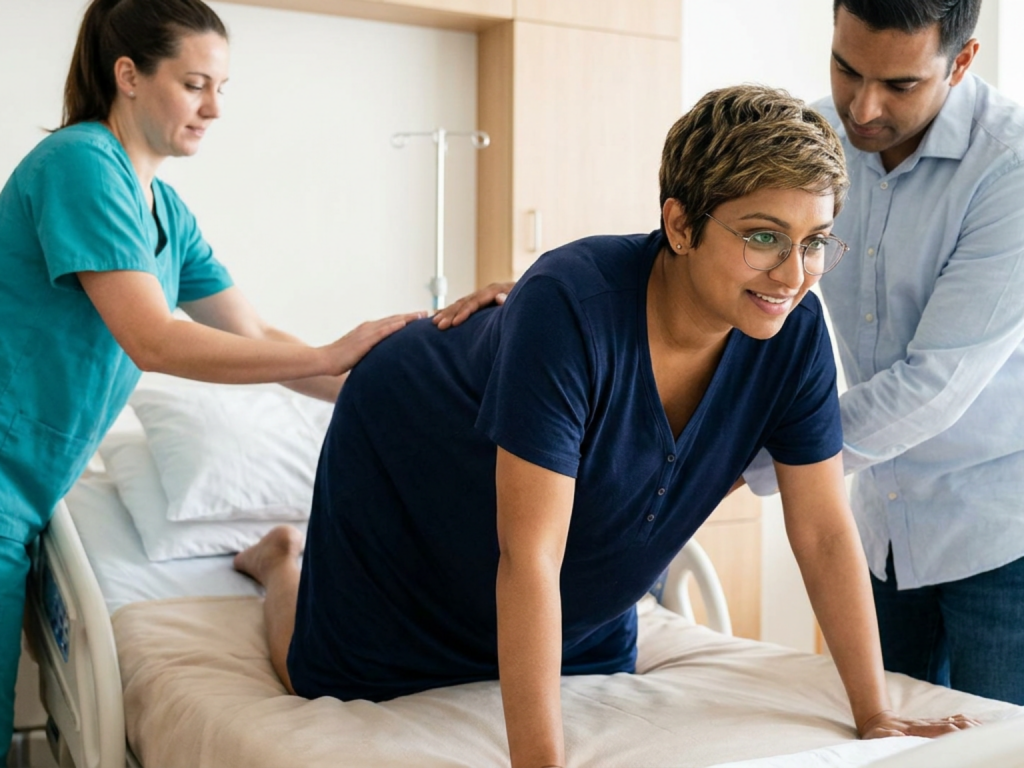
The hands-and-knees position places the laboring person on all fours, usually with knees apart and hands, forearms, or upper body supported. This can be done on a bed, floor mat, birth ball, or raised head of the bed. Its benefit is partly mechanical and partly neurophysiologic.
Mechanically, hands-and-knees may reduce sacral compression because the sacrum is not pinned against the mattress. The pelvis can rock, tilt, and widen in response to contractions. Rounding the back during a contraction, similar to the cat phase of cat-cow, can help open the posterior pelvis and decrease pressure sensations. Swaying or making small circles may also reduce muscle guarding in the lumbar paraspinal and gluteal regions.
Neurophysiologically, changing position can reduce noxious input by altering pressure points, improving the laboring person’s sense of agency, and decreasing stress-mediated muscular tension. When someone feels trapped on their back during severe sacral pain, pain perception often intensifies. A supported hands-and-knees posture can make coping more active and less isolating.
Research on repeated hands-and-knees positioning in labor has found significant reduction in persistent back pain and good acceptability. Proposed mechanisms include pain and stress reduction, improved uterine blood flow, and enhanced fetopelvic relationships. Educational childbirth guidance also highlights that this position has few downsides for many low-risk situations and may work with gravity while providing full-body support.
How to use the position during contractions
Hands-and-knees does not need to look one exact way. The goal is comfort, stability, and room for the pelvis to respond. Some people prefer palms flat on the bed; others feel better resting on forearms, stacking pillows under the chest, or leaning over a birth ball. The knees can be directly under the hips or slightly wider, depending on hip comfort and fetal monitoring needs.
A simple sequence for hands-and-knees position for back labor is to move into the posture between contractions, settle the upper body, then begin small pelvic movements as the next contraction builds. During the peak, many people instinctively round the back, tuck the pelvis slightly, breathe downward, or press the hips back toward the heels. As the contraction fades, the body can soften, the abdomen can relax, and the shoulders can release.
Pelvic tilts are often recommended for back labor relief. In a cat-cow pattern, the back gently rounds, then returns toward neutral or a mild arch. The movement should be smooth, not forceful. Rounding can feel especially relieving when sacral pressure is intense. Some people prefer a static posture with stillness and counterpressure; others want continuous rocking. Both are valid.
If the bed is adjustable, the head can be raised so the person kneels and leans forward against pillows. This reduces wrist strain and may be easier with fatigue. If continuous monitoring is needed, staff can often adjust monitor placement, though sometimes signal quality limits movement options. The safest version is the one that maintains maternal stability, fetal assessment, and access for clinical care.
Combining hands-and-knees with counterpressure and breath
Hands-and-knees often works best as part of a comfort toolkit rather than as a stand-alone intervention. Sacral counterpressure during contractions can be especially effective for back labor. A partner, doula, nurse, or midwife may apply firm, steady pressure with the heel of the hand, a fist, or a massage tool over the sacrum. The laboring person should guide the exact location and intensity; pressure that is relieving for one person may be irritating for another.
Hip squeezes can also be used in this position. The support person presses inward on both sides of the pelvis, often near the iliac crests or upper buttocks, during contractions. This may change pelvic sensations and reduce the feeling that the sacrum is being forced open from the inside. As with any technique, it should stop immediately if it worsens pain, causes numbness, or feels emotionally overwhelming.
Breath can help coordinate the posture. Slow breathing for early or active labor may reduce unnecessary shoulder, jaw, and pelvic floor tension. During more intense contractions, shorter patterned breathing or open-throat vocalization may help the laboring person avoid breath-holding unless directed during pushing. The focus is not performance; it is oxygenation, rhythm, and recovery between waves.
Other comfort measures can be layered in: heat over the lower back, cold packs, sterile water injections where offered, hydrotherapy if available and safe, or leaning forward over a raised surface. Avoiding lying directly on the back may be helpful for some people with back labor, but there is no moral value in any position. Relief, safety, and clinical context matter most.
Possible benefits beyond pain relief
The most immediate reason to try hands-and-knees is comfort, but the position may offer additional physiologic advantages. By taking pressure off the inferior vena cava and major pelvic vessels compared with flat supine positioning, forward-leaning or all-fours postures may support maternal hemodynamics and uteroplacental blood flow in some circumstances. This is one reason many birth teams encourage avoiding prolonged flat-on-back positioning when alternatives are feasible.
Hands-and-knees may also enlarge functional pelvic space. The pelvic bones do not dramatically open like a hinge, but posture changes the relationship of the sacrum, coccyx, pelvic floor, and fetal head. When the abdomen hangs forward and the pelvis is mobile, some babies may have more opportunity to flex, descend, and rotate. This may be relevant when an occiput posterior fetal position is suspected, though only clinical assessment can evaluate fetal position and labor progress.
Another benefit is psychological. Labor pain is not only sensory; it is shaped by fear, fatigue, autonomy, environment, and support. A position that allows the laboring person to move, vocalize, and receive direct back support can reduce distress. In studies, acceptability matters because a technically useful position is not helpful if it feels undignified, unsafe, or impossible to maintain. Hands-and-knees is often acceptable because it can be modified with pillows, bed adjustments, and hands-on support.
Finally, it is compatible with many birth goals. It can be used in unmedicated labor, during low-intervention birth plan preferences, during parts of monitored labor, and sometimes even with low-dose epidural analgesia under supervision. The exact plan should be made with the clinical team.
Safety, epidurals, and when to modify the posture
Hands-and-knees is generally considered low risk for many laboring people, but it is not automatically appropriate in every situation. Balance, leg strength, blood pressure, fetal monitoring, intravenous lines, epidural effects, and urgency of clinical assessment all matter. If an epidural is in place, the person may have reduced proprioception or motor strength. Some low-dose epidurals allow assisted position changes, but staff should assess safety before getting into or out of hands-and-knees.
Modifications can make the position safer. Forearms on pillows may reduce wrist load. A peanut ball or birth ball under the chest can provide support. The bed can be kept low, side rails used appropriately, and one or two staff members can assist with transitions. If knees become painful, extra padding can help. If the person feels dizzy, short of breath, numb, or unstable, the position should be changed.
There are times when clinicians may recommend another posture or more direct intervention. Examples include nonreassuring fetal heart rate patterns requiring rapid assessment, heavy epidural motor block, significant bleeding, severe hypertension symptoms, cord prolapse concern, or the need for urgent operative birth. In those moments, the priority is maternal and fetal safety, not maintaining a preferred position.
It is also important not to interpret back labor as proof of a specific fetal position or complication. Only trained clinicians can assess fetal presentation, station, rotation, maternal status, and labor progress. Hands-and-knees can be a comfort measure while evaluation continues, but it should not delay needed medical care.
Supporting someone in hands-and-knees
Support people can make this position more sustainable. The most useful first step is practical: stabilize pillows, adjust the bed, offer water between contractions, and protect privacy. Then ask brief, specific questions such as, “More pressure or less?” and “Higher or lower on your back?” Long conversations during contractions can be hard to process.
For back labor, a partner can provide steady sacral pressure, hip squeezes, or gentle reminders to release the shoulders and jaw. A doula or nurse may suggest pelvic rocking, side-to-side shifts, or resting the upper body over a ball. The clinical team can help keep monitors in place, evaluate whether the position is helping, and suggest alternatives if fatigue develops.
Hands-and-knees can be used for a few contractions, repeated periodically, or maintained longer if comfortable. It should never be framed as something the laboring person must endure to “fix” the baby’s position. If it stops helping, changing to side-lying, supported kneeling, standing and leaning forward, or a semi-reclined position may be more appropriate. Good labor support is responsive rather than rigid.
After using the position, transitions deserve attention. Moving too quickly can cause dizziness, especially after intense contractions or with neuraxial analgesia. Rolling to one side first, then sitting or repositioning with help, may be safer than abruptly standing or turning. Small safety steps preserve the benefits of movement without adding unnecessary risk.
When to get clinical help promptly
- Tell your care team immediately about severe pain that feels unusual, sudden, or different from contraction pain.
- Seek urgent assessment for vaginal bleeding, fever, fainting, severe headache, visual symptoms, or chest pain.
- Do not change positions without assistance if you have dense epidural numbness, leg weakness, or dizziness.
- If fetal monitoring is concerning or staff request assessment, prioritize medical evaluation over maintaining the position.
- Call your maternity unit or emergency services if you are at home and have decreased fetal movement, ruptured membranes with concerns, or signs of urgent labor complications.
Tools & Assistance
- Ask your labor nurse or midwife to help set up a supported hands-and-knees position.
- Use pillows, a raised bed, or a birth ball to reduce wrist and shoulder strain.
- Have a partner practice sacral counterpressure during contractions before labor if possible.
- Discuss mobility options in advance if you are considering epidural analgesia.
- Include preferred position changes in your birth preferences while staying flexible.
FAQ
Can hands-and-knees turn a posterior baby?
It may encourage more favorable fetopelvic alignment and rotation for some babies, but it is not guaranteed. Fetal position and labor progress should be assessed by your clinical team.
Is hands-and-knees safe with an epidural?
Sometimes, especially with low-dose epidural analgesia, but only with staff support and assessment of leg strength, balance, monitoring, and overall safety.
How long should I stay in the position?
There is no fixed duration. Some people use it for a few contractions, rest, and repeat. Change positions if you feel unstable, exhausted, numb, or if your care team advises it.
What if hands-and-knees makes pain worse?
Stop or modify the position. Back labor comfort is individual, and side-lying, forward leaning, counterpressure, hydrotherapy, medication, or other approaches may be more helpful.
Can I use hands-and-knees during pushing?
Some people do, depending on fetal status, maternal stability, clinician access, and birth setting. Discuss pushing positions with your obstetric or midwifery team.
Sources
- National Institutes of Health / PubMed Central — Repeated hands-and-knees positioning during labour
- Lamaze International — Four Birth Positions to Get You Off Your Back
- Cleveland Clinic — Back Labor: Signs, How It Feels, Causes & Relief
Disclaimer
This article is for general educational purposes only and does not replace medical advice, diagnosis, or treatment. Always consult your obstetrician, midwife, nurse, or emergency services for concerns during labor.













Please log in to leave a comment.