
Intro
Starting kindergarten is a major developmental transition. A child is learning to manage a new schedule, separate from familiar caregivers, follow group instructions, communicate needs, regulate emotions, and participate in a peer community—all while adapting to a different physical environment. Excitement, clinginess, fatigue, irritability, regression in previously mastered skills, or reluctance to attend can occur during the early adjustment period.
Most children gradually develop confidence as the setting becomes predictable and relationships with teachers and classmates strengthen. Families can support this process through consistent routines, emotionally attuned conversations, gradual preparation, and collaborative communication with school staff. Adaptation is individual; the goal is not an immediate absence of distress, but a steady increase in participation, recovery, and belonging.
Highlights
Predictable home routines can help children manage kindergarten expectations and support attention, conduct, and prosocial behavior.
A short, calm, consistent goodbye ritual is usually more helpful than prolonged or repeated departures.
Social adaptation develops through repeated opportunities to observe, practice, repair misunderstandings, and receive adult support.
Persistent or worsening distress deserves discussion with the teacher and, when appropriate, a pediatrician or child mental health professional.
Why kindergarten adjustment can feel demanding
Kindergarten combines several developmental tasks that may previously have occurred separately. A child may need to wake earlier, dress within a time limit, travel to school, separate from a caregiver, attend to group directions, wait for turns, use classroom materials appropriately, manage toileting and meals more independently, and shift between activities. These demands place substantial weight on executive function, including working memory, inhibitory control, cognitive flexibility, and the ability to initiate and complete a task.
Emotional regulation is also being exercised continuously. A child may need to tolerate disappointment, postpone a preferred activity, ask for help, and recover from sensory or social overload. Behaviour that looks oppositional at home may reflect exhaustion, language limitations, uncertainty, or reduced regulatory capacity rather than deliberate defiance. After holding themselves together at school, some children have after-school meltdowns in children who otherwise appear settled during the school day.
Research using a large longitudinal sample found that stronger family routines during the preschool period were associated with better kindergarten readiness. The associations included fewer conduct and attention problems and more prosocial behaviour. This does not prove that routines alone cause successful adjustment, because family resources, child characteristics, and school context also matter. It does, however, support the practical value of predictable daily patterns.
Build a predictable routine before and during the transition
Begin adjusting the daily rhythm before kindergarten starts, changing wake time, bedtime, breakfast, and departure gradually rather than abruptly. A routine should be realistic for the family and sufficiently flexible to accommodate illness, travel, and occasional disruptions. The most useful elements are consistency and clear sequencing, not perfection.
A visual schedule can translate time into concrete steps for a young child. It might show waking, toileting, dressing, eating breakfast, brushing teeth, packing a bag, travelling, and saying goodbye. Use simple words or pictures and invite the child to move a marker as each step is completed. This supports predictability and reduces the amount of verbal prompting required when the child is tired.
- Keep bedtime and wake time broadly consistent, allowing enough opportunity for age-appropriate sleep.
- Prepare clothing, food, medication if prescribed by the child’s clinician, and school materials the evening before.
- Practise opening containers, putting on outerwear, using the bathroom, and asking an adult for assistance.
- Use the same basic sequence on school mornings, including a brief buffer for unexpected delays.
- Maintain an orderly after-school transition with food, hydration, quiet time, movement, and connection before demanding questions or homework.
Routines work best when caregivers use supportive limit-setting: acknowledge the feeling, state the expectation, and offer a manageable choice. For example, “You are tired and want to keep playing. It is time to get dressed. Would you like the blue shirt or the striped shirt?” This approach combines emotional validation with a clear boundary.
Support separation and emotional security
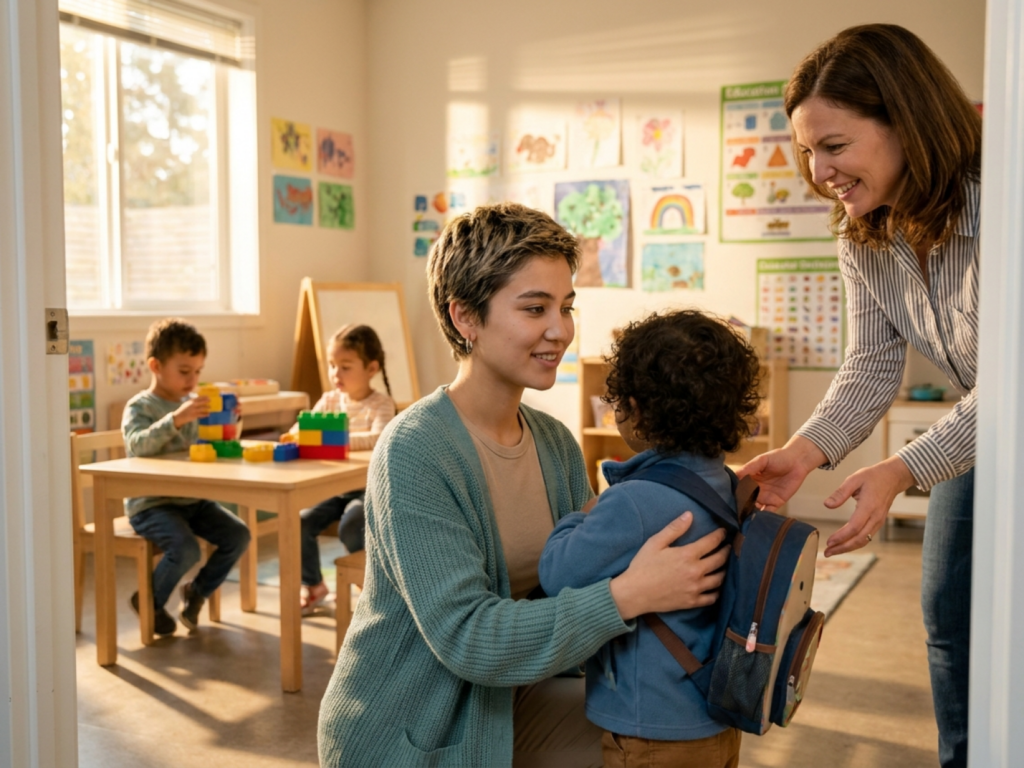
Separation is often the most visible challenge at the beginning of kindergarten. Crying at the door does not necessarily mean that school is harmful or that a child cannot adapt. Some children settle within minutes; others require a longer period of repeated, supported experiences. The caregiver’s calm, confident behaviour can provide co-regulation while the child’s own coping skills develop.
Talk about kindergarten in a factual, reassuring way. Name likely events, such as where the child will enter, who will greet them, when they will eat, and when the caregiver will return. Avoid promising that the child will never feel sad or that every day will be fun. A more credible message is, “You may miss me, and your teacher will help you. I will come back after the afternoon activity.” Use the school’s actual schedule or a concrete pickup reference whenever possible.
Establish a brief predictable goodbye routine. It might include one hug, a phrase, a wave at a designated place, and transfer to a teacher. Prolonged negotiations, repeated returns, or leaving secretly can increase uncertainty, even when they are understandable responses to distress. Once the goodbye is complete, staff should help the child move toward a familiar activity, classroom job, book, or peer interaction.
Children may benefit from a small permitted comfort item, a family drawing in a pocket, or a rehearsed coping statement, provided the school allows it. At home, invite the child to express feelings through play, drawing, or storytelling rather than requiring a detailed verbal account. Praise specific adaptive behaviours: entering the classroom, asking for help, recovering after crying, or telling a teacher about a need.
Make the school environment familiar
Familiarity reduces the cognitive load of a new setting. Before the first day, visit the school or classroom when possible, walk the route, identify the entrance and bathroom, and discuss where belongings will be stored. Meeting the teacher or seeing photographs of the classroom can make the environment more predictable. Families can also ask about arrival procedures, lunch arrangements, toileting support, rest periods, transportation, and how the school communicates concerns.
Role-play common kindergarten situations without turning preparation into an examination. Practise greeting a teacher, joining a group, requesting a turn, saying “I need help,” and responding when another child says no. Use toys or drawings to model transitions: “The block center is finished; now the class goes to the carpet.” Keep practice brief and playful. The purpose is to create scripts that can be retrieved under stress, not to demand flawless performance.
Share relevant information with the teacher, including communication preferences, sensory sensitivities, food restrictions, toileting needs, sleep difficulties, language background, prior early education experiences, and strategies that usually help the child recover. This is not a request for special treatment; it gives staff clinically and educationally relevant context for responsive support. If a child has a diagnosed or suspected developmental, medical, speech-language, hearing, vision, or emotional condition, coordinate with appropriate professionals and follow the school’s formal support procedures.
Consistent home-school communication is especially useful during the first weeks. Brief updates about arrival, participation, eating, toileting, peer interactions, and recovery can distinguish a transient transition response from a pattern requiring intervention.
Help children develop peer relationships
Social adaptation is more than making a best friend immediately. It includes entering play, sharing space and materials, interpreting social cues, communicating preferences, coping with rejection, negotiating rules, and repairing minor conflicts. Kindergarten children vary widely in language, temperament, impulse control, and previous group experience, so uneven social performance is expected.
Teach concrete phrases and actions rather than giving broad instructions such as “be nice.” Useful scripts include, “Can I play too?”, “Let’s take turns,” “Please stop,” “I do not like that,” and “Can we try again?” Practise noticing another child’s perspective while avoiding assumptions about intent: “You both wanted the same truck. What could help now?” Adults can model calm problem-solving and distinguish accidents from purposeful harm.
Short, structured play opportunities outside school may help a child become more comfortable with peers. One familiar classmate, a predictable activity, and close adult supervision are often easier than a large unstructured gathering. Do not force friendship or repeatedly question a child about popularity. Instead, focus on inclusion, safety, and the child’s ability to participate in small moments of shared activity.
Teachers can support peer belonging through cooperative tasks, buddy systems, small groups, explicit teaching of classroom norms, and observation of less visible exclusion. If conflict occurs, the aim should be accountability and repair rather than shame. A child may need help identifying what happened, acknowledging impact, practising an alternative response, and re-entering play safely. Concerns about repeated aggression, intimidation, peer exclusion, or bullying should be shared promptly with the school.
Recognize common adjustment patterns and warning signs
During the first weeks, temporary changes may include morning protest, increased need for closeness, fatigue, appetite variation, irritability, reduced tolerance for demands, or reluctance to describe the school day. These responses often improve as routines and relationships become familiar. A child may also show competence at school but become emotionally dysregulated at home because home feels safe enough for release.
Track the pattern rather than judging a single difficult day. Note when distress occurs, how long it lasts, what triggers it, what helps, and whether the child is gradually recovering more quickly. Ask the teacher about participation and functioning across settings, not only whether the child cried. School adjustment includes emotional, social, behavioural, and early academic functioning.
Seek a collaborative review if distress is intense, persistent, worsening, or interfering substantially with attendance, sleep, eating, toileting, learning, or relationships. Warning signs can include frequent physical complaints without an identified medical explanation, panic-like episodes, persistent school refusal, marked withdrawal, repeated aggression, ongoing inability to separate, significant regression, or statements suggesting hopelessness or self-harm. Medical causes, sleep problems, hearing or vision difficulties, language differences, neurodevelopmental needs, sensory factors, trauma, and school-based stress can all affect adjustment and should not be assumed away.
Start with the teacher and school leadership, then consult the child’s pediatrician or another qualified clinician when concerns persist or functioning is affected. Depending on the situation, assessment may involve developmental screening, mental health evaluation, speech-language or occupational therapy input, or formal educational supports. Early consultation is not a label or a prediction of long-term difficulty; it is a way to understand the child’s needs and coordinate practical assistance.
Create a compassionate partnership with the child
Children adapt more effectively when adults communicate confidence without dismissing distress. Ask open but specific questions, such as “What was easy today?” “When did you need help?” or “Who did you sit near?” Some children need decompression before talking. Drawing, pretend play, or sharing a snack may reveal more than direct questioning.
Notice effort and recovery rather than rewarding only outgoing behaviour. “You felt nervous and still walked into the room” reinforces agency. Avoid comparing the child with siblings or classmates, and avoid repeatedly rehearsing worst-case scenarios. At the same time, take the child’s report seriously. Reassurance should not replace investigation if the child describes pain, frightening behaviour, exclusion, unsafe supervision, or a specific concern about an adult or peer.
Review the routine periodically with the child and school. A plan may need adjustment as fatigue changes, classroom expectations increase, or new social situations arise. The central goals are a stable rhythm, a secure relationship with at least one responsive adult, opportunities for successful peer participation, and timely support when ordinary adaptation is not progressing.
When to seek additional help
- Contact the school promptly about suspected bullying, repeated intimidation, unsafe conduct, or persistent peer exclusion.
- Consult a pediatrician if physical complaints, sleep disruption, appetite changes, toileting regression, or fatigue are persistent or concerning.
- Seek professional assessment for worsening school refusal, severe anxiety, marked withdrawal, aggression, or substantial loss of functioning.
- Treat statements about self-harm, wanting to disappear, or not wanting to live as urgent concerns requiring immediate professional and emergency support.
Tools & Assistance
- A visual morning and after-school schedule
- A brief predictable goodbye routine practised at home
- Role-play for asking for help, joining play, and resolving minor conflict
- A daily two-minute home-school communication method
- Pediatric, developmental, speech-language, occupational therapy, or child mental health services when indicated
FAQ
How long does it usually take a child to adjust to kindergarten?
There is no single normal timetable. Many children show gradual improvement over several weeks, while others need longer. Look for increasing recovery, participation, and familiarity rather than expecting distress to disappear immediately.
Should a caregiver stay longer at drop-off if the child is crying?
Usually, a brief and consistent goodbye coordinated with the teacher is more predictable than repeated departures. The school may recommend a specific plan based on the child’s response and safety needs.
What if my child says they have no friends?
Listen without minimizing the feeling, ask about specific interactions, and share the concern with the teacher. Structured small-group activities and supported play may help. Repeated exclusion or bullying requires prompt school follow-up.
Are after-school meltdowns a sign that kindergarten is going badly?
Not necessarily. Fatigue and the effort of self-regulation can lead to emotional release at home. Consider sleep, food, sensory load, and recovery time, while also asking the teacher about the child’s functioning during the day.
When should I contact a healthcare professional?
Contact a pediatrician or qualified child mental health professional when distress is persistent, worsening, unusually intense, or interfering with attendance, sleep, eating, toileting, learning, safety, or relationships.
Sources
- ERIC — Family Routines and School Readiness during the Transition to Kindergarten
- National Association for the Education of Young Children — Transitions to Kindergarten
- National Association for the Education of Young Children — Transitioning to Kindergarten
Disclaimer
This article provides general educational information and is not a diagnosis or individualized medical advice. Consult a pediatrician, qualified mental health professional, or school support team about persistent, severe, or safety-related concerns.
















Please log in to leave a comment.