
Intro
Peer relationships are a central part of childhood, not merely a source of entertainment or social approval. Through everyday conversations, shared play, classroom projects, and moments of disagreement, children practice communication, perspective-taking, emotional regulation, problem-solving, and belonging. These experiences can influence learning, confidence, and behavior across development.
The effects of peer interaction are not uniformly positive or negative. A supportive friendship may reduce stress and encourage persistence, while exclusion, coercive group behavior, or distracting social dynamics may interfere with participation and academic focus. Understanding this balance helps caregivers, educators, and clinicians respond with empathy rather than assuming that a child’s social experience reflects a fixed personality trait.
Highlights
Warm peer relationships can support emotional security, collaborative learning, and engagement.
Teamwork teaches negotiation, turn-taking, shared responsibility, and conflict resolution.
Friendship does not automatically improve group performance; familiarity can sometimes create distraction, unequal participation, or reduced accountability.
Children benefit when adults create structured, inclusive opportunities for interaction and monitor persistent distress or exclusion.
Why peer interaction matters in childhood
Peer interaction provides a developmentally meaningful setting in which children learn skills that are difficult to acquire through instruction alone. A child who joins a game must notice other people’s intentions, communicate a preference, tolerate an unexpected change, and adjust behavior to preserve the shared activity. These repeated exchanges exercise social cognition, including the ability to interpret perspectives, predict reactions, and understand reciprocal expectations.
Interaction also offers practice in executive function. Children may need to inhibit an impulsive response, remember rules, shift strategies, and sustain attention while other children are speaking or acting. These capacities develop gradually and are influenced by age, temperament, language ability, neurodevelopmental profile, stress, and the quality of the social environment. A child who struggles in a noisy or unstructured group may participate more successfully in a smaller, predictable setting.
Peer experiences can also shape a child’s sense of competence. Being invited, listened to, or trusted with a meaningful role communicates that the child belongs. Conversely, repeated rejection or humiliation can contribute to worry, avoidance, irritability, or reduced willingness to attempt challenging tasks. One difficult interaction is usually not a reliable indicator of a serious problem; patterns over time and the child’s level of distress are more informative.
Teamwork builds practical social and learning skills
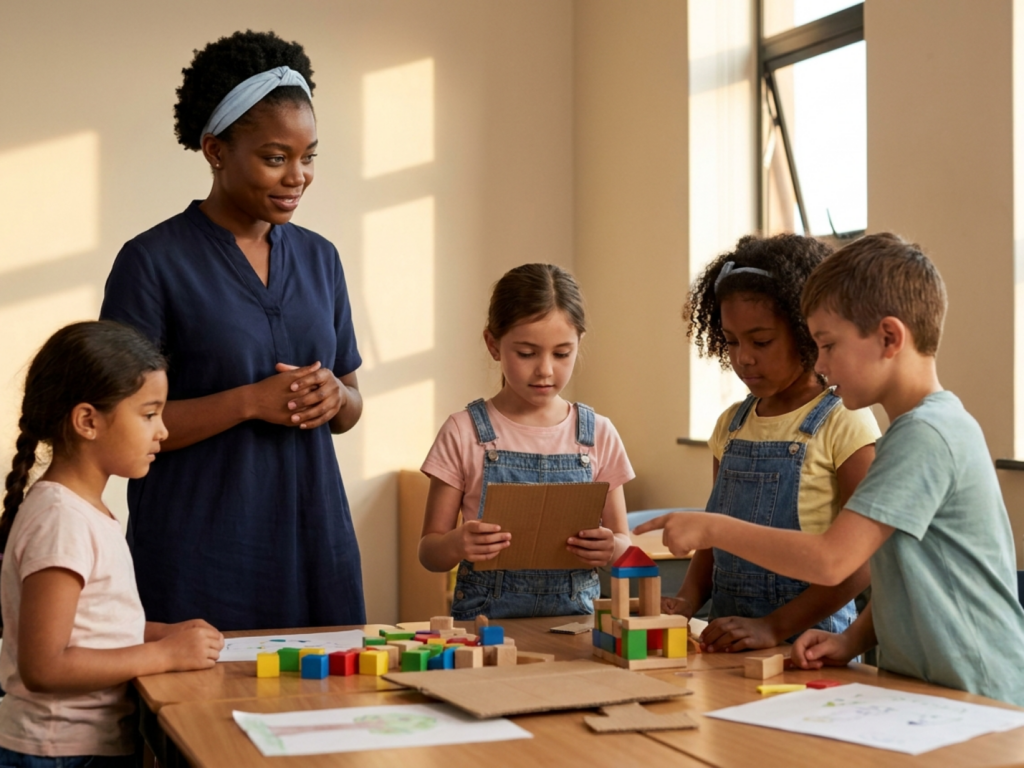
Teamwork asks children to coordinate individual goals with a shared objective. Whether they are constructing a model, planning a performance, solving a science problem, or organizing a game, they must divide tasks, exchange information, listen to alternative ideas, and decide how to proceed. These activities can strengthen communication, flexible thinking, and responsibility when the expectations are appropriate for the child’s developmental level.
Effective collaboration is more than placing children in the same group. The task should have a clear purpose, manageable roles, and opportunities for each participant to contribute. A teacher or caregiver might assign rotating responsibilities such as materials manager, recorder, questioner, or presenter. Rotating roles reduces the likelihood that one confident child always directs the activity while another remains silent. It also lets children practice skills that may not come naturally to them.
Teamwork can promote metacognition, meaning awareness of how one thinks and learns. Children may compare strategies, explain why an answer works, or revise a plan after receiving feedback. However, group work can also increase cognitive load when instructions are unclear or when conflict dominates the task. Adults can help by modeling concise communication, breaking complex work into steps, and pausing for a brief group check-in: What is working, who needs help, and what should change?
Activities that develop teamwork skills through play are especially useful because play allows rehearsal without the pressure of formal evaluation. Cooperative building, turn-taking games, and imaginative scenarios can make negotiation and shared planning engaging while giving adults an opportunity to observe strengths and support needs.
Friendships, emotional support, and academic engagement
Friendships can provide companionship, emotional validation, and a sense of security. A trusted peer may help a child recover after disappointment, feel less alone during a stressful transition, or become more willing to participate in a new setting. Reviews of friendships in academic contexts describe possible links with emotional support, reduced stress, collaborative learning, and improved focus, although the strength and direction of these effects vary across children and environments.
Supportive friendships and self-esteem may reinforce one another. When children experience acceptance and reciprocal interest, they often have more opportunities to practice competence and receive constructive feedback. A friend can encourage persistence with schoolwork or make an unfamiliar activity feel safer. Friendships may also motivate prosocial behavior, such as sharing, helping, including others, and repairing minor disagreements.
Friendship quality matters more than simply having a large number of peers. A relationship characterized by trust, reciprocity, respect for boundaries, and reasonably balanced participation is generally more supportive than one based on fear, status, manipulation, or persistent pressure. Children’s friendships can change quickly, and temporary conflict is common. The goal is not to eliminate every disagreement but to help children develop language for expressing concerns, listening, apologizing when appropriate, and deciding when adult support is needed.
Adults should avoid treating friendship as a reward for good behavior or as a measure of a child’s worth. Some children prefer one close friend, while others thrive in a broader social network. Cultural expectations, communication differences, disability, and personal temperament can influence how children seek connection. Inclusion should therefore focus on meaningful participation and emotional safety rather than conformity to one social style.
When friendship and teamwork do not improve outcomes
It is tempting to assume that children will work best with their friends. Research in collaborative learning has produced a more complicated picture. One empirical study of collaboration found a significant negative association between prior friendship and performance in the setting examined. This does not mean that friendship is harmful or that children should be separated from friends. It shows that familiarity alone does not guarantee effective collaboration and that outcomes depend on the task, group structure, accountability, and relationship dynamics.
Friends may become distracted, reinforce off-task behavior, avoid giving honest feedback, or divide work unevenly because preserving the relationship feels more important than challenging a peer. Conversely, unfamiliar children may bring different ideas and maintain clearer task boundaries. Educational research using social network analysis has also found that friendship and group-work connections can overlap, suggesting that friendship often shapes whom children choose to work with. Choice can increase comfort, but it may also produce exclusion or stable group hierarchies.
A balanced approach gives children some opportunities for choice while also teaching them to collaborate respectfully with a range of peers. Adults can make expectations explicit: every person contributes, decisions are explained, disagreement is permitted, and the group remains responsible for the final result. Assessment or feedback should include individual accountability when appropriate. These safeguards preserve the emotional benefits of friendship without assuming that friends will automatically manage teamwork well.
Negative peer dynamics require particular attention. Teasing, coercion, bullying, social exclusion, rumor-spreading, or repeated pressure to break rules can affect mood, attendance, concentration, and participation. Children may minimize what is happening because they fear losing social standing or upsetting adults. Calm, non-leading questions and regular communication with school personnel can help clarify patterns without blaming the child.
How adults can create healthier peer environments
Adults influence peer interaction through the environments they design and the behavior they model. A classroom, childcare setting, or home activity can make cooperation more likely by using predictable routines, clearly stated rules, accessible materials, and group sizes that match the task. Children need enough time to enter an activity, understand expectations, and recover from small frustrations rather than being judged on a single awkward exchange.
Coaching is often more effective than lecturing. An adult might say, “You both want the same piece. What are two fair solutions?” or “First listen to the idea, then explain your own.” This language teaches problem-solving while respecting the children’s agency. Praise should be specific: noticing another child’s perspective, inviting someone into play, waiting for a turn, or returning to a task after disagreement. Specific feedback helps children identify behaviors they can repeat.
For children who find group interaction difficult, gradual participation may be helpful. Start with a predictable partner activity, then progress to a small group, while allowing an appropriate way to pause or seek assistance. Visual schedules, explicit role descriptions, communication supports, or a quiet space may improve access for children with language, attention, sensory, motor, or neurodevelopmental differences. These supports should be individualized rather than applied as assumptions about a diagnosis.
Caregivers can ask open questions after school: Who did you work or play with? What felt easy? Was anything uncomfortable? What did you do when plans changed? Listening without immediately solving the problem encourages disclosure. If a child reports persistent isolation, fear, physical harm, significant school refusal, sleep disruption, or a marked change in mood or behavior, consult the child’s pediatrician, school counselor, psychologist, or another qualified professional. A coordinated assessment can distinguish ordinary developmental conflict from concerns requiring more structured support.
Building lasting skills through reflection and repair
Peer competence develops through repeated experiences, reflection, and repair rather than through a single lesson. After a group activity, children can discuss what helped everyone participate and what made cooperation harder. A short reflection may ask each child to name one contribution, one challenge, and one plan for next time. This process promotes accountability without turning teamwork into public criticism.
Conflict repair after friendship problems is an important long-term relationship skill. Repair may involve acknowledging harm, clarifying intent, making a practical change, or accepting that a relationship needs more distance. Adults should not force an apology or reunion when a child feels unsafe. Instead, they can help the child identify boundaries, seek support, and consider whether the relationship is reciprocal and respectful.
Healthy peer environments also allow children to maintain multiple forms of connection. A child may have a close friend, participate in a club, work with classmates, and enjoy family relationships without every social need depending on one person. A wider social network can provide resilience when one friendship becomes strained. The overall aim is not popularity; it is access to relationships and group experiences that support dignity, learning, emotional regulation, and age-appropriate independence.
Because social behavior is context-dependent, observations from caregivers and teachers are valuable but should be interpreted carefully. A child may communicate confidently at home and become quiet at school, or manage structured tasks but struggle during unstructured recess. Sharing specific examples with a healthcare or mental health professional can support a more accurate understanding and avoid premature labeling.
When to seek additional support
- Persistent social isolation, fear of peers, or distress before school warrants thoughtful follow-up.
- Repeated bullying, threats, coercion, physical aggression, or online harassment should be reported through appropriate safeguarding channels.
- A sudden change in mood, sleep, appetite, attendance, concentration, or behavior deserves professional attention.
- Do not force a child to remain in a relationship or group activity that feels unsafe.
- Seek urgent help if a child expresses thoughts of self-harm, suicide, or immediate danger.
Tools & Assistance
- Use brief daily check-ins with open-ended questions about play, group work, and belonging.
- Ask teachers for concrete observations of peer interactions across structured and unstructured settings.
- Practice turn-taking games, cooperative building, and role-play at home.
- Consult a pediatrician, school psychologist, counselor, speech-language pathologist, or occupational therapist when concerns persist.
- Create a written communication plan among caregivers and school staff when bullying or repeated exclusion is reported.
FAQ
Should children always be allowed to work with their friends?
Choice can increase comfort and motivation, but friends do not always collaborate effectively. A balanced approach combines some choice with opportunities to work respectfully with different classmates and clear individual accountability.
What is a healthy friendship for a child?
A healthy friendship is generally reciprocal, respectful, and emotionally safe. Children can disagree, but neither child should routinely control, threaten, humiliate, exclude, or pressure the other.
How can I help a child who struggles in groups?
Begin with predictable, small-group activities, model specific communication phrases, and provide roles that make participation clear. If difficulties are persistent or impairing, discuss them with the child’s healthcare professional and educational team.
Is having few friends necessarily a concern?
Not necessarily. Some children prefer one close friend or limited social contact. Concern is more related to distress, loneliness, exclusion, functional impairment, or a significant change from the child’s usual pattern.
What should adults do after a friendship conflict?
Listen calmly, clarify what happened, validate feelings without assigning premature blame, and help the child consider boundaries and repair. Do not force contact if there is intimidation, abuse, or an ongoing safety concern.
Sources
- Stanford University — When Is Collaborating With Friends A Good Idea? Insights from an Empirical Study
- PubMed Central / NIH — The Benefits of Friendships in Academic Settings
- University of Plymouth — Exploring peer relationships, friendships and group work dynamics in higher education: applying social network analysis
Disclaimer
This article is for general educational information and does not diagnose, treat, or replace advice from a qualified healthcare or education professional. Seek professional help for persistent distress, impairment, bullying, or safety concerns.


















Please log in to leave a comment.