
Intro
Motor skills development is one of the most visible parts of childhood growth. From a newborn’s early reflexive movements to a school-age child’s coordinated running, drawing, throwing, and handwriting, each stage reflects ongoing maturation of the brain, nerves, muscles, vision, balance, and sensory systems.
Every child develops at an individual pace, and normal variation is wide. Still, age-based motor milestones can help families, educators, and clinicians notice when a child may benefit from closer observation, enriched play opportunities, or professional assessment.
Highlights
Motor development includes gross motor skills, such as sitting, walking, running, and jumping, and fine motor skills, such as grasping, drawing, dressing, and using utensils.
Chronological age is strongly associated with motor skill progression, but nutrition, health conditions, sleep, opportunities for active play, and sensory experiences also matter.
A missed milestone does not automatically mean a disorder, but persistent asymmetry, loss of skills, or marked delay should be discussed with a healthcare professional.
Supportive practice works best when it is playful, safe, and matched to the child’s current abilities rather than pressured or compared with peers.
What motor skills include
Motor skills are voluntary movement abilities that emerge as the central nervous system matures and the child gains strength, balance, sensory feedback, and practice. They are usually described in two overlapping categories: gross motor and fine motor skills.
Gross motor skills use larger muscle groups of the trunk, neck, arms, and legs. They include head control, rolling, sitting, crawling, pulling to stand, walking, running, climbing, hopping, throwing, catching, and balancing. These skills depend on muscle tone, postural control, vestibular input, vision, proprioception, and cardiopulmonary endurance.
Fine motor skills involve smaller, more precise movements, especially of the hands and fingers. They include reaching, grasping, transferring objects, using a pincer grasp, stacking blocks, turning pages, feeding with utensils, drawing, cutting, buttoning, and handwriting. Fine motor performance also depends on visual-motor integration, tactile processing, attention, and bilateral coordination.
Milestones are best understood as ranges, not strict deadlines. A child may walk slightly later but have advanced language, or draw detailed pictures while still working on ball skills. Clinicians consider the whole developmental profile, medical history, neurological examination, family context, and whether skills are progressing over time.
Infancy: birth to 12 months
In the first year, motor development moves from reflexive, poorly controlled movements toward purposeful postural control and exploration. Early newborn movements include primitive reflexes, such as the palmar grasp and stepping reflex, which gradually integrate as voluntary control improves.
During the first months, babies typically begin lifting the head briefly when prone, bringing hands toward the mouth, and visually tracking caregivers or toys. As neck and trunk strength increase, they usually gain better head control, push up on forearms, roll from tummy to back or back to tummy, and reach for objects.
By the middle of the first year, many infants sit with support and then independently, transfer toys between hands, and begin more refined grasping. Some rock on hands and knees, pivot on the belly, or move by rolling, commando crawling, or creeping. Crawling patterns vary; some healthy infants skip classic hands-and-knees crawling and proceed to pulling to stand.
Near the end of the first year, many babies pull to stand, cruise along furniture, lower themselves with increasing control, and may take independent steps. Fine motor skills often progress from raking objects with the whole hand toward an inferior and then more precise pincer grasp between thumb and index finger. This allows finger feeding and more deliberate exploration of small safe objects.
Support at this age includes supervised tummy time, floor play, safe reaching games, and varied positions while awake. Prolonged time in restrictive devices, such as seats or swings, may reduce opportunities to practice antigravity movement. Any regression, persistent fisting, clear hand preference before 12 months, marked stiffness or floppiness, or feeding and breathing difficulties should prompt professional advice.
Toddler years: 12 to 36 months
Toddlerhood is a period of rapid locomotor growth. Between 12 and 18 months, many children transition from early independent walking to more stable walking, squatting to pick up toys, climbing onto low furniture, and carrying objects while moving. Falls remain common because balance reactions and judgment are still developing.
From 18 to 24 months, toddlers often begin running with limited coordination, walking up stairs with help, kicking a ball, and throwing overhand in an immature pattern. Fine motor abilities improve as they stack blocks, scribble spontaneously, turn several book pages at a time, use a spoon with spills, and remove simple clothing items.
Between 2 and 3 years, many children jump with both feet, climb playground equipment with close supervision, pedal or push ride-on toys, and begin walking up or down stairs using a railing. Hand skills expand to building taller block towers, imitating vertical or circular strokes, turning single pages, and participating in dressing. Toilet learning also requires motor coordination, body awareness, communication, and readiness; it should not be reduced to age alone.
Research in children under 3 supports age as a major predictor of gross motor developmental delay, while also highlighting modifiable factors such as adequate complementary nutrition and playtime. This is a useful reminder that development is biological and environmental: children need both maturation and repeated chances to move safely.
If a toddler is not walking independently by around 18 months, has a very asymmetric gait, frequently toe-walks with tightness, cannot rise from the floor without unusual effort, or loses previously acquired skills, caregivers should seek evaluation. Assessment may involve a pediatrician, developmental specialist, physical therapist, occupational therapist, or neurologist depending on the pattern.
Preschool age: 3 to 5 years
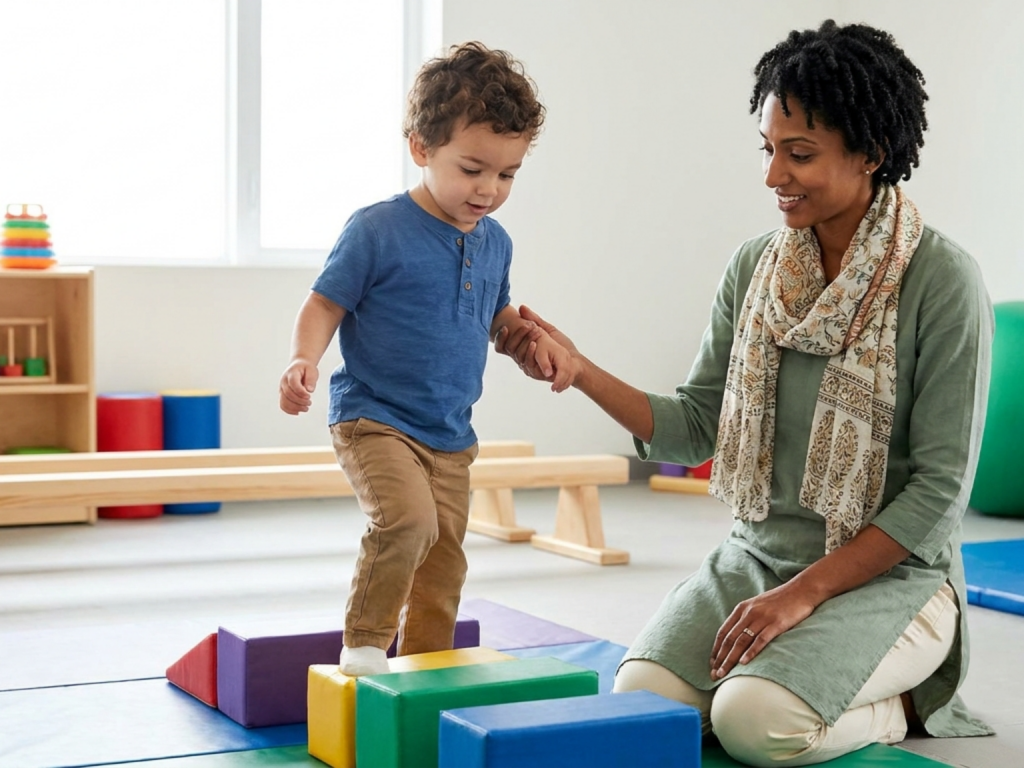
Preschool motor development is characterized by better balance, planning, strength, and bilateral coordination. Children become more capable of combining movements, such as running and kicking, climbing and balancing, or holding paper with one hand while drawing with the other.
At around 3 years, many children run more smoothly, jump from low steps, pedal a tricycle, walk up stairs with alternating feet, and briefly balance on one foot. Fine motor skills often include copying a circle, stringing large beads, using a fork, building block structures, and beginning to snip with child-safe scissors.
By around 4 years, children often hop on one foot, catch a large ball with arms, climb with more confidence, and descend stairs with alternating feet. They may copy a cross, draw a person with several body parts, pour with help, dress with less assistance, and manage some fasteners. Hand dominance may become more apparent, although some variation remains normal.
By around 5 years, many children skip, balance longer on one foot, perform more coordinated jumping, and throw or catch with improving accuracy. Fine motor milestones may include copying a square or triangle, coloring within broad boundaries, cutting along lines, printing some letters, and managing most dressing tasks. These skills prepare the child for classroom demands, but readiness should also account for attention, language, vision, social-emotional development, and fatigue tolerance.
Play-based practice is often more effective than repetitive drills. Obstacle courses, dancing, playground climbing, ball games, puzzles, play dough, drawing, building toys, water play, and pretend cooking can strengthen motor systems while preserving motivation. If a child avoids playground equipment, tires unusually quickly, has persistent drooling or feeding motor problems, struggles markedly with utensils, or cannot keep up with peers despite practice, it is reasonable to discuss screening.
Early school age: 6 to 10 years
From 6 to 10 years, motor development becomes more refined and task-specific. Children typically improve speed, endurance, agility, hand-eye coordination, and the ability to plan sequential movements. Research on basic motor skills across ages 3 to 10 shows significant age-related differences in locomotion, object manipulation, and overall motor development, supporting the importance of chronological age while still recognizing individual variability.
At 6 to 7 years, many children can run with better coordination, skip rhythmically, ride a bicycle with training progression, throw and catch smaller balls, and participate in organized games with simple rules. Fine motor skills support clearer handwriting, more accurate cutting, tying shoelaces for some children, and using school tools such as glue, rulers, and keyboards.
At 8 to 10 years, children often show greater precision in sports, dance, martial arts, swimming, cycling, and playground games. They can learn more complex movement sequences, adjust force more accurately, and sustain activity for longer periods. Fine motor control usually supports faster handwriting, crafts, musical instruments, model building, and more independent self-care.
Academic environments can make motor differences more visible. A child with weak core stability may slump or fatigue during desk work. A child with poor visual-motor integration may understand a lesson but struggle to copy from the board. A child with coordination difficulties may avoid sports because repeated failure affects confidence. These patterns deserve empathy, not criticism.
Concerns at this age may include persistent clumsiness, frequent injuries beyond expected play, severe handwriting fatigue, difficulty learning bicycle riding or ball skills despite instruction, or avoidance of daily tasks requiring coordination. Evaluation can identify whether vision, vestibular function, strength, joint hypermobility, attention, anxiety, developmental coordination disorder, or another factor may be contributing.
What influences motor development
Motor development is shaped by interacting biological and environmental factors. Prematurity, low birth weight, genetic conditions, neuromuscular disorders, cerebral palsy, congenital orthopedic differences, chronic illness, visual or hearing impairment, and prolonged hospitalization can all affect motor trajectories. Some children also have differences in muscle tone, joint stability, sensory processing, or motor planning.
Nutrition is important because movement depends on growth, muscle function, bone health, and energy availability. Iron deficiency, vitamin D deficiency, insufficient caloric intake, or feeding problems may contribute to fatigue or delayed progress, although they are only one part of the assessment. Sleep, pain, respiratory symptoms, and medication effects can also influence activity tolerance.
Opportunity matters. Children need safe floor time, outdoor play, climbing, reaching, carrying, drawing, building, and self-care practice. Cultural caregiving practices, housing space, access to playgrounds, screen time, and caregiver stress can affect how often children practice movement. This does not mean families are to blame; it means support should include practical, realistic ways to create movement opportunities.
Temperament also plays a role. A cautious child may master a skill later because they need more observation before trying. A highly active child may practice gross motor skills frequently but need help slowing down for fine motor tasks. Neurodevelopmental differences can alter attention, imitation, sensory tolerance, and persistence.
Because so many factors overlap, a single missed milestone should be interpreted carefully. The key clinical questions are whether the child is gaining skills, whether the pattern is symmetric and functional, whether other developmental domains are affected, and whether there are neurological or medical red flags.
How caregivers can support motor progress
Supportive motor practice should be safe, frequent, and enjoyable. Children learn movement through exploration, repetition, feedback, and success that feels meaningful. The goal is not to accelerate development artificially, but to provide the body and brain with appropriate chances to practice.
- For infants, prioritize supervised tummy time, reaching for toys, side-lying play, and time on a safe floor surface while awake.
- For toddlers, offer climbing, pushing and pulling toys, ball play, music-and-movement games, chunky crayons, blocks, and self-feeding practice.
- For preschoolers, use obstacle courses, tricycles or balance bikes, playground play, scissors with supervision, drawing, puzzles, and dressing routines.
- For school-age children, encourage swimming, cycling, dance, team or individual sports, crafts, cooking tasks, handwriting breaks, and activities that match the child’s interests.
Safety remains essential. Use helmets for wheeled activities, age-appropriate playgrounds, supervision near water, and safe storage of choking hazards. Avoid forcing painful stretches or pushing a child through fear. If a child consistently refuses a task, consider whether it is too hard, too sensory-intense, painful, or associated with embarrassment.
When concerns persist, early referral can be helpful. Physical therapists address strength, balance, gait, posture, and gross motor function. Occupational therapists often support fine motor skills, visual-motor integration, sensory regulation, feeding, dressing, and school participation. Speech-language pathologists may help if oral-motor feeding or communication issues coexist. A pediatric clinician can coordinate evaluation and determine whether further medical testing is appropriate.
Seek professional advice promptly if you notice
- Loss of previously acquired motor skills at any age.
- Marked asymmetry, such as consistently using only one side or dragging one limb.
- Very stiff, very floppy, or painful movements.
- No independent walking by about 18 months, or a major change in gait.
- Frequent choking, poor feeding coordination, or breathing difficulty with activity.
- Motor delay together with seizures, vision concerns, or significant developmental concerns in other areas.
Tools & Assistance
- Discuss milestone concerns with the child’s pediatrician or family doctor.
- Ask about developmental screening at routine well-child visits.
- Request referral to pediatric physical therapy or occupational therapy when functional concerns persist.
- Use safe daily play routines that include floor time, outdoor movement, drawing, building, and self-care practice.
- Contact early intervention or school-based support services if available in your region.
FAQ
Do all children reach motor milestones at the same age?
No. Milestones occur across ranges. What matters most is steady progress, functional movement, and absence of concerning neurological or medical signs.
Is skipping crawling always a problem?
Not always. Some children move by rolling, bottom-shuffling, or pulling to stand before walking. Persistent asymmetry or broader delays should be assessed.
When should I ask for help with handwriting or fine motor skills?
Consider asking if handwriting causes pain, severe fatigue, avoidance, very slow work, or difficulty keeping up despite appropriate teaching and practice.
Can more playtime really affect motor development?
Yes. Active, varied, safe play gives children repeated practice with balance, strength, coordination, and hand skills, which supports motor learning.
Sources
- Frontiers in Public Health — Development of gross motor skills in children under the age of 3 years
- National Center for Biotechnology Information / PubMed Central — Development of Basic Motor Skills from 3 to 10 Years of Age
- OpenStax — 5.2 Motor Development and Physical Skills in Early Childhood
Disclaimer
This article is for informational purposes only and is not a diagnosis or treatment plan. Consult a qualified healthcare professional for concerns about a child’s development or health.














Please log in to leave a comment.