

Intro
Creativity in childhood is not a luxury or a talent reserved for a few. It is a living part of development that supports cognitive flexibility, language, motor planning, social problem-solving, and emotional expression. Many children become more inventive when they are given time, materials, and permission to explore rather than only follow fixed instructions.
For parents, teachers, and caregivers, the goal is not to force originality. It is to create conditions where children feel safe experimenting, making mistakes, asking questions, and combining ideas in new ways. Research in early childhood education suggests that structured, intentional activities can be especially helpful, including small-group drawing and imaginative tasks, art, drama, and family involvement.
Highlights
Creativity grows best when children have both freedom and gentle structure, not pressure to perform.
Simple activities such as drawing, storytelling, crafting, and pretend play can support divergent thinking and self-expression.
Creative routines can strengthen fine motor skills, language skills, executive function, and social adjustment.
Children vary widely in temperament and developmental pace, so activities should be age-appropriate and flexible.
If a child has persistent concerns with play, language, attention, or sensory tolerance, a pediatric professional can help assess next steps.
Why creativity matters in child development
Creativity is often described as the ability to generate original and useful ideas. In children, it also includes curiosity, symbolic thinking, flexible attention, and the confidence to try something unfamiliar. These abilities are not separate from everyday development; they are woven into play, language, motor skills, and social learning.
Studies of childhood creativity have linked creative engagement with positive social and behavioral adjustment later in childhood. That does not mean every drawing session changes a child’s future. It does mean that creative experiences can support broader developmental skills, including persistence, perspective-taking, and communication. When children invent a story or redesign a craft project, they practice planning, self-regulation, and problem-solving.
Creative activities can also be emotionally protective. A child who is unsure how to explain a feeling may communicate it through paint, movement, or pretend play. This can be especially helpful for children who are shy, highly active, or still building language. The key is not artistic perfection. The key is the process of exploration itself.
Principles that make activities creativity-friendly
The most effective activities usually share a few traits: they are open-ended, age-appropriate, and low in judgment. Open-ended materials invite more than one solution. A box of paper scraps, blocks, fabric, clay, or markers can become many different things, which encourages divergent thinking rather than one correct answer.
Research in early childhood settings suggests that structured, intentional activities can be especially beneficial when they are designed to allow exploration. In practice, that means a caregiver can set up a clear invitation such as a drawing table, a dramatic play corner, or a simple science tray, then step back enough for the child to lead. Short instructions are often better than long lectures.
Helpful principles include:
- Offer choice whenever possible, such as color, material, or theme.
- Use process-focused feedback for children, for example, “You tried a new idea,” instead of judging the final product.
- Keep materials accessible so children can return to them independently.
- Allow repetition; children often build creativity through revisiting the same idea in new ways.
These principles reduce pressure and make experimentation feel safe.
Art activities that support imagination and fine motor skills
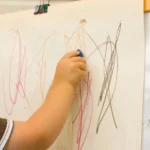
Art is one of the simplest ways to encourage creativity because it naturally combines sensory exploration, decision-making, and motor practice. Drawing, painting, collage, clay work, stamping, and mixed-media projects all invite children to test ideas. In a group setting, small-group drawing can be particularly effective because it combines modeling, observation, and peer inspiration without overwhelming the child.
Try offering a theme with broad possibilities, such as “make a place where animals could live” or “draw a machine that helps at home.” This gives enough structure to reduce hesitation, but not so much structure that the child only copies an example. Children can also benefit from revisiting the same materials over time. A simple sketchbook, a reusable tray of crayons, or a clay basket can become a reliable creative routine.
For younger children, sensory-based art may be more engaging than detailed craft instructions. Finger painting, sponge painting, tearing paper, and shape stamping are useful because they emphasize exploration. For older children, combining art with storytelling, labels, or design challenges can add language and planning demands.
Keep in mind that messy art is still meaningful art. Clean, perfect results are less important than the child’s own ideas.
Storytelling, drama, and pretend play
Storytelling and dramatic play are powerful creativity activities because they ask children to create characters, sequence events, and solve imaginary problems. A child who acts out a veterinarian visit, a store, or a superhero rescue is practicing symbolic thinking and social imagination. These are important building blocks for communication and cooperation.
Simple props can support this kind of play without taking over. A blanket, cardboard box, stuffed animal, puppet, or set of dress-up items can become the starting point for a story. Open-ended materials for pretend play are especially helpful because they do not dictate the outcome. The child decides what they mean and how they will be used.
Adults can enrich the play by asking curious questions rather than directing the scene. For example: “What happens next?” “Who else is in the story?” or “How does your character feel now?” This keeps the child in control while encouraging narrative development and emotional expression.
Families can also use daily routines for storytelling. A car ride, a bedtime conversation, or a picture book can become a prompt for inventing new endings or alternate viewpoints. These moments are small, but they accumulate into a richer creative environment.
Movement, science, outdoor exploration, and family involvement
Creativity is not limited to the art table. Movement games, science tasks, math puzzles, and outdoor exploration all build flexible thinking in different ways. The same child who invents a dance may also enjoy sorting leaves by shape, designing a bridge from blocks, or predicting which objects will sink in water. These activities engage attention, reasoning, and trial-and-error learning.
Trips and everyday excursions can also spark creative thinking. A walk in the park can become a shape hunt, a color hunt, or a story seed for later drawing. A trip to the grocery store can turn into a game of designing a meal or comparing textures and categories. When families take part, children often feel more motivated because creativity is embedded in shared experience rather than framed as schoolwork alone.
Science and math activities work best when they are concrete and playful. Building towers, measuring ingredients, observing shadows, or mixing colors helps children see patterns and test hypotheses. This kind of playful experimentation is a gentle form of problem-solving that supports later school readiness without feeling like a test.
Family involvement matters because children imitate the adults around them. When caregivers show curiosity, tolerate mistakes, and enjoy making things together, children are more likely to take creative risks.
How to adapt creative activities for age, temperament, and neurodiversity
Not every child approaches creativity in the same way. Some children jump into messy materials immediately, while others need time, predictability, or a clear model before they begin. Children with sensory sensitivities may dislike sticky, noisy, or highly stimulating activities. Others may need extra support with attention, language, or fine motor coordination. These differences are common and do not mean a child is less creative.
For younger children, keep activities short, concrete, and highly tactile. For school-age children, longer projects and collaborative tasks may work better. For children who prefer routine, a predictable creative schedule can be reassuring. A weekly art box, a regular storytelling time, or a repeated building challenge may reduce anxiety and increase participation. In contrast, children who become bored easily may do better with variation and choice.
Neurodivergent children may benefit from sensory adaptations for creative play, such as quieter spaces, larger tools, washable materials, or visual schedules. The goal is participation, not compliance. If a child resists an activity, it may help to adjust the environment rather than assume lack of interest. Creativity often appears after the child feels regulated and safe.
When adults offer age-appropriate creative hobbies and respond with patience, children are more likely to develop confidence and originality over time.
When to seek extra support
Most children do not need formal evaluation to enjoy creative activities. Still, it is reasonable to speak with a pediatrician, occupational therapist, speech-language pathologist, or mental health professional if concerns persist. For example, a child who rarely engages in play, has marked difficulty with symbolic or pretend play, shows ongoing language delays, or becomes distressed by ordinary sensory experiences may benefit from a professional review.
It is also worth seeking help if creative frustration is accompanied by broader concerns such as loss of skills, severe rigidity, persistent attention problems, or social withdrawal. These signs do not point to a single explanation on their own, and they are not a diagnosis. They simply suggest that a more complete developmental assessment may be useful.
In most cases, the best next step is gentle observation. Notice what the child enjoys, what triggers resistance, and what kind of support helps them start. Share those observations with a qualified professional if needed. That collaborative approach is usually far more helpful than trying to push creativity through pressure.
When to pause and ask for help
- Do not force a child to continue an activity that causes distress, panic, or sensory overload.
- Seek professional advice if play skills, language, attention, or social interaction seem significantly delayed or lost.
- Do not interpret messy art, quiet play, or brief interest as failure; children develop at different rates.
- If behavior changes are sudden or concerning, consult a healthcare professional rather than assuming a creative issue.
Tools & Assistance
- A small art box with paper, crayons, child-safe scissors, glue, and recycled materials
- A simple storytelling basket with puppets, fabric pieces, and open-ended props
- A weekly family or classroom creative time with no screen distractions
- A pediatrician, occupational therapist, or speech-language pathologist for developmental concerns
FAQ
What activities most often encourage creativity in children?
Drawing, storytelling, crafts, painting, drama, building, and pretend play are all strong options because they let children make choices and test ideas.
Should I correct my child’s art or stories?
Usually it is better to support the process than correct the result. Gentle prompts and process-focused feedback often encourage more creative confidence.
What if my child does not like messy activities?
That is common. Try quieter or more structured options such as blocks, stickers, storytelling, simple science tasks, or controlled art materials.
Can creativity help with social skills?
Creative play can support cooperation, perspective-taking, language use, and emotional expression, which may benefit social development.
Sources
- Springer — Enhancing Children’s Creativity in Early Childhood Education and Care: A Systematic Review and Multivariate Meta-Analysis of Studies Between 1969 and 2019
- PubMed Central (NIH/NLM) — Effects of creativity on social and behavioral adjustment in 7-year-old children
- PubMed Central (NIH/NLM) — Promoting creativity in early childhood education
Disclaimer
This article is for educational purposes only and is not a substitute for individualized medical or developmental advice. If you have concerns about a child’s development, behavior, or sensory tolerance, consult a qualified healthcare professional.

















Please log in to leave a comment.