
Intro
Curiosity is one of the most natural ways children learn. When a child reaches, asks, repeats, sorts, tests, or imagines, the brain is building language, attention, memory, and problem-solving at the same time. At home, curiosity does not need a formal classroom to grow. It needs warmth, safety, time, and adults who are willing to notice what captures a child’s interest.
A supportive home learning environment is less about perfect materials and more about the quality of the interactions around them. Small changes, such as leaving out open-ended toys, slowing down during routines, and responding to questions with patience, can make a big difference. The goal is not to push children to perform. It is to help them feel secure enough to explore, make mistakes, and keep going.
Highlights
Curiosity grows best when children feel safe, respected, and free to explore at their own pace.
A home can support learning with simple, open-ended materials and predictable routines.
Adult language matters: modeling wonder and asking thoughtful questions can deepen thinking.
Daily tasks and outdoor moments can become rich learning opportunities without pressure.
Different ages and temperaments need different levels of structure, movement, and sensory support.
Why curiosity matters in early learning
Curiosity is not a distraction from learning; it is one of the main engines of learning. Harvard Graduate School of Education describes curiosity as a force that can unlock learning when children are allowed to wonder, play, and investigate in an environment that feels safe. A child who is genuinely interested is more likely to pay attention, remember what happened, and try again after a mistake.
This matters at home because family life offers repeated chances to build that pattern. A child who wonders why the moon changes shape, how a spoon balances, or where rain goes after it falls is practicing observation and inference. Those are not small skills. They are the building blocks of scientific thinking, language growth, and later school learning. The adult role is to protect the spark rather than rush to the answer. When children sense that their questions are welcome, they usually ask more, explore more, and persist longer. That persistence is one reason curiosity is so closely linked to independent learning skills in children.
Design a home that invites exploration
The physical environment can either support or interrupt curiosity. Children explore with their hands, eyes, mouths, and whole bodies, so a thoughtful space helps them move from interest to action. Low shelves, a few sturdy books, blocks, crayons, simple puzzles, measuring cups, and safe household objects can all invite exploration. The aim is not to make every room look like a classroom. It is to make important materials visible, reachable, and easy to return after use.
Rotating toys and tools can keep the environment fresh without overwhelming the child. Too many options can create sensory load, make decisions harder, and reduce follow-through. A smaller set of materials often leads to deeper play. Open-ended objects are especially valuable because there is no single correct way to use them. A box can become a garage, a rocket, or a pretend stove. This is one reason play-based preschool learning is so effective: children practice planning, imagination, and problem-solving while they are actively engaged. For toddlers, childproofing by developmental stage helps adults reduce hazards while preserving room for discovery. That balance lets the child explore without hearing constant correction.
Whenever possible, place materials where the child can access and clean them up independently. Small acts of self-direction, such as choosing a book or returning blocks to a basket, build confidence and make the home feel more like a shared learning space.
Use language that expands thinking
Conversation is one of the simplest and most powerful learning tools available at home. NAEYC recommends modeling wonder and using open-ended questions, especially with infants and toddlers. Instead of focusing only on right answers, try prompts that invite observation and prediction: What do you notice? What do you think will happen next? How could we try that another way? These questions tell children that their ideas matter.
With very young children, narration works well. An adult might describe what the child is doing, what changed, or what stayed the same. That kind of language supports vocabulary, attention, and pattern recognition without turning play into a test. For older children, curiosity can become a shared investigation. You can count, compare, sort, estimate, test, and discuss results together. It also helps to pause before answering too quickly. A small wait time gives children a chance to think, and it communicates respect for their process. When adults model curiosity instead of only delivering facts, children learn that learning is active rather than passive.
Children also benefit from hearing adults think out loud in a calm way. Saying that you are unsure, that you want to look something up, or that you need to try again shows that uncertainty is normal. That message can reduce fear of mistakes and support persistence.
Turn everyday routines into learning opportunities
Many of the richest learning experiences at home happen during ordinary routines. Cooking can teach counting, measuring, sequencing, and safety. Laundry can teach sorting, matching, and categorizing. Setting the table can teach one-to-one correspondence. A trip to the store can support planning and language as a child names shapes, compares sizes, or helps choose ingredients. These moments are useful because they are meaningful. The child sees a real purpose for the activity and is more likely to stay engaged.
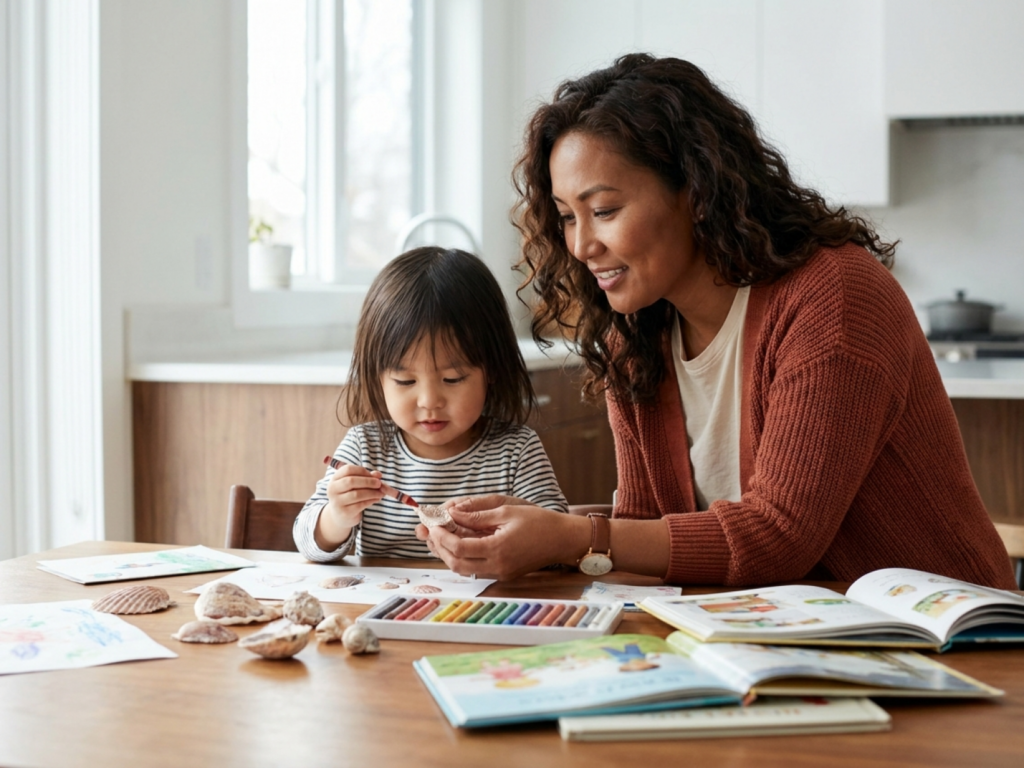
The Greater Good Science Center at the University of California, Berkeley encourages families to nurture wonder by noticing small changes together and by making space for shared observation. Nature is especially good for this. A leaf, cloud, puddle, seed, or insect can hold attention far longer than a screen because it changes in subtle ways. If you can, keep a simple wonder kit nearby: crayons, a notebook, a magnifying glass, or a small basket for safe natural objects. None of these tools needs to be fancy. Their value comes from helping the child slow down, look closely, and talk about what they see.
Over time, these routines build self-direction, patience, and independent learning skills in children because the child learns to choose, test, and revise without needing constant adult rescue.
Adjust for age, temperament, and sensory needs
Children do not all show curiosity in the same way. Some rush toward new experiences, while others watch quietly before joining in. Some learn best through movement and repetition; others prefer calm, focused tasks. A home learning environment works better when it respects those differences rather than expecting one style to fit everyone. For infants and toddlers, sensory exploration may be enough. For school-age children, curiosity often grows through projects with a beginning, middle, and end. Both approaches are valid.
If a child seems easily overwhelmed, it may help to lower noise, reduce clutter, and keep transitions predictable. A quieter room, fewer choices, and a steady routine can make exploration feel safer. Some children also need more time to warm up before they try something new. That does not mean they lack interest. It may mean they need a gentler entry point. In families where there are concerns about speech, motor skills, attention, or frequent frustration, it is wise to speak with a pediatrician or another qualified professional. An occupational therapist or speech-language pathologist may be able to help you understand whether the child needs extra support or a different approach. A careful evaluation can protect curiosity by removing barriers that are getting in the way of participation.
Protect curiosity from stress and overstructure
Curiosity grows best in a setting that balances freedom with dependable limits. Too much structure can make children afraid to experiment. Too little structure can make exploration feel chaotic. The sweet spot is a warm routine with enough flexibility for choice. Clear expectations around sleep, meals, cleanup, and safety help children feel settled, and a settled child is usually a more curious child.
It can also help to praise effort, persistence, and thoughtful questions rather than only the final product. If a child says something feels hard, respond with calm problem-solving instead of urgency or criticism. A smaller step, a different tool, or a short break may be enough to restart engagement. This is not about lowering expectations. It is about matching the task to the child’s current developmental capacity.
Adults can strengthen curiosity by modeling it themselves. When a caregiver wonders aloud about a plant leaning toward the window, a recipe changing texture, or a bird returning to the same branch, the child sees that learning is lifelong. That attitude supports executive function, language growth, and emotional resilience. Most importantly, it tells the child that questions are welcome at home. That sense of welcome is often what allows curiosity to become a lasting habit.
Important safety reminders
- Keep small parts, sharp tools, hot liquids, and chemicals out of reach during exploration.
- Supervise water play, even in shallow containers or bath time.
- Do not overcrowd the play area; too much clutter can increase frustration and risk.
- If a child has persistent concerns with language, movement, attention, or play, seek professional evaluation.
- Use screens thoughtfully; passive screen time should not replace hands-on interaction and conversation.
Tools & Assistance
- A low shelf or basket system for rotating books, blocks, and art materials
- Simple household objects for open-ended play, such as cups, boxes, spoons, and fabric scraps
- A short daily nature walk or outdoor observation routine
- A notebook for wonder questions, drawings, and small discoveries
- A pediatrician, occupational therapist, or speech-language pathologist if developmental concerns arise
FAQ
How much structure does a child need at home?
Enough predictability to feel safe, plus regular time and materials for free exploration. Many children do best with a stable routine and a few flexible choices.
What if my child asks endless questions?
That is usually a strength, not a problem. Answer simply when you can, ask a question back, and admit when you do not know something.
Are worksheets necessary for learning at home?
Not for building curiosity. Hands-on play, conversation, chores, reading, and outdoor observation can teach a great deal.
When should I ask for help?
If you are concerned about speech, behavior, attention, motor skills, or a child who seems persistently overwhelmed, speak with a pediatrician or another qualified professional.
Sources
- Harvard Graduate School of Education — How Curiosity Can Unlock Learning for Every Child
- NAEYC — Rocking and Rolling. Fostering Curiosity in Infants and Toddlers
- Greater Good Science Center, University of California, Berkeley — Take-Home Skill: Nurturing Children's Wonder and Curiosity
Disclaimer
This article is for general educational purposes only and is not a substitute for medical or developmental assessment. If you have concerns about a child’s learning, behavior, safety, or development, please consult a pediatrician or other qualified professional.


















Please log in to leave a comment.