
Intro
At 11 months, many babies seem to be standing at the doorway between infancy and toddlerhood. Your baby may be pulling up, cruising along furniture, pointing, copying sounds, protesting separations, or showing strong opinions about food, sleep, and play. This can be joyful and exhausting at the same time, especially when every new skill brings new safety questions.
Development at this age is best viewed as a range, not a strict checklist. Some 11-month-olds are already taking a few independent steps, while others are focused on crawling, kneeling, or perfecting fine motor control. What matters most is steady progress, social engagement, and the absence of concerning signs such as loss of previously acquired skills. If you are worried, a pediatric clinician can assess your baby’s neurologic, sensory, motor, and communication development and guide next steps.
Highlights
Most 11-month-olds are approaching 1-year milestones such as pulling to stand, cruising, using gestures, and exploring objects with more precise hand control.
Communication is often a mix of babbling, imitation, pointing, waving, and understanding simple phrases like “no” or “come here.”
Feeding becomes more independent, but breast milk or formula usually remains an important nutrition source until around the first birthday unless a clinician advises otherwise.
Variation is common, but developmental regression, persistent asymmetry, poor visual or auditory response, or very limited social engagement should be discussed promptly.
What 11-month development usually looks like
By 11 months, the infant brain is rapidly integrating motor planning, sensory feedback, memory, and social communication. Babies are learning that their actions have consequences: a dropped spoon makes a sound, a parent responds to a gesture, and furniture can be used to move across a room. This is why everyday routines often become learning laboratories.
Many babies at this age are close to the developmental profile described for the 1-year visit. They may pull to stand, move from sitting to crawling or kneeling, cruise while holding furniture, and use their hands more precisely. They may also look for hidden objects, copy simple gestures, and show preferences for familiar people.
It is normal for skills to emerge unevenly. A baby who is highly focused on movement may seem less interested in words for a few weeks, while another baby may babble constantly but be cautious about standing. Development differences between babies are expected, but the overall trajectory should move forward over time.
Gross motor milestones: standing, cruising, and early steps
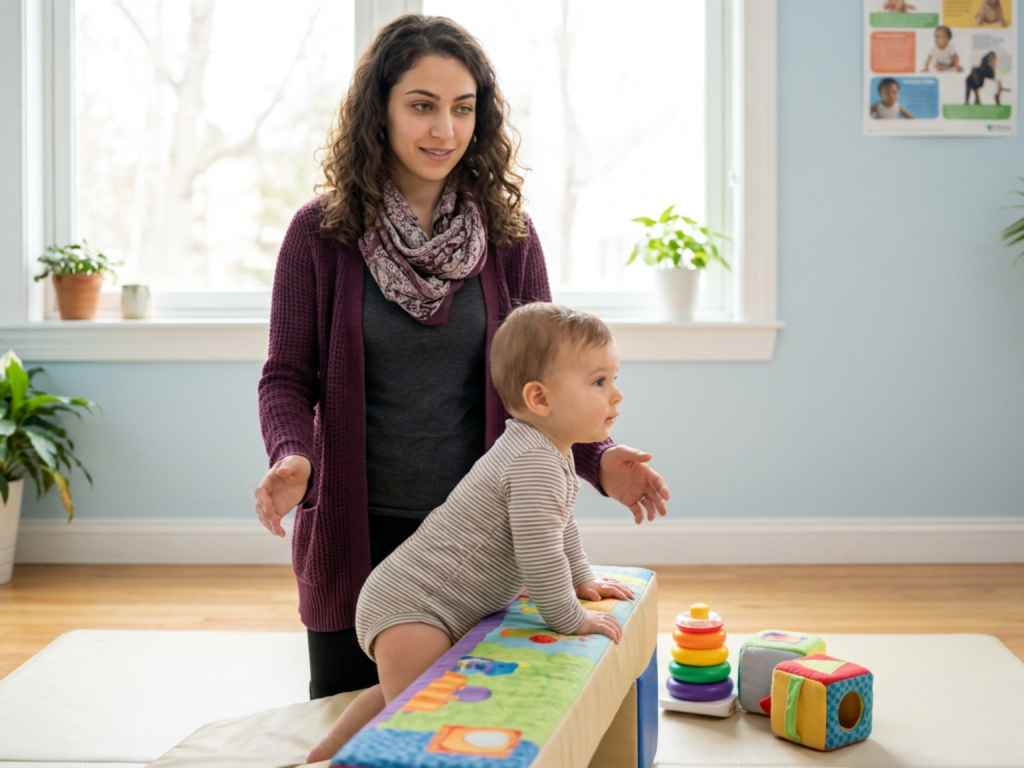
Gross motor development at 11 months often centers on vertical movement. Many babies pull to stand using a sofa, crib rail, or caregiver’s hands. Some lower themselves carefully from standing to sitting, while others still “plop” down and need close supervision. Cruising, which means stepping sideways while holding furniture, is common near this age and helps build balance, hip stability, and motor confidence.
Some 11-month-olds crawl quickly, creep on hands and knees, bottom-shuffle, or use another pattern to move. A few may stand briefly without support or take first steps, but independent walking is not required at 11 months. Infant gross motor development is influenced by temperament, opportunities for floor play, muscle tone, prematurity, illness, and individual neurologic maturation.
- Offer safe floor play for babies several times daily, with space to crawl, pivot, kneel, pull up, and cruise.
- Anchor furniture, block stairs, and remove unstable objects that could tip when used for support.
- Use barefoot play indoors when safe, because foot sensation helps balance and postural control.
- Avoid baby walkers with wheels, which increase injury risk and do not teach mature walking mechanics.
Fine motor skills and hand coordination
Fine motor development in infancy becomes more refined around 11 months. Many babies use an emerging pincer grasp, picking up small pieces of food or objects between the thumb and index finger. They may transfer toys from one hand to the other, bang objects together, place items into containers, and poke with one finger. These movements reflect improving corticospinal control, visual-motor integration, and sensory processing.
Expect plenty of repetition. Dropping, filling, emptying, stacking, and knocking down are not misbehavior; they are experiments in cause and effect. Offer safe household objects such as nesting cups, soft blocks, large board books, and containers with easy-to-grasp toys. Avoid small objects, button batteries, magnets, coins, and foods that pose choking hazards.
If one hand is consistently ignored, one side of the body seems weak, or your baby has persistent infant movement asymmetry, discuss it with a pediatric professional. Early assessment can help distinguish normal preference from a motor concern that may benefit from therapy.
Language, gestures, and social communication
At 11 months, early communication milestones are often more visible than true spoken vocabulary. Many babies babble with repeated syllables such as “mama,” “dada,” or “baba,” though they may not always use them specifically. They may respond to their name, understand “no” in context, follow a simple direction with a gesture, wave bye-bye, lift their arms to be picked up, or point to request help.
Receptive language, meaning what a baby understands, usually develops before expressive speech. Your baby may look toward a familiar object when you name it, pause when you say “stop,” or copy a clap during a song. These behaviors show that hearing, attention, memory, and social reciprocity are working together.
- Use short, warm phrases during daily care: “Cup up,” “Socks on,” “Daddy is here,” or “More banana?”
- Label what your baby sees and does rather than drilling words.
- Pause after speaking so your baby can gesture, vocalize, or look back at you.
- Read board books daily, even if your baby mostly chews, turns pages, or points.
Contact a clinician if your baby does not respond to sounds, rarely makes eye contact, does not use gestures, or loses communication skills they previously had.
Cognitive and emotional development
Object permanence is stronger now, so your baby understands that you still exist when you leave the room. This cognitive leap is one reason separation anxiety can intensify around 11 months. A baby may cry when a parent leaves, cling in unfamiliar settings, or become wary of strangers. Although emotionally difficult, this often reflects healthy attachment and growing memory.
Play becomes more purposeful. Your baby may search for a toy hidden under a cloth, imitate brushing hair, press buttons to make sounds, or repeat an action that made adults laugh. They are also learning social boundaries: “no” may become fascinating, and testing limits is part of learning how people respond.
Support social-emotional development in infancy with predictable routines, affectionate responses, and simple boundaries. For example, say “I won’t let you pull the cord” while moving the baby to a safe activity. Consistency helps babies feel secure without expecting them to have toddler-level self-control.
Feeding and self-feeding at 11 months
Many 11-month-olds are enthusiastic, messy self-feeders. They may pick up soft finger foods, drink small amounts from an open cup or straw cup with help, and show clear preferences. Their oral-motor skills are improving, but choking prevention remains essential. Foods should be soft, appropriately cut, and supervised closely.
Breast milk or infant formula commonly remains a major source of nutrition until about 12 months. Solid foods add iron, zinc, protein, healthy fats, texture practice, and family-food exposure. Offer iron-rich foods such as soft meat, fish without bones, eggs if tolerated, beans, lentils, tofu, or iron-fortified cereals. Introduce allergenic foods according to your clinician’s guidance, especially if your baby has eczema, known food allergy, or other risk factors.
Appetite often fluctuates. Growth velocity slows compared with early infancy, and babies may eat more one day and less the next. Avoid forcing bites; instead, provide regular meals and snacks, model eating, and let your baby practice. Speak with a healthcare professional if feeding is persistently stressful, weight gain is concerning, swallowing seems difficult, or coughing and choking occur frequently during meals.
Sleep, routines, and daily rhythm
At 11 months, many babies sleep about two naps per day, though some begin moving toward one longer nap closer to toddlerhood. Night waking can reappear during teething, illness, separation anxiety, travel, or major motor leaps such as pulling to stand in the crib. A baby who practices standing may need help learning how to sit back down safely.
A calming bedtime routine can reduce stress for both baby and caregiver. Keep it predictable: feeding, bath or wipe-down, pajamas, book, song, and crib. Place the baby on their back for sleep in a safe sleep space, and keep the sleep area free of loose blankets, pillows, and soft objects unless your healthcare professional has given individualized advice based on age and safety standards in your region.
If sleep problems are severe, sudden, or associated with breathing pauses, poor feeding, persistent vomiting, fever, or developmental concerns, seek medical advice rather than assuming it is only a regression.
How to support development safely
The most effective developmental support is usually simple, responsive, and repeated. Babies learn through warm interaction, movement, imitation, sensory exploration, and safe practice. You do not need expensive toys or a rigid teaching program.
- Practice supervised tummy time while awake if your baby still enjoys it, and vary positions with sitting, crawling, kneeling, and cruising opportunities.
- Sing repetitive songs with gestures, such as clapping or waving, to combine rhythm, language, and imitation.
- Play “hide and find” games with toys to strengthen memory and object permanence.
- Offer safe containers for putting objects in and taking them out to build hand skills.
- Talk through routines in real time, because ordinary care is rich language input.
Developmental screening questionnaires at well-child visits can help identify concerns early. Screening does not label a child; it organizes observations and helps decide whether reassurance, monitoring, hearing or vision testing, or early intervention services for infants may be appropriate.
When to talk to a healthcare professional
Trust your observations. Parents and caregivers often notice subtle changes before anyone else. A single missed milestone does not automatically mean a disorder, but certain patterns deserve timely discussion with a pediatrician, family physician, health visitor, developmental specialist, or early intervention program.
Ask for guidance if your 11-month-old does not bear weight on legs when supported, cannot sit without help, does not attempt to move toward objects, uses one side of the body much more than the other, does not respond to sounds, does not seem to see well, rarely smiles or shares attention, does not babble, or does not use gestures such as reaching, waving, or pointing. Developmental regression in babies, meaning loss of previously acquired skills, should always be evaluated promptly.
For babies born preterm, clinicians often use corrected age for preterm babies when interpreting milestones. This adjustment can make the developmental picture more accurate and reduce unnecessary worry while still allowing appropriate surveillance.
Seek medical advice promptly if
- Your baby loses previously acquired motor, language, feeding, or social skills.
- Your baby does not respond to sounds, does not track visually, or seems unusually difficult to engage.
- There is persistent stiffness, floppiness, tremor, or strong asymmetry between the two sides of the body.
- Feeding involves frequent choking, coughing, blue color change, poor weight gain, or repeated vomiting.
- You have any urgent concern about breathing, consciousness, fever, injury, dehydration, or seizure-like activity.
Tools & Assistance
- Schedule the 12-month well-child visit and bring a written list of milestone questions.
- Use a developmental screening questionnaire provided by your pediatric clinic or local child health service.
- Create a safe movement area with anchored furniture, blocked stairs, and choking hazards removed.
- Track new skills, regressions, feeding concerns, sleep changes, and caregiver observations in a simple notes app.
- Ask about early intervention services if delays, sensory concerns, or motor asymmetry are suspected.
FAQ
Should my 11-month-old be walking already?
Not necessarily. Some babies walk before 12 months, but many are still crawling, pulling to stand, or cruising. Discuss concerns if your baby is not bearing weight, seems very stiff or floppy, or is not progressing.
How many words should an 11-month-old say?
Many 11-month-olds have no clear spoken words yet, but they often babble, imitate sounds, respond to their name, and use gestures. Lack of babbling, gestures, or response to sound should be discussed.
Is separation anxiety normal at this age?
Yes. Stronger memory and attachment can make goodbyes harder around 11 months. Predictable routines, brief calm separations, and warm reunions usually help.
What toys are best for 11-month development?
Simple safe toys are enough: board books, stacking cups, soft blocks, balls, containers, and cause-and-effect toys. Avoid small parts, button batteries, magnets, and unstable climbing objects.
When should I worry about development?
Seek professional guidance for loss of skills, poor response to sound or vision cues, no babbling or gestures, inability to sit, no interest in moving, persistent asymmetry, or feeding safety concerns.
Sources
- Centers for Disease Control and Prevention — Milestones by 1 Year | Learn the Signs. Act Early.
- Raising Children Network — Baby development at 11-12 months
- Nutricia — Your Baby's 11 Month Developmental Milestones
Disclaimer
This article is for general educational purposes only and does not replace individualized medical advice, diagnosis, or treatment. Consult a qualified healthcare professional about concerns regarding your baby’s development, feeding, sleep, or health.
















Please log in to leave a comment.