
Intro
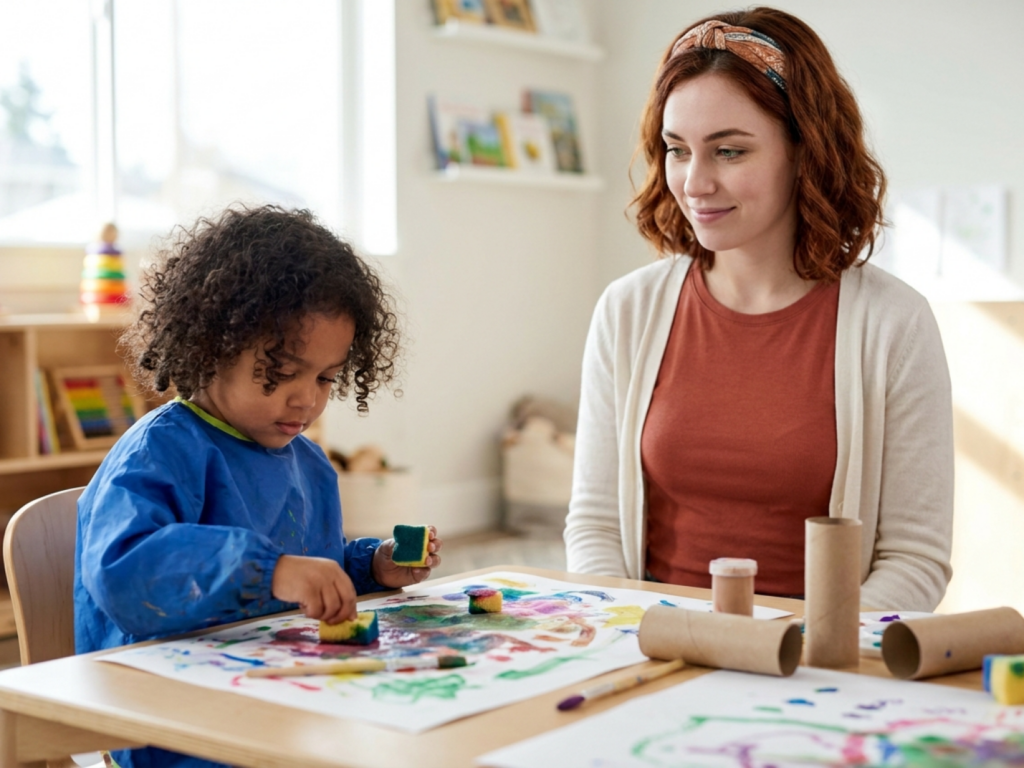
Process art is an approach to making art in which the child’s exploration matters more than producing a particular finished object. Children choose materials, test techniques, make decisions, change direction, and discover what happens. The adult provides a safe, inviting environment without requiring every child to copy a model or create an identical result.
This approach can be especially supportive for young children because it values curiosity, autonomy, sensory experience, and communication. A painting that looks unfinished to an adult may represent sustained attention, experimentation, emotional expression, or an important moment of problem-solving for the child.
Highlights
Process art emphasizes experimentation, choice, and discovery rather than a uniform finished product.
Children can develop fine-motor coordination, planning, language, flexibility, and confidence while exploring materials.
Adults support the experience by preparing accessible materials, observing carefully, and using open-ended prompts.
There is no single correct artistic outcome, and children may participate through movement, touch, sound, construction, or visual mark-making.
Safety, supervision, accessibility, and respect for sensory preferences remain essential.
What process art means
In process art, the central experience is the child’s activity while making: selecting a tool, combining colors, pressing or dragging a material, observing cause and effect, and deciding what to do next. The finished piece may be displayed, but it is not the main measure of success. A process-focused activity usually has no required sample to copy, no step-by-step sequence that every child must follow, and no single right or wrong outcome.
This differs from a product-focused craft, in which an adult often prepares the components and directs the child toward a recognizable object. Product-focused activities can have a place in childhood, particularly when children are learning to follow a sequence or practice a specific technique. However, if most art experiences require children to reproduce an adult-designed result, children may learn that pleasing the adult is more important than investigating their own ideas.
Process art leaves room for individual variation. One child might make broad marks with a sponge, another might carefully arrange scraps of paper, and a third might spend much of the session mixing colors. All three are participating meaningfully. The value lies in engagement, experimentation, and agency rather than visual similarity.
Why exploration matters for child development
Open-ended art creates repeated opportunities for children to form hypotheses and test them. What happens when water is added to paint? Which tool makes a thin line? Can a piece of cardboard make a print? These small investigations involve observation, working memory, attention, and flexible thinking. When an approach does not produce the expected effect, the child can modify the plan and try again.
Art also supports fine-motor practice. Grasping a crayon, squeezing a bottle, tearing paper, manipulating clay, or using tongs requires varying combinations of hand strength, bilateral coordination, and visual-motor integration. The activity should not be treated as therapy or as a way to diagnose a developmental concern, but it can provide natural practice in a motivating context.
Language develops alongside making. Adults can describe actions and invite reflection: “You pressed hard,” “The colors changed when they touched,” or “You moved the brush in circles.” Children may explain their intentions, invent stories, negotiate access to materials, or use gestures and sounds when verbal language is still emerging. This kind of interaction connects artistic activity with symbolic thinking, social communication, and emotional expression.
For a broader discussion of child-led creative exploration, families may also consider how creative play gives children opportunities to test ideas and express meaning without relying on a predetermined answer.
Preparing an inviting process-art environment
A successful setup does not need to be expensive or elaborate. Offer a manageable selection of materials within the child’s reach, with enough space to move and pause. Useful choices may include washable paint, large paper, cardboard, crayons, chalk, fabric scraps, natural objects, sponges, rollers, recycled containers, child-safe scissors, glue, clay, and water. Different textures and tools allow children to explore pressure, resistance, pattern, sound, and movement.
When selecting open-ended materials for preschoolers, consider whether each item can be used in several ways. A cardboard tube might become a printing tool, a construction component, or an object for rolling paint. A sheet of paper might be drawn on, folded, torn, layered, or used as a background for collage. Materials with multiple possible uses tend to support more divergent thinking than materials designed to become one specific object.
Make the physical environment predictable and safe. Protect the work surface, provide aprons or clothing that can get messy, keep materials labeled or visually organized, and place cleaning supplies nearby. Supervise closely around small parts, scissors, water, and art materials that are not intended for ingestion. Follow product age recommendations and avoid materials that could pose a choking, inhalation, allergy, or skin-irritation risk.
Accessibility matters. Some children may need larger handles, thicker tools, non-slip mats, a stable chair, an alternative to wet or sticky materials, or additional time. Participation can include watching, choosing, touching briefly, making one mark, or directing another person. The goal is meaningful engagement, not forcing a particular sensory experience.
How adults can support without taking over
The adult’s role is to prepare, observe, and respond. Begin with an invitation rather than a demand: “These materials are available if you would like to explore them.” Then allow the child time to approach. Some children need a period of observation before joining, and this can be part of participation rather than a sign that the activity has failed.
Open-ended prompts are more useful than questions that imply a correct answer. Try “What do you notice?” “What could you try next?” “How did you make that mark?” or “Would you like another tool?” Avoid repeatedly asking what the picture is supposed to be. That question can unintentionally shift attention toward producing a recognizable image for the adult.
Specific, descriptive feedback helps children notice their own process. Instead of saying only “That is beautiful,” an adult might say, “You used three different tools,” “You kept changing the pressure,” or “You decided to add paper after looking at the paint.” This language communicates that persistence, decision-making, and observation are valued.
Adults should resist correcting, finishing, or improving the artwork unless the child requests assistance. If a child asks for help, clarify the type of help wanted: demonstrating how to open a container, stabilizing paper, or taking over the artistic decision. Preserving authorship supports autonomy and reduces performance pressure.
Adapting process art for different children
Process art can be adapted without changing its central principle of child choice. For a child with limited hand strength or motor coordination, offer thick crayons, easy-grip brushes, vertical surfaces, larger paper, or tools that require less precision. Tape can secure paper, while a tray can define the work area. An adult may provide physical assistance only with consent and in a way that leaves the child directing the activity.
Children with sensory sensitivities may prefer dry materials before trying paint, gloves or tools instead of direct touch, a smaller quantity of a sticky substance, or a quieter workspace. Avoid interpreting sensory avoidance as unwillingness or misbehavior. Gradual exposure should not be forced, and families can seek advice from an occupational therapist or another qualified professional when sensory or motor concerns affect daily participation.
For children who use augmentative and alternative communication, provide symbols, gestures, eye gaze, or simple choices for tools and colors. A child does not need fluent speech to make meaningful artistic decisions. Children with attention differences may benefit from short sessions, clear boundaries, movement breaks, and a limited number of materials available at one time.
Adults should also consider cultural and family context. There is no requirement that art look a particular way or represent a particular subject. Respect the child’s interests, avoid assumptions about ability, and make room for solitary, parallel, collaborative, and highly imaginative forms of participation.
Making process art part of everyday life
Process art does not need to be reserved for a formal classroom activity. Children can explore marks with sidewalk chalk, arrange leaves and stones outdoors, make prints from household objects, build temporary sculptures from boxes, or experiment with shadows and light. Everyday experiences become richer when adults notice the investigation rather than rushing toward cleanup or a finished display.
At home or in early-childhood settings, keep a small, reachable art area available when practical. Rotating a few materials can maintain interest without overwhelming the child. Save selected works if the child wants to keep them, but do not assume every experiment must become a permanent product. Photographs, brief notes, or the child’s own explanation can document the experience while preserving the work area for future exploration.
Process art can also support relationships. Sitting nearby, sharing materials, and discussing discoveries create opportunities for co-regulation and connection. A child who becomes frustrated may need acknowledgment before problem-solving: “The paper tore, and that was disappointing. We can look at what you want to try now.” This response validates emotion without taking away the child’s opportunity to decide.
Families looking for related activities can connect process art with creative hobbies for children, outdoor exploration, storytelling, construction, music, or imaginative play. The common thread is sustained engagement in an activity where children can make meaningful choices and develop ideas over time.
When to seek additional guidance
Variation in artistic interest, mess tolerance, attention, and motor style is normal. A child may dislike a particular material, prefer watching, or create in ways that differ from peers. One art session should not be used to judge intelligence, creativity, emotional wellbeing, or developmental status.
Consider discussing concerns with a pediatrician, occupational therapist, speech-language pathologist, psychologist, or other qualified professional when difficulties are persistent, occur across settings, and interfere with everyday function. Examples might include marked distress with many ordinary textures, ongoing difficulty using both hands for age-expected tasks, communication barriers that limit participation, or a loss of previously acquired skills. Professionals can consider the child’s broader history and environment rather than drawing conclusions from artwork alone.
Process art is an educational and relational opportunity, not a diagnostic test. Its strongest contribution is creating a respectful context in which children can explore, communicate, practice skills, and experience themselves as capable learners.
Safety and developmental cautions
- Supervise children around small parts, scissors, water, cords, and any material that could be inhaled or swallowed.
- Use only art products intended for children and follow the manufacturer’s age guidance.
- Do not force messy or tactile participation; offer adaptations and alternative ways to engage.
- Do not interpret a child’s artwork as a diagnosis or as definitive evidence of emotional or developmental status.
- Seek professional advice when persistent functional concerns, regression, or significant distress affect daily life.
Tools & Assistance
- A washable art mat, smock, and low open shelf for materials
- Large paper, cardboard, crayons, washable paint, glue, and child-safe tools
- A visual choice board or simple communication symbols
- A notebook or camera for documenting the child’s process and words
- Guidance from a pediatrician or allied health professional when participation concerns persist
FAQ
Does process art mean adults should never demonstrate a technique?
No. Adults can demonstrate how to use a tool or care for materials, especially when safety is involved. The key is to avoid presenting the demonstration as the required final result and to let the child decide how to apply it.
What if my child only wants to make recognizable pictures?
That is completely compatible with process art. The focus is not on preventing representational drawing; it is on allowing the child to choose the subject, materials, and approach without unnecessary pressure.
How long should a process-art activity last?
There is no fixed ideal duration. Follow the child’s engagement, energy, and regulation. A brief, focused exploration can be valuable, and children may return to the same materials repeatedly.
Can process art help with developmental delays?
It can offer motivating opportunities to practice communication, motor planning, attention, and choice-making, but it is not a substitute for assessment or individualized therapy. Discuss specific concerns with an appropriate healthcare or developmental professional.
Sources
- National Association for the Education of Young Children — How Process-Focused Art Experiences Support Preschoolers
- National Association for the Education of Young Children — What Will We Make? Using Process Art to Spark Preschoolers' Creativity
- ChildCare Education Institute — Process versus Product: Art Experiences in Early Childhood
Disclaimer
This article provides general educational information and is not medical advice or a diagnosis. Consult a qualified healthcare or developmental professional about individual concerns.












Please log in to leave a comment.