
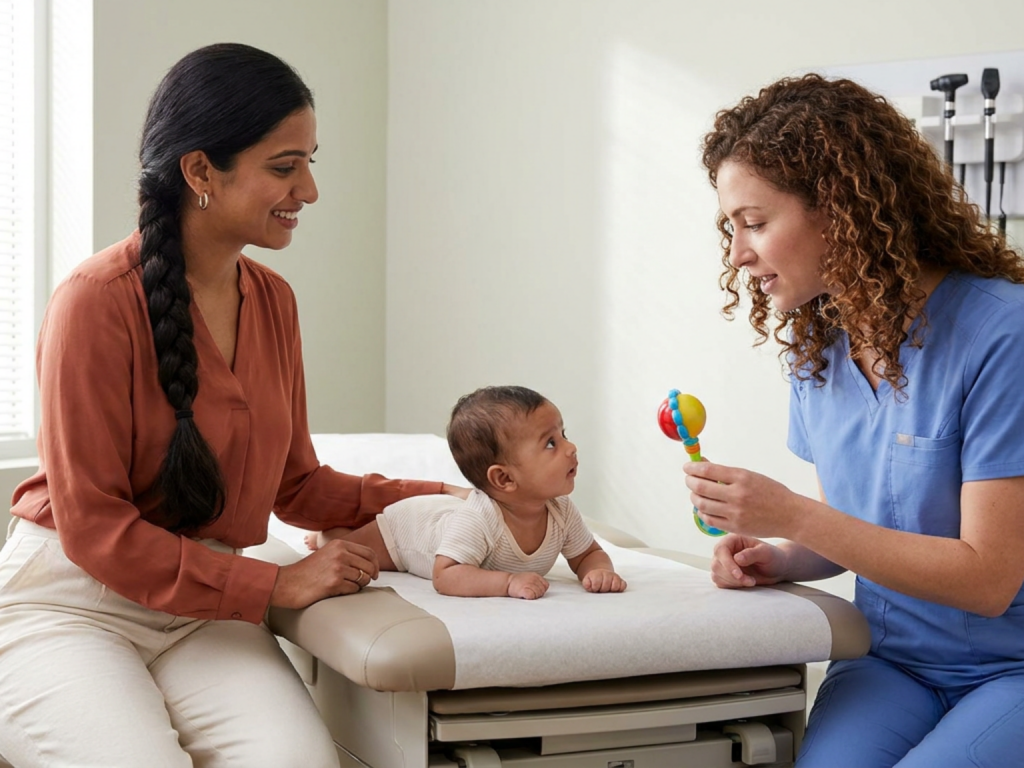
Intro
Baby development is the broad, living process of how an infant’s brain, body, senses, relationships, and communication skills mature over time. Milestones are specific observable skills within that process, such as smiling, tracking a face, rolling, sitting, babbling, or reaching. Understanding the difference can make developmental tracking feel less like a high-stakes checklist and more like a supportive way to notice patterns, celebrate progress, and ask for help early when needed.
For medically literate parents and caregivers, it can help to think of milestones as clinical markers used in developmental surveillance, not as exact deadlines. A baby may acquire skills in a slightly different order or at a different pace and still be developing typically. At the same time, consistent delays, loss of skills, or concerning neurologic or social signs deserve timely discussion with a pediatric clinician.
Highlights
Development is the whole maturational trajectory; milestones are selected skills that help clinicians and families monitor that trajectory.
Milestone ages are best interpreted as windows and surveillance tools, not rigid pass-or-fail cutoffs.
Healthy babies vary, but regression, persistent asymmetry, poor feeding, or limited social responsiveness should be discussed promptly with a healthcare professional.
Developmental screening questionnaires and routine well-child visits help identify infants who may benefit from closer monitoring or early support.
For preterm babies, corrected age for preterm babies is often used when interpreting early milestone timing.
Development is the bigger picture
Baby development is a dynamic interaction between neurobiology, growth, sensory experience, caregiving, sleep, nutrition, temperament, and health. It includes the maturation of the central nervous system, strengthening of muscles, integration of primitive reflexes, visual and auditory processing, attachment, emotional regulation, and early learning. This is why development rarely looks perfectly linear. A baby may spend several weeks focused on feeding and alertness, then suddenly show new head control, more vocal play, or a stronger interest in faces.
Development also happens across interconnected domains. Gross motor skills involve posture, head control, rolling, sitting, crawling, and later walking. Fine motor development in infancy includes opening the hands, bringing hands to the mouth, reaching, grasping, and transferring objects. Communication includes receptive language, expressive sounds, turn-taking, and gestures. Cognitive development includes attention, memory, cause-and-effect learning, and object exploration. Social-emotional development in infancy includes eye contact, calming with a familiar caregiver, smiling, and reciprocal interaction.
Because these domains influence one another, a delay in one area can affect another without meaning there is a single diagnosis. For example, low muscle tone may make reaching or sitting harder, which can reduce opportunities for object exploration. Hearing differences may affect early communication milestones. A pediatric clinician can help interpret whether a pattern reflects normal variation, a temporary health issue, prematurity, environmental opportunity, or a need for additional evaluation.
Milestones are markers, not a full portrait
Developmental milestones are age-linked skills that many children demonstrate within a predictable range. They are useful because they translate a complex developmental process into observable behaviors: lifting the head, smiling responsively, following movement, cooing, rolling, sitting with support, reaching for objects, or responding to familiar voices. Public health and pediatric organizations use milestones to guide developmental surveillance, meaning ongoing observation and conversation at regular visits.
The key distinction is that a milestone is not the same as development itself. A milestone is one signpost on a much larger road. A baby who rolls later than a peer may still show excellent strength, curiosity, social engagement, and steady progress. Another baby may meet one motor milestone early but show limited social reciprocity or feeding difficulties that deserve attention. Looking only at a single skill can be misleading; looking at the pattern over time is more clinically meaningful.
Research-based milestone ages are often chosen to support surveillance: if a child has not achieved a skill by a particular age, it may prompt closer observation, screening, or referral. That does not mean every missed milestone equals a disorder. It means the child may benefit from a more careful look. This is why milestone charts are most helpful when used with context, including birth history, corrected age for preterm babies, medical conditions, sensory function, family history, and the baby’s overall developmental trajectory.
Why milestone timing varies
Developmental differences between babies are expected. Genetics, gestational age, neonatal course, temperament, sleep, feeding efficiency, opportunities for movement, and caregiver interaction all influence when skills appear. A baby who dislikes tummy time may take longer to build prone head and shoulder strength, while a highly observant baby may seem less motor-driven but more engaged with voices and faces. Variation is not automatically pathology.
Prematurity is a particularly important factor. In early infancy, clinicians often use corrected age for preterm babies, calculated from the due date rather than the birth date, to interpret milestones more fairly. A baby born eight weeks early may not be expected to show the same motor or social behaviors as a full-term baby of the same chronological age. The degree of prematurity, medical complications, and ongoing growth all matter.
Culture and caregiving routines can also shape milestone expression. Some infants spend more time carried, some have more floor time, and some are exposed to multiple languages. These differences do not necessarily slow development, but they can influence which skills are most visible at a given moment. The most reassuring pattern is steady acquisition of skills, increasing interaction, and growing control of the body over time.
Caregivers can support development through simple, responsive routines: talking during diaper changes, offering supervised tummy time while awake, letting the baby visually track faces and safe objects, responding to coos, and providing safe opportunities to move. These activities are not a prescription and do not need to be intensive. They work best when they are warm, frequent, and adapted to the baby’s cues.
Typical domains clinicians watch
Clinicians usually organize infant development into several domains. These categories help families describe what they notice and help clinicians decide whether a concern is isolated or part of a broader pattern.
- Gross motor: head control, posture, symmetry, rolling, sitting, crawling, and weight-bearing as the infant matures.
- Fine motor and adaptive: hand opening, reaching, grasping, bringing objects to the mouth, transferring toys, and early self-feeding readiness.
- Communication: crying patterns, cooing, babbling, response to sound, turn-taking, gestures, and early understanding of familiar words.
- Cognitive and sensory: visual tracking, attention to faces, exploration of objects, cause-and-effect learning, and response to novelty.
- Social-emotional: calming with caregivers, social smiling, eye contact, shared enjoyment, preference for familiar people, and early serve-and-return interactions.
In the first three months, many babies gradually become more alert, lift the head briefly during tummy time, respond to sound, bring hands toward the mouth, watch faces, and begin social smiling. These early behaviors are not just cute; they reflect emerging neural integration, sensory processing, muscle control, and social communication. Still, the exact timing varies, and a clinician should interpret concerns in the context of the whole infant.
Milestones, screening, and surveillance
Developmental surveillance is the ongoing process of asking questions, observing the baby, reviewing caregiver concerns, and tracking progress at each health visit. Pediatric developmental screening is more formal: it often uses standardized developmental screening questionnaires at recommended ages or when a concern arises. Screening does not diagnose a condition by itself. Instead, it helps identify which infants may need a fuller developmental assessment, hearing or vision evaluation, physical therapy, occupational therapy, speech-language assessment, or early intervention services for infants.
This distinction matters because many parents worry that mentioning a concern will label their child. In reality, early discussion is a protective step. If everything is within expected variation, reassurance can reduce anxiety. If support is needed, earlier referral may improve access to therapy and help families learn strategies that fit daily life.
Clinicians may ask whether a baby is gaining skills, whether skills are symmetrical, whether feeding and growth are adequate, whether the baby responds to sound and faces, and whether there has been any loss of developmental skills. They may also consider neurologic examination findings such as tone, reflexes, posture, visual engagement, and movement quality. A single missed item is less informative than the pattern across history, examination, and time.
When variation becomes a concern
It is normal to feel anxious when a baby does not match a chart exactly. The more clinically important question is whether the baby is progressing, engaging, and using the body in an increasingly coordinated way. Temporary plateaus can happen around illness, sleep disruption, travel, or growth changes. However, certain patterns should prompt a call to a pediatric clinician rather than watchful waiting.
Concerns include developmental regression in babies, such as losing a previously consistent social smile, no longer using a hand as before, or stopping babbling after it was established. Persistent infant movement asymmetry, such as always turning to one side, keeping one hand tightly fisted while the other opens, or using one side much more than the other in early infancy, also deserves assessment. Other warning signs include poor feeding, weak suck, lethargy, very stiff or very floppy tone, lack of response to loud sounds, limited eye contact or visual tracking, or no improvement in head control over time.
These signs do not automatically identify a diagnosis, and they can have many causes, including hearing or vision differences, neuromotor conditions, feeding problems, illness, or benign variation. The safest approach is to seek professional guidance. A pediatrician, family physician, health visitor, developmental pediatrician, or early intervention team can help decide whether monitoring, screening, or referral is appropriate.
How parents can use milestones without fear
Milestones are most helpful when they support curiosity rather than comparison. Instead of asking, “Is my baby ahead or behind?” try asking, “What is my baby practicing now, and what new skill seems to be emerging?” This reframes milestones as clues. A baby who is batting at toys may be preparing for purposeful reaching. A baby who coos back and forth is practicing conversational rhythm. A baby who pushes up on forearms during supervised tummy time is building strength for later rolling and sitting.
Keep brief notes before well-child visits if you have concerns. Useful observations include when a skill first appeared, whether it happens consistently, whether it occurs on both sides of the body, what seems to help, and whether any skill has disappeared. Short videos can sometimes help clinicians see movement quality or social interaction, especially if the behavior does not occur during the appointment.
Most importantly, trust your knowledge of your baby. Caregiver concern is a valid reason to ask for developmental screening for babies, even if the concern feels difficult to describe. Support is not a sign of failure; it is part of responsive healthcare. Babies develop through relationships, and caregivers deserve clear information, calm guidance, and timely access to professional help when something does not feel right.
Call a clinician promptly if you notice
- Loss of developmental skills or reduced social responsiveness after a skill was established.
- Poor feeding, weak suck, dehydration signs, persistent vomiting, or inadequate weight gain.
- Marked stiffness, unusual floppiness, persistent fisting, or strong movement asymmetry.
- No response to loud sounds, limited visual tracking, or concern about hearing or vision.
- Extreme lethargy, breathing difficulty, seizures, or any acute change in alertness.
Tools & Assistance
- Keep a brief development note before routine well-child visits.
- Ask about pediatric developmental screening if you have persistent concerns.
- Use corrected age when discussing milestones for a baby born preterm.
- Share short videos of concerning movements or interactions with your clinician.
- Contact early intervention services for infants if a referral is recommended or locally self-referral is available.
FAQ
Are milestones the same as development?
No. Development is the full process of growth and maturation across body, brain, communication, and relationships. Milestones are selected skills used to monitor that process.
Does a missed milestone mean my baby has a disorder?
Not necessarily. A missed milestone may reflect normal variation, prematurity, limited opportunity, illness, or another factor. It is a reason to discuss the pattern with a healthcare professional.
Should I compare my baby with other babies?
Occasional comparison is natural, but it can be misleading. It is more useful to look for steady progress, social engagement, symmetry, and whether your baby is gaining new skills over time.
What is corrected age for preterm babies?
Corrected age estimates development from the baby’s due date rather than birth date. Clinicians often use it in early infancy to interpret milestones more appropriately for babies born early.
When should I ask for screening?
Ask whenever you have persistent concerns, notice loss of skills, see significant asymmetry, or feel your baby is not progressing. Developmental screening questionnaires can help guide next steps.
Sources
- Pediatrics / PubMed Central — Evidence-based milestone ages as a framework for developmental surveillance
- Centers for Disease Control and Prevention — Module 2: Understanding Children's Developmental Milestones
- Mayo Clinic — Infant development: Birth to 3 months
Disclaimer
This article is for general educational purposes only and is not a diagnosis or treatment plan. Always consult a qualified healthcare professional about concerns regarding your baby’s development, feeding, growth, or behavior.
















Please log in to leave a comment.