
Intro
A stroller can make daily life with a baby much more manageable: it supports transport, protects caregiver posture, and allows outings that may benefit both infant and parent wellbeing. At the same time, stroller safety depends on small repeated habits, such as using the harness every time, checking the brake, avoiding overloaded handles, and keeping a young baby’s airway visible and unobstructed.
This guide is written for medically literate caregivers who want practical, evidence-informed steps without unnecessary alarm. It cannot replace the stroller manufacturer’s instructions or individualized advice from a pediatrician, nurse, physiotherapist, occupational therapist, or child passenger safety professional, especially for premature infants, babies with hypotonia, reflux, respiratory disease, craniofacial differences, or delayed motor control.
Highlights
Choose a stroller that matches your baby’s age, weight, motor control, and the manufacturer’s stated limits.
Use the harness and brake consistently; many stroller injuries occur during ordinary moments when a caregiver is distracted.
For newborns and young infants, airway patency is a priority: the baby should lie flat or be in an approved newborn mode with the head, neck, and chest well supported.
Avoid hanging heavy bags on the handlebar, because this can shift the center of gravity and increase tip-over risk.
Register the stroller and monitor recall information so you can respond promptly if a safety defect is identified.
Start with the right stroller for your baby
Stroller safety begins before the first walk. Check the manufacturer’s age, weight, and developmental guidance rather than relying only on the baby’s chronological age. A newborn usually needs a stroller mode that allows a flat or near-flat position, because early cervical and truncal control is limited. A baby who cannot maintain head midline may slump into flexion, and excessive chin-to-chest positioning can narrow the upper airway.
Before purchase or use, confirm that the stroller has a stable frame, a working brake, secure locking systems, a suitable harness, and no damaged hinges, wheels, or fabric. If the stroller folds, unfold it fully until all locks are engaged. A partially locked stroller can collapse unexpectedly, especially when weight shifts during curb navigation or when a child moves.
Second-hand strollers can be economical, but inspect them carefully. Look for missing parts, frayed harness straps, loose screws, cracked plastic, wheel instability, and product labels that allow you to identify the model. If you cannot confirm the model or instructions, it is harder to verify recalls or correct use.
Use the harness every time, even for short trips
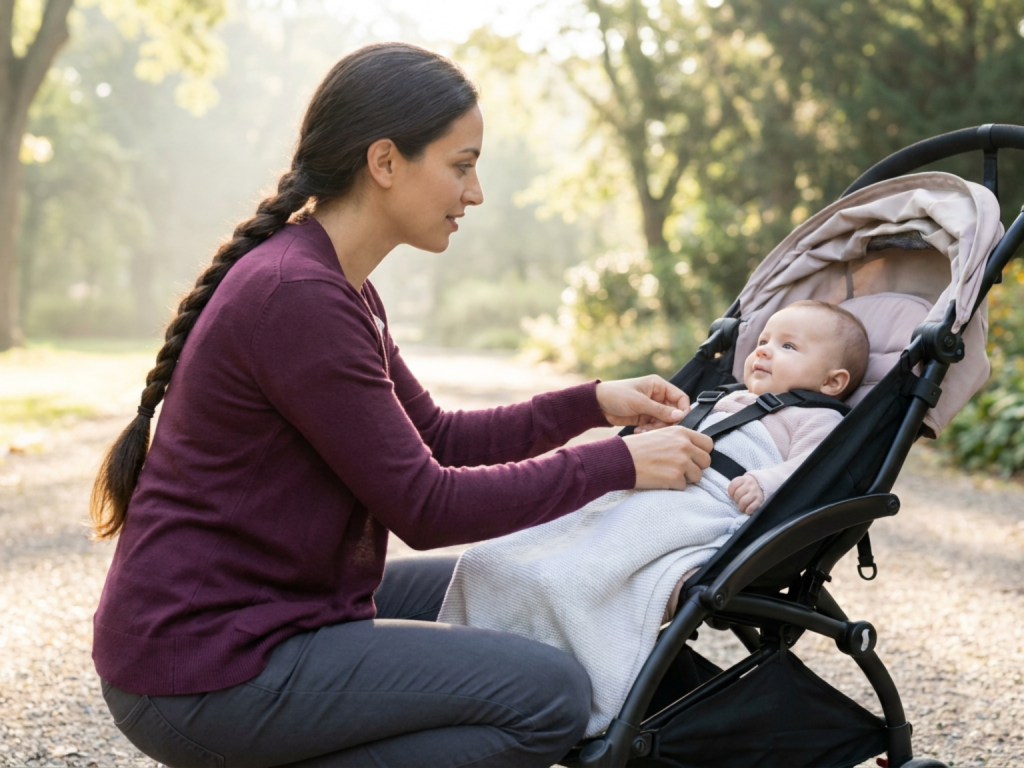
A harness is not only for active toddlers. Infants can slide, rotate, or slump, and older babies may lean forward suddenly. Use the stroller’s restraint system according to the manual, usually a five-point or three-point harness depending on the design. The straps should be snug enough to limit sliding but not so tight that they restrict breathing, circulation, or comfortable movement.
Check that shoulder, waist, and crotch straps sit where the manufacturer intends. The crotch strap helps prevent submarining, where a baby slides downward under the waist belt. For small infants, ensure the harness does not pull the shoulders into an awkward position or force the neck into flexion. If the fit seems poor despite correct adjustment, ask the manufacturer or a qualified professional whether the stroller mode is appropriate for your baby’s size and motor control.
Do not let a child stand in the stroller seat, climb in unassisted, or ride on footrests not designed for standing. If an older sibling wants to help push, keep an adult hand on the stroller and set clear boundaries around speed, slopes, and curbs.
Protect newborn airway and body position
For young infants, stroller positioning is a physiologic safety issue, not just a comfort issue. Newborns have proportionally large heads, compliant airways, and immature postural control. A safe position keeps the airway open, supports the head and neck, and avoids prolonged slumping. The face should remain visible, and the nose and mouth should not be pressed against padding, blankets, toys, or a caregiver’s clothing.
If your stroller has a bassinet or newborn insert, use only components approved by the manufacturer for that exact model. Improvised padding may appear supportive but can increase suffocation risk or alter the harness geometry. Avoid placing thick blankets under the baby or adding pillows, sleep positioners, or loose cushioning.
During outings, pause periodically to check respiratory effort, color, temperature, and posture. If the baby is premature, has bronchopulmonary dysplasia, laryngomalacia, neuromuscular weakness, congenital heart disease, or a history of clinically significant apnea, discuss stroller positioning with the baby’s healthcare team. The same caution applies if you are uncertain about newborn head and neck support or newborn airway alignment in a particular stroller mode.
Brakes, parking, and stopping safely
Use the brake whenever the stroller is stopped, even on apparently flat ground. A mild slope, a bump from another person, or the caregiver reaching into a bag can be enough for a stroller to roll. Engage the brake before placing the baby in the stroller, taking the baby out, adjusting blankets, or pausing at a curb.
After applying the brake, gently test that the stroller does not move. Some brakes lock both rear wheels; others lock only one side or require a specific pedal position. If a brake feels stiff, loose, or unreliable, stop using the stroller until it is repaired or replaced according to manufacturer guidance.
Never leave a baby unattended in a stroller. Supervision matters because risks can develop quickly: the baby may slump, a sibling may climb onto the frame, a pet may pull at the wheels, or the stroller may shift if the brake was not fully engaged.
Avoid tipping, collapse, and terrain hazards
A stroller’s stability depends on its center of gravity. Hanging a heavy diaper bag, shopping bag, or handbag from the handlebar can make the stroller tip backward, particularly when the baby is small or the seat is reclined. Store items in the manufacturer-approved basket and stay within its weight limit. Do not place heavy objects on the canopy or tray unless the manual specifically permits it.
Use extra caution on curbs, ramps, uneven pavement, gravel, grass, and wet surfaces. Slow down before transitions, keep both hands on the handle, and avoid sudden turns. Strollers are generally not safe on stairs or escalators; use an elevator or ramp when available. If you must navigate an unavoidable obstacle, remove the baby first if that can be done safely, and ask for help rather than lifting a loaded stroller awkwardly.
Jogging, skating, cycling, or running with a standard stroller can create excessive vibration and instability. Use only a stroller specifically designed for jogging, follow the age guidance carefully, and ask your pediatric clinician whether higher-impact movement is appropriate for your baby, especially before good head and trunk control is established.
Manage temperature, sun, and airflow
Stroller covers can protect from sun, wind, insects, or light rain, but they can also reduce airflow and trap heat. Babies have immature thermoregulation, a larger surface-area-to-body-mass ratio, and limited ability to communicate overheating. In warm weather, check the baby’s chest, back, and neck for heat and sweating rather than relying only on hands or feet, which can feel cool for normal physiologic reasons.
Use the stroller canopy as intended, and choose breathable, manufacturer-compatible accessories. Avoid draping thick blankets over the entire stroller, especially in warm or humid conditions. If a cover is needed, ensure there is adequate ventilation and that you can see the baby’s face.
In cold weather, dress the baby in layers and keep the airway clear. Blankets should not cover the face or interfere with the harness. If the baby becomes unusually sleepy, flushed, pale, mottled, difficult to rouse, or appears to be breathing abnormally, stop the outing and seek medical advice promptly.
Toys, snacks, and daily-use details
Use only toys or accessories that are intended for stroller use. Toys should be securely attached, lightweight, and free of small detachable parts that could become choking hazards. Avoid long cords, straps, or loops near the baby’s neck. Do not attach toys in a way that interferes with folding, locking, braking, or harness function.
Be cautious with snacks in the stroller. Eating while reclined or moving may increase choking risk, especially in infants and toddlers who are still developing chewing coordination. If a child is eating, keep them upright, supervised, and developmentally ready for the food texture. Follow your pediatric clinician’s guidance for feeding progression and choking prevention.
Make stroller checks part of your routine: wheels secure, frame locked, brake functional, harness adjusted, basket not overloaded, and baby positioned well. These brief checks are particularly useful when switching caregivers, using public transport, or moving between car seat, carrier, and stroller. Safe stroller and carrier positioning can reduce cumulative risk during busy outings.
When to seek professional advice
Most families can use a stroller safely with consistent routines, but individualized guidance is valuable in some circumstances. Ask your baby’s healthcare professional for advice if your baby was born prematurely, has low tone or high tone, poor head control for age, airway concerns, feeding-related breathing difficulty, seizures, orthopedic conditions, or medical equipment such as oxygen tubing or a feeding tube.
Consult the manufacturer if you are unsure whether a car seat, bassinet, adaptor, rain cover, ride-on board, or accessory is compatible with your stroller model. Mixing parts across brands may compromise locking systems or weight distribution. If the stroller has been involved in a crash, fall, or significant impact, inspect it carefully and contact the manufacturer before continued use.
Finally, trust your observations. If your baby repeatedly slumps, seems uncomfortable, has noisy breathing in the stroller, or cannot be positioned with a clear airway, stop using that mode until you receive appropriate guidance.
Stop and reassess immediately
- The baby’s chin is pressed toward the chest or the face is not visible.
- The stroller frame is not fully locked open or the brake does not hold.
- The stroller tips, wobbles, or feels unstable after bags or accessories are added.
- A blanket, cover, toy, or padding obstructs the baby’s nose or mouth.
- You need to use stairs, an escalator, or rough terrain with the baby still in the stroller.
- The baby has abnormal breathing, color change, unusual lethargy, or is difficult to rouse.
Tools & Assistance
- Read and keep the stroller manufacturer’s manual for weight limits, recline settings, folding locks, and approved accessories.
- Register the stroller with the manufacturer so recall and safety notifications can reach you.
- Create a pre-walk checklist: frame locked, brake tested, harness fastened, airway visible, basket within weight limit.
- Ask your pediatrician, health visitor, nurse, physiotherapist, or occupational therapist for positioning advice if your baby has medical or developmental needs.
- Check official consumer product safety recall channels in your country before using a second-hand stroller.
FAQ
Can a newborn sit upright in a stroller?
Most newborns need a flat or manufacturer-approved newborn position because they lack reliable head and trunk control. Follow the stroller manual and ask a clinician if your baby has prematurity, low tone, respiratory disease, or airway concerns.
Is it safe to hang a diaper bag on the stroller handle?
It is safer to use the approved storage basket and stay within the weight limit. Heavy items on the handlebar can shift the center of gravity and increase tip-over risk.
Should I use the brake if I am only stopping for a moment?
Yes. Engage the brake every time the stroller stops, including when adjusting the baby, checking your phone, paying at a counter, or waiting at a crossing.
Can my baby sleep in the stroller?
Short supervised sleep during a walk may happen, but the baby’s airway must remain clear and the position must be appropriate for age and development. For routine sleep, follow safe sleep guidance from your healthcare professional.
Are stroller covers safe in hot weather?
Use caution. Thick or poorly ventilated covers can trap heat and reduce airflow. Keep the baby visible, check temperature frequently, and use breathable manufacturer-compatible accessories.
Sources
- Raising Children Network — Prams and strollers: safety guide
- Consumer Product Safety Office, Singapore — Safety Tips on Strollers
- Safety 1st — Stroller Safety Tips
Disclaimer
This article is for general educational purposes only and is not a substitute for medical care, diagnosis, or individualized safety advice. Consult your child’s healthcare professional for concerns about breathing, positioning, prematurity, development, or stroller suitability.















Please log in to leave a comment.