
Intro
Deciding when a child can stay home alone is a developmental and safety decision, not simply an age milestone. Parents must consider the child’s judgment, emotional comfort, ability to respond to an emergency, the home environment, and how long the child will be unsupervised.
Some children may manage a brief period alone around the early adolescent years, while others need more time or continued adult supervision. A gradual, planned approach can build independence without making a child feel pressured or responsible for situations beyond their capabilities.
Highlights
Age is a useful starting point, but maturity, judgment, and emotional readiness are equally important.
Many children are not ready to stay home alone until at least age 12, although there is no universal age threshold.
Begin with short, predictable periods and rehearse what the child should do if something goes wrong.
A child who feels frightened, pressured, or reluctant is communicating important information about readiness.
Frequency matters: regular or prolonged periods alone may affect wellbeing and should be considered carefully.
There is no single age that fits every child
Age provides context, but it cannot determine readiness by itself. The Nationwide Children’s Hospital notes that most children are not ready to stay home alone until at least age 12. This should be treated as a general developmental benchmark rather than a universal rule. A younger child may be unusually capable in some situations but still lack the judgment or emotional regulation needed for unsupervised time. An older child may also need supervision if they have difficulty following safety rules, managing impulses, or seeking help.
Local regulations and child-protection guidance may differ, so parents should check the requirements that apply where they live. Regardless of the legal context, the central question is whether the child can remain safe and make sensible decisions without an adult physically present.
Readiness is also situation-specific. A child might be comfortable alone for 20 minutes during daylight but not for several hours after dark, during severe weather, or when responsible for a younger sibling. The first decision should therefore define the exact circumstances rather than ask whether the child is simply “ready” in general.
Assess practical and cognitive readiness
A ready child does not need to predict every possible danger, but they should reliably recognize common risks and follow established rules. Consider whether the child can:
- State their full name, home address, and a parent or caregiver’s telephone number without relying only on a device’s contact list.
- Call emergency services when appropriate, describe the situation clearly, and answer basic questions from a dispatcher.
- Identify at least two trusted adults nearby who could help if a parent cannot be reached.
- Lock and unlock doors, avoid opening the door to unexpected visitors, and decline to tell callers that they are alone.
- Follow household rules about cooking, appliances, candles, medication, chemicals, firearms, balconies, pools, and leaving the property.
- Use a phone responsibly and understand when texting a parent is insufficient.
These abilities reflect executive functioning: planning, inhibition, working memory, and flexible problem-solving. Ask the child to explain what they would do in realistic scenarios rather than relying on a simple promise to “be careful.” For example, ask what they would do if the power went out, a smoke alarm sounded, they smelled gas, someone knocked repeatedly, or they became ill. Listen for a clear sequence of actions, not just confidence.
Emotional readiness matters as much as safety skills
A child may know emergency procedures and still not be emotionally ready for solitude. Anxiety, separation distress, fear of intruders, nighttime fears, or a tendency to panic can make an otherwise brief period alone feel overwhelming. The child’s own comfort is therefore a core part of the assessment, not an optional preference.
Have a calm conversation without presenting staying home alone as a test of maturity. Ask what feels exciting, worrying, or confusing. A child who says they do not want to be alone should not be shamed, bribed, or pressured. Reluctance may reflect normal caution, an unresolved fear, or recognition that the proposed situation is too demanding.
It is also useful to observe how the child responds to minor problems when an adult is nearby. Can they pause, regulate their emotions, and seek help appropriately, or do they become disorganized and unable to act? Emotional regulation does not mean a child will never feel scared. It means they can use a practiced plan despite manageable fear and know when to contact an adult.
Consider neurodevelopmental differences, communication needs, medical conditions, and previous traumatic experiences individually. These factors do not automatically preclude independence, but they may require tailored safety planning and advice from a pediatrician, psychologist, or another qualified professional.
Review the home, neighborhood, and time period
The physical environment can make the same child more or less prepared. Before the first trial, complete a structured home safety review. Secure medications, cleaning products, alcohol, weapons, matches, lighters, and other hazardous materials. Check smoke and carbon-monoxide alarms, confirm that doors and windows function properly, and make sure the child knows safe exit routes. A broader review of home safety for children can help identify hazards that are easy to overlook.
Decide whether the child will be allowed to use the stove, oven, microwave, shower, or other appliances. Many families initially limit activities to low-risk routines, such as eating food that has already been prepared, reading, or doing homework. Keep emergency information visible but private, and avoid posting an address or access code where visitors could see it.
Assess the neighborhood as well. Identify a nearby trusted adult, clarify whether the child may go next door, and establish rules for deliveries, visitors, pets, online contact, and leaving the home. Think about weather, traffic, building security, and whether the child would know where to go if the home became unsafe.
Start with a short period during daylight, when the child is healthy, rested, and expecting the arrangement. Avoid making the first attempt during a hectic schedule, at bedtime, during a storm, or when the parent may be difficult to reach. The child’s age, the duration alone, and whether siblings are present should all influence the plan.
Build and rehearse an emergency plan
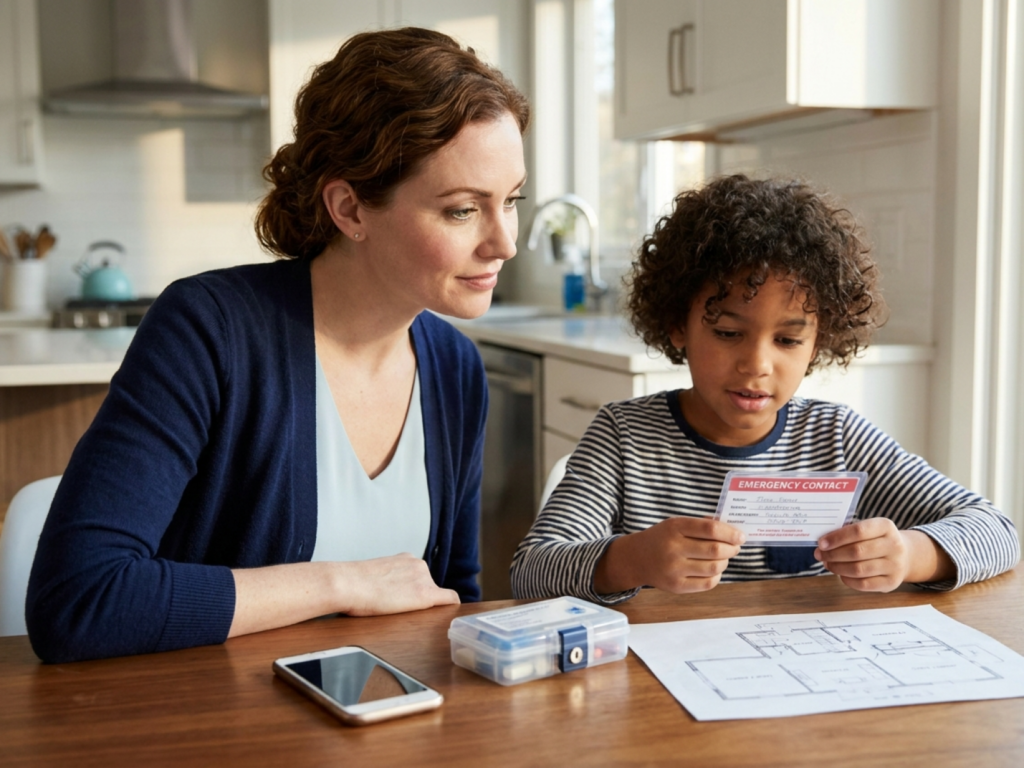
An emergency plan should be specific, simple, and practiced. Write down parent and caregiver numbers, emergency services, a nearby trusted adult, the home address, and any relevant medical information. The child should know that calling for help is appropriate and that they will not be punished for seeking assistance during a genuine emergency.
Use role-play to rehearse several scenarios:
- If there is smoke or fire, leave immediately using the safest exit, move away from the building, and call emergency services from a safe location.
- If the child smells gas, they should avoid switches, flames, and electrical equipment, leave the home, and contact emergency services or the gas provider from outside as instructed locally.
- If an unfamiliar person knocks or calls, the child should not open the door or disclose that they are alone. They can contact the parent or trusted adult.
- If the child is injured or becomes acutely unwell, they should contact a parent or emergency services depending on severity and follow the instructions given.
- If the phone or power fails, the child should know the backup plan, including where to go for help and which neighbor or relative is trusted.
Practice until the child can explain the plan in their own words. Avoid overwhelming them with unlikely disasters; focus on a few high-consequence situations and repeat the essentials periodically. Review online safety as well, including not sharing their location, answering video calls from strangers, or allowing unknown people into the home.
Begin gradually and monitor how it goes
Independence is usually safer when introduced in steps. You might begin with the parent in another room, then move briefly outside, remain close by, or arrange a short daytime errand. After each trial, discuss what felt easy or difficult and revise the plan. A check-in call or message can reassure the child, but it should not create a false sense of security: a phone cannot replace an available adult or a safe environment.
Set clear expectations before leaving. Agree on when the parent will return, which activities are permitted, where the child may be, and what to do if plans change. Parents should return at the agreed time whenever possible. Reliability helps the child develop a realistic sense of safety and trust.
Pay attention to changes after unsupervised periods, such as persistent worry, sleep disruption, somatic complaints, irritability, avoidance, or repeated requests not to be left alone. These signs do not establish a mental health diagnosis, but they indicate that the arrangement may be too stressful and should be paused or modified. A study from Japan found that being left home alone once a week or more was associated with poorer mental health outcomes in the sample studied. Because this was an observational association, it does not prove that being alone caused the outcome; it does, however, reinforce that frequency, context, and the child’s experience matter.
When a child should not stay home alone
Continue adult supervision if the child cannot reliably follow basic safety rules, does not know how to contact help, is strongly opposed to the arrangement, or has difficulty remaining calm enough to act during a problem. Supervision is also prudent when the home contains hazards that cannot be adequately secured, the neighborhood presents substantial risks, or the parent will be unreachable for an extended period.
Extra caution is needed when younger siblings are present. Caring for another child adds responsibility, conflict management, and emergency decision-making. A child who can safely manage their own brief time alone may not be ready to supervise a sibling.
Do not use staying home alone as a substitute for reliable childcare during long work shifts, overnight periods, or situations involving illness, medication administration, bathing, cooking, or transportation. If there is uncertainty about developmental readiness, anxiety, behavioral regulation, or a medical condition, discuss the situation with the child’s healthcare professional. A clinician can help identify reasonable supports without labeling the child or promising that one age will be suitable for everyone.
Safety concerns that should stop the plan
- Never leave a child alone if they cannot explain how to summon emergency help.
- Do not pressure a fearful or unwilling child to prove independence.
- Secure firearms, medications, toxic substances, and ignition sources before any trial.
- Do not assume a phone, smart speaker, or security camera can replace adult supervision.
- A child supervising younger siblings requires a separate and higher level of readiness.
Tools & Assistance
- A written emergency contact card with the home address
- A home safety plan for children covering exits, visitors, appliances, and hazards
- Scenario-based role-play for fire, injury, severe weather, and unexpected visitors
- A gradual trial schedule with agreed check-in times
- A pediatrician, child psychologist, school counselor, or local child-safety service
FAQ
Is 12 the legal age to stay home alone?
Not necessarily. The age mentioned by Nationwide Children’s Hospital is a general safety benchmark, not a universal legal rule. Laws and child-protection guidance vary by location, so check local requirements and assess maturity, environment, duration, and comfort.
How long should a first trial last?
Choose a short, predictable daytime period when the child is comfortable and a trusted adult is reachable. Increase duration only after the child handles earlier trials calmly and reliably.
Should a child be allowed to cook while alone?
There is no universal answer. Many families begin with food that needs no heating and introduce appliances only after reviewing fire prevention, safe operation, and the child’s judgment. Follow household rules and local safety guidance.
What if my child is capable but anxious?
Do not force the transition. Discuss the specific fear, practice the emergency plan, shorten the trial, or arrange another caregiver. Persistent or impairing anxiety warrants discussion with a qualified healthcare professional.
Sources
- Nationwide Children's Hospital — Staying Home Alone
- PubMed — Relationship Between Leaving Children at Home Alone and Their Mental Health: Results From the A-CHILD Study in Japan
- Connecticut Department of Children and Families — Leaving children home alone
Disclaimer
This article provides general educational information and does not replace individualized medical, psychological, legal, or child-protection advice. Consult a qualified healthcare professional or local authority about your child’s specific circumstances.














Please log in to leave a comment.