
Intro
A child’s fever can be frightening, especially when the number on the thermometer rises quickly or your child looks miserable. Fever is a physiologic response, usually to infection, and the goal at home is not always to make the temperature “normal,” but to keep your child comfortable, hydrated, and safely monitored.
This guide explains practical steps, temperature measurement, medication safety, and red flags that should prompt urgent medical care. It is not a substitute for your child’s clinician, particularly for infants, medically fragile children, or any child who seems seriously unwell.
Highlights
Treat the child, not just the number: comfort, hydration, breathing, alertness, and circulation matter as much as the temperature.
Infants under 3 months with a temperature of 100.4°F or 38°C or higher need prompt medical evaluation; newborns under 28 days generally require emergency evaluation.
Acetaminophen and ibuprofen may reduce fever and discomfort when age-appropriate and dosed by weight, but they are not required for every fever.
Avoid unsafe cooling methods such as alcohol rubs, ice baths, or over-bundling; use light clothing and a comfortable room temperature.
Seek urgent care for breathing difficulty, seizure, stiff neck, blue lips, dehydration, inconsolable crying, or a child who is difficult to wake.
Start by assessing your child, not only the thermometer
When your child has a fever, pause and look at the whole clinical picture. A fever is commonly defined as a temperature of 100.4°F or 38°C or higher, but the child’s appearance and behavior often provide more meaningful information than the exact number. A child who is drinking, urinating, making eye contact, breathing comfortably, and settling between periods of discomfort is usually less concerning than a child with a lower fever who is lethargic, difficult to arouse, breathing hard, or refusing all fluids.
Check for immediate danger signs first: trouble breathing, bluish lips or face, a seizure, a stiff neck, a new purple or non-blanching rash, signs of severe dehydration, or extreme irritability that cannot be consoled. If any of these are present, seek emergency care rather than trying to manage the fever at home.
Also consider age and medical context. Infants under 3 months have immature immune systems and can develop serious bacterial infections with few outward signs, so a rectal temperature of 100.4°F or 38°C or higher warrants prompt medical assessment. Children with cancer, immune suppression, complex heart disease, indwelling central lines, sickle cell disease, or recent surgery may need earlier evaluation; follow their clinician’s fever plan if one exists.
Measure the temperature in the most reliable way
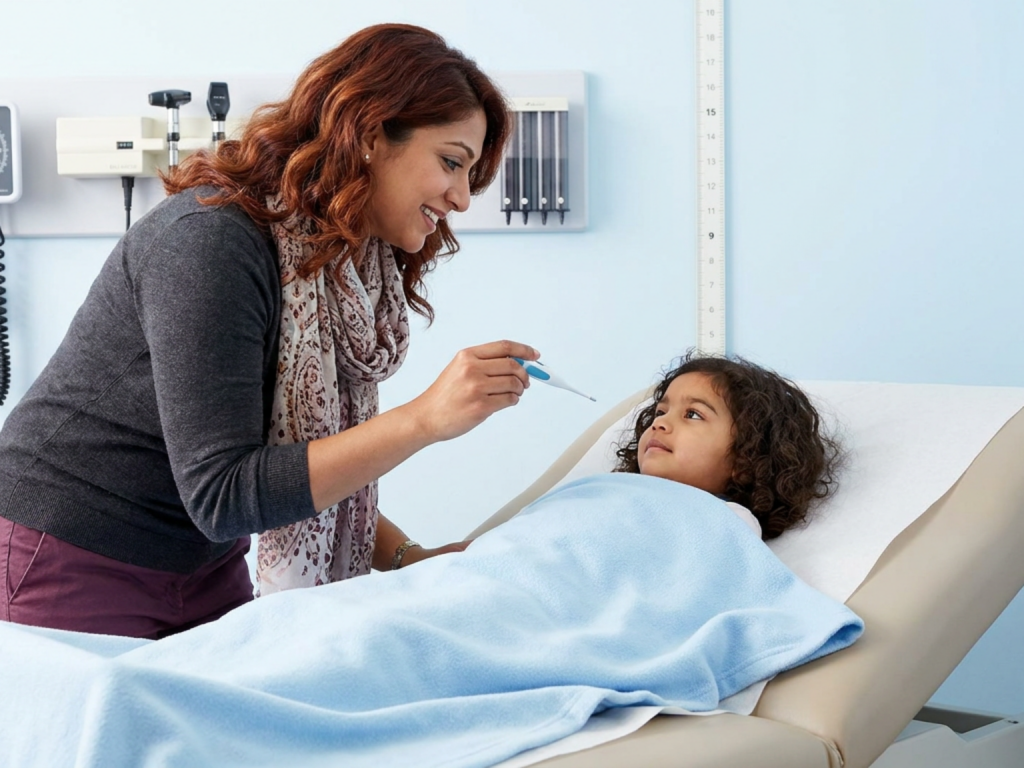
Accurate temperature measurement helps you communicate clearly with a clinician and decide how urgent the situation is. Rectal temperature is generally the most reliable method for infants and is often recommended when precision matters. For young children, an axillary, or underarm, reading can be used for screening, though it may be less accurate. Older children who can hold a thermometer correctly under the tongue without biting it can use an oral thermometer.
Try to record the method along with the number, for example, “102.1°F oral” or “100.8°F rectal.” This matters because temperatures vary by site. Avoid relying on touch alone; a child can feel hot from crying, exercise, heavy blankets, or a warm room.
Use the thermometer according to the manufacturer’s instructions. Clean it before and after use, label rectal thermometers so they are not used orally, and avoid taking an oral temperature immediately after hot or cold drinks. If a reading does not match how your child appears, repeat it once using careful technique rather than repeatedly checking every few minutes, which can increase anxiety without improving care.
Support hydration, rest, and comfort
The foundation of fever care is supportive care. Fever increases insensible fluid loss and can reduce appetite, so hydration matters more than forcing food. Offer small, frequent amounts of fluid: breast milk, formula, milk, water, or an oral rehydration solution such as Pedialyte may be appropriate depending on age and feeding pattern. For a vomiting child, try teaspoons or small sips every few minutes; large volumes can trigger more vomiting.
Watch urine output as a practical hydration marker. Fewer wet diapers, very dark urine, dry mouth, no tears when crying, dizziness, or unusual sleepiness can suggest dehydration. Babies should generally continue breast milk or formula unless a clinician advises otherwise.
Dress your child in light, comfortable clothing and keep the room comfortably cool. Do not bundle a feverish child in heavy blankets to “sweat it out,” because that can raise temperature and worsen discomfort. A lukewarm bath may help some children feel better, but stop if it causes shivering; shivering can increase heat production. Avoid alcohol rubs, cold baths, or ice packs because these can be unsafe and distressing.
Rest is helpful, but strict bed rest is not necessary if your child wants quiet play. Let energy level guide activity. Fever often rises in the evening and may fluctuate; this pattern alone does not necessarily mean the illness is worsening.
Use fever medicine carefully when comfort is the goal
Fever-reducing medicines can improve comfort, reduce aches, and help a child drink better. They do not treat the underlying cause of fever, and they are not required simply because a temperature is elevated. If your child is sleeping comfortably, breathing normally, and hydrated, it is usually reasonable to let them rest rather than wake them only to give medicine, unless your clinician has advised otherwise.
Acetaminophen is commonly used in children older than 3 months, and ibuprofen is commonly used in children older than 6 months. Dosing should be based on the child’s current weight, not just age, and caregivers should use the measuring device that comes with the medication. Do not estimate with kitchen spoons. If you are unsure of the correct dose, call your pediatrician, pharmacist, or local nurse line before giving it.
Important medication safety points include:
- Do not give ibuprofen to infants under 6 months unless specifically instructed by a clinician.
- Do not give acetaminophen to infants under 3 months without medical guidance.
- Do not give aspirin to children or teenagers unless a clinician specifically prescribes it.
- Avoid duplicate acetaminophen exposure from combination cold, cough, or flu products.
- Avoid over-the-counter cough and cold medicines in children under 6 unless directed by a healthcare professional.
Fever medicine often lowers temperature by only 1–2°F, and that can still be effective if the child feels better. Alternating acetaminophen and ibuprofen can lead to dosing errors; do it only with clear instructions from a healthcare professional.
Know when to call a clinician or seek emergency care
Age is one of the most important triage factors. A baby younger than 28 days with a temperature of 100.4°F or 38°C or higher should be evaluated urgently in an emergency setting. For infants under 3 months, contact a healthcare professional promptly for any fever at or above this threshold, even if the baby appears relatively well. For children between 3 and 36 months, fever combined with poor feeding, persistent vomiting, dehydration, unusual sleepiness, or concerning behavior deserves same-day medical advice.
Seek emergency care regardless of the number if your child has trouble breathing, blue lips, a seizure, severe headache with stiff neck, confusion, limpness, persistent inconsolable crying, a rapidly spreading rash, or signs of poor circulation such as mottled skin and cold extremities. Non-stop crying in an infant, especially with fever, should be taken seriously.
Call your child’s clinician if fever lasts more than several days, returns after improving, or is associated with ear pain, painful urination, persistent abdominal pain, worsening cough, sore throat with dehydration, or new localized pain. Also call sooner if your child has immune compromise, a central venous catheter, a history of febrile seizures, complex chronic illness, or if your parental intuition says something is wrong. Caregivers know their children; a change that feels unsafe is a valid reason to seek help.
Understand fever patterns and common concerns
Fever height does not perfectly predict illness severity. Some viral infections cause high fevers in otherwise stable children, while serious infections can sometimes present with modest temperature elevations. The response to fever medicine is also not diagnostic; a temporary drop in temperature does not prove the illness is harmless, and a fever that does not fully normalize does not automatically mean an emergency.
Febrile seizures can occur in some young children and are alarming to witness. During any seizure, place the child on their side on a safe surface, do not put anything in the mouth, and call emergency services if the seizure lasts more than a few minutes, breathing is abnormal, the child turns blue, or it is the first seizure. Medical evaluation is important after a first febrile seizure or any atypical event.
Appetite commonly decreases during fever. This is usually less concerning than fluid refusal. Offer bland foods if your child wants them, but prioritize hydration. Avoid pressuring a child to eat; nausea and throat discomfort often improve as the illness resolves.
After recovery, most children gradually return to baseline energy and behavior. If you notice persistent weakness, unusual confusion, developmental regression in children, or a prolonged change in walking, speech, or interaction after a febrile illness, contact a healthcare professional for individualized evaluation.
Prepare for the call: what information helps clinicians
If you call a pediatric office, nurse line, urgent care, or emergency service, concise details can speed triage. Have your child’s age, weight, temperature, measurement method, and timing available. Note when the fever began, the highest recorded temperature, medicines given with exact dose and time, fluid intake, urine output, and associated symptoms such as cough, rash, vomiting, diarrhea, pain, or breathing changes.
Mention relevant exposures, including sick contacts, recent travel, tick bites, animal bites, vaccinations, COVID-19 or influenza exposure, and any recent antibiotics. For infants, include feeding pattern, number of wet diapers, birth history if premature, and whether the baby is harder to wake or unusually irritable.
It can help to write a simple log: temperature, medicine, fluids, urination, and major symptoms. Avoid excessive checking that disturbs sleep, but do document meaningful changes. If you go to urgent care or the emergency department, bring medication bottles, your child’s allergy list, and any chronic-condition care plan. Clear information does not replace an exam, but it helps clinicians assess risk and decide what testing or monitoring may be needed.
Seek urgent medical help now if
- Your baby is under 3 months and has a temperature of 100.4°F or 38°C or higher.
- Your child has trouble breathing, blue lips, a seizure, severe lethargy, or is difficult to wake.
- There is a stiff neck, confusion, persistent inconsolable crying, or a new non-blanching rash.
- Your child shows dehydration signs such as very little urine, dry mouth, no tears, or dizziness.
- Fever occurs in a child with immune suppression, a central line, sickle cell disease, or serious chronic illness.
- Your instincts tell you your child is seriously unwell, even if the temperature is not very high.
Tools & Assistance
- Use a digital thermometer appropriate for your child’s age and record the measurement method.
- Keep an oral rehydration solution at home for vomiting, diarrhea, or reduced intake.
- Call your pediatrician, nurse advice line, pharmacist, or local urgent care for weight-based dosing questions.
- Use emergency services for breathing difficulty, seizure, blue lips, severe lethargy, or a newborn with fever.
- Maintain a simple fever log with temperature, fluids, urine output, symptoms, and medication times.
FAQ
Should I always give medicine for a fever?
Not always. Fever medicine is mainly for comfort, body aches, or helping a child drink. If your child is comfortable and hydrated, medication may not be necessary unless a clinician advises it.
Is a high fever dangerous by itself?
Fever height alone does not reliably show severity. The child’s age, breathing, alertness, hydration, rash, neck stiffness, and overall appearance are critical for deciding urgency.
Can I use a cold bath or alcohol rub to bring the fever down?
No. Alcohol rubs, ice baths, and very cold baths can be unsafe. Use light clothing, a comfortable room temperature, fluids, and age-appropriate medicine if needed.
When can my child return to school or daycare?
Follow local policy and your clinician’s guidance. In general, children should be improving, able to participate, and fever-free without fever-reducing medicine for the recommended period.
What if the fever comes back after medicine wears off?
That can happen with many infections. Monitor comfort, hydration, and warning signs. Contact a healthcare professional if the fever persists, the child worsens, or you are unsure.
Sources
- Seattle Children's Hospital — Fever - Safety and Wellness
- Capital Women's & Bay Area Health Center — What to Do When Your Child Has a Fever: A Parent's Guide
- CHOC Children's Hospital of Orange County — Fever Chart Guide - When to Go to the ER
Disclaimer
This article is for informational purposes only and does not replace professional medical advice, diagnosis, or treatment. Contact a qualified healthcare professional for guidance about your child’s specific symptoms.
















Please log in to leave a comment.