
Intro
Cognitive development describes how children learn to perceive, remember, reason, solve problems, use language, and adapt their thinking as their brain and experiences mature. Milestones are useful reference points, not rigid deadlines; children often develop unevenly, with strengths in one area and slower growth in another.
For medically literate families and caregivers, the key is to combine developmental knowledge with careful observation. A single missed milestone rarely explains a child’s whole developmental picture, but persistent delays, regression, or concerns across several domains deserve timely discussion with a pediatrician, developmental-behavioral specialist, psychologist, or early intervention team.
Highlights
Cognitive milestones progress from sensory exploration and object permanence in infancy to symbolic thought, logical reasoning, and later abstract thinking.
Variation is common, but developmental surveillance and screening help identify children who may benefit from early support.
Cognition is closely linked with language, motor development, sleep, emotional regulation, social interaction, and the child’s learning environment.
Regression, loss of acquired skills, or major functional concerns should be addressed promptly with a healthcare professional.
What cognitive development means
Cognitive development is the maturation of mental processes that allow a child to take in information, organize it, remember it, and use it flexibly. It includes attention, perception, memory, language-related reasoning, executive function, problem solving, symbolic play, numeracy concepts, and later metacognition, which is the ability to think about one’s own thinking.
Classically, Jean Piaget described four broad cognitive stages: the sensorimotor stage from birth to about 2 years, the preoperational stage from about 2 to 7 years, the concrete operational stage from about 7 to 11 years, and the formal operational stage beginning around age 12. These stages remain clinically useful as a framework, although modern developmental science recognizes more overlap, individual variability, and influence from culture, health, education, and caregiving context.
Milestones should be interpreted as patterns rather than pass-or-fail tests. A child’s cognition cannot be separated from hearing, vision, sleep, nutrition, motor access, emotional security, and language exposure. For example, a toddler who does not place objects into containers may have limited opportunity, motor difficulty, or a broader problem-solving delay. Context matters.
Infancy: learning through the senses and movement
During the sensorimotor period, infants learn by looking, mouthing, grasping, banging, dropping, reaching, and watching what happens next. Early cognition is strongly tied to cause and effect. A baby discovers that kicking may move a mobile, that shaking a rattle makes sound, and that a caregiver’s face and voice are predictable sources of comfort and information.
By around 6 months, many infants explore objects with both hands and mouth, show curiosity about nearby items, and begin to understand repeated routines. Around 9 months, cognitive milestones often include banging two objects together, looking for a partially hidden object, and responding with more intentional actions. These behaviors show emerging working memory, attention, and early problem solving.
Object permanence, the understanding that something still exists when it is out of sight, becomes more robust across the first 2 years. This is why an older infant may search for a toy hidden under a cloth. Infants also begin to anticipate sequences, such as feeding or bedtime routines, and recognize familiar people and objects. These are early building blocks for memory, attachment, and later symbolic thought.
Toddler cognition: imitation, containers, and symbolic play
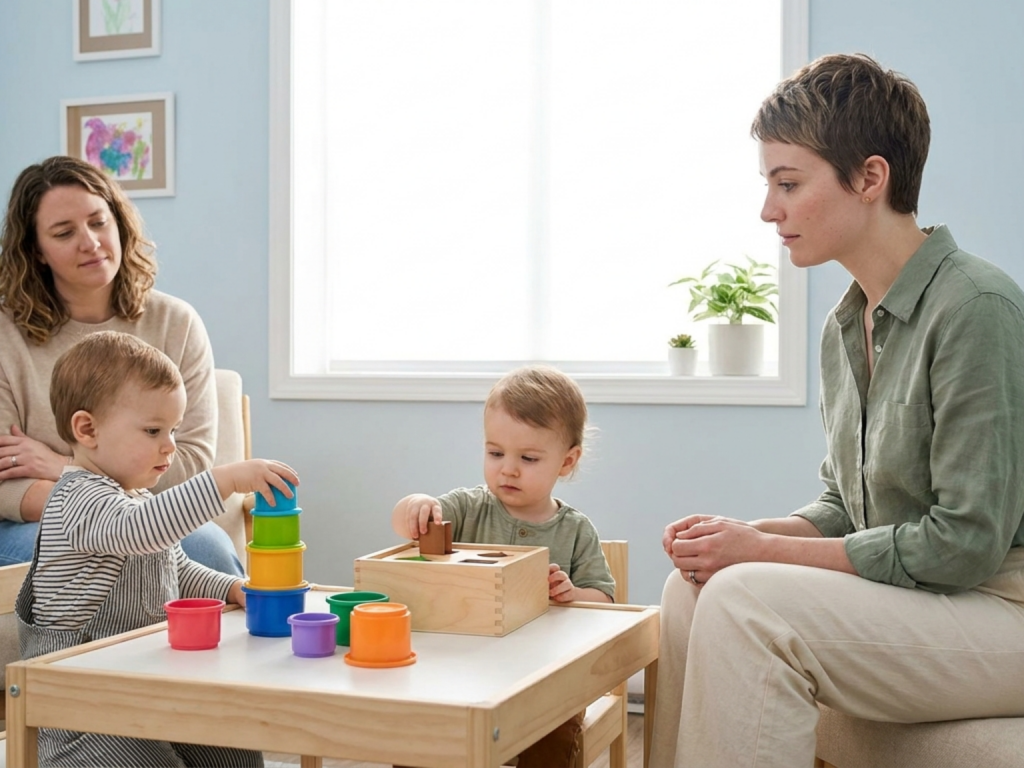
Between 12 and 36 months, children become increasingly intentional problem solvers. Around 12 months, many children put items into containers, take them out again, look for hidden objects, and imitate simple gestures. These actions may seem ordinary, but they reflect categorization, sequencing, spatial reasoning, and the ability to hold a goal in mind.
By about 18 months, many toddlers copy simple household actions, such as wiping a surface or pretending to talk on a phone. This imitation is more than mimicry; it shows that the child can observe, encode, and reproduce meaningful social behavior. Pretend play then expands, often with feeding dolls, using blocks as other objects, or acting out familiar routines.
From 2 to 3 years, toddlers often begin sorting by shape or color, completing simple puzzles, following two-step instructions, and asking early “why” or “what happened” questions. Attention span remains limited and highly dependent on interest, fatigue, and environment. A 3-year-old may focus for several minutes on a preferred task but have difficulty persisting when frustrated. This is developmentally expected and reflects still-maturing self-regulation.
Preschool years: language, imagination, and early reasoning
The preoperational stage is marked by rapid growth in symbolic thinking. Preschool children use words, drawings, objects, and pretend scenarios to represent real experiences. They may create elaborate play scenes, retell parts of stories, ask many questions, and classify objects based on visible features. Their reasoning is often vivid and creative, but it may not yet be logical in an adult sense.
Egocentric thinking is common in this period, meaning the child may have difficulty taking another person’s perspective. Magical thinking can also appear; a child may believe their thoughts caused an event. These patterns are usually normal and gradually soften as social experience, language, and brain maturation improve perspective-taking.
Preschool cognition is closely tied to executive function, including inhibitory control, cognitive flexibility, and working memory. Children practice these skills when they wait for a turn, remember game rules, shift from one activity to another, or follow a multi-step routine. Play is not a luxury in this age group; it is a primary route for cognitive, social, and emotional integration. Reading aloud, naming emotions, counting during daily activities, and offering choices can support learning without turning every interaction into a lesson.
School-age thinking: logic, rules, and concrete operations
From about 7 to 11 years, many children enter the concrete operational stage. They become better at logical reasoning when problems involve real objects, familiar situations, or observable events. They increasingly understand conservation, such as recognizing that the amount of liquid is unchanged when poured into a differently shaped glass. They can classify objects by multiple features and order items by size, number, or sequence.
Memory strategies become more intentional. A school-age child may rehearse spelling words, group related items, use visual reminders, or check work for errors. Academic learning also makes cognitive differences more visible, because reading, mathematics, handwriting, attention, and processing speed are tested repeatedly in structured settings. Fine motor skill progression can influence apparent cognition when written output is required, so clinicians and educators often consider both thinking ability and motor access.
This stage also brings more realistic self-evaluation. Children compare their performance with peers, notice mistakes, and may become sensitive to repeated failure. Supportive adults can help by praising strategy, effort, and persistence while also seeking assessment when a child consistently struggles despite appropriate instruction.
Adolescence: abstract thought and executive control
Beginning around age 12, many young people gradually develop formal operational thinking. This includes abstract reasoning, hypothetical thinking, scientific reasoning, and the ability to consider multiple possible outcomes. Adolescents may debate moral principles, think about future identity, understand algebraic variables, and evaluate evidence more systematically than younger children.
Executive function in adolescence continues to mature over many years. Planning, impulse control, flexible problem solving, emotional regulation, and risk assessment are still developing, partly because frontal brain networks and their connections refine into young adulthood. This helps explain why a teenager may reason well in a calm conversation yet make poor decisions under stress, sleep deprivation, peer pressure, or intense emotion.
Adolescent cognition is not simply “adult thinking with less experience.” It is a dynamic transition in which abstract capacity grows alongside heightened sensitivity to reward, belonging, autonomy, and identity. Support works best when it combines respect for emerging independence with clear structure, sleep protection, mental health awareness, and opportunities to practice real decision-making.
How caregivers can support cognitive growth
Children build cognition through responsive relationships and repeated, meaningful experiences. For infants, this may mean face-to-face interaction, safe floor play, naming objects, responding to babbling, and allowing exploration with supervision. For toddlers, it includes simple choices, sorting games, songs with actions, pretend play, and predictable routines that reduce cognitive overload.
For preschool and school-age children, shared reading, open-ended questions, puzzles, building toys, outdoor exploration, cooking steps, board games, and conversation about feelings and plans can all strengthen thinking. The adult’s role is to scaffold: offer enough help for the child to succeed, then gradually step back. This supports confidence and problem solving more effectively than taking over the task.
Screen media deserves thoughtful limits. High-quality interactive content may have a place for some children, but it should not displace sleep, physical play, language-rich interaction, or schoolwork. Cognition also benefits from adequate sleep, hearing and vision care, nutrition, physical activity, and treatment of chronic medical conditions. Cognitive development, social development, and Motor skills development by age often progress together, so broad observation is more useful than focusing on one domain in isolation.
When milestone concerns need professional input
Developmental surveillance and screening are important because early support can improve function and reduce secondary stress for children and families. Parents should raise concerns if a child is not gaining new skills, has difficulty engaging with people or objects, cannot use skills across settings, or seems far behind peers in problem solving, attention, language comprehension, or play.
More urgent discussion is warranted if there is loss of acquired skills, such as a child who previously used words, gestures, play routines, or social responses and then stops. Other concerns include limited eye contact combined with reduced social reciprocity, persistent lack of response to sound, unusual spells or seizures, significant regression after illness or injury, or developmental delays across multiple domains.
Evaluation may include medical history, family history, neurologic examination, hearing and vision assessment, standardized developmental screening, psychoeducational testing, speech-language evaluation, occupational therapy assessment, or referral to early intervention services. These assessments do not label a child’s worth or potential; they clarify what kind of support may help. Families should avoid self-diagnosis and should work with qualified professionals for interpretation and next steps.
Seek timely advice
- Contact a healthcare professional if a child loses previously acquired cognitive, language, motor, or social skills.
- Ask for developmental screening if concerns persist across settings or interfere with daily function.
- Hearing, vision, sleep, seizures, chronic illness, and emotional stress can affect learning and should be considered.
- Do not use milestone charts alone to diagnose developmental disorders.
- Early intervention is most useful when concerns are addressed promptly rather than waiting for a child to "grow out of it."
Tools & Assistance
- Keep a simple milestone and behavior log with dates, examples, and settings.
- Bring specific observations or short videos to pediatric visits when concerns are hard to describe.
- Use recommended developmental screening visits and ask what tool is being used.
- Request evaluation through early intervention services or the school system when delays affect function.
- Check hearing and vision when language, attention, or learning concerns appear.
FAQ
Do all children follow the same cognitive milestone timeline?
No. Milestones are ranges, and children may be advanced in one area while needing more time in another. Persistent delays, regression, or functional concerns should still be discussed with a professional.
Is pretend play a cognitive milestone?
Yes. Pretend play reflects symbolic thinking, memory, imitation, language, and social understanding. Its quality and progression can provide useful developmental information.
Can motor or language delays make cognition look delayed?
Yes. A child may understand more than they can say or show if speech, hearing, vision, or motor skills limit expression. Comprehensive evaluation helps separate these factors.
When does abstract thinking usually develop?
Abstract and hypothetical reasoning commonly strengthens from early adolescence onward, although the timing and consistency vary. Executive control continues maturing beyond the early teen years.
What should I do if I am worried about my child’s cognition?
Write down specific examples and speak with the child’s pediatrician. Depending on age and concerns, screening, early intervention, school evaluation, or specialist referral may be appropriate.
Sources
- NCBI Bookshelf (NIH) — Cognitive Development
- CDC — Module 2: Understanding Children's Developmental Milestones
- Verywell Mind — Cognitive Developmental Milestones
Disclaimer
This article is for informational purposes only and is not a diagnosis or treatment plan. Consult a qualified healthcare professional for concerns about a child’s development.


















Please log in to leave a comment.