
Intro
Toddler emotions can arrive like weather: sudden, intense, and hard to predict. A young child may sob over the wrong cup, cling at childcare drop-off, hit when frustrated, or collapse during transitions. These reactions are not evidence of poor parenting or a “bad” child; they often reflect a nervous system that is still developing language, inhibitory control, and coping capacity.
Highlights
Toddlers regulate best through co-regulation: a calm, connected adult helps the child’s stress system settle before teaching can occur.
Naming feelings, using predictable routines, and offering simple choices help toddlers build early emotional literacy and autonomy.
Tantrums, aggression, and separation distress need calm limits and skill-building, not shame or lengthy lectures.
Persistent, severe, or developmentally concerning emotional difficulties should be discussed with a pediatrician, early childhood mental health clinician, or developmental specialist.
Understanding toddler emotions as a developmental task
Toddlers are not small adults with smaller feelings. Their limbic system, which helps generate emotional responses, is highly active, while the prefrontal networks involved in inhibition, planning, and flexible problem-solving are immature. This mismatch helps explain why a toddler can know a rule one moment and impulsively break it the next. Emotional regulation is a developmental skill, not a character trait.
Many behaviors that worry caregivers, including crying, clinging, refusing, running away, hitting, or screaming, are forms of communication when language and self-control are limited. A toddler may be saying, “I am tired,” “This transition is too fast,” “I want control,” or “I do not know how to stop.” Seeing behavior as communication does not mean allowing unsafe behavior. It means responding with both empathy and structure.
Supportive care aims to reduce physiological overload, teach words for internal states, and build coping routines through repetition. Evidence-informed early childhood programs, including structured social-emotional interventions such as Fun FRIENDS, have shown benefits in reducing internalizing and externalizing behaviors and strengthening resilience, confidence, and coping skills. The common thread is practice: toddlers need many calm repetitions before skills become reliable.
Start with connection before correction
When a toddler is dysregulated, the first intervention is usually relational rather than verbal. A child in a high-arousal state may not process explanations well because stress physiology narrows attention and reduces flexible thinking. Connection before correction means helping the child feel safe enough to regain access to learning.
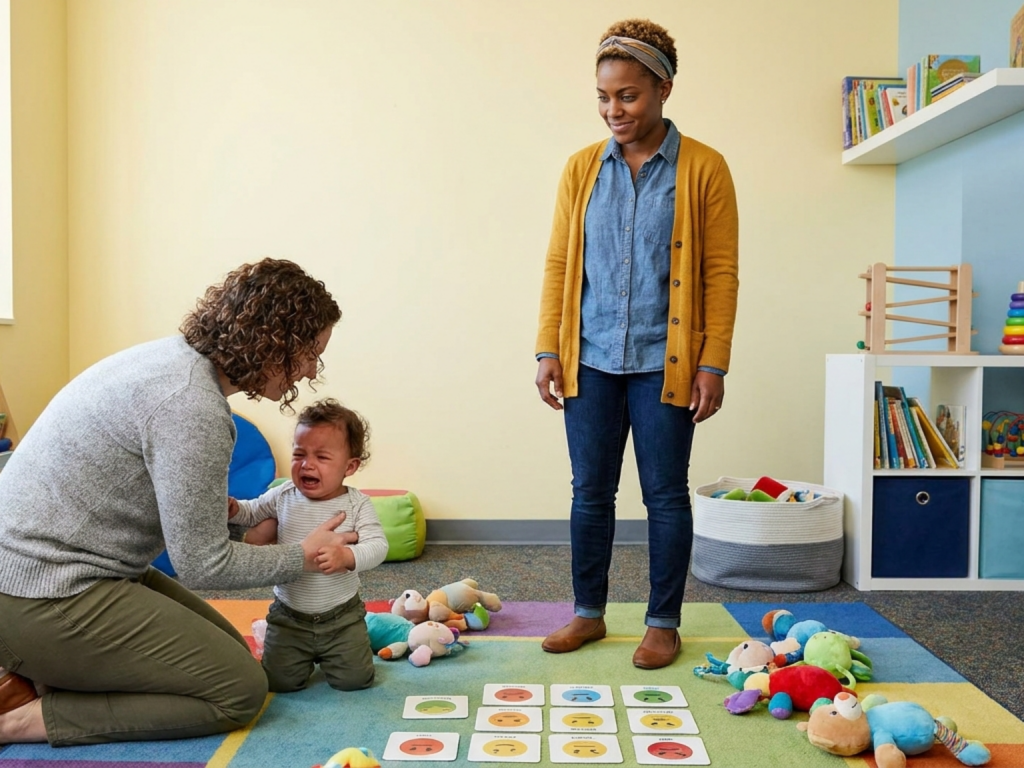
Co-regulation can be simple: lower your voice, move slowly, get near the child if safe, and use short phrases. For example, “You are very mad. I am here. I will not let you hit.” This combines emotional validation with a firm safety boundary. The adult’s calm posture, predictable tone, and non-threatening presence become external supports for the child’s immature regulation system.
Secure relationships also support conscience, empathy, and trust. A toddler who experiences adults as dependable during distress is more likely to internalize soothing strategies over time. This does not require constant happiness or perfect patience. Repair matters. If you yell or respond harshly, a brief repair such as “I used a loud voice. I am sorry. Let’s try again” models accountability and emotional recovery.
For caregivers using toddler behavior management approaches, connection is not the opposite of discipline. It is the foundation that makes discipline more effective. A connected child is usually better able to accept limits, imitate coping skills, and return to cooperation.
Build emotional language and body awareness
Emotional literacy begins long before a child can give a nuanced explanation. Caregivers can narrate feelings in everyday moments: “You look disappointed,” “Your body is wiggly and excited,” or “You are worried because I am leaving.” Pairing words with bodily sensations helps toddlers connect internal cues with language. Over time, this can reduce the need to communicate distress through behavior alone.
Use a small set of repeated feeling words at first: mad, sad, scared, happy, tired, frustrated, and calm. Too many labels can overwhelm a young child. Visual supports such as simple emotion cards, mirror play, or picture books can help. During calm periods, ask low-pressure questions: “Which face looks angry?” or “What helps this child feel better?”
It is also useful to describe intensity. A toddler may learn that feelings can be “small,” “medium,” or “big.” This prepares the child for coping choices: a small frustration might need help asking for a turn, while a big feeling might need a quiet space and an adult’s hug. Avoid insisting that a toddler “use words” while fully escalated; instead, offer the words yourself and practice later.
Modeling is powerful. When adults say, “I feel frustrated, so I am taking a slow breath,” they make emotion regulation visible. This is more effective than pretending adults never feel angry or anxious. The goal is not emotional suppression, but safe expression.
Use predictable routines and scaffolding
Toddlers cope better when the day has recognizable patterns. Predictable routines reduce the cognitive load of wondering what comes next and support transitions, sleep, meals, separation, and cleanup. A simple sequence such as bath, pajamas, two books, song, and bed can become a regulatory cue for the nervous system.
Scaffolding means giving enough support for the child to succeed without taking over completely. If a toddler struggles to leave the playground, an adult might provide a warning, a visual cue, a choice, and physical closeness: “Two more slides, then stroller. Do you want to hop or hold my hand?” This supports autonomy while keeping the boundary clear.
Helpful scaffolds include:
- First-then language: “First shoes, then outside.”
- Limited choices: “Blue cup or green cup?”
- Transition objects: a small toy, photo, or comfort item during separations.
- Visual routines: pictures showing meals, play, bath, and bedtime.
- Practice when calm: rehearsing “stop,” “help,” “my turn,” and “all done.”
Predictability should not become rigidity. The aim is to create enough structure that the child can tolerate normal variation. If a routine changes, name it simply: “Today Grandma picks you up. That is different. You are safe.”
Responding to tantrums without escalating them
Toddler tantrums are often the visible part of overload: frustration, fatigue, hunger, sensory overwhelm, illness, or a demand that exceeds current coping capacity. During a tantrum, prioritize safety, reduce stimulation, and keep language brief. Long explanations, bargaining, or repeated questions can intensify distress.
A practical sequence is: notice, name, limit, support, and teach later. For example: “You wanted the cookie. You are mad. Cookies are all done. I will sit with you.” If the child is throwing objects or trying to hit, move dangerous items away and block gently if needed. Keep the limit steady without adding threats or shame.
After the child calms, use a short teaching moment. “You were mad. You can stomp feet or say ‘help.’ Hitting hurts.” Then reconnect through ordinary activity. Some toddlers benefit from a calm corner, but it should not feel like isolation or punishment. A calm space may include pillows, books, sensory toys, or a caregiver nearby.
Effective praise is especially useful when a child uses even a tiny coping skill: “You were angry and you gave me the block instead of throwing it.” This kind of specific praise tells the child exactly what behavior to repeat. For more detailed context, families may find Toddler tantrums explained relevant when tantrums are frequent or difficult to interpret.
Supporting separation, fear, and anxiety
Separation distress and fearfulness are common in toddlerhood. Object permanence, memory, and attachment are developing rapidly, but the child may not yet understand time well. “I will be back after nap” may be reassuring only after many repeated experiences of return.
Goodbyes should be warm, brief, and predictable. Sneaking away can increase vigilance because the child learns that caregivers may disappear unexpectedly. A consistent ritual helps: hug, phrase, handoff, and leave. For example, “One hug, one kiss, I come back after snack.” The caregiver’s confidence matters; a worried, prolonged goodbye can communicate danger even when the setting is safe.
For fear of loud noises, medical visits, animals, or unfamiliar people, validate without reinforcing avoidance as the only solution. “That sound scared you. I will hold you. Let’s look from here.” Gradual exposure with control, such as watching from a distance or touching a doctor’s toy stethoscope before an exam, can build mastery. Never force intense exposure when a child is panicked; the goal is tolerable practice.
If fear or separation distress severely limits sleep, feeding, childcare attendance, or family functioning, discuss it with a pediatric clinician or qualified child mental health professional. Early support can clarify whether the pattern fits typical development, stress response, sensory sensitivity, communication delay, or another concern requiring evaluation.
Aggression, impulsivity, and safe limits
Hitting, biting, grabbing, and pushing can be alarming, but they are not uncommon in early childhood. They often reflect immature self-control, limited language, sensory seeking, fatigue, or difficulty sharing. The response should be immediate, calm, and consistent: stop the unsafe action, label the limit, and teach an alternative.
Use very few words in the moment: “I will not let you bite. Biting hurts.” Attend first to the injured child if another child was hurt; this avoids accidentally rewarding aggression with intense attention. Then help the toddler repair in a developmentally appropriate way, such as bringing a tissue, checking if the peer is okay, or practicing “my turn please.” Forced apologies are usually less useful than guided repair and replacement skills.
Prevention is often more effective than reaction. Track patterns: Does aggression happen before meals, in crowded play, during toy conflict, or when language demands are high? If a toddler bites when overwhelmed in childcare, the plan may include closer supervision during transitions, teething alternatives if relevant, and coaching simple phrases. Toddler hitting and biting behavior may require coordinated strategies between home and childcare.
Seek professional guidance if aggression is frequent, causes injury, occurs with developmental regression, is accompanied by loss of language or social engagement, or persists despite consistent supports. A pediatrician may consider hearing, sleep, pain, neurodevelopmental, speech-language, or psychosocial contributors.
Caregiver regulation and when to seek help
Supporting a toddler’s emotions is demanding work. Adult nervous systems are part of the intervention. Sleep deprivation, financial strain, relationship stress, trauma history, depression, or anxiety can make calm responses harder. This is not a moral failure; it is a signal that the caregiver also deserves support.
Plan for your own regulation before the hardest moments. Some caregivers use a phrase such as “My child is having a hard time, not giving me a hard time.” Others step a few feet away after ensuring safety, unclench their jaw, breathe slowly, or tag in another adult. If you fear you may hurt your child, place the child in a safe location and seek immediate help from another trusted adult or emergency service.
Consider developmental screening for behavior concerns when emotional outbursts are unusually prolonged, very frequent, associated with self-injury, include severe aggression, or interfere with sleep, feeding, childcare, or relationships. Screening is not a diagnosis; it is a structured way to identify whether a toddler may benefit from speech-language evaluation, occupational therapy, parent-child therapy, early intervention, or medical assessment.
Supportive strategies work best when tailored to the child’s temperament, developmental level, health status, and family context. A toddler with chronic ear infections, poor sleep, autism-related sensory differences, language delay, trauma exposure, or gastrointestinal pain may need different supports than a child whose main challenge is transitions. When in doubt, bring specific observations to a healthcare professional: what happens, how often, how long it lasts, what triggers it, and what helps recovery.
Seek prompt professional advice if
- Tantrums regularly involve self-injury, loss of consciousness, or dangerous aggression.
- Your toddler loses previously acquired language, social, motor, or play skills.
- Emotional distress severely disrupts sleep, feeding, childcare participation, or family safety.
- You suspect pain, illness, trauma, hearing problems, or developmental delay may be contributing.
- A caregiver feels at risk of harming the child or cannot safely manage the situation.
Tools & Assistance
- Keep a brief behavior log noting sleep, meals, triggers, duration, and recovery supports.
- Ask your pediatrician about developmental screening and early intervention referral if concerns persist.
- Use visual routines and simple first-then language for transitions.
- Coordinate a consistent response plan with childcare providers.
- Consider evidence-based parent-child therapy or early childhood mental health consultation when needed.
FAQ
Should I ignore my toddler’s big feelings?
Usually no. It is better to acknowledge the feeling while not giving in to unsafe or unreasonable behavior. Calm presence and firm limits teach regulation more effectively than emotional withdrawal.
Is it okay to use time-out?
Some families use brief time-outs for specific unsafe behaviors, but many toddlers benefit more from time-in, close supervision, and guided calming. Discuss persistent behavior concerns with a pediatric or child development professional.
How long does emotional regulation take to develop?
It develops gradually across early childhood and beyond. Toddlers need repeated co-regulation, language, routines, and modeling before they can reliably manage strong emotions independently.
When are tantrums more concerning?
Concern increases when tantrums are very frequent, prolonged, injurious, associated with regression, or significantly impair daily life. In those cases, developmental screening and medical review are appropriate.
Sources
- National Institutes of Health — Enhancing social-emotional skills in early childhood
- Zero to Three — Tips for Promoting Social-Emotional Development in Infants and Toddlers
- American Psychological Association — How to help kids understand and manage their emotions
Disclaimer
This article is for general educational purposes and is not a diagnosis or treatment plan. Consult a pediatrician or qualified child development professional for concerns about your child’s behavior, safety, or development.


















Please log in to leave a comment.