A–Z Glossary

emotional regulation

Emotional regulation is a child’s ability to manage feelings, stress, and reactions without becoming overwhelmed or dysregulated.

← Back to A–Z Glossary

Search results for: emotional regulation

Enhancing psychological stability

Enhancing psychological stability

Understanding psychological stability in pregnancy Psychological stability during pregnancy is best understood as adaptive emotional regulation rather than constant happiness. A pregnant person may still experience worry before an ultrasound, irritability after poor sleep, or grief about life changes. Stability means these feelings are recognized, contained, and supported enough that they do not consistently overwhelm […]

Partner role in birth plan

Partner role in birth plan

Why the partner matters in a birth plan A birth plan is most effective when it reflects the birthing person’s informed preferences and is understood by the people who will help communicate those preferences. The partner is often the person who knows the birthing person’s baseline emotional state, coping style, pain cues, trauma history, cultural […]

How partner manages fear and emotions

How partner manages fear and emotions

Why fear shows up for partners Fear in a birth setting is usually a normal stress response, not a sign of weakness. The brain reads pain, uncertainty, previous loss, medical language, and responsibility for another person as potential threat. That can activate sympathetic arousal: faster heart rate, tight muscles, shallow breathing, and racing thoughts. In […]

Common myths about emotional experience

Common myths about emotional experience

Myth: Every emotion is a universal, hardwired category Popular language often treats emotions such as fear, anger, sadness, and joy as biologically fixed packages. The assumption is that each emotion has a distinctive facial expression, body response, brain pattern, and behavioral meaning that should be recognizable across people and cultures. Research reviewed in the psychological […]

How to bond with newborn baby

How to bond with newborn baby

Understand what bonding really means Bonding is the developing emotional relationship between a baby and the people who care for them. In medical and developmental terms, it is closely related to attachment: the infant gradually comes to expect that distress will be noticed and that comfort, nutrition, warmth, and protection will be available. This expectation […]

How babies express feelings

How babies express feelings

Emotional communication begins before speech Infants do not need spoken language to communicate meaningful internal states. Their nervous systems continuously respond to hunger, pain, temperature, fatigue, touch, sound, light, and social contact. Observable behavior is the outward result of these interacting physiological and emotional processes. A baby may therefore be communicating a feeling, a bodily […]

Role of environment in development

Role of environment in development

Development begins before birth The developmental environment begins during pregnancy. The fetus is exposed to maternal nutrition, stress physiology, medications and substances, infections, air pollution, and other aspects of the surrounding environment through complex biological pathways. These influences do not determine a child’s future in a simple or predictable way, but they can alter developmental […]

Small Skills That Often Appear Before Major Milestones

Small Skills That Often Appear Before Major Milestones

Milestones Are Built From Overlapping Skills A milestone is an observable functional achievement, such as sitting without support, taking an independent step, using a meaningful word, or responding consistently to a familiar request. It is helpful to remember that the visible event is usually the endpoint of several less obvious changes. The nervous system must […]

Connecting Sleep Cycles Without Full Waking

Connecting Sleep Cycles Without Full Waking

What Happens Between Infant Sleep Cycles Sleep is not a single uniform state. It alternates between non-rapid eye movement sleep, or NREM sleep, and rapid eye movement sleep, or REM sleep. NREM sleep generally becomes progressively deeper, while REM sleep is associated with greater brain activity, variable breathing, eye movements, and more active dreaming in […]

Responsive parenting and routines

Responsive parenting and routines

What responsive parenting means Responsive parenting is a reciprocal process in which a caregiver notices a child’s signals, interprets them within context, and responds in a timely, appropriate, and emotionally available way. In infancy, signals may include crying, facial expressions, body movements, gaze, vocalizations, changes in muscle tone, and shifts in alertness. The same behavior […]

Top soothing techniques for babies

Top soothing techniques for babies

Start with a calm, structured check Before adding more stimulation, pause and consider the most likely immediate needs. Babies commonly become fussy because they are hungry, have a wet or soiled diaper, are too warm or cool, need a burp, are tired, or have become overstimulated. A quiet check reduces the chance of cycling through […]

Self-soothing in babies explained

Self-soothing in babies explained

What self-soothing means in infancy Self-soothing is best understood as part of infant self-regulation: the gradual development of the capacity to modulate arousal, emotion, movement, and attention. A baby may lower arousal by sucking a hand, holding a comfort object when developmentally appropriate, looking away, flexing and relaxing the limbs, making repetitive sounds, or pausing […]

When babies learn to self-soothe

When babies learn to self-soothe

Self-soothing begins with co-regulation In infancy, self-soothing refers to a baby’s emerging ability to reduce arousal or return to a calmer state using their own behaviors. It may look like bringing a hand to the mouth, sucking, holding a comforting object when developmentally appropriate, making quiet vocal sounds, or briefly resettling after a normal night […]

How to teach baby to self-soothe

How to teach baby to self-soothe

Understand what self-soothing means Infant self-soothing refers to behaviors a baby uses to reduce arousal and settle without immediate caregiver intervention. These may include sucking fingers or a pacifier, holding a comfort item when developmentally and safely appropriate, rubbing the face, changing position, vocalizing briefly, or pausing quietly before returning to sleep. It does not […]

Helping baby settle independently

Helping baby settle independently

What independent settling means in infancy Independent settling is the developing ability to fall asleep, or return to sleep after a normal arousal, in a safe sleep space without needing the same level of caregiver assistance every time. It can include quietly looking around, sucking a hand, making small movements, vocalising briefly, or having a […]

Self-soothing myths explained

Self-soothing myths explained

What self-soothing actually means In everyday conversation, self-soothing can mean anything from sucking a hand to falling asleep without being held. In infant sleep research, it is usually narrower: the infant returns to sleep after a nighttime arousal without a parent intervening. This is not evidence that the baby has no needs, did not wake, […]

When babies recognize faces

When babies recognize faces

Recognition Starts Before It Looks Obvious When caregivers ask when babies recognize faces, they are often asking several related questions at once. Can a newborn see a face? Can a baby tell one person from another? Does the baby know who is safe, familiar, or emotionally important? These abilities overlap, but they mature at different […]

Baby attention span explained

Baby attention span explained

What baby attention span really means In infancy, attention span is not the same as the adult ability to concentrate on a task for a sustained period. It is closer to a set of early neurodevelopmental skills: orienting toward a stimulus, maintaining alertness, filtering competing sensory input, shifting gaze when something new appears, and disengaging […]

How long babies focus on objects

How long babies focus on objects

What focusing means in infancy When adults ask how long a baby should focus on an object, they are usually describing several related skills at once: visual fixation, sustained attention, gaze shifting, visual tracking, and recognition. Visual fixation means holding the eyes on a target. Sustained attention means maintaining engagement long enough to process information. […]

Why babies get bored quickly

Why babies get bored quickly

Boredom in babies is often a learning signal Babies may appear to get bored quickly because their brains are designed to learn efficiently, not to remain politely engaged. An infant who looks away, arches, fusses, or drops a toy may be signaling that the stimulus has stopped being useful, has become too demanding, or is […]

Throwing Toys During Play and Meals

Throwing Toys During Play and Meals

Why babies throw in the first place Throwing is not just random mischief. In infancy and toddlerhood, it can reflect exploration, repetition, and the basic human desire to see what happens next. A baby may drop a toy from the high chair several times because the action is interesting, predictable, and rewarding. The adult reaction […]

Calm vs active baby behavior

Calm vs active baby behavior

What calm and active behavior can mean A calm baby is often described as easy to soothe, observant, steady during transitions, and able to spend short periods in quiet alertness. Quiet alertness is a wakeful state in which the infant has open eyes, relatively smooth movements, and good availability for face-to-face interaction. A calm baby […]

Why babies resist changes

Why babies resist changes

Attachment makes change feel risky For a baby, the world is still small and highly dependent on proximity to a trusted adult. The caregiver-baby relationship is not just about comfort; it is the infant’s main source of safety, co-regulation, and meaning. When that familiar person steps away, hands the baby to someone new, or changes […]

Adjusting baby to new situations

Adjusting baby to new situations

Why new situations feel intense for babies A baby’s adjustment to change is shaped by rapid neurologic development, immature self-regulation, and complete dependence on caregivers for safety. Infants can detect patterns in voice, smell, touch, feeding, sleep timing, light, and movement long before they can understand explanations. When those patterns shift, the brain must update […]

Why babies get frustrated easily

Why babies get frustrated easily

Frustration starts as communication For a baby, frustration is rarely a deliberate behavior. It is usually a signal. Newborns and young infants have a limited behavioral vocabulary: crying, facial grimacing, body stiffening, turning away, rooting, sucking, hand-to-mouth movements, arching, and changes in tone or color. These cues carry a lot of information, but they are […]

How babies express frustration

How babies express frustration

Frustration is communication, not misbehavior Frustration in infancy is best understood as an early affective response to a blocked goal or an overwhelming demand. The baby may want milk faster than it is arriving, reach for an object that remains out of range, become unable to settle after stimulation, or protest when a caregiver changes […]

Why babies pull ears

Why babies pull ears

Normal discovery and self-soothing One of the most common reasons babies pull their ears is also one of the least alarming: they have found them. Infants gradually learn that their hands can reach different body parts, and the ear is easy to grasp. Pulling, rubbing, folding, or patting the ear may simply be sensory exploration. […]

Responsive caregiving

Responsive caregiving

What responsive caregiving means The World Health Organization describes responsive caregiving as the ability to notice, understand, and respond appropriately and promptly to a young child’s signals. Those signals include behavior, movements, vocalizations, facial expressions, and changes in state such as alertness, fatigue, hunger, discomfort, or overstimulation. The response is not merely practical. Its quality […]

Understanding child behavior patterns

Understanding child behavior patterns

Behavior as developmental communication Child behavior is best understood as an observable output of a developing brain. Executive functions, including inhibitory control, working memory, cognitive flexibility, and planning, mature gradually from early childhood through adolescence. Emotional regulation also develops slowly and depends heavily on co-regulation: the adult’s ability to provide calm, predictable support while the […]

Common mistakes in social development

Common mistakes in social development

Why social mistakes are so common Children are still building the abilities needed for social life: attention, language, impulse control, emotion regulation, perspective-taking, and flexible thinking. In early life, social learning depends heavily on co-regulation before self-regulation, meaning an adult helps the child settle, name feelings, and stay organized before the child can manage those […]

Overprotecting and not encouraging social interaction

Overprotecting and not encouraging social interaction

What overprotection looks like in daily life Overprotective parenting is more than being attentive or cautious. It usually means an adult steps in before a child has a chance to solve age-appropriate problems, tolerate discomfort, or test social skills. Examples can include answering every question for the child, arranging all play around adult comfort, avoiding […]

Why some children struggle to make friends

Why some children struggle to make friends

Friendship begins with repeated practice To understand why some children struggle, it helps to see how children make friends in the first place. Friendship is usually built through repeated small exchanges: noticing another child, joining play, responding to bids for attention, taking turns, and recovering after disagreement. These steps sound simple to adults, but for […]

Conflict resolution skills children

Conflict resolution skills children

Why conflict resolution matters in childhood Conflict is not proof that a child is disrespectful or that a family is failing. In childhood, disagreement is often a normal sign that a child wants autonomy, fairness, or control over a limited resource. The developmental task is to move from impulse-driven reactions toward teaching conflict resolution skills […]

How kids handle disagreements

How kids handle disagreements

Why disagreements are part of normal development Children are learning how to be separate people while still staying connected to others. That developmental task creates friction. A child may want the same toy, the same seat, the same turn, or the same attention as someone else, and the resulting disagreement is often a first lesson […]

Problem solving in relationships kids

Problem solving in relationships kids

What relationship problem solving means for children Problem solving in relationships is more than telling children to be nice. It means helping them move from emotion to action without ignoring either one. A child has to notice the conflict, label the feeling, consider the other person’s point of view, and choose a response that protects […]

Handling peer conflicts children

Handling peer conflicts children

Why peer conflict is a normal part of childhood Children do not build friendship skills in a straight line. They test boundaries, misread intentions, want the same toy, or feel hurt by a comment and react quickly. In this sense, peer conflict is part of learning how to negotiate membership in a group. Developmental research […]

Sibling relationships in children

Sibling relationships in children

Why sibling relationships matter Siblings often share the most consistent peer-like contact a child has at home. That makes the relationship an important setting for learning how to negotiate turns, read emotions, manage disappointment, and recover after conflict. In everyday life, siblings also influence each other’s routines, interests, language, and sense of belonging. Longitudinal research […]

Helping siblings get along and bonding

Helping siblings get along and bonding

Why sibling relationships can feel so intense Siblings are not simply other children in the home; they are daily relationship partners. They share parents, space, routines, and often attention. That combination makes sibling dynamics especially sensitive to perceived unfairness. A younger child may want to copy an older one, while the older child may feel […]

Helping children accept an apology while keeping healthy boundaries

Helping children accept an apology while keeping healthy boundaries

Why apology and boundaries are separate skills One of the most helpful ideas to give children is that accepting an apology does not mean giving up their right to safety or comfort. A child can listen, notice the other person’s words, and still decide, ‘I need space right now.’ That is not rude; it is […]

Teaching children that friendship does not require constant agreement

Teaching children that friendship does not require constant agreement

Why disagreement is part of friendship Children are still learning how to manage desire, fairness, and frustration. That means even close friends will sometimes want different games, different rules, or different turns. Research on middle childhood shows that conflict can be a normal feature of friendship, and it may even happen more often among friends […]

Helping children cope when a best friend chooses someone else

Helping children cope when a best friend chooses someone else

When a friendship shift feels like rejection Children often experience close friendships as highly exclusive. A best friend may be the person they sit with, play with, or confide in every day, so when that friend starts choosing someone else, the child may hear an unspoken message: “I am not wanted.” Developmentally, this is not […]

Jealousy between friends and how children can manage it

Jealousy between friends and how children can manage it

Why jealousy shows up between friends Jealousy is a normal emotion in childhood. In friendships, it often appears when a child believes that attention, closeness, or belonging is being taken away. The feeling can be triggered by a friend spending time with someone new, choosing another playmate, or sharing something private with another child. From […]

Supporting children when friendships fade naturally

Supporting children when friendships fade naturally

Why friendships sometimes fade naturally Children do not form static social bonds. In middle childhood and adolescence, friendships often change as children develop different interests, move into new classrooms, join new activities, or become more selective about whose company feels comfortable. A friendship that once felt close can quietly loosen without either child doing something […]

Cliques in childhood and how parents can support healthy choices

Cliques in childhood and how parents can support healthy choices

Why cliques can feel so intense in childhood Clique behavior often reflects normal developmental needs: children want belonging, identity, and status. In elementary and middle school years, social groups may become more organized, with unspoken rules about appearance, interests, or who is allowed into the group. For a child, this can feel all-consuming because peer […]

Why play is important for children

Why play is important for children

Play is a core part of development In child development, play is best understood as active exploration. A child who stacks blocks, pretends to cook, chases a ball, or invents rules for a game is not simply passing time. The child is testing ideas, adjusting to feedback, and learning how actions lead to consequences. That […]

Balancing group and solo play

Balancing group and solo play

Why balancing play styles matters Play is not a single skill. In early childhood, it is a cluster of abilities that includes exploration, communication, imitation, problem-solving, and emotional regulation. A child who enjoys alone time may be practicing different skills from a child who thrives in a busy group, but both are learning. That is […]

Arts crafts and music creative expression children

Arts crafts and music creative expression children

Why creative expression matters in childhood Children learn through action, repetition, and meaningful play. Arts, crafts, and music provide all three. When a child tears paper, shapes clay, shakes a rattle, or chooses colors for a drawing, they are practicing decision-making, cause-and-effect reasoning, and flexible thinking. These experiences also invite curiosity, which is an important […]

Loose parts play: using everyday objects for creative play

Loose parts play: using everyday objects for creative play

What loose parts play means Loose parts play means giving children everyday objects that can be moved, combined, stacked, sorted, carried, torn apart, and rebuilt. The key feature is not what the object is, but what the child can do with it. A cardboard tube may become a telescope, a bridge, a megaphone, or part […]

Building teamwork through play

Building teamwork through play

Why teamwork is learned most naturally in play Teamwork is not a single skill. It is a cluster of capacities: joint attention, receptive and expressive language, impulse control, theory of mind, frustration tolerance, flexible problem-solving, and the ability to repair a social rupture. Play brings these capacities together in a low-stakes but emotionally meaningful setting. […]

When is a child ready to stay home alone

When is a child ready to stay home alone

There is no single age that fits every child Age provides context, but it cannot determine readiness by itself. The Nationwide Children’s Hospital notes that most children are not ready to stay home alone until at least age 12. This should be treated as a general developmental benchmark rather than a universal rule. A younger […]

Parental involvement and setting expectations children

Parental involvement and setting expectations children

Why parental expectations matter Children use caregivers’ expectations as information about both the task and themselves. A message such as “I know you can learn this, and we will find the right support” communicates confidence without demanding immediate perfection. By contrast, vague criticism, comparison with siblings, or repeated emphasis on grades can make performance feel […]

Common mistakes in child routines

Common mistakes in child routines

Treating routines as rigid rules One common mistake is confusing predictability with inflexibility. A routine should provide a reliable sequence, not require every event to occur at exactly the same minute. Children need repeated cues, but they also need opportunities to learn that plans can change safely. Insisting on perfect adherence may increase conflict when […]

Encouraging self management children

Encouraging self management children

Understanding self-management as a developmental process Self-management includes several related capacities: self-awareness, emotional regulation, planning, task initiation, monitoring, decision-making, communication, and problem-solving. These abilities rely partly on executive functions, which continue to mature throughout childhood and adolescence. A child may be highly independent in one area, such as choosing clothing, yet still need substantial support […]

Too busy schedule and lack of structure issues children

Too busy schedule and lack of structure issues children

Why an overloaded schedule can become stressful Children need time not only for formal learning and organized activities, but also for sleep, meals, movement, relationships, recovery, and self-directed play. When every part of the day is assigned, the child may have few opportunities to decompress or process experiences. Repeated transitions between school, tutoring, sports, lessons, […]

Helping children adjust when daily routines differ between homes

Helping children adjust when daily routines differ between homes

Why routine differences can feel stressful Routines reduce the number of decisions a child must make. Repeated sequences provide external structure while executive function—the capacity to plan, shift attention, remember instructions, and regulate behavior—is still developing. Moving between homes can temporarily increase the need for these skills. A child may need to remember different rules, […]

Rebuilding family routines after moving to a new home

Rebuilding family routines after moving to a new home

Understand why a move can unsettle children A move changes more than an address. Children may lose familiar sensory cues, neighborhood landmarks, classmates, caregivers, play spaces, and expectations about what happens next. Even when the move is positive, the transition can increase cognitive load: a child must learn new routes, room layouts, household rules, and […]

Child school life overview by age

Child school life overview by age

Ages 3 to 5: building the foundations for school Preschool and the kindergarten-entry period are often focused less on formal academic achievement and more on readiness for group learning. Children practice separating from caregivers, following short sequences of instructions, taking turns, listening during group activities, using classroom materials safely, and communicating basic needs. Play remains […]

Adjusting to kindergarten routine and social adaptation

Adjusting to kindergarten routine and social adaptation

Why kindergarten adjustment can feel demanding Kindergarten combines several developmental tasks that may previously have occurred separately. A child may need to wake earlier, dress within a time limit, travel to school, separate from a caregiver, attend to group directions, wait for turns, use classroom materials appropriately, manage toileting and meals more independently, and shift […]

School success factors children explained

School success factors children explained

What school success means School success is broader than achieving high marks. It may include acquiring literacy and numeracy, participating in lessons, attending regularly, developing executive functions, forming relationships, managing frustration, and becoming increasingly independent. A child may be progressing meaningfully even when their attainment is not yet at the expected level. Academic achievement is […]

Questions parents should ask during a parent-teacher conference

Questions parents should ask during a parent-teacher conference

Prepare for a focused, collaborative conversation Before the conference, review recent assignments, school communications, report cards, attendance information, and any notes your child has shared. Write down two or three priorities. These might include reading fluency, mathematics, organization, separation distress, frequent headaches before school, conflict with peers, or difficulty completing homework. Prioritizing helps you use […]

Responding calmly to a disappointing school report

Responding calmly to a disappointing school report

Pause before the first conversation The first few minutes after seeing a disappointing school report often set the emotional tone for everything that follows. If you feel angry, embarrassed, or frightened, it is reasonable to delay the conversation. A brief cooling-off period protects both you and your child from a reactive exchange that may be […]

Kindergarten adaptation checklist

Kindergarten adaptation checklist

1. Begin with an individualized readiness review Kindergarten readiness is multidimensional. It includes physical self-care, receptive and expressive language, attention, motor coordination, social participation, emotional regulation, and the ability to transition between activities. It does not require a child to read independently, remain calm at all times, or perform every task without assistance. The most […]

Screen free habits and digital well being kids

Screen free habits and digital well being kids

Why Screen-Free Habits Matter Screen-free habits are protective routines that reserve parts of a child’s day for sleep, movement, face-to-face communication, imaginative play, reading, outdoor activity, and unhurried family connection. They do not require eliminating all digital media. Instead, they help prevent screens from becoming the default response to boredom, distress, transitions, meals, or bedtime. […]

Family rules and parents as role models tech use

Family rules and parents as role models tech use

Why parent modeling changes the home media climate Children are careful observers of adult behavior, even when they seem absorbed in their own media. If a parent checks messages during meals, answers notifications mid-conversation, or keeps a phone beside the bed overnight, the child may learn that constant digital availability is normal. If the parent […]

Screen use during family time and tech free zones

Screen use during family time and tech free zones

Why family time is neurologically valuable Family time is not just pleasant background for childhood; it is a repeated neurodevelopmental learning environment. During meals, play, reading, chores, and bedtime, children practice joint attention, emotional labeling, impulse control, conversational turn-taking, and recovery from frustration. These skills are shaped through responsive interaction: the caregiver notices a cue, […]

Balancing family and technology

Balancing family and technology

Technology is part of family life Family technology balance begins with an honest premise: digital media is not simply an outside threat entering the home. It is often woven into caregiving, education, employment, entertainment, safety, and social connection. A child may use a tablet for school reading, a messaging app to coordinate a sports pickup, […]

Impact of technology on children and digital habits

Impact of technology on children and digital habits

Technology Is A Developmental Environment For children, digital technology is not only a tool; it is also an environment where learning, play, identity formation, and peer interaction can occur. A video call with a grandparent, a classroom learning platform, a creative drawing app, a cooperative game, and an endless short-video feed are all screen-based, but […]

Technology behavior patterns children

Technology behavior patterns children

Patterns are communication Technology behavior patterns in children are rarely about the device alone. A child who cries when a tablet is removed, rushes through homework to play a game, or becomes irritable after videos may be communicating fatigue, anxiety, sensory overload, boredom, social pressure, or difficulty with transitions. Understanding child behavior patterns means asking […]

Common screen time problems children

Common screen time problems children

How to Think About Screen Time Problems Screen time becomes clinically relevant when it repeatedly interferes with a child’s developmental needs, functioning, or relationships. The issue is rarely just the number of minutes. Content type, timing, device portability, autoplay, gaming rewards, background television, family stress, sleep debt, and the child’s temperament all matter. A medically […]
Child refuses screens too much gaming and conflicts

Child refuses screens too much gaming and conflicts

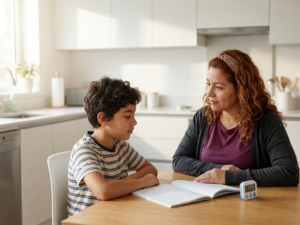
Why Screen Refusal Feels So Intense When a child refuses to stop gaming, the reaction may look disproportionate from the outside: yelling, bargaining, crying, threats, or physical resistance over a device. Clinically, it helps to view this as a transition problem plus a reward-regulation problem. Video games provide immediate feedback, novelty, social connection, and intermittent […]

Screens replacing real activities and solutions

Screens replacing real activities and solutions

The replacement problem For many children, screens begin as helpful tools: a cartoon during dinner preparation, a tablet for homework, a video call with relatives, or a game after school. The difficulty appears when screens stop being one activity among many and become the default replacement for nearly every pause in the day. In that […]

Common myths about screen time

Common myths about screen time

Myth 1: All screen time has the same effect Screen use is not a single behavior. A video call with a grandparent, an interactive educational activity, a collaborative game, a passive video, and late-night social media use differ in purpose, cognitive demand, social context, and likely effect on the rest of the day. Treating them […]

Myths about technology and gaming kids

Myths about technology and gaming kids

Myth 1: gaming is always harmful to children It is understandable to worry when a child becomes absorbed in a game. Games are designed to be engaging, rewarding, and socially sticky. Still, the claim that gaming is inherently harmful is too broad. Research reviews describe a mixed picture: some children experience problems related to excessive […]