
Intro
A baby’s development is shaped by an ongoing interaction between biology and experience. Genes provide important biological potential, but the environments surrounding a baby before birth and during infancy influence how that potential is expressed. Environment includes much more than the home: it includes nutrition, air quality, housing, noise, relationships, routines, healthcare access, safety, and opportunities for movement and communication.
Understanding environmental influences can help caregivers focus on practical protections and supportive experiences without placing blame. No family can control every exposure or circumstance. Small, consistent improvements, combined with appropriate medical and community support, can contribute to a healthier developmental context.
Highlights
Development reflects the interaction of genetic factors, prenatal conditions, caregiving relationships, and the physical world.
Responsive, predictable relationships help support emotional regulation, communication, and early learning.
Clean air, safe housing, adequate nutrition, and protection from toxic exposures are important public-health foundations.
Environmental risks are often cumulative, so healthcare and social-service support can be valuable when circumstances are difficult.
Development begins before birth
The developmental environment begins during pregnancy. The fetus is exposed to maternal nutrition, stress physiology, medications and substances, infections, air pollution, and other aspects of the surrounding environment through complex biological pathways. These influences do not determine a child’s future in a simple or predictable way, but they can alter developmental conditions during sensitive periods of brain, immune, and organ formation.
Research on early development describes mechanisms that may include inflammation, oxidative stress, altered endocrine signaling, and epigenetic regulation. Epigenetic regulation refers to chemical and cellular processes that influence how genes are activated or silenced without changing the underlying DNA sequence. These processes are one way environmental conditions may affect later vulnerability or resilience.
Nutrition is particularly important because fetal growth and nervous-system development require energy, protein, fatty acids, vitamins, minerals, and oxygen. Both inadequate nutrition and certain excessive exposures can create risks, but individual needs vary. Pregnant people should discuss supplements, dietary restrictions, medications, alcohol, tobacco, cannabis, and occupational or household exposures with an obstetric or primary-care professional rather than relying on general advice alone.
Stress also deserves a compassionate interpretation. Ordinary emotional stress is common and does not mean a caregiver has harmed a baby. Persistent severe stress, violence, housing insecurity, discrimination, or lack of social support may affect health through sleep disruption, hormonal pathways, nutrition, and reduced access to care. Supportive services can reduce these pressures and are part of developmental care.
Relationships are part of the developmental environment
For an infant, other people are not separate from the environment; they are one of its most influential features. Through repeated interactions, caregivers help a baby organize attention, arousal, emotion, and expectations about safety. Looking, talking, holding, feeding, comforting, and responding to sounds or gestures provide repeated opportunities for the developing nervous system to practice regulation and communication.
Responsive caregiving means noticing a baby’s cues and responding as consistently as circumstances allow. It does not require perfect timing or constant entertainment. A caregiver may pause when a baby turns away, reduce stimulation when the baby becomes overwhelmed, or offer comfort when the baby cries. These ordinary exchanges help build early social-emotional capacities and support the gradual development of self-regulation.
Predictable caregiving cues are also useful. Familiar sequences around feeding, sleep, bathing, and transitions can help an infant anticipate what comes next. Predictability is not the same as a rigid schedule. Babies have changing needs, and routines may need to adapt to illness, growth, feeding patterns, work demands, and family circumstances.
Caregiver wellbeing affects this relational environment. Exhaustion, postpartum depression, anxiety, trauma, financial strain, and isolation can make responsive interaction harder, but they are treatable and deserving of support. A healthcare professional can help assess concerns and connect a family with mental-health care, lactation support, home-visiting programs, early-intervention services, or community resources. Seeking help is a protective action, not a failure.
The physical environment influences health and learning
A baby’s physical surroundings can affect development through direct biological exposure and through opportunities for sleep, movement, exploration, and interaction. Important factors include clean indoor air, safe drinking water, appropriate temperature, adequate lighting, sanitary conditions, safe sleep arrangements, and protection from injury.
Air pollution and tobacco smoke are associated with respiratory illness and may also affect neurodevelopment through inflammation and reduced oxygen delivery. Potential household hazards can include lead in older paint or plumbing, contaminated soil, pesticides, solvents, certain renovation materials, and unsafe combustion from heating or cooking equipment. Babies are especially vulnerable because their organs and nervous systems are developing, they breathe more air relative to body size, and they frequently place their hands and objects in their mouths.
Noise, crowding, and housing instability can interfere with sleep and increase physiological stress. Persistent sleep disruption may affect mood, attention, feeding, and caregiver-infant interaction. Crowded or poorly maintained housing may also increase exposure to infectious disease, dampness, mold, pests, and injury hazards. These conditions are often linked to broader social inequities, so advice should acknowledge structural barriers rather than implying that every family can solve them independently.
Neighborhood quality matters as well. Safe areas with access to parks, walkable space, healthcare, childcare, libraries, and supportive social networks create more opportunities for physical activity and learning. Conversely, traffic danger, violence, environmental contamination, and limited services can restrict a family’s options. Public-health measures such as housing standards, clean-air regulations, safe water systems, and accessible early-childhood programs are therefore developmental interventions at a population level.
Nutrition, movement, sleep, and sensory experience
Development is supported by an environment that meets a baby’s basic physiological needs. Feeding provides nutrients for growth and also creates opportunities for communication and attachment. Breast milk, infant formula, or a combination may be appropriate depending on the family’s circumstances and medical guidance. Feeding decisions should be discussed with a qualified healthcare professional when there are concerns about growth, swallowing, allergies, hydration, or feeding difficulty.
Babies benefit from safe opportunities to move and explore. When awake and supervised, age-appropriate floor time allows infants to practice head control, postural adjustments, reaching, rolling, and later mobility. A clear, hazard-free surface is generally more useful than specialized equipment that restricts movement. Infants should not be left unattended on elevated surfaces, near water, or with objects that could cause choking or suffocation.
Sleep is another environmental and biological process. A calm sleep setting, appropriate supervision, and adherence to current safe-sleep guidance can reduce preventable risks. Caregivers should obtain individualized advice for premature infants, babies with medical conditions, or families whose living arrangements make standard recommendations difficult to follow. Developmental support should never require unsafe sleep practices.
Sensory experiences should be varied but not overwhelming. Babies can learn from ordinary sights, voices, textures, movement, and outdoor observation. Strong or continuous noise, bright flashing media, and excessive activity may make it harder for some infants to settle. Watching the baby’s signals, including turning away, stiffening, fussing, or becoming unusually quiet, can guide caregivers in adjusting the level of stimulation.
Reducing risks without creating fear
Environmental protection is most effective when it is practical and proportionate. Families can begin by identifying the exposures most relevant to their situation. Examples include avoiding tobacco and vaping aerosols around the baby, using ventilation when cooking, following local guidance about lead or water testing, storing cleaning products securely, and keeping medications and small objects out of reach. Any home renovation involving old paint, dust, or chemical products should be planned with appropriate safety precautions.
Do not use unverified detoxification products or make major dietary changes for a baby without professional advice. Household remedies, supplements, essential oils, and herbal preparations can have pharmacologic effects or contamination risks. Healthcare professionals, poison-control services, public-health departments, and qualified environmental-health programs can provide more reliable guidance when a specific exposure has occurred.
Risk reduction should also include social conditions. If a family is experiencing homelessness, food insecurity, domestic violence, unsafe housing, transportation problems, or difficulty obtaining healthcare, a pediatrician, family physician, midwife, social worker, or community health worker may be able to coordinate assistance. Early support can address both immediate safety and the conditions that influence development over time.
It is equally important to avoid interpreting environmental research as a prediction about one individual child. Development is dynamic. Protective relationships, responsive care, appropriate treatment of health conditions, and access to early support can promote resilience even when early circumstances have been challenging.
Monitoring development in context
Developmental surveillance involves observing a baby’s emerging skills, behavior, communication, movement, and social responses over time. A healthcare professional interprets these observations alongside gestational age, medical history, family context, feeding and sleep patterns, hearing and vision, and the quality of opportunities available to the baby.
Families should share concerns about loss of previously acquired skills, feeding or swallowing problems, unusual muscle tone, hearing or vision responses, persistent difficulty with regulation, or a pattern of not meeting expected skills. A single difference does not establish a diagnosis, and developmental ranges are broad. Premature babies are often assessed using corrected age for an appropriate period, as advised by their clinician.
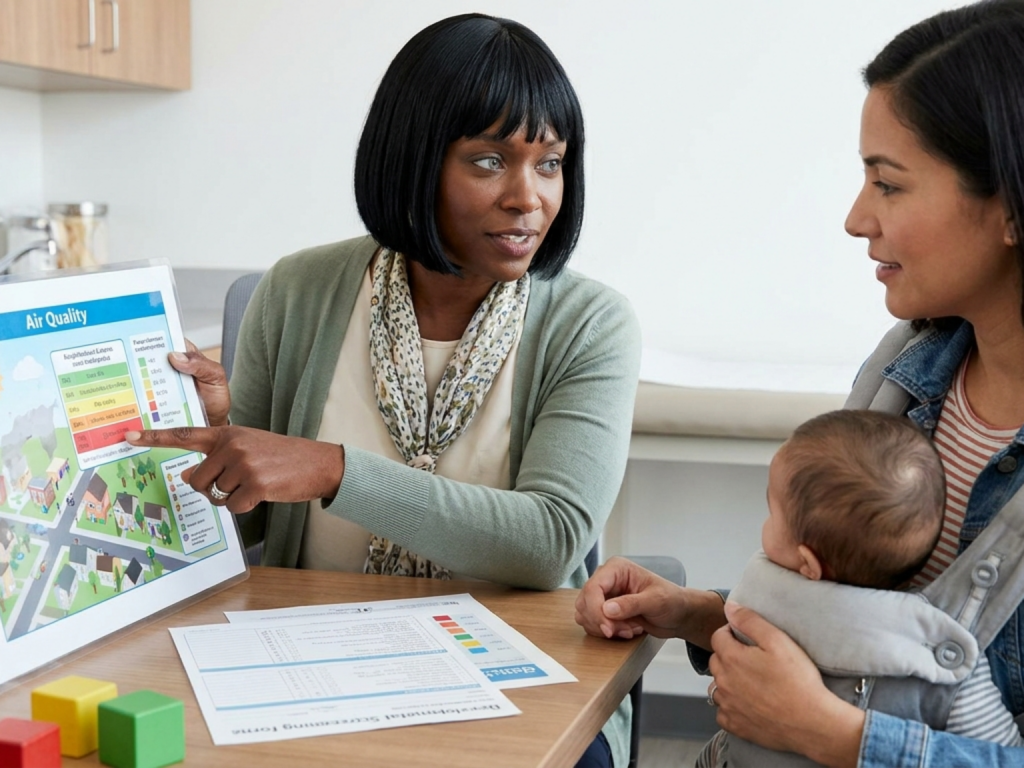
Appointments are useful opportunities to discuss housing exposures, air quality, nutrition, caregiver mental health, sleep safety, and access to resources. Bring specific observations and questions. If a concern is urgent, such as possible poisoning, serious breathing difficulty, severe dehydration, injury, or immediate danger at home, seek emergency or poison-control assistance according to local guidance.
The central message is hopeful but realistic: a baby’s environment matters, yet it is only one part of a complex developmental picture. Safe surroundings, adequate care, and warm, responsive relationships provide a strong foundation, while professional and community support can help families address risks that are beyond individual control.
Important safety guidance
- Seek urgent medical help for breathing difficulty, serious injury, suspected poisoning, severe dehydration, or immediate danger.
- Keep tobacco smoke, vaping aerosols, alcohol, drugs, medications, chemicals, and small choking hazards away from babies.
- Discuss suspected lead, mold, contaminated water, pesticide, or occupational exposures with a healthcare or environmental-health professional.
- Do not use supplements, herbal products, essential oils, or detoxification treatments for a baby without qualified medical advice.
- Contact a healthcare professional about developmental regression or persistent concerns rather than waiting for a routine milestone.
Tools & Assistance
- Pediatric or family-medicine developmental surveillance
- Local public-health department and environmental-health services
- Poison-control center for suspected toxic exposures
- Home-visiting, early-intervention, and community health-worker programs
- Housing, food, transportation, and domestic-violence support services
FAQ
Can a stressful pregnancy determine how a baby will develop?
No. Stress is one influence among many and does not determine an individual child’s outcome. Persistent severe stress can affect health through several pathways, so compassionate mental-health and social support are appropriate.
What environmental changes are most useful at home?
Prioritize smoke-free air, safe sleep, secure storage of hazardous substances, clean water and food practices, injury prevention, and regular responsive interaction. Ask a professional about risks specific to the home.
Does a baby need expensive developmental equipment?
Usually not. Safe floor space, ordinary conversation, face-to-face interaction, supervised movement, and responsive caregiving provide valuable developmental experiences. Equipment should not replace supervision or restrict movement unnecessarily.
When should environmental concerns be discussed with a clinician?
Discuss concerns about toxins, poor housing, feeding, sleep, caregiver wellbeing, or developmental skills at a healthcare visit. Seek urgent assistance for suspected poisoning, serious breathing problems, severe dehydration, or immediate safety threats.
Sources
- PubMed Central — Environmental Forces that Shape Early Development: What We Know and What We Need to Learn
- PubMed Central — The physical environment and child development
- World Health Organization — Clean, safe and secure environments to support early childhood development
Disclaimer
This article provides general educational information and does not diagnose, treat, or replace advice from a qualified healthcare professional. Consult your baby’s clinician for individualized guidance, and seek urgent care for emergencies.















Please log in to leave a comment.