
Intro
Buying baby gear secondhand can reduce costs, extend the useful life of well-made products, and make preparation for a new baby more manageable. It can also introduce safety questions that do not arise when purchasing a current product directly from the manufacturer. A low price is helpful only when the item’s history, condition, and safety features can be verified.
The central question is not simply whether an item is used. It is whether the product remains appropriate for its intended purpose, meets current safety standards, has not been recalled, and can be cleaned and inspected adequately. This guide explains which categories are usually reasonable to consider, which require extra caution, and which are generally best purchased new.
Highlights
Secondhand clothing, books, and some hard-sided equipment are often reasonable choices when they are clean, intact, and age appropriate.
Car seats, crib mattresses, and products with unknown histories require a much higher level of scrutiny; some are best purchased new.
Before buying, verify the brand, model, manufacture date, safety notices, missing parts, and evidence of damage or modification.
For sleep products and restraints, current safety standards and correct use matter more than appearance or price.
Start with the purpose and the risk
A useful first step is to classify the gear by the harm that could result if it failed. Products that support a baby during sleep, restrain a child in a vehicle, hold body weight at height, or contain small detachable components have a relatively high safety burden. A defect may contribute to suffocation, strangulation, entrapment, falls, or injury during a collision. Products used mainly for warmth, storage, or play generally have a different risk profile, although they still need inspection.
Ask four questions before considering a purchase: What is the product designed to do? Could hidden damage compromise that function? Can I identify the exact model and instructions? Can I return or reject it if important information is missing? If the answer to any of these questions is no, the saving may not justify the uncertainty.
Age and developmental stage also matter. A product that was appropriate for a newborn may become unsafe when a baby can roll, sit, pull to stand, or climb. Check the manufacturer’s weight, height, and developmental limits rather than relying on a seller’s description. A pediatric clinician can help clarify whether a particular positioning or support product is appropriate for a baby with medical complexity, prematurity, hypotonia, or other special considerations.
Secondhand gear that is often reasonable
Many low-risk items can be purchased used when they are in good condition and easy to clean. Examples include baby clothing, blankets that are not used as loose bedding, board books, washable play mats, storage containers, changing-table organizers, and some toys designed for the child’s age. Examine textiles for mold, persistent odors, pests, loose threads, broken fasteners, and peeling materials. Wash items according to their care instructions and avoid products that cannot be cleaned adequately.
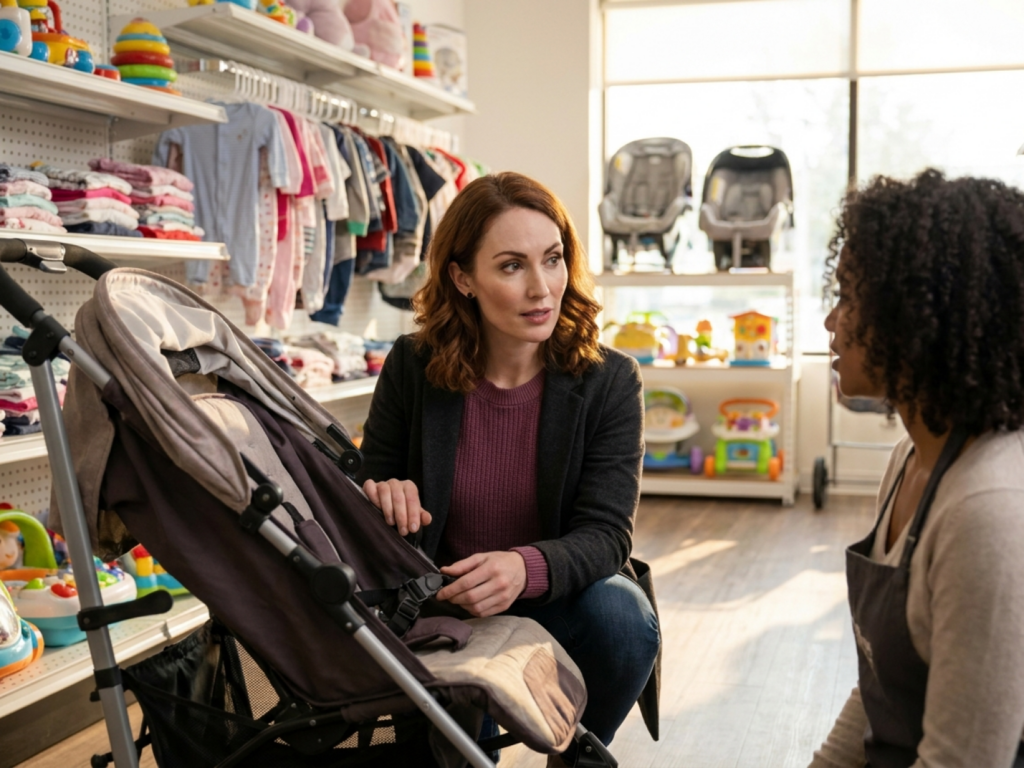
Strollers, baby carriers, and high chairs may also be reasonable secondhand purchases, but they are not automatically safe. Confirm that the frame is not bent or cracked, wheels and brakes work, harnesses and buckles fasten correctly, and all required parts are present. For a carrier, inspect the seams, attachment points, buckles, and adjustment mechanisms. For a high chair, check stability, locking features, tray attachment, foot support, and the condition of the restraint system.
Ask for the instruction manual or download the exact manual from the manufacturer. Correct assembly and use can be as important as the condition of the product. Do not accept a substitute part unless the manufacturer specifically identifies it as compatible. Homemade repairs, missing screws, altered harnesses, and improvised padding are reasons to decline the item.
Products that need a careful case-by-case decision
Some products may be acceptable used only when their history and safety status are clear. Cribs are an important example. A secondhand crib should meet current regulatory requirements, have its original hardware, and show no cracks, warping, loose joints, missing slats, or evidence of unsafe modification. The slat spacing, mattress support, and side structure must be appropriate for the current standard. Avoid drop-side cribs and any crib whose safety history cannot be verified.
A crib mattress deserves separate evaluation. It should fit the crib tightly, remain firm and flat, and have no sagging, tears, water damage, mold, or exposed internal material. Because mattresses can absorb bodily fluids and may have been stored in unsuitable conditions, many families choose to purchase this item new even when the crib itself is secondhand. A fitted sheet should be the only item placed on the sleep surface unless a healthcare professional has given specific guidance for a medically necessary situation.
Bath seats, changing tables, play yards, swings, and bouncers also require caution. Check for recalls, stability, intact restraint systems, and age or weight limits. Never use a product for sleep simply because a baby settles in it. Inclined or sitting devices may create an unsafe sleep environment, particularly if an infant’s head falls forward and compromises the airway. Move a sleeping infant to a separate, firm, flat sleep surface intended for sleep.
Items generally best purchased new
Car seats are usually best purchased new unless a secondhand seat comes from someone you trust and its complete history is known. A used seat may have been involved in a crash, exposed to extreme heat, damaged during storage, recalled, or used beyond its service life. Damage is not always visible. The seat must have its labels, model number, manufacture date, instructions, original components, and an unexpired service period. A car seat with an unknown crash history should not be used.
Never assume that a clean appearance confirms safety. Look for a car seat expiration date or service-life limit from the manufacturer, and verify that the model remains compliant with current requirements. A certified child passenger safety technician can assess installation and identify compatibility problems between the restraint, the vehicle, and the child’s size. Caregivers planning a purchase may also benefit from reviewing guidance on rear-facing car seat limits and other age- and size-based transitions.
Breast pumps are another category that requires special care. Personal-use pumps can present hygiene and contamination concerns when internal tubing or components cannot be fully sterilized. Some pumps are designed for multiple users, but they must be used with new personal accessory kits and according to the manufacturer’s instructions. If the product’s intended user type is unclear, consult the manufacturer or choose a new pump.
Used helmets, flotation devices, and protective equipment should generally be avoided because prior impact or degradation may be hidden. Likewise, do not buy secondhand products that have been recalled, lack safety labels, have unknown modifications, or are intended for a purpose different from the one described by the manufacturer.
A practical inspection and recall checklist
Inspect the item in person whenever possible. Request clear photographs of labels, connection points, the underside, moving parts, and any repaired area. Record the brand, exact model name or number, manufacture date, and serial number before purchase. These details allow you to search the manufacturer’s website and the relevant government recall database. Nationwide Children’s Hospital emphasizes that recall checks and complete product information are essential parts of evaluating secondhand products.
- Confirm the product’s intended use, age range, weight limit, and developmental limits.
- Search the exact model for recalls, safety notices, discontinued parts, and updated instructions.
- Check that every structural component, fastener, restraint, label, and instruction is present.
- Look for cracks, bends, rust, frayed webbing, stretched seams, broken plastic, stains, mold, and unauthorized repairs.
- Test brakes, locks, hinges, wheels, buckles, and adjustment points under normal use.
- Ask whether the item has been in a crash, exposed to flooding or smoke, stored outdoors, or repaired.
- Choose a seller who can answer questions and provide a receipt or return option when possible.
Do not rely solely on online ratings or the seller’s assurance that the item was “barely used.” If information is incomplete, the safest decision is to decline the purchase. For unfamiliar or high-risk products, contact the manufacturer directly. They may confirm the model’s service life, identify required parts, or explain whether cleaning agents could damage its materials.
Cleaning, transport, and correct use after purchase
Once a secondhand item passes inspection, clean it according to the manufacturer’s instructions. Household disinfectants, bleach solutions, solvents, and abrasive tools can weaken plastics, webbing, foam, finishes, or adhesives. Do not mix cleaning products. If the item has been exposed to mold, flooding, smoke, bodily fluids, or pests and cannot be fully decontaminated, discard it rather than attempting an uncertain restoration.
Transport and storage can create new damage. Avoid placing heavy objects on plastic components, leaving gear in a hot vehicle, or storing textiles while damp. Reassemble the product exactly as directed and test it before placing a baby in it. Keep packaging and manuals if available, and register the product with the manufacturer when registration remains possible.
Use the gear only within its intended setting. A stroller is not necessarily a sleep space, a nursing pillow is not a restraint, and a bouncer is not a substitute for a crib or bassinet. Follow safe sleep recommendations and keep loose bedding, pillows, and soft objects out of an infant’s sleep area. If a baby has a medical condition that affects breathing, tone, feeding, or positioning, discuss equipment choices with the child’s healthcare professional before use.
How to make the decision without guilt
Budget constraints are real, and choosing secondhand gear can be a responsible way to obtain useful equipment. Safety does not require buying every item new. It does require prioritizing products according to potential harm, verifying information, and being willing to walk away from an attractive bargain.
Consider buying new for products where hidden damage, contamination, expiration, or sleep and restraint risks are central. Consider used items when the product is durable, inspectable, washable, supported by current instructions, and offered with reliable information. A trusted friend or family member may be able to provide a clearer history than an anonymous marketplace seller, but familiarity does not replace a recall check or condition assessment.
When uncertainty remains, ask a pediatric clinician, certified child passenger safety technician, public health nurse, or the manufacturer for guidance. The goal is not perfection. It is to create a reasonably safe environment using evidence, careful inspection, and decisions that fit your family’s circumstances.
Do not take chances with these warning signs
- Unknown crash history for a car seat
- Missing model, manufacture, or safety information
- A recalled product or one that cannot be checked for recalls
- Cracks, bent frames, frayed harnesses, broken locks, or improvised repairs
- A crib, mattress, or sleep product that is soft, damaged, inclined, or not intended for infant sleep
- Mold, flooding, smoke exposure, pests, or contamination that cannot be fully removed
Tools & Assistance
- Manufacturer website and customer-support line
- Government product-recall database
- Certified child passenger safety technician
- Pediatric clinician or public health nurse
- Exact product manual and model-number record
FAQ
Is it safe to buy a used stroller?
Often, yes, if the stroller is not recalled and its frame, brakes, wheels, harness, locks, and seat fabric are intact. Confirm that all original parts are present and follow the exact manufacturer instructions.
Should I buy a secondhand car seat from a stranger?
Generally, no. A used car seat may have hidden crash damage, an unknown history, missing parts, or an expired service life. A secondhand seat is only worth considering when its complete history and current safety status can be verified.
Can I use a secondhand crib?
Possibly, if the crib meets current safety requirements, has original hardware and instructions, has not been modified, and has no structural damage. Avoid older or recalled designs and evaluate the mattress separately.
How can I tell whether used baby gear has been recalled?
Record the exact brand, model, manufacture date, and serial number, then search the manufacturer’s website and the relevant official recall database. If the identifying information is missing, do not assume the product is safe.
Is a used breast pump hygienic?
It depends on the pump type and the manufacturer’s instructions. Personal-use pumps may have internal components that cannot be sterilized between users. A new pump or a clearly approved multi-user model with new personal accessories is usually the more cautious option.
Sources
- Nationwide Children's Hospital — Secondhand Products and Recalls: 3 Safety Tips
- Consumer Reports — Is It Safe to Buy Used Car Seats, Strollers, or Cribs?
- BabyCenter — Safety tips for buying second-hand baby gear
Disclaimer
This article provides general safety information and is not a substitute for advice from a pediatric clinician, certified child passenger safety technician, or product manufacturer. Consult a qualified healthcare professional about your baby’s individual medical or developmental needs.














Please log in to leave a comment.