
Intro
Core strength and posture development in babies are gradual, interconnected processes that support movement, balance, and participation in everyday activities. A baby's trunk muscles, neck muscles, pelvis, and shoulder girdle develop through ordinary opportunities to move against gravity, observe the environment, and interact with caregivers. Development does not follow a rigid timetable, and variation is common.
The goal is not to make a baby exercise or maintain a particular posture. Instead, caregivers can provide safe, responsive opportunities for movement while respecting fatigue, temperament, feeding needs, and developmental readiness. Because posture and motor skills are influenced by gestational age, medical history, vision, muscle tone, and many other factors, a pediatric healthcare professional should assess persistent concerns rather than relying on comparison with another child.
Highlights
Trunk control develops progressively through head control, rolling, reaching, sitting, and later transitions between positions.
Short, frequent periods of supervised movement are usually more manageable than prolonged practice.
A symmetrical, varied movement environment supports motor learning more effectively than forcing a baby into a posture.
Premature birth and medical conditions can alter the expected timeline, so corrected age and individual clinical context matter.
Adult core-training research may inform general principles of trunk conditioning, but it should not be directly applied as an exercise prescription for infants.
What Core Strength Means in Infancy
In infancy, core strength refers to the coordinated activity of muscles and connective tissues around the trunk, pelvis, spine, and shoulder girdle. It is not simply the ability to produce force. Effective postural control requires anticipatory and reactive adjustments: the baby stabilizes the trunk while moving the head, reaching with an arm, shifting weight, or changing position. The nervous system gradually integrates sensory information from vision, the vestibular system, joints, skin, and muscles to organize these responses.
Early control typically progresses from the head and neck downward, although real development is less linear than a simple sequence suggests. Improved cervical control helps a baby orient toward people and objects. Trunk control then supports midline positioning, reaching, rolling, and increasingly independent sitting. Pelvic and lower-limb control later contribute to crawling, pulling to stand, cruising, and walking. Each skill provides practice for the next, but babies may use different movement strategies and may temporarily emphasize one area.
Posture should therefore be understood as dynamic alignment rather than a fixed pose. A healthy baby will not look perfectly still or symmetrical at all times. The more informative question is whether the baby can move comfortably, use both sides of the body, recover from small shifts, and gradually acquire new functional skills.
How Postural Control Emerges
During the early months, a baby is learning to control the head while the body is supported. As neck flexor and extensor coordination improves, the baby may hold the head more steadily during carrying and supported upright interaction. In prone play, the baby begins to lift and rotate the head, press through the forearms, and later extend the upper trunk. These activities build a foundation for visual exploration and upper-limb use.
With maturation, babies develop greater trunk dissociation: the chest, pelvis, and limbs can adjust somewhat independently instead of moving as one unit. This allows weight shifting, reaching beyond the base of support, pivoting, rolling, and eventually moving into and out of sitting. The quality of movement matters, but it must be interpreted in context. Brief wobbling, loss of balance, or an awkward transition can be normal while a new motor skill is emerging.
Posture also depends on motivation. A baby may demonstrate more control when reaching for a familiar caregiver, tracking a toy, or participating in a social exchange. Responsive caregiving for babies can make movement practice meaningful because attention, voice, and face-to-face interaction encourage active engagement without turning development into a performance test.
Safe Opportunities for Building Trunk Control
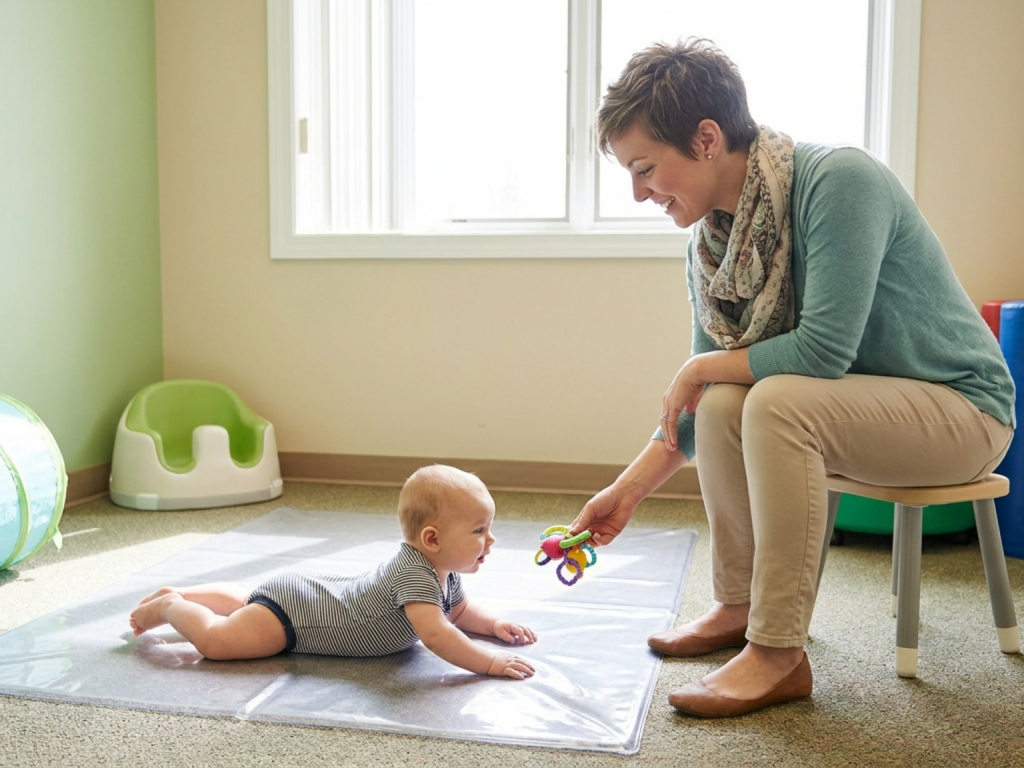
Babies develop strength through active movement against gravity. Safe floor time for infants offers a stable surface on which a baby can turn the head, move the arms and legs, shift weight, and explore different positions. Prone play is particularly useful for developing extensor activation through the neck, upper back, and trunk, but it should occur only when the baby is awake and directly supervised. Begin with brief, tolerable periods and increase opportunities gradually according to the baby’s cues.
Prone play can take place on a firm, clear floor surface, across a caregiver’s chest while the caregiver is fully awake, or with a small rolled towel placed under the upper chest when a clinician has recommended that approach. Place interesting objects within comfortable reach rather than repeatedly moving them far away. Alternating the direction from which a caregiver approaches can encourage head turning to both sides.
Other useful experiences include unrestricted kicking on the back, reaching toward toys at midline, side-lying play with close supervision, and opportunities to turn the head toward voices. Varying positions during awake periods helps prevent overreliance on one movement pattern. Equipment that limits movement, such as prolonged time in restrictive seats or containers, should not replace active floor play. Sleep positioning is separate: babies should be placed on their backs for every sleep, on an appropriate firm sleep surface, according to current safe-sleep guidance.
Supporting Alignment Without Forcing a Position
Caregivers can support posture by arranging the environment so the baby has a reason to look, reach, and shift weight in both directions. Keep frequently used toys near the midline, then vary their position gradually. During holding, provide support at the trunk and pelvis while allowing the baby to make small adjustments. Newborn head and neck support remains essential until the baby demonstrates reliable control; the amount of support can be reduced progressively rather than removed abruptly.
When a baby is learning to sit, brief supported sitting may be appropriate when the baby is alert and ready, but the adult should avoid pulling the baby into sitting by the arms or leaving the baby unsupported on an elevated surface. A baby may sit briefly before being able to get into sitting independently; this is not necessarily concerning, but free movement on the floor remains important. Avoid using pillows, cushions, or positioning devices as a substitute for supervision because they can create entrapment or suffocation hazards.
Babywearing can provide close interaction, but it should not be treated as core training. In a carrier, the baby’s airway must remain visible and unobstructed, the chin should not be pressed against the chest, and the head, neck, back, and hips should be supported according to the manufacturer’s instructions and the baby’s developmental stage. Caregivers should also maintain their own stable posture and avoid activities that increase fall risk.
Reading Movement Quality and Developmental Variation
Developmental milestones are useful reference points, not exact deadlines. A preterm baby’s skills may be interpreted using corrected age for preterm babies, particularly during the first years of life. A pediatrician or therapist may also consider birth complications, hospitalization, neurologic findings, vision or hearing differences, feeding issues, and the baby’s opportunity to move freely.
Look for broad patterns over time. Reassuring signs may include increasing head stability, active movement of all limbs, growing interest in the surroundings, the ability to bring hands toward the midline, and gradual progress in changing position. Some asymmetry can occur, especially when a baby favors a visually interesting direction, but persistent one-sided use deserves attention. Examples include consistently turning the head one way, flattening associated with a strong positional preference, markedly reduced movement on one side, or repeatedly arching and becoming distressed during handling.
Fatigue can temporarily reduce postural control. Pause when the baby yawns, turns away, becomes fussy, loses interest, changes color, breathes unusually, or shows disorganized movements. Overstimulation signs in babies can be subtle, and a calm reset with holding, feeding, or rest may be more beneficial than continuing an activity. Do not judge strength from a single session or from a baby’s performance when hungry, ill, or overtired.
Evidence, Professional Assessment, and Next Steps
Clinical discussions of core strength often emphasize the relationship between trunk stability, spinal alignment, and efficient movement. Mayo Clinic describes the core as a group of muscles that helps stabilize the spine and notes that weakness in adults may contribute to poor posture and injury risk. A randomized controlled trial in adults also found that eight weeks of resistance training emphasizing the posterior chain and core was associated with reduced anterior pelvic tilt and improved related performance measures. These findings support the general importance of coordinated trunk and pelvic function, but they do not establish an infant exercise program or define normal infant posture.
For babies, the safest evidence-informed approach is developmental play, active floor movement, and observation of functional progress. Healthcare professionals can distinguish normal variation from a possible motor, musculoskeletal, or neurologic concern through history and examination. A pediatric physical therapist may assess tone, range of motion, symmetry, head control, transitional movements, and the interaction between posture and sensory or visual factors.
Contact the baby’s clinician if skills appear to stop progressing, if there is persistent asymmetry, marked stiffness or floppiness, loss of a previously acquired skill, difficulty controlling the head beyond the expected developmental context, or distress with ordinary movement. Seek urgent medical care for breathing difficulty, blue or gray coloration, unresponsiveness, a significant injury, or sudden loss of movement. Early professional input is supportive, not a judgment about caregiving, and can clarify practical ways to help.
Safety reminders
- Use prone play only when the baby is awake and continuously supervised.
- Always place a baby on the back for sleep on a firm, clear sleep surface.
- Do not force sitting, standing, stretching, or range-of-motion exercises.
- Stop activity if the baby shows fatigue, breathing difficulty, color change, pain, or marked distress.
- Seek professional assessment for persistent asymmetry, regression, or unusual muscle tone.
Tools & Assistance
- A firm, clear floor mat for supervised awake movement
- Simple toys that can be placed at midline and on either side
- A daily observation note recording new skills, preferences, and fatigue cues
- A pediatrician, public health nurse, or pediatric physical therapist
- A properly fitted carrier used according to current safety instructions
FAQ
Does tummy time strengthen a baby's core?
Supervised prone play can encourage activation and coordination of the neck, shoulder, and trunk muscles. It should be brief and enjoyable at first, with the duration increased according to the baby's tolerance.
Should I sit my baby upright to improve posture?
Supported sitting may be part of normal play when a baby is developmentally ready, but caregivers should not force the position or leave the baby unsupported. Floor-based movement and opportunities to transition are more important than maintaining a pose.
Is it normal for a baby to favor one side?
A temporary preference can occur, but persistent head turning, one-sided reaching, or reduced movement on one side should be discussed with a pediatric healthcare professional.
How does prematurity affect posture development?
Prematurity can change the expected timing of motor skills. Clinicians may use corrected age and the baby's medical history when interpreting development, rather than comparing the baby with full-term age peers.
Can a baby use an exercise ball or infant training device?
Such equipment is not necessary for normal development and may introduce fall or handling risks. Ask a pediatric clinician or therapist before using specialized equipment, and never use it without direct supervision.
Sources
- PubMed — Posterior chain and core training improves pelvic posture, hamstring strength and sporting performance: A randomized controlled trial
- Mayo Clinic — Why you should strengthen your core muscles
- Mayo Clinic — Exercises to improve your core strength
Disclaimer
This article provides general educational information and is not a diagnosis or individualized medical advice. Consult a pediatrician or qualified pediatric healthcare professional about your baby's development, safety, or any concerns.















Please log in to leave a comment.