
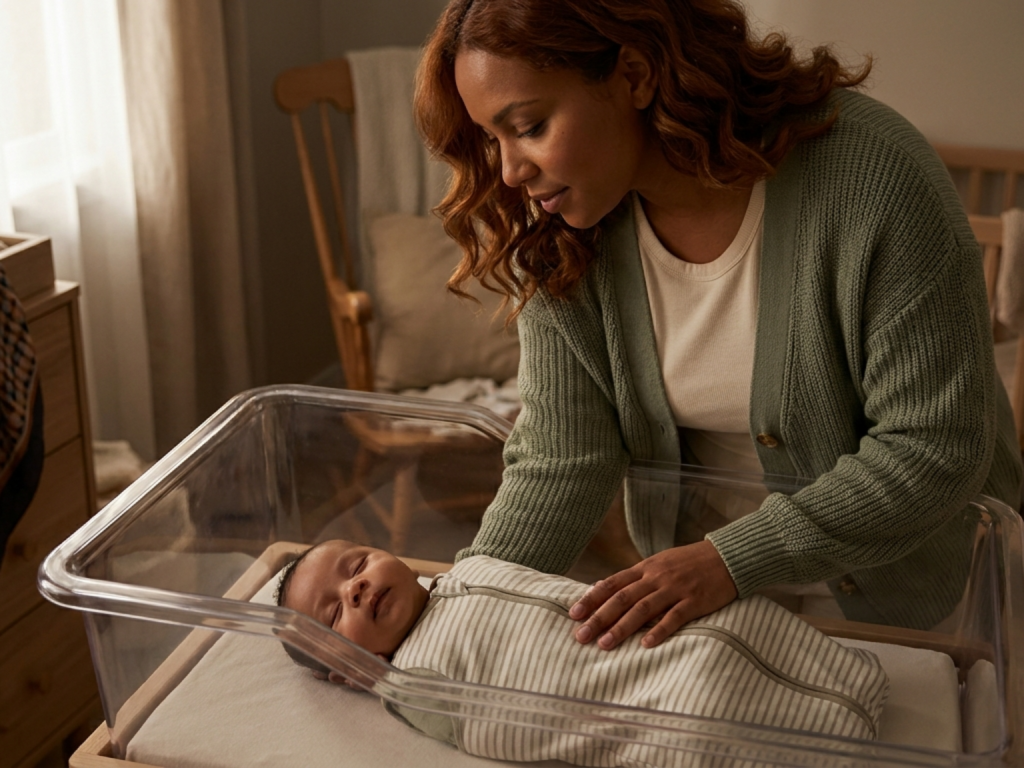
Intro
Self-soothing describes a baby’s emerging ability to reduce arousal and return to a calmer state, sometimes with limited help from a caregiver. It may involve sucking, bringing hands to the mouth, turning away from stimulation, rhythmic movements, or gradually settling after a brief awakening. It is not a fixed skill that every baby should demonstrate at a particular age, and it does not mean that a baby should be expected to stop communicating through crying.
Understanding self-soothing can reduce pressure on families. Responsive care, safe sleep practices, and realistic expectations are more important than making a baby settle independently on demand. Babies differ substantially in temperament, neurological maturation, feeding needs, medical history, and sensitivity to stimulation. When crying is persistent, unusual, or associated with illness, a healthcare professional should assess the baby rather than attributing everything to sleep or self-soothing.
Highlights
Self-soothing is a developing regulatory capacity, not a test of good parenting or infant independence.
Responsive comforting does not prevent self-soothing; it can help a baby develop regulation through repeated experiences of safety.
Putting a baby down drowsy but awake may be associated with greater self-settling during some night wakings, but it is not appropriate or realistic for every sleep period.
Safe sleep means placing babies on their backs on a firm, flat, clear sleep surface; soothing must never involve unsafe sleep arrangements.
A caregiver who feels overwhelmed should place the baby safely in the cot and take a brief break, seeking support when needed.
What self-soothing means in infancy
Self-soothing is best understood as part of infant self-regulation: the gradual development of the capacity to modulate arousal, emotion, movement, and attention. A baby may lower arousal by sucking a hand, holding a comfort object when developmentally appropriate, looking away, flexing and relaxing the limbs, making repetitive sounds, or pausing during crying. These behaviors are not necessarily signs that the baby is ready to settle without assistance; they may be early attempts that work only intermittently.
During the first months, regulation is substantially co-regulated. The infant’s immature nervous system depends on predictable caregiver responses, physical closeness, feeding, warmth, voice, and movement. In practical terms, a calm adult helps provide an external regulatory environment while the baby gradually internalizes patterns of settling. Responding to crying is therefore compatible with later self-soothing. Comforting a baby does not “spoil” the child or create a moral failure of independence.
Self-soothing also has limits. Hunger, pain, reflux-like discomfort, fever, respiratory difficulty, an overly stimulating environment, or the need for contact may exceed a baby’s current regulatory capacity. Crying remains communication, not merely a behavior to extinguish.
Why babies vary in their ability to settle
There is no single timetable for self-soothing. Developmental maturation, gestational age at birth, temperament, sensory processing, feeding pattern, and the quality of the sleep environment all contribute. A premature infant, a baby recovering from illness, or a baby experiencing feeding difficulties may need more frequent support than a healthy term infant of the same chronological age. Even within one child, settling can vary across the day.
Newborns commonly wake for physiological reasons. Their stomach capacity is limited, sleep is distributed across the day and night, and circadian rhythms are still developing. Night waking is therefore expected and should not automatically be treated as a failure to self-soothe. Older infants may still wake between sleep cycles, seek feeding or reassurance, or become unsettled during periods of rapid motor, cognitive, or social development.
Overtiredness can also make regulation harder. A baby who has missed sleep may become more irritable and physiologically activated, while an undertired baby may simply not have enough sleep pressure to settle. Watching patterns such as yawning, reduced engagement, staring, jerky movements, or turning away can be more useful than relying on a rigid clock-based schedule. Families can discuss persistent sleep or feeding concerns with a pediatrician, health visitor, or other qualified clinician.
Responsive ways to support calming
Soothing works best when it is matched to the baby’s state and the likely cause of distress. Begin with basic needs: consider feeding cues, a wet or soiled nappy, temperature, clothing, burping needs, illness, and whether the environment is too bright, noisy, or busy. Some babies respond to a quiet voice, gentle holding, slow rocking, skin-to-skin contact, or a steady hand placed reassuringly on the chest while they are awake and supervised. Others need less handling and benefit from reduced sensory input.
Try one approach for long enough to observe its effect, rather than rapidly switching between many techniques. Fast changes, repeated passing between adults, loud talking, or vigorous movement can increase arousal. A predictable sequence—lower lights, reduce noise, offer a feed if indicated, hold or rock gently, then pause—can help the infant’s autonomic arousal decrease. This is not a prescription or a guarantee; it is an adaptable framework.
Non-nutritive sucking may be calming for some babies. If a family uses a pacifier, it should be discussed in the context of feeding, age, and local safe-use guidance. Never force an object into a baby’s mouth, attach a pacifier to cords or clothing during sleep, or use unsafe substitutes. For more persistent crying, practical guidance on safe soothing strategies for newborns can be useful, while medical advice is appropriate when the pattern is severe or atypical.
Self-soothing, bedtime routines, and sleep onset
A brief, repeatable bedtime routine can provide behavioral cues that sleep is approaching. Depending on the baby’s age and family circumstances, this might include feeding, nappy changing, dim lighting, a short song, cuddling, and placement in the sleep space. The aim is not to create a perfect ritual but to reduce stimulation and make transitions more predictable.
Some evidence supports placing an infant down drowsy but awake as one component of a broader sleep-parenting pattern. A PubMed-indexed study found that particular bedtime practices, especially placing infants down drowsy but awake, were associated with greater self-soothing during night wakings. This is an association, not proof that one technique causes independent sleep, and it should not be interpreted as a requirement to leave a distressed baby alone. The study does not eliminate the importance of age, feeding, temperament, health, or family context.
In early infancy, a baby may fall asleep while feeding or being held, and that can be developmentally normal. If caregivers later wish to separate feeding from sleep onset, gradual changes may be more manageable than abrupt expectations. A feeding to sleep habit is not automatically harmful, although families should consider whether it is sustainable, whether night feeds remain medically indicated, and whether the arrangement permits safe sleep. Babies may need different strategies at different developmental stages.
Safe sleep is non-negotiable
Soothing and sleep must be considered together. When a baby is placed to sleep, the safest general arrangement is on the back, on a firm, flat, separate sleep surface designed for infants, with the sleep area free of pillows, loose blankets, toys, and other soft items. Follow current recommendations from local public-health authorities and your baby’s clinician, particularly for premature infants or babies with medical conditions.
A baby may fall asleep during feeding, rocking, or cuddling. If the adult is becoming sleepy, the infant should be moved to an appropriate sleep surface as soon as practical. Sofas, armchairs, adult beds, and improvised nests carry substantial hazards, especially when an adult is exhausted or when bedding can cover the face. Do not use weighted sleep products, positioners, inclined devices, or restrictive swaddling products unless their safety and suitability have been specifically addressed by a qualified professional. Swaddling also requires careful attention to hip position, temperature, and stopping when the baby shows signs of rolling.
Self-soothing techniques must never involve shaking, forceful bouncing, smothering, holding the baby’s mouth closed, or leaving the baby in an unsafe location. If a caregiver feels unable to respond safely, place the baby on the back in a clear cot, step away briefly, and call a trusted person or urgent support service.
When crying needs medical assessment
Not every unsettled period reflects a sleep problem. Seek prompt medical advice for a baby who has difficulty breathing, becomes blue or unusually pale, is markedly lethargic, has a seizure, has a fever when age-specific guidance makes this urgent, is repeatedly vomiting, has blood in the stool or vomit, feeds poorly, produces substantially fewer wet nappies, or has a concerning rash. A high-pitched, weak, or markedly different cry also warrants attention. Emergency services should be contacted for severe breathing difficulty, unresponsiveness, or other immediate danger.
Contact a healthcare professional when crying is persistent, worsening, difficult to console, associated with poor weight gain, or causing concern even without a clear red flag. Colic-like patterns can occur in otherwise well infants, but the label should not prevent assessment when the presentation changes. Medical evaluation may consider feeding, growth, infection, gastrointestinal causes, injury, medication exposure, and the caregiver’s observations.
Caregiver wellbeing is part of infant safety. Prolonged crying can trigger frustration, sleep deprivation, anxiety, or depressive symptoms. Asking another adult to take over, contacting a primary-care team, or using a crisis or parenting support service is a responsible response. The priority is a safe pause, not perfect calm.
Safety warnings
- Never shake, jerk, hit, or forcefully bounce a baby.
- Do not use sofas, armchairs, adult beds, or soft surfaces as routine infant sleep spaces.
- Place a sleeping baby on the back on a firm, flat, clear surface.
- Seek urgent care for breathing difficulty, blue color, unresponsiveness, seizure, or severe deterioration.
- If overwhelmed, put the baby safely in the cot and step away briefly while obtaining support.
Tools & Assistance
- A simple log of feeds, wet nappies, sleep periods, crying episodes, and soothing attempts
- A low-stimulation bedtime routine with dim lights and consistent cues
- A safe, clear infant cot or bassinet that meets current local standards
- A plan identifying another trusted adult or healthcare contact for periods of caregiver exhaustion
- Primary care, pediatric, health visitor, or community nurse support for persistent concerns
FAQ
Does responding to crying prevent a baby from learning to self-soothe?
No. Responsive care supports co-regulation and does not inherently prevent later self-settling. Babies differ in timing, and crying should be interpreted as communication rather than manipulation.
Should every baby be put down drowsy but awake?
No. It may be a useful option for some families, and research has associated it with greater self-soothing during night wakings, but it is not a universal requirement and should not replace responsive care or needed feeding.
Is night waking a sign that my baby cannot self-soothe?
Not necessarily. Young babies wake for feeding and normal physiological reasons, and older babies can wake between sleep cycles. Consider the baby’s age, growth, feeding needs, and overall wellbeing.
What should I do if soothing attempts are making crying worse?
Reduce stimulation and pause frequent changes. Check basic needs, use a calm voice or gentle holding if welcomed, and place the baby safely in the cot if you need a break. Seek medical advice if crying is persistent or unusual.
Sources
- PubMed — Sleep parenting practices are associated with infant self-soothing during night wakings
- MedlinePlus Medical Encyclopedia — Colic and crying - self-care
- NHS — Soothing a crying baby
Disclaimer
This article provides general educational information and does not diagnose, treat, or replace advice from a qualified healthcare professional. Seek prompt medical care for concerning symptoms or changes in your baby’s condition.


















Please log in to leave a comment.