
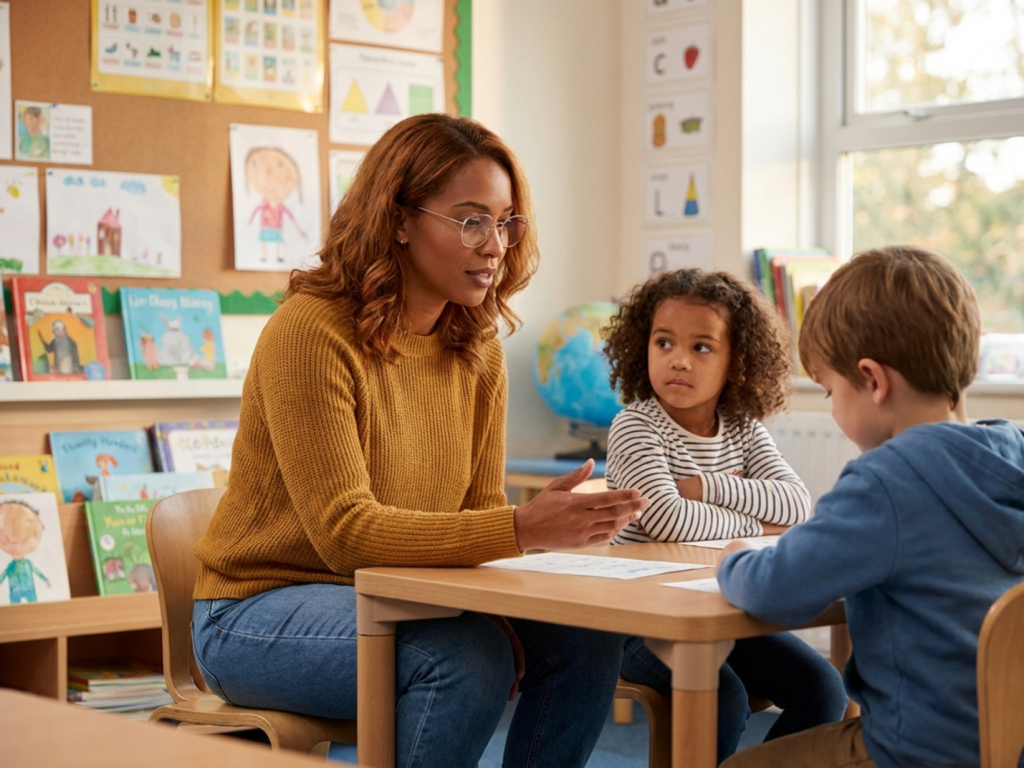
Intro
Peer conflict is a normal part of childhood and adolescence. Children disagree about toys, rules, fairness, status, friendships, online messages, and belonging. For many families, the hardest part is not the argument itself but the child’s distress afterward: tears, anger, shame, refusal to go to school, or repeated stories about being excluded.
A supportive response does not mean deciding who is “right” every time. It means helping the child feel safe, understand emotions, develop perspective-taking, practice repair, and know when adult protection is needed. Some peer conflicts are developmentally expected; others may signal bullying, anxiety, communication differences, trauma exposure, neurodevelopmental vulnerabilities, or broader stress in family and school systems.
Highlights
Peer conflict is common and can support social learning when adults guide children calmly and consistently.
A child’s emotional comprehension, regulation skills, and family stress environment can influence how conflicts begin and resolve.
Adults should distinguish ordinary disagreement from bullying, coercion, discrimination, or physical aggression.
The goal is not to eliminate all conflict, but to build safe, respectful peer conflict resolution strategies.
Understanding peer conflict in childhood
Child conflicts with peers usually involve a clash of needs, interpretations, or social goals. One child wants a turn, another wants control of the game. One child thinks teasing is playful, another feels humiliated. One child changes friendship groups, another experiences this as rejection. These situations can be emotionally intense because children are still developing social cognition, impulse control, and the ability to tolerate ambiguity.
It is helpful to separate conflict from bullying. Conflict generally involves relatively equal power, a specific disagreement, and some possibility of repair. Bullying involves repeated or severe harm, a power imbalance, intimidation, social exclusion, humiliation, threats, or coercive control. A child who is repeatedly targeted, afraid to attend school, physically harmed, or pressured to keep secrets needs adult intervention rather than simple advice to “work it out.”
Age matters. Preschool children often fight over objects, space, and turn-taking because executive function is immature. School-age children may argue about rules, fairness, teams, and loyalty. Preteens and adolescents may experience relational exclusion in preteens, reputation concerns, digital group chats, romantic interests, and status conflicts. The same behavior may have different meanings at different developmental stages.
Why emotions drive many peer conflicts
Research on children’s emotional comprehension suggests that children who better understand emotions tend to manage disagreements more constructively. Emotional comprehension includes recognizing facial expressions and tone, naming feelings, understanding mixed emotions, and predicting how actions may affect another person. A child who can think, “She may be embarrassed because everyone laughed,” has more options than a child who only thinks, “She is being mean.”
Emotion regulation in peer conflict is equally important. A child may know the right thing to do but be unable to access it when physiologically aroused. Anger, shame, fear, and social embarrassment activate stress responses. Heart rate rises, attention narrows, and the child may fight, flee, freeze, or appease. In those moments, adult lectures often fail because the child’s nervous system is not ready for complex reasoning.
Co-regulation before self-regulation is a useful principle. The adult first lowers intensity: a calm voice, fewer words, physical space, water, breathing, or a short walk. Later, when the child is settled, the adult can help reconstruct the event: what happened, what each person may have felt, what choices were available, and what repair might be appropriate. This approach teaches the brain a sequence: calm first, think second, solve third.
Family, school, and social spillover
Peer conflict rarely exists in isolation. Studies of adolescents show reciprocal associations between family and peer conflict: distress in one setting can spill over into the other. A child who experiences frequent criticism, sibling aggression, parental conflict, instability, or high stress at home may arrive at school already hypervigilant or emotionally depleted. Conversely, repeated peer rejection can make a child irritable, withdrawn, or reactive at home.
This does not mean parents are to blame. It means conflict patterns are systemic. Children learn conflict scripts from many places: caregivers, siblings, teachers, media, online platforms, sports teams, and peer groups. If the dominant model is shouting, sarcasm, avoidance, revenge, or silent exclusion, children may use similar strategies with classmates. If they see repair conversations, apology without humiliation, boundaries, and problem-solving, they gain more adaptive scripts.
School climate also matters. Crowded classrooms, unstructured recess, inconsistent supervision, competitive peer cultures, and unclear reporting systems can intensify conflict. Teacher observations of peer interactions are often valuable because adults may see patterns children cannot describe clearly. A child may report “everyone hates me,” while a teacher notices that conflict peaks during transitions, group projects, sports selection, or lunch seating.
How to respond when your child tells you about a conflict
Start by regulating yourself. It is natural to feel protective, angry, or frightened when a child is hurt. However, an alarmed adult can unintentionally increase the child’s anxiety. A grounded response communicates, “I can handle this with you.” Try to listen before investigating, correcting, or contacting another parent.
Useful first responses include: “I’m glad you told me,” “That sounds painful,” “Help me understand what happened from the beginning,” and “What did you want to happen instead?” These statements validate the emotional experience without assuming all facts are known. Avoid immediate labels such as “bully,” “bad friend,” or “toxic” until the pattern is clearer.
Then gather information gently. Ask who was present, what happened before the incident, what each child said or did, whether there has been a pattern, whether the child feels safe, and whether an adult at school knows. If there was physical injury, threats, sexualized behavior, discrimination, stalking, or coercion, prioritize safety and involve appropriate school or professional supports.
When the situation is lower risk, coach choices rather than taking over. Options may include ignoring minor provocation, using a firm statement, seeking a different playmate, asking for adult help, suggesting a rule change, or planning a repair conversation. The child should not be forced to apologize if they are dysregulated or if an apology would place them back into an unsafe dynamic.
Teaching skills without shaming the child
Children benefit from explicit social coaching. Many adults assume children will “just know” how to enter a game, disagree respectfully, or repair a friendship. In reality, these are learned skills involving language, timing, emotional inhibition, and perspective-taking during disagreements.
Practice works best when it is brief and concrete. Instead of saying, “Be nicer,” try rehearsing exact phrases. Examples include: “Can I have a turn after you?” “I don’t like being called that.” “Let’s ask the teacher to help decide.” “I’m sorry I grabbed it; I was frustrated.” “I still want to be friends, but I need you not to share my message.” Social scripts for children can reduce cognitive load during stressful moments.
Role-play from multiple positions. Let the child practice being themselves, the peer, and an observer. This builds mental flexibility without implying that their hurt is invalid. For younger children, puppets, drawings, or toy figures can make rehearsal less threatening. For older children, collaborative problem-solving may feel more respectful: “What are three possible responses? What might happen with each one?”
Be careful not to overcorrect personality. A quiet child does not need to become socially dominant; a passionate child does not need to become emotionless. The goal is safe, flexible communication. Praise effort: pausing before reacting, telling the truth, asking for help, naming feelings, and attempting repair. These are meaningful developmental achievements.
When peer conflict may signal a bigger concern
Some patterns deserve closer attention. Persistent peer rejection, repeated aggression, severe avoidance of school, frequent somatic complaints before school, sleep disturbance, loss of appetite, self-blame, irritability, or sudden academic decline may indicate significant distress. These signs do not automatically mean a child has a psychiatric disorder, but they justify careful assessment by a pediatrician, school counselor, psychologist, or other qualified clinician.
Consider additional support when a child has difficulty interpreting social cues, unusually intense reactions, rigid thinking, impulsivity, language delays, sensory sensitivities, trauma exposure, chronic anxiety, or depressive symptoms. Neurodevelopmental conditions, speech-language differences, learning disorders, and mental health concerns can affect peer interactions. A professional evaluation can clarify strengths, needs, and supports without reducing the child to a label.
Also watch for aggression that is escalating in frequency, intensity, or planning. A child who repeatedly threatens, humiliates, excludes, or physically harms peers needs compassionate but firm intervention. Research linking conflict resolution patterns across family, marital, parent-child, and peer contexts suggests that how conflicts are handled over time can relate to aggression in peer groups. Early support can prevent entrenched patterns and protect all children involved.
Working with schools and other parents
When school is involved, document facts: dates, locations, names of supervising adults, what was said or done, injuries, screenshots of digital messages, and how the child responded. Keep the tone factual rather than accusatory. Schools can respond more effectively when concerns are specific: “This has happened three times at lunch near the basketball court,” rather than “Nobody is helping.”
Ask for practical supervision and skill support. Depending on the situation, this may include a seating change, structured recess activity, check-ins with a trusted adult, school-based conflict mediation, a safety plan, or small-group social skills work. If bullying or harassment is suspected, ask about the school’s formal policy and reporting pathway.
Contacting another parent can be useful in some communities and risky in others. If you do reach out, stay brief and nonjudgmental: “The children seem to be having a hard time over the game rules. I’d like to help them reset.” Avoid sending emotionally charged messages late at night or forwarding children’s private messages widely. For serious harm, repeated bullying, or threats, communicate through the school or appropriate authorities rather than trying to negotiate alone.
Supporting recovery and resilience
After a painful conflict, children need both protection and confidence-building. Overprotection can unintentionally teach that peers are dangerous and the child is helpless. Underprotection can teach that adults will not help. The balanced message is: “You are not alone, and you can learn skills.”
Encourage stable routines, sleep, nutrition, movement, and noncompetitive connection. A child who feels rejected at school may need success in another setting: art, music, coding, sport, volunteering, faith community, or one-on-one structured playdates. One secure friendship can buffer the impact of broader peer stress.
Repair is not always reconciliation. Sometimes repair means apologizing and rebuilding trust. Sometimes it means setting a boundary and choosing distance. Sometimes it means an adult-led safety plan. Teach children that forgiveness, friendship, and access are different. They can wish someone well without returning to an unsafe pattern.
Finally, model repair at home. Let children hear adults say, “I was frustrated and spoke too sharply. I’m sorry. Next time I’ll pause.” This is powerful because it shows that conflict is not the end of connection. With patient coaching, many children become more capable of empathy, assertiveness, and thoughtful problem-solving over time.
Seek help promptly if safety is in question
- A child is being physically harmed, threatened, stalked, extorted, or sexually harassed.
- There is repeated bullying, humiliation, coercion, discrimination, or social exclusion with a power imbalance.
- Your child refuses school, has panic-like episodes, self-harm thoughts, or major changes in sleep, appetite, or mood.
- Aggression by your child is escalating, planned, or causing injury to others.
- Digital messages include threats, non-consensual images, blackmail, or pressure to keep secrets.
Tools & Assistance
- Schedule a meeting with the teacher, school counselor, or safeguarding lead.
- Keep a factual incident log with dates, locations, witnesses, and screenshots when relevant.
- Practice short social scripts at home when the child is calm.
- Consult a pediatrician or child mental health professional if distress is persistent or impairing.
- Use school-based conflict mediation only when there is no bullying, coercion, or safety risk.
FAQ
Should I tell my child to ignore peer conflict?
Sometimes ignoring minor provocation is useful, but it is not appropriate for repeated bullying, threats, humiliation, or physical harm. Teach a range of responses, including firm boundaries and seeking adult help.
What if my child is the one causing conflicts?
Respond with calm accountability. Look for triggers, teach repair, coordinate with school, and consider professional guidance if aggression, impulsivity, or social misunderstanding is persistent.
Should children always apologize after a conflict?
An apology is most meaningful when the child understands what happened and feels safe. Forced apologies can increase shame or resentment; coached repair is usually more effective.
When should I involve a healthcare professional?
Seek guidance if peer conflict is associated with school refusal, persistent anxiety, depressive symptoms, somatic complaints, sleep disruption, aggression, self-harm concerns, or suspected neurodevelopmental or communication difficulties.
Sources
- PubMed Central — The influence of children’s emotional comprehension on peer conflict management
- PubMed — Reciprocal associations between family and peer conflict in adolescence
- PubMed — Conflict resolution in the parent-child, marital, and peer contexts and children's aggression in the peer group: a process-oriented cultural perspective
Disclaimer
This article is for informational purposes only and is not a medical, psychological, or legal diagnosis or treatment plan. Consult qualified healthcare, mental health, school, or safeguarding professionals for concerns about a child’s safety or wellbeing.
















Please log in to leave a comment.