
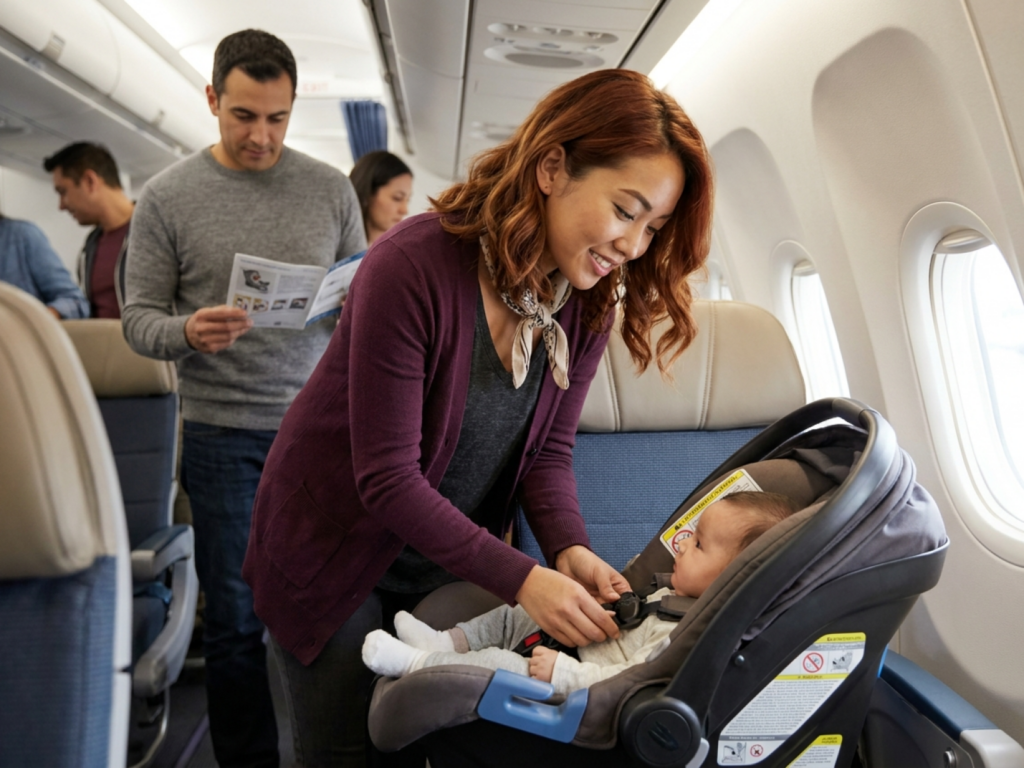
Intro
Flying with a baby requires a practical decision about where the infant will travel: on an adult's lap or in a separate airplane seat with an approved child restraint system. The choice affects safety, cost, logistics, and how manageable the flight may feel for the family.
For children younger than 2 years, many airlines allow lap travel, but regulatory permission is not the same as optimal protection. Aviation and pediatric safety guidance generally supports securing an infant in an appropriate restraint installed in a separate seat. Families should also consider the baby's age, medical history, developmental status, the flight itinerary, airline policies, and advice from the child's healthcare professional.
Highlights
Lap travel may be permitted for infants under age 2, but an adult cannot reliably restrain a baby during severe turbulence or sudden aircraft movement.
A separate seat with an approved child restraint provides more consistent protection during taxiing, takeoff, landing, turbulence, and emergency maneuvers.
Before booking, verify the airline's rules for child restraint systems, seat placement, dimensions, labels, and installation.
Infants with prematurity, respiratory disease, recent illness, or other medical concerns may need individualized travel guidance.
A careful preparation plan can reduce feeding, sleep, transfer, and airport stress regardless of the seating choice.
What the Two Options Mean
A lap infant travels without a ticketed seat of their own, usually seated on an accompanying adult’s lap for the flight. In the United States, airlines commonly permit this arrangement for children younger than 2 years, although documentation requirements and policies can vary. The adult remains responsible for holding and caring for the child, and the infant may not use an adult seat belt as a substitute for an approved restraint.
A separate-seat arrangement requires purchasing a ticket for the infant. The child then occupies an aircraft seat with a child restraint system that the airline accepts for use in flight. Depending on the product and the airline, this may be an FAA-approved child safety seat or another approved restraint identified by the relevant aviation authority. The restraint must be used according to both the manufacturer’s instructions and the airline’s rules.
The decision is therefore not simply a comparison between a free option and a paid option. It is a choice between holding an unrestrained infant and creating a dedicated, secured seating position. Families should confirm the current policy directly with the airline before travel because requirements can differ by carrier, aircraft, route, and seat configuration.
Why a Separate Seat Is Generally Safer
The central safety issue is force. During turbulence, abrupt deceleration, or an emergency maneuver, an infant can be displaced from an adult’s arms even when the adult is attentive and physically strong. The adult may also be thrown forward, lose balance, or be unable to maintain a protective hold. A lap-held infant has no independent restraint that transfers these forces in a controlled way.
An approved child restraint is designed to hold the child close to the seat and distribute forces across stronger areas of the body. A rear-facing configuration supports the infant’s head, neck, and torso while the child has limited postural control. The restraint also provides a consistent position during routine phases of flight, when caregivers may otherwise be distracted by meals, luggage, boarding activity, or fatigue.
The Federal Aviation Administration and the American Academy of Pediatrics support using an approved child restraint in a separate seat as the safest approach for infants and young children. The Aerospace Medical Association likewise describes the limitations of lap holding during turbulence and sudden aircraft movement. These recommendations do not mean that every flight with a lap infant will result in harm; they explain why the physical protection offered by a secured restraint is more reliable.
Medical and Developmental Factors to Consider
Most healthy term infants can travel by air, but the timing and precautions may differ after birth or during illness. A baby with prematurity, chronic lung disease, congenital heart disease, anemia, recent respiratory infection, fever, significant nasal congestion, or another medical condition may require individualized advice. Reduced cabin oxygen pressure can be relevant for some cardiopulmonary conditions, and feeding, hydration, and sleep may be more difficult when a child is unwell.
Contact the baby’s pediatric clinician before travel when there is a medical concern, a recent hospitalization, oxygen use, a history of clinically significant apnea, or uncertainty about fitness to fly. The clinician may review the itinerary and the child’s current status, but should not be expected to approve a specific airline’s restraint policy. Airline medical clearance procedures, when required, are separate from routine pediatric advice.
Development also matters. A newborn has limited head and trunk control, while an older infant may move vigorously, attempt to climb, or resist being held for long periods. Neither stage makes lap travel reliably protective during unexpected aircraft motion. A properly fitted restraint can help maintain positioning, but caregivers should continue to monitor breathing, head position, comfort, and signs of distress.
Choosing and Using the Restraint
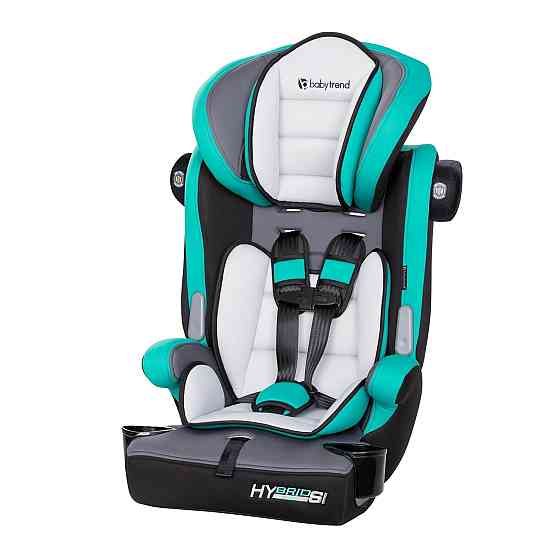
For a separate seat, select a restraint specifically approved for aircraft use and suitable for the baby’s current size and developmental stage. Read the label and manual rather than relying on appearance alone. Some car seats are not approved for aircraft use, and an aviation approval label does not guarantee that the seat will fit every aircraft seat or be accepted by every airline.
Families who use a rear-facing infant car seat should verify the infant car seat harness fit, the required recline position, and the manufacturer’s weight and height limits. Harness straps should lie flat and be adjusted according to the manual. Bulky clothing can interfere with harness positioning, so caregivers should ask a qualified child passenger safety professional about appropriate layers and fit.
Airplane seats and vehicle seats are not identical. Lower anchors may not be available, and the restraint will typically be installed using the aircraft seat belt according to the product instructions. Before departure, practice the installation and identify how the seat will be carried through the airport. A certified child passenger safety technician can help with fit and installation questions, although airline staff determine whether a particular restraint may be used on that aircraft.
Do not attach a restraint to an exit-row seat or a location restricted by the airline. Keep aisles and evacuation paths clear, and follow crew instructions if the seat must be repositioned. Never improvise with extra straps, pillows, aftermarket inserts, or accessories that are not approved by the restraint manufacturer.
Booking, Boarding, and In-Flight Logistics
Call or check the airline’s current written policy before booking. Ask whether the restraint must have a specific certification statement, whether it can be used in a particular cabin, which rows are permitted, and whether the aircraft has seat-width limitations. If traveling internationally, review the rules of every airline on the itinerary, including connecting carriers. Carry the restraint manual or a clear record of the approval information in case questions arise at the airport.
Request an appropriate seat assignment early. Window seats are commonly preferred for a child restraint because they keep the device and its occupant away from the aisle, although the airline’s seating rules control. Avoid placing the restraint where it could obstruct another passenger’s access to the aisle or interfere with emergency procedures. Confirm whether the adult accompanying the child must sit next to the restraint.
Boarding early can provide time for installation, but some families find that one adult boards first with the restraint while another remains at the gate with the baby. The best plan depends on the airline’s process and the infant’s temperament. During taxi, takeoff, landing, and turbulence, secure the infant as directed rather than removing the child for soothing. Feeding or a pacifier during descent may help some babies with pressure-related ear discomfort, but never force a feed or delay care when the child is distressed.
Making the Decision Under Real-World Constraints
Cost, availability, and family circumstances are legitimate considerations. A separate seat may be financially difficult, particularly for a long itinerary or multiple children. It can also require carrying a large restraint through the airport and coordinating transfers. A lap arrangement may seem simpler, especially for a short flight, but it does not remove the turbulence risk or the need for careful planning.
When a separate seat is feasible, families may find that the restraint creates a predictable place for the infant and leaves the accompanying adult’s hands available for documents, hydration, and other care tasks. It may also make the transition between air travel and ground transportation easier when the restraint is compatible with the family’s vehicle plan. If the restraint will be used in a car after landing, review local requirements and ensure it is appropriate for that vehicle and child.
If lap travel is chosen, treat it as a permitted arrangement rather than a safety equivalent to a separate restrained seat. Follow crew instructions, use the infant belt or other device only if specifically provided and directed by the airline, and do not attempt to secure the infant to the adult with a shared belt. Keep essential supplies accessible, plan for diapering and feeding, and have a backup plan for delays. The safest decision may change if the baby becomes ill, the itinerary changes, or the airline cannot accommodate the intended restraint.
A Practical Preflight Checklist
Several days before departure, verify the baby’s travel documents, the airline’s infant policy, and the restraint’s aircraft approval. Inspect the seat for damage, confirm that the harness and buckles work, and review the manual. If the child has a medical condition or was recently ill, contact the pediatric clinician early enough to discuss whether travel is appropriate and what warning signs should prompt urgent care.
- Confirm whether the infant will be a lap passenger or have a ticketed seat.
- Measure or check the restraint against the airline’s seat-width and certification requirements.
- Practice installing the restraint with an aircraft lap belt.
- Pack feeding supplies, diapers, spare clothing, medications that have been prescribed for the child, and essential comfort items in the cabin bag.
- Keep medical information and clinician contact details accessible during travel.
At the airport, allow extra time for security screening, gate changes, and installation. During the flight, monitor the baby’s airway and posture, especially when sleeping. Seek help from the crew for operational questions, but do not expect crew members to provide medical assessment or to override the restraint manufacturer’s instructions.
Safety Warnings
- Never rely on an adult's arms as protection during severe turbulence or sudden aircraft movement.
- Do not use an adult seat belt around both an adult and an infant unless the airline provides a specifically approved device and directs its use.
- Do not use a child restraint on an aircraft unless it is approved for aircraft use and accepted by the airline.
- Do not add unapproved inserts, padding, straps, or accessories to alter the restraint.
- Seek individualized medical guidance for a premature, medically complex, recently ill, or oxygen-dependent infant.
Tools & Assistance
- Airline customer service or accessibility desk for current infant and restraint policies
- Pediatric clinician for individualized fitness-to-fly questions
- Certified Child Passenger Safety Technician for restraint fit and installation education
- FAA child passenger safety resources for U.S. aviation guidance
- A printed or digital copy of the restraint manual for airport and in-flight reference
FAQ
Can a baby under age 2 fly on a parent's lap?
Many airlines allow children younger than 2 years to travel as lap infants, but policies, documentation, and international requirements vary. Permission to travel on a lap does not provide the same protection as an approved restraint in a separate seat.
Is a separate airplane seat safer for an infant?
A separate seat with an approved child restraint is generally considered the safer arrangement because it provides independent protection during turbulence, sudden deceleration, and other unexpected aircraft movements.
Can I use an infant car seat on an airplane?
Some infant car seats are approved for aircraft use, but not all are. Check the product labeling and manual, then confirm the airline's requirements, seat-width limits, and permitted seating locations before travel.
Should I ask a pediatrician before flying with a newborn?
Discuss travel with the baby's clinician when the infant was premature, has cardiopulmonary or other significant medical conditions, was recently hospitalized, or is currently ill. Healthy infants may not need an individualized consultation, but the timing of travel after birth can still warrant professional advice.
Where should an aircraft child restraint be placed?
The airline determines acceptable locations. A window seat is often used so the restraint does not obstruct the aisle, but exit rows and other restricted locations are generally unavailable. Follow the carrier's instructions and crew directions.
Sources
- Federal Aviation Administration — Kids' Corner
- HealthyChildren.org / American Academy of Pediatrics — Flying With Baby: Parent FAQs & Tips for Safer, Easier Air Travel
- Aerospace Medical Association — Child Restraint Systems and Airline Travel
Disclaimer
This article provides general educational information and is not medical advice, diagnosis, or a substitute for care from a qualified healthcare professional. Consult your baby's clinician and the airline before travel, especially if your infant has a medical condition or was recently ill.














Please log in to leave a comment.