
Intro
The transition from toddler to preschool parenting is not a single birthday milestone; it is a gradual shift in how your child’s brain, body, emotions, and social world are developing. Many children enter preschool around ages 3 to 5, when language is expanding rapidly, symbolic play becomes more elaborate, separation from caregivers may become more frequent, and expectations for group participation begin to increase. For parents, this can feel both exciting and disorienting: the child who still needs help with toileting, sleep, and emotional regulation may also be asking sophisticated questions, negotiating rules, and forming friendships.
A supportive transition recognizes two truths at once. Preschoolers are becoming more autonomous, but they remain young children with immature executive function, limited impulse control, and a strong need for predictable attachment relationships. Parenting at this stage is less about demanding sudden maturity and more about scaffolding: creating routines, practicing separations, partnering with teachers, and responding to behavior as communication while maintaining warm, consistent boundaries.
Highlights
Preschool readiness is not only academic. It includes emotional regulation, communication, self-help skills, sleep, safety awareness, and the ability to participate in routines with adult support.
A gradual, relationship-centered transition can reduce stress for children and parents. Research on preschool transitions highlights the value of parent participation and family–teacher collaboration.
Behavior may temporarily regress during major changes. Clinginess, toileting accidents, sleep disruption, or tantrums and intense emotional reactions can occur when a child is adapting.
Consistent preschool routines help children feel safer because they reduce uncertainty and support developing executive function.
Children with developmental delays, disabilities, chronic medical conditions, or early intervention services may need more formal transition planning with professionals.
What changes between toddlerhood and preschool age
Toddlerhood is dominated by rapid motor development, emerging language, attachment-driven exploration, and frequent emotional dysregulation. Preschool age builds on those foundations. Children often develop longer attention spans, more complex pretend play, improved receptive and expressive language, early theory of mind, and greater interest in peers. However, the prefrontal cortical networks involved in inhibition, planning, flexible thinking, and emotional modulation are still immature. A preschooler may sound remarkably verbal while still needing adult co-regulation during disappointment, fatigue, hunger, or overstimulation.
This is why developmentally appropriate expectations matter. A 3- or 4-year-old may be able to follow a two-step instruction in a calm moment but not during a noisy classroom transition. They may remember a safety rule one day and impulsively ignore it the next. Parenting preschool children often requires fewer physical interventions than toddler parenting, but more coaching, rehearsal, and collaborative problem-solving at a child’s developmental level.
The goal is not to rush your child out of toddler behaviors. Instead, parents can gradually shift from doing everything for the child to supporting participation: offering choices, narrating feelings, practicing self-help skills, and using predictable limits.
Preschool readiness is broader than letters and numbers
Families are often told to think about school readiness, but readiness is frequently misunderstood as early academics. Letter recognition and counting can be enjoyable, but they are not the whole picture. Preschool learning through play is developmentally powerful because play integrates language, motor skills, social cognition, problem-solving, and emotional expression.
Helpful readiness areas include:
- Communication: using words, gestures, pictures, or assistive communication to express needs and understand simple directions.
- Self-help skills: participating in handwashing, dressing, feeding, cleanup, and toileting routines as developmentally appropriate.
- Separation tolerance: recovering with support after saying goodbye to a caregiver.
- Group participation: taking turns, listening briefly, joining songs or stories, and transitioning between activities.
- Emotional regulation: accepting adult help when upset, naming feelings, and learning safe ways to express frustration.
- Safety awareness: beginning to understand boundaries around streets, playgrounds, classroom materials, and unfamiliar adults.
If your child is not strong in every area, that does not mean they are failing. Preschool is designed to teach many of these skills. The question is what supports your child needs to participate safely and meaningfully.
Build routines that bridge home and preschool
Young children rely on repetition because predictable routines reduce cognitive load. Routines and transitions are also moments when behavior often escalates: leaving the house, getting into the car, saying goodbye, cleaning up toys, moving from play to meals, or going to bed. Expert early childhood guidance emphasizes consistency, preparation, and cues that help children know what comes next.
Start with a few routines that matter most for preschool adjustment:
- Morning rhythm: wake, toilet or diaper change, dress, breakfast, teeth, shoes, bag, goodbye ritual.
- Sleep schedule: a consistent bedtime and wake time that protect adequate sleep for behavior and learning.
- Practice transitions: use simple warnings such as “two more minutes, then shoes,” visual schedules, songs, or a timer.
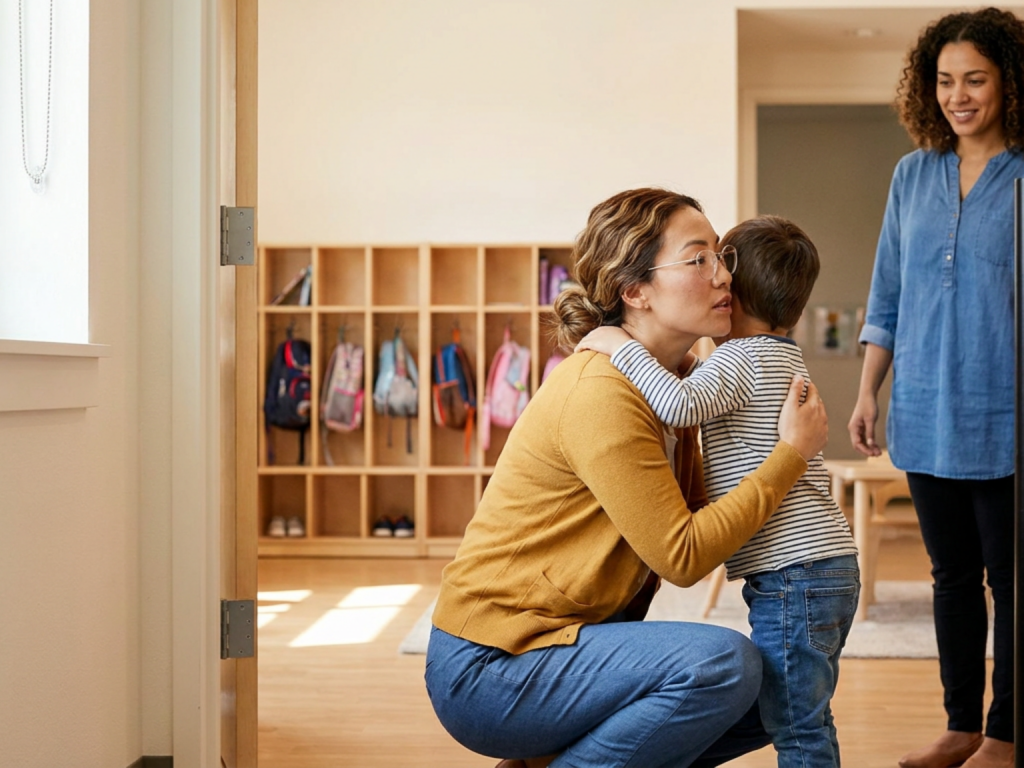
- Goodbye ritual: keep it warm, brief, and predictable. Lingering anxiously can unintentionally communicate danger.
- After-school decompression: provide food, quiet play, outdoor movement, or connection before asking many questions.
Consistent preschool routines do not have to be rigid. Flexibility is healthy, but the core sequence should be familiar enough that the child can anticipate it. This predictability supports executive function by externalizing what the child’s brain cannot yet organize independently.
Separation is an attachment task, not a character test
Separation distress is common when children begin preschool or move to a new classroom. It does not necessarily indicate that a child is “spoiled,” that the parent is doing something wrong, or that preschool is harmful. Separation asks the child to hold an internal sense of safety while the caregiver is absent and to accept comfort from another trusted adult.
Helpful preparation may include visiting the preschool, meeting the teacher, looking at photos of the classroom, reading books about school, and practicing short separations with a predictable return. Some transition models include more intensive introductory activities, gradual timing, or parent participation before full separation. Research on the transition to preschool suggests that parent involvement can support adjustment and strengthen family–teacher relationships, particularly when programs create meaningful opportunities for communication and collaboration.
During goodbye, aim for calm confidence: “I love you. Your teacher will help you. I will come back after snack and playground.” Then leave as planned. If your child cries, the teacher can help you understand how long it lasts and what helps them recover. Many children are upset for a few minutes but then engage. If distress is prolonged, escalating, or accompanied by concerning functional changes, discuss it with the teacher and your pediatrician or a child mental health professional.
Partner with teachers as developmental allies
The parent–teacher relationship is one of the most important protective factors during the preschool transition. Parents bring knowledge of the child’s temperament, medical history, sleep, eating, sensory preferences, family culture, and communication style. Teachers bring expertise in group routines, peer interaction, classroom expectations, and early childhood pedagogy. When these perspectives are shared respectfully, the child benefits.
Before or early in the school year, consider discussing:
- What helps your child calm when distressed
- Words your child uses for toileting, hunger, pain, or fear
- Allergies, medications, chronic conditions, or emergency plans, if relevant
- Sensory sensitivities to noise, clothing, food textures, light, or touch
- Nap needs and signs of fatigue
- Family languages and cultural routines
- Any early intervention, speech-language, occupational therapy, behavioral, or developmental supports
If your child has been receiving early intervention services, transition planning may need to begin before the child ages out of one system and into preschool or school-based services. Families can ask about eligibility processes, evaluations, individualized plans, timelines, and the role of service coordinators. This can feel bureaucratic and emotionally heavy, but you do not have to navigate it alone; early childhood programs, healthcare clinicians, and parent information centers can help clarify steps.
Expect some regression and big feelings
A new preschool environment can temporarily increase clinginess, irritability, toileting accidents, sleep disruption, appetite changes, or tantrums and intense emotional reactions. Regression is often a stress response rather than a deliberate refusal to grow. Children may use familiar younger behaviors when their nervous system is overloaded.
Respond with a balance of empathy and boundaries. For example: “You really wanted to stay home. It is hard to say goodbye. I will help you put on your shoes.” This validates emotion without removing the necessary routine. During unsafe behavior during emotional dysregulation, prioritize safety first: move dangerous objects, use a calm voice, reduce stimulation, and avoid lengthy reasoning until the child is physiologically calmer.
Preschool emotional regulation develops through repeated co-regulation. A child borrows the adult’s calm, language, and structure until they can internalize those skills. This does not mean accepting aggression or chaos; it means correcting behavior without shaming the child’s nervous system for being immature.
Support body-based needs: sleep, food, toileting, and sensory regulation
Preschool behavior and sleep are closely linked. Insufficient sleep can worsen impulsivity, emotional lability, inattention, and aggression. Many preschoolers still need a nap or quiet rest, while others are dropping naps and may require an earlier bedtime. If sleep is persistently difficult, especially with snoring, pauses in breathing, restless legs, severe night waking, or daytime sleepiness, consult a pediatric clinician.
Nutrition also matters, but avoid turning food into a power struggle. Preschoolers may eat inconsistently, especially during transitions. Offer predictable meals and snacks, include familiar foods in lunchboxes, and inform teachers about choking risks, allergies, feeding therapy plans, or medically necessary diets. For toileting, expect variability. Some children are fully toilet trained at home but anxious about unfamiliar bathrooms, loud flushes, or asking for help. Pack extra clothes without criticism and coordinate language and routines with teachers.
Sensory needs can be particularly visible in preschool. A child may struggle with crowded cubbies, loud songs, messy art, scratchy labels, or transitions from outdoor play to indoor sitting. Occupational therapists, pediatricians, and early childhood specialists can help assess whether sensory strategies are needed, but parents and teachers can begin by observing patterns: when does the child become overwhelmed, and what helps them recover?
Discipline shifts from control to coaching
As children move from toddlerhood into preschool, discipline can become more verbal and collaborative, but it should still be concrete and immediate. Long lectures rarely help because preschoolers have limited working memory and impulse control. Effective discipline is usually warm, brief, predictable, and connected to the behavior.
Useful strategies include:
- State the rule positively: “Walking feet inside” instead of only “Don’t run.”
- Offer limited choices: “Red cup or blue cup?” not “Do you want breakfast?” when breakfast is non-negotiable.
- Use natural or logical consequences: “Blocks are for building. If they are thrown, I will put them away for now.”
- Notice desired behavior: “You stopped your body when I said wait. That kept you safe.”
- Repair after conflict: model apologies, cleanup, gentle touch, or checking on someone who was hurt.
Developmentally appropriate toddler discipline often emphasized safety, redirection, and simple limits. Preschool discipline adds more teaching: naming feelings, practicing alternatives, and helping children understand how their actions affect others. Still, if a child is hungry, exhausted, ill, overstimulated, or frightened, coaching may need to wait until the body is regulated.
Take care of the parent transition too
Parents also go through a transition. You may feel relief, grief, pride, worry, or guilt, sometimes all in the same morning. Preschool can stir up concerns about whether your child will be liked, understood, safe, or “behind.” It can also challenge family logistics: work schedules, transportation, illness policies, tuition, meals, and communication with staff.
Caregiver stress and child safety are connected. When parents are chronically overwhelmed, it becomes harder to stay patient during morning delays, bedtime resistance, or repeated preschool illnesses. Practical support matters: shared routines, backup pickup plans, prepared clothes and lunches, and realistic expectations for the first weeks.
If you notice persistent anxiety, depression, intrusive fears, rage, or feeling unable to cope, consider reaching out to a healthcare professional, therapist, or trusted support service. Seeking professional parenting support is not a sign of inadequacy; it is a way to protect both your well-being and your child’s adjustment.
When to seek extra support
- Consult a pediatrician if sleep, feeding, toileting, pain, breathing during sleep, or growth concerns are persistent or worsening.
- Ask for developmental evaluation if language, social communication, motor skills, adaptive skills, or play seem significantly delayed.
- Seek urgent help if a child’s behavior creates immediate danger to self or others and cannot be safely managed.
- Discuss prolonged separation distress, severe anxiety, or major functional regression with qualified child health or mental health professionals.
- For allergies, asthma, seizures, diabetes, or other medical conditions, create a written preschool care plan with the child’s healthcare team.
Tools & Assistance
- A simple visual schedule for morning, preschool drop-off, pickup, meals, and bedtime
- A brief teacher information sheet covering comfort strategies, medical needs, communication style, and sensory preferences
- A consistent goodbye phrase and predictable reunion routine
- Early intervention or preschool special education transition planning if developmental services are involved
- A pediatric visit to review sleep, toileting, feeding, behavior, or developmental concerns
FAQ
How long does it usually take a child to adjust to preschool?
Adjustment varies widely. Some children settle within days, while others need several weeks or longer, especially if they are younger, sensitive to transitions, have developmental differences, or are experiencing other family stressors.
Should I leave quickly if my child cries at drop-off?
A warm, brief, predictable goodbye is usually more helpful than repeated returns. However, coordinate with the teacher and adjust the plan if distress is prolonged or your child is not recovering after separation.
What if my child has toileting accidents after starting preschool?
Occasional accidents can happen during transitions. Avoid shame, pack extra clothes, ask about bathroom access and routines, and consult a clinician if accidents are persistent, painful, associated with constipation, or represent a major change.
Is preschool necessary for every child?
Preschool can offer valuable peer interaction, routines, and play-based learning, but families differ in needs and resources. High-quality caregiving, language-rich play, safe routines, and responsive relationships are beneficial in any setting.
How can I tell normal adjustment from a bigger concern?
Look at duration, intensity, and function. Temporary clinginess or fatigue may be expected; persistent severe distress, loss of skills, aggression that cannot be kept safe, or major sleep, eating, or developmental concerns warrant professional guidance.
Sources
- PubMed Central / National Library of Medicine — Transition to Preschool: Paving the Way for Preschool Teacher and Parent Collaboration
- Center for Parent Information and Resources — Transition to Preschool
- NAEYC — Routines and Transitions
Disclaimer
This article is for general educational purposes and does not provide diagnosis, treatment, or individualized medical advice. Consult your child’s pediatrician, developmental specialist, therapist, or qualified healthcare professional for concerns about development, behavior, sleep, feeding, or safety.
















Please log in to leave a comment.