
Intro
Choosing an infant car seat can feel like a high-stakes decision, especially when you are preparing for a first ride home from the hospital or trying to compare dozens of similar-looking models. The reassuring truth is that a safe choice is not about finding one universally perfect seat. It is about matching the seat to your baby’s size, your vehicle, and your ability to use it correctly every single ride.
This guide uses a medically cautious approach: it explains safety principles, growth limits, fit, positioning, and practical shopping checks. If your baby was born preterm, has low birth weight, hypotonia, airway concerns, or other medical complexity, discuss travel positioning with your pediatrician, neonatology team, or a certified child passenger safety technician before discharge or long trips.
Highlights
The best infant car seat is one that fits your baby, fits your vehicle, and can be installed and used correctly every time.
Rear-facing travel is the protective standard for infants and should continue until the child reaches the seat manufacturer’s height or weight limit.
Harness fit, recline angle, and everyday details such as coat thickness and chest clip position matter as much as the model you buy.
Premature or medically fragile infants may need individualized guidance because car seat positioning can affect airway patency and oxygenation.
Start with the safety principle, not the brand
When parents ask how to choose an infant car seat, it is natural to start with price, ratings, or what friends recommend. Those factors can help narrow a list, but they should not be the foundation of the decision. The core safety principle is fit: the seat must fit your baby’s current size, fit your vehicle seating position, and fit your family’s ability to install and buckle it correctly on ordinary, tired, rushed days.
In the United States, car seats sold by reputable retailers must meet federal safety standards. This does not mean every model will work equally well for every baby or every car. A compact vehicle, deeply sloped back seat, narrow rear bench, or need to accommodate multiple car seats can make a technically safe seat difficult to install securely. Likewise, a very small newborn may not fit well in a seat with higher minimum weight limits or harness slots that sit too high.
Think of your purchase as a clinical fit assessment rather than a luxury product comparison. The right infant car seat should keep the baby rear-facing, position the harness correctly, support a safe recline angle, and be simple enough that caregivers can repeat the same steps consistently. If two caregivers or multiple vehicles will be involved, each person and vehicle should be part of the decision.
Choose the right type of rear-facing seat
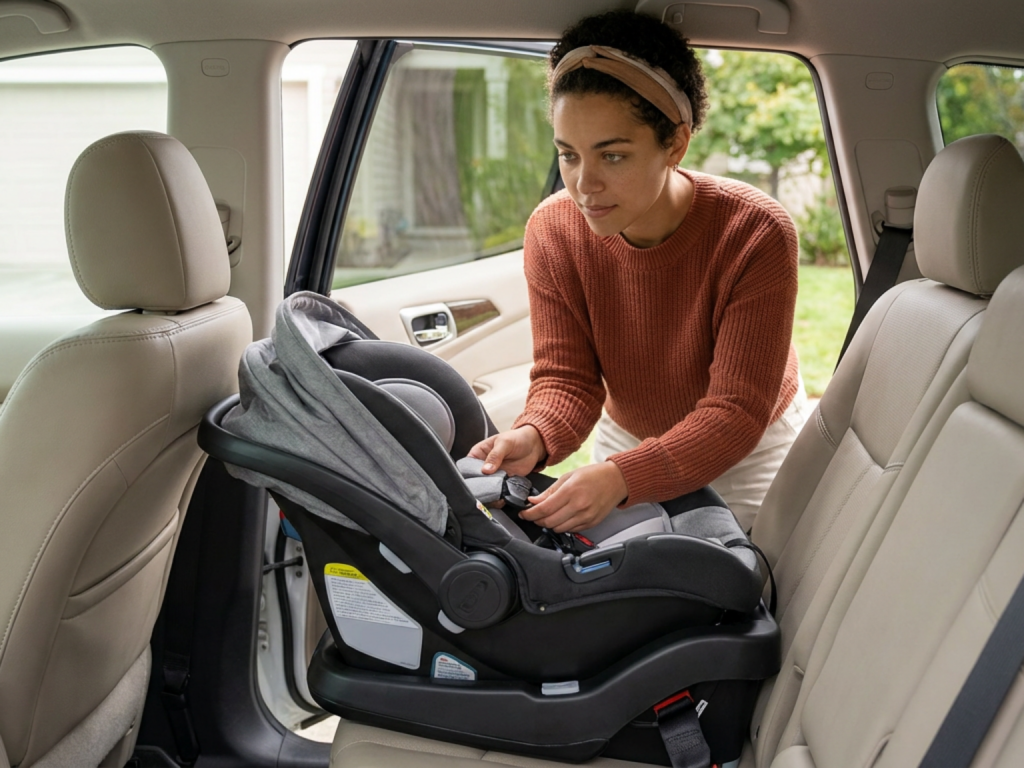
Most newborns travel in either an infant-only rear-facing seat or a convertible seat used rear-facing from birth. An infant-only seat usually has a detachable carrier that clicks into a base. This can be convenient for short transfers, especially during the newborn period, but the carrier should not be used as a routine sleep space outside the car. A convertible seat stays installed in the vehicle and can later be used rear-facing for larger infants and toddlers, depending on the manufacturer’s limits.
An infant-only seat may be a good fit if you want a smaller shell, a removable carrier, or compatibility with a stroller system. A convertible rear-facing seat may be appealing if you want one seat that lasts longer before replacement. However, not all convertible seats fit small newborns equally well, even if the label says they start at a low weight. Check whether the lowest harness position can sit at or below the baby’s shoulders and whether the newborn insert, if included, is permitted for your baby’s size.
For car seat safety, rear-facing is the key orientation for infants because it supports the head, neck, and spine during a crash. Infants have proportionally large heads, immature cervical musculature, and developing vertebral structures, so crash forces need to be distributed across the back of the seat rather than concentrated through the neck. Keep your child rear-facing until they reach the maximum height or weight allowed by that specific seat.
Check height, weight, and newborn fit before buying
Every seat has minimum and maximum weight and height limits, and both matter. Many families focus on weight alone, but a baby may outgrow a seat by height before reaching the weight limit. Look for the manufacturer’s rules about the top of the child’s head relative to the shell, harness slot position, and any insert requirements. Do not assume that a higher maximum weight automatically means the seat will last longer if the shell height is short.
For a newborn, the most important fit details are the harness height, crotch buckle distance, recline, and head positioning. In a rear-facing seat, harness straps should generally come from at or below the shoulders, according to the seat manual. The crotch buckle should help prevent slumping without forcing the baby into a curled or compressed posture. The baby’s head should remain in a neutral position, not flexed chin-to-chest, because excessive neck flexion can narrow the upper airway.
Infants born preterm or with low birth weight may require extra caution. Some hospitals perform a car seat tolerance screening before discharge for certain babies, observing oxygen saturation, heart rate, and breathing while positioned in the seat. This screening does not guarantee safety in every situation, but it can identify babies who need further evaluation or a car bed for travel. If your baby has apnea, bradycardia, chronic lung disease, neuromuscular concerns, or feeding-related airway issues, ask your clinical team about premature infant car seat positioning before choosing or using a seat.
Make sure the seat fits your vehicle
A highly rated seat is not helpful if it cannot be installed securely in your car. Before buying, review your vehicle owner’s manual and the car seat manual online if available. Check which seating positions allow lower anchors, which allow seat belt installation, and whether there are restrictions related to inflatable seat belts, overlapping belts, seat contouring, or advanced airbags. The back seat is the safest location for children, and a rear-facing car seat should never be placed in front of an active passenger airbag.
If possible, try the seat in your vehicle before finalizing the purchase, or buy from a retailer with a practical return policy. Important vehicle-fit questions include whether the front seats can still be used safely, whether the car seat base rests as the manufacturer requires, whether the recline indicator can be placed in the newborn range, and whether the installed seat moves less than one inch side-to-side or front-to-back at the belt path.
You may install many seats with either the lower anchors or the vehicle seat belt, but usually not both unless the manual explicitly permits it. One method is not automatically safer than the other; the safer method is the one that achieves a correct installation in that seating position. If you are unsure, a certified Child Passenger Safety Technician can check your installation and teach you how to reproduce it yourself.
Prioritize easy, repeatable installation features
Ease of use is not a superficial feature. It directly affects real-world safety because even a very protective seat can perform poorly if it is loose, over-reclined, under-reclined, or routed incorrectly. When comparing models, look for clear labeling, a recline indicator that is easy to read, accessible belt paths, and a base that tightens without requiring excessive force. Some seats include built-in lock-offs for seat belt installation, load legs, anti-rebound features, or tensioning systems. These can be helpful, but only when used according to the manual and compatible with the vehicle.
Consider who will install and use the seat. A postpartum parent recovering from cesarean birth, a grandparent with arthritis, or a caregiver frequently moving the seat between vehicles may need different usability features than someone who will install the base once and leave it in place. Weight of the carrier also matters; a heavier carrier may be harder to lift safely, especially as the baby grows.
Look beyond showroom impressions. Practice loosening and tightening the harness, adjusting the headrest, removing and replacing the cover, and attaching the carrier to the base. If the mechanism feels confusing when you are rested in a store, it may feel much harder in the rain, at night, or with a crying infant.
Evaluate infant car seat harness fit and positioning
Infant car seat harness fit is one of the most important everyday safety checks. The harness should lie flat without twists, pass through the correct rear-facing slots, and be snug enough that you cannot pinch excess webbing at the shoulder. The chest clip, if the seat uses one, should be at armpit level. A loose harness allows excessive movement in a crash, while a twisted harness can concentrate force over a smaller body area.
Bulky coats under the harness are unsafe because they compress during a crash and leave the straps effectively loose. Dress the baby in thin, warm layers, buckle the harness snugly, and place a blanket over the secured harness if needed. Only use inserts, strap covers, head supports, or padding that came with the seat or are specifically approved by the manufacturer for that model. Aftermarket accessories can alter crash performance or positioning.
Recline angle is also medically relevant. Newborns need enough recline to reduce head slump, but too much recline may change crash dynamics and may not be permitted by the manufacturer. Follow the seat’s recline indicator for your baby’s weight or age range. If your baby’s chin falls toward the chest, breathing sounds labored, color changes, or the baby seems unusually difficult to arouse during travel, stop when safe and seek medical guidance promptly.
Compare convenience features without letting them override fit
Convenience features can make life easier, but they should support safety rather than distract from it. Stroller compatibility, a no-rethread harness, machine-washable fabrics, extra bases, canopy coverage, and carrier weight may all be legitimate considerations. If you use rideshares, taxis, or travel frequently, you may value a seat that can be installed securely without the base, provided the manual allows baseless installation and you are comfortable doing it correctly.
A higher price does not guarantee a better match for your baby or vehicle. Similarly, a popular travel system may not be ideal if the car seat has poor newborn harness fit or is awkward in your back seat. Use comparison guides and ease-of-use ratings as tools, but make the final decision based on child fit, vehicle fit, and caregiver competence.
Be cautious with used seats. Only consider one if you know its full history: no crashes unless the manufacturer and relevant guidance clearly allow continued use, no missing labels or parts, no recalls left unresolved, no expired date, and a complete manual. If any of those details are uncertain, choose a new seat or a verified safe alternative through a community program.
Plan for growth, recalls, and when to move on
Choosing the first seat also means planning for the next transition. Register the car seat with the manufacturer so you can receive recall notices. Keep the manual accessible, either physically or digitally. Recheck fit regularly, because infants can change length, weight, and posture quickly. The harness height, insert use, crotch buckle setting, and recline range may need adjustment as your baby grows.
Do not turn a baby forward-facing just because they seem uncomfortable, their legs touch the vehicle seat, or they reach a first birthday. The safer approach is to use the rear-facing seat until the child reaches the manufacturer’s rear-facing height or weight limit. When to upgrade car seat depends on the specific seat’s limits and your child’s measurements, not on age alone.
Finally, make support part of your plan. Many families benefit from an in-person check with a certified child passenger safety technician, especially before the first ride, after changing vehicles, after adjusting the harness, or when moving to the next stage. Asking for help is not a sign that you failed; it is a practical safety step in a system that is genuinely complex.
Safety cautions
- Never place a rear-facing infant seat in front of an active passenger airbag.
- Do not use unapproved aftermarket inserts, head supports, or strap covers.
- Avoid bulky coats under the harness because compression can make the harness loose.
- Seek medical guidance for premature, low-birth-weight, or medically fragile infants before routine car travel.
- Replace or stop using a seat if it is expired, recalled without remedy, missing parts, or has an uncertain crash history.
Tools & Assistance
- Use the NHTSA car seat finder and ease-of-use resources to compare appropriate models.
- Read both the car seat manual and your vehicle owner’s manual before installation.
- Schedule an installation check with a certified Child Passenger Safety Technician.
- Register the car seat with the manufacturer for recall notifications.
- Ask your pediatrician or neonatal team about travel positioning if your baby has medical risk factors.
FAQ
Is an infant-only seat safer than a convertible seat for a newborn?
Not automatically. The safer choice is the rear-facing seat that fits your baby’s size, supports correct harness positioning, fits your vehicle, and can be used correctly every ride.
How long should my baby stay rear-facing?
Keep your child rear-facing until they reach the maximum rear-facing height or weight limit listed by the seat manufacturer.
Can I buy a used infant car seat?
Only if you know its full history, it is not expired, has no unresolved recall, has all parts and labels, includes the manual, and has not been in a crash that requires replacement.
What if my baby cries in the car seat?
Crying does not usually mean the seat is unsafe, but recheck harness fit, diaper comfort, temperature, and recline. If your baby has breathing difficulty, color change, or unusual lethargy, stop safely and seek medical advice.
Do I need professional installation?
You can install the seat yourself by following the manuals, but many families find a certified technician check helpful because small errors are common and correct use is essential.
Sources
- HealthyChildren.org — Car Seats: Information for Families
- National Highway Traffic Safety Administration — Car Seat & Booster Seat Safety, Ratings, Guidelines
- Consumer Reports — Choose the Right Car Seat for Your Child
Disclaimer
This article is for general educational purposes and does not replace medical care or individualized safety assessment. Consult your pediatrician, neonatal team, or a certified child passenger safety technician for concerns about your baby’s health or car seat use.














Please log in to leave a comment.