
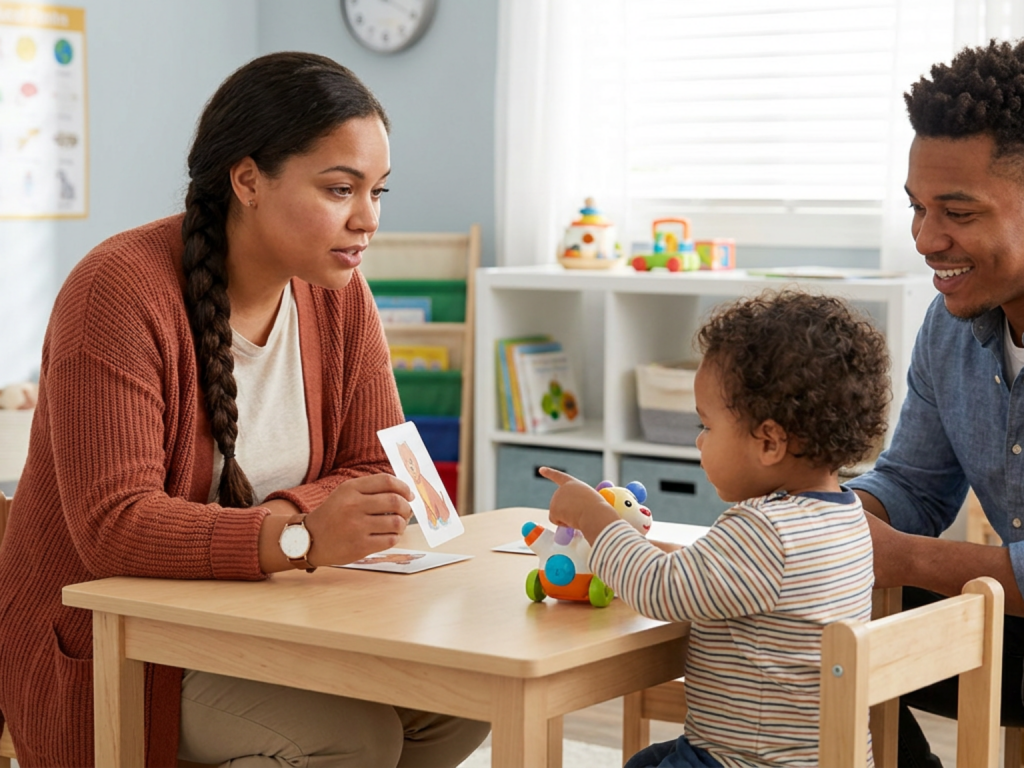
Intro
Early speech development begins well before a baby says a recognizable first word. From the first reflexive cries to cooing, babbling, pointing, and shared attention, babies are building the neurologic, auditory, motor, and social foundations of communication. For many families, this period is joyful and also uncertain: one baby may babble constantly, while another may be quieter but still developing within a typical range.
This article explains early communication milestones, signs that speech and language are progressing, and warning signs that deserve professional attention. It is not meant to diagnose a delay. Instead, it can help you observe patterns, prepare for a pediatric visit, and understand when an audiologist, speech-language pathologist, or developmental specialist may be helpful.
Highlights
Speech development is more than talking; it includes hearing, social engagement, gestures, imitation, receptive language, and oral-motor coordination.
Babbling, pointing, responding to name, and understanding simple words are meaningful early communication milestones, not just cute behaviors.
A single missed milestone does not confirm a disorder, but persistent concerns, regression, or reduced response to sound should be discussed promptly with a healthcare professional.
Hearing concerns in babies are especially important because even mild or intermittent hearing loss can affect speech and language learning.
What early speech development includes
Speech is the motor act of producing sounds, while language is the system of understanding and using words, gestures, symbols, and grammar. In infancy, these systems develop together with hearing, cognition, attention, social reciprocity, and motor control. A baby who turns toward a caregiver’s voice, smiles during interaction, imitates sounds, or reaches to be picked up is already communicating.
Medically, clinicians often separate communication into receptive language, expressive language, speech sound production, pragmatic or social communication, and feeding or oral-motor skills when relevant. Receptive language means what a child understands. Expressive language means what the child communicates outwardly, whether through sounds, words, signs, pointing, or facial expression. Pragmatic communication includes back-and-forth interaction, eye gaze, turn-taking, and using communication for a purpose.
These areas do not mature in a perfectly linear sequence. Some babies are early babblers but slower to use gestures; others point and understand many words before they say much. The overall pattern, the child’s medical history, hearing status, and progression over time matter more than a single isolated behavior.
Birth to 6 months: listening, cooing, and social sound play
During the first months, babies learn that sounds carry meaning. Newborns startle or quiet to sound, recognize familiar voices, and use crying to signal needs. Over time, many babies begin to coo, make pleasure sounds, smile in response to social interaction, and vary their cries for hunger, discomfort, or fatigue.
By around 4 to 6 months, typical signs may include turning eyes or head toward sounds, noticing toys that make noise, laughing, squealing, and making vowel-like sounds such as “ah” or “oo.” Babies may also watch a caregiver’s mouth, respond to changes in tone, and enjoy face-to-face vocal play. These behaviors show the integration of auditory input, social attention, and early motor planning for sound.
Caregivers can support this stage through calm, responsive interaction. Speak during daily routines, pause as if waiting for an answer, imitate the baby’s sounds, and use warm facial expression. This serve-and-return pattern helps the baby learn that vocalizations can influence another person.
6 to 12 months: babbling, gestures, and shared attention
In the second half of the first year, babbling usually becomes more complex. Babies often experiment with repeated consonant-vowel syllables such as “ba-ba,” “ma-ma,” or “da-da,” even before those sounds refer to a specific person. They may use voice to gain attention, respond to their name, recognize common words like “no” or “bye-bye,” and show interest in games such as peekaboo.
Gestures become increasingly important. Waving, reaching, lifting arms to be picked up, showing objects, and pointing are not separate from speech development; they are part of the same communication system. Pointing in particular can reflect joint attention, meaning the baby is intentionally directing another person’s focus to something interesting.
By about 12 months, many babies use one or more simple words with meaning, though the exact timing varies. They may also understand familiar names for people or objects, follow simple routines, and combine vocalization with gesture. If a baby is not babbling, rarely responds to sound, does not use gestures, or seems to lose previously acquired communication skills, it is reasonable to contact a pediatric clinician rather than waiting to see what happens.
12 to 24 months: first words and early word combinations
Between the first and second birthdays, expressive vocabulary often grows from a few meaningful words to many more. Words may be approximations rather than adult-like pronunciations. For example, “ba” for ball or “wawa” for water can still count as a word if the child uses it consistently and intentionally. Understanding usually advances as well: toddlers may point to body parts, identify familiar objects, follow simple directions, and bring an item when asked.
By around 18 months, many toddlers use several words, imitate new words, point to request or show, and understand more than they can say. By about 24 months, many begin combining two words, such as “more milk” or “daddy go.” Speech intelligibility is still developing, so unfamiliar listeners may not understand everything. However, caregivers should usually see steady growth in the number of words, communicative attempts, and understanding.
Potential warning signs in this period include using very few words by 18 to 24 months, not combining words near age 2, relying almost entirely on pulling or crying instead of gestures or words, or having difficulty understanding simple language. These signs do not automatically identify the cause, but they justify discussion with a pediatrician and often referral for hearing evaluation and speech-language assessment.
2 to 3 years: clearer speech, longer phrases, and early grammar
From 2 to 3 years, many children move from two-word phrases to short sentences. Vocabulary expands rapidly, and children may ask simple questions, name familiar pictures, use pronouns imperfectly, and follow two-step directions. Speech sounds are still immature, but parents and frequent caregivers typically understand much of what the child says.
At this stage, clinicians pay attention to both expressive and receptive skills. A child who says many words but does not seem to understand directions may need evaluation just as much as a child who understands well but speaks very little. Speech sound clarity also matters, especially if frustration is high or communication is difficult outside the family.
It is also helpful to consider broader development. Cognitive development in babies and toddlers, play skills, motor development, attention, social reciprocity, and sensory responses can all influence communication. Some children with language delay have isolated speech-language needs; others may have hearing loss, neurodevelopmental differences, motor speech difficulties, or medical factors such as recurrent otitis media. Professional evaluation helps clarify the pattern.
Red flags that deserve timely attention
Families are often told that children develop at their own pace, which is true, but it should not be used to dismiss persistent concerns. Early support is generally most effective when it begins promptly. You do not need to know the cause of a concern before asking for help.
- No clear response to sound, inconsistent response to name, or caregiver concern about hearing at any age.
- No babbling by the later part of the first year, especially if vocal play is limited or declining.
- No gestures such as pointing, waving, or showing by around 12 months.
- Very few meaningful words by 18 months or no two-word spontaneous phrases by around 24 months.
- Loss of previously acquired skills, including words, gestures, social engagement, or response to sound.
- Speech that remains very difficult for caregivers to understand as the child approaches age 3.
Regression is particularly important. Loss of previously acquired skills should be discussed promptly with a healthcare professional because it can reflect hearing changes, neurologic conditions, developmental disorders, psychosocial stressors, or other medical issues.
Hearing, feeding, and medical factors
Hearing is central to speech and language development. Some babies pass newborn hearing screening yet later develop conductive hearing loss from middle ear fluid, recurrent ear infections, or other conditions. Others may have progressive or delayed-onset hearing loss. Because speech depends on consistent access to sound, hearing concerns in babies should be evaluated rather than assumed to be inattention.
Feeding and oral-motor history can also provide context. Difficulty coordinating sucking, swallowing, breathing, persistent coughing with feeds, or significant oral-motor challenges may be relevant to overall communication assessment, although feeding issues do not always predict speech delay. Prematurity, neonatal intensive care, genetic conditions, neurologic injury, craniofacial differences, and chronic illness can also affect developmental trajectories.
If concerns arise, a typical evaluation pathway may include pediatric examination, hearing testing by an audiologist, standardized speech-language assessment, and developmental screening questionnaires. Depending on findings, the child may be referred to early intervention services, a developmental-behavioral pediatrician, otolaryngologist, neurologist, or other specialists.
How caregivers can support communication at home
Home support does not need to look like formal lessons. Babies and toddlers learn language through repeated, emotionally safe, meaningful interaction. The goal is not to pressure a child to perform, but to increase opportunities for connection and communication.
- Use responsive talk: describe what the child is looking at, doing, or feeling during ordinary routines.
- Pause often: give the child time to vocalize, gesture, look, or attempt a word before you continue.
- Expand gently: if the child says “ball,” you might say “big ball” or “roll ball.”
- Read simple books: label pictures, make animal sounds, and let the child turn pages or point.
- Limit passive background noise: constant television or device audio can reduce high-quality conversational turns.
- Follow the child’s interest: communication grows best when the child is motivated and emotionally engaged.
If your child is already receiving therapy, ask the speech-language pathologist how to adapt strategies to daily routines. Consistency across meals, bath time, play, dressing, and outdoor time often matters more than isolated practice sessions.
When to seek professional advice promptly
- Your baby does not startle, turn, quiet, or respond consistently to sound.
- Your child loses words, gestures, social engagement, or other previously acquired skills.
- There is no babbling by the later part of the first year or no gestures around 12 months.
- Your toddler has very few meaningful words by 18 to 24 months or is not combining words near age 2.
- Speech is extremely difficult to understand, or communication frustration is intense and persistent.
- You have a strong caregiver concern, even if others suggest waiting.
Tools & Assistance
- Pediatric well-child visit with developmental surveillance
- Audiology hearing evaluation
- Speech-language pathology assessment
- Early intervention program or local child development service
- Parent notes or short videos of communication behaviors to share with clinicians
FAQ
Is it normal if my baby understands words but does not say much yet?
Some children understand more than they can say, especially early in toddlerhood. However, expressive language should gradually increase. If words remain very limited by 18 to 24 months, discuss evaluation with a pediatric professional.
Do bilingual babies talk later?
Bilingual exposure does not cause a language disorder. A bilingual child’s vocabulary should be considered across all languages. If there are concerns in understanding, gestures, social communication, or progress in all languages, professional advice is appropriate.
Should I wait until age 3 before asking about speech delay?
Waiting is not necessary when concerns are persistent. Earlier hearing testing, speech-language evaluation, and early intervention can identify needs and support communication during a highly plastic developmental period.
Can pacifiers or screen time affect speech?
Occasional pacifier use is not the same as a developmental disorder, but prolonged daytime use may reduce chances to practice sounds. Heavy passive screen exposure can displace responsive conversation, which is important for language learning.
What counts as a first word?
A first word does not need perfect pronunciation. It usually counts if the child uses a sound or word approximation consistently, intentionally, and with the same meaning, such as "ba" for bottle.
Sources
- National Institute on Deafness and Other Communication Disorders, NIH — Speech and Language Developmental Milestones
- American Speech-Language-Hearing Association — Early Identification of Speech, Language, Swallowing, and Hearing Disorders
- Nemours KidsHealth — Delayed Speech or Language Development
Disclaimer
This article is for general educational purposes and is not a diagnosis or treatment plan. If you have concerns about a child’s speech, language, hearing, feeding, or development, consult a qualified healthcare professional.














Please log in to leave a comment.