
Intro
Installing an infant car seat can feel surprisingly high pressure, especially when you are preparing for a first ride home, recovering from birth, or trying to make sense of several manuals at once. That nervousness is understandable. A correctly installed rear-facing infant seat is one of the most important injury-prevention tools for babies, whose large head-to-body ratio, immature cervical musculature, and developing spine make crash forces especially hazardous.
The goal is not perfection on the first attempt; it is a repeatable safety routine. You will combine three sources of instructions: your car seat manual, your vehicle owner’s manual, and current child passenger safety guidance. When those agree, follow them closely. When you are unsure, ask a certified Child Passenger Safety Technician or another qualified safety professional to check the installation.
Highlights
Infants should ride rear-facing in the back seat, within the height and weight limits set by the car seat manufacturer.
A secure installation means the car seat or base moves less than one inch side-to-side or front-to-back when tested at the belt path.
Use either the seat belt or the lower anchors if permitted; using both together is not automatically safer and should only be done if both manuals allow it.
Harness straps should be snug, lie flat, and come from at or below the baby’s shoulders for a rear-facing seat, with the chest clip at armpit level.
The recline angle matters because an overly upright newborn can slump forward, potentially compromising airway alignment.
Start with the right seat, manuals, and seating position
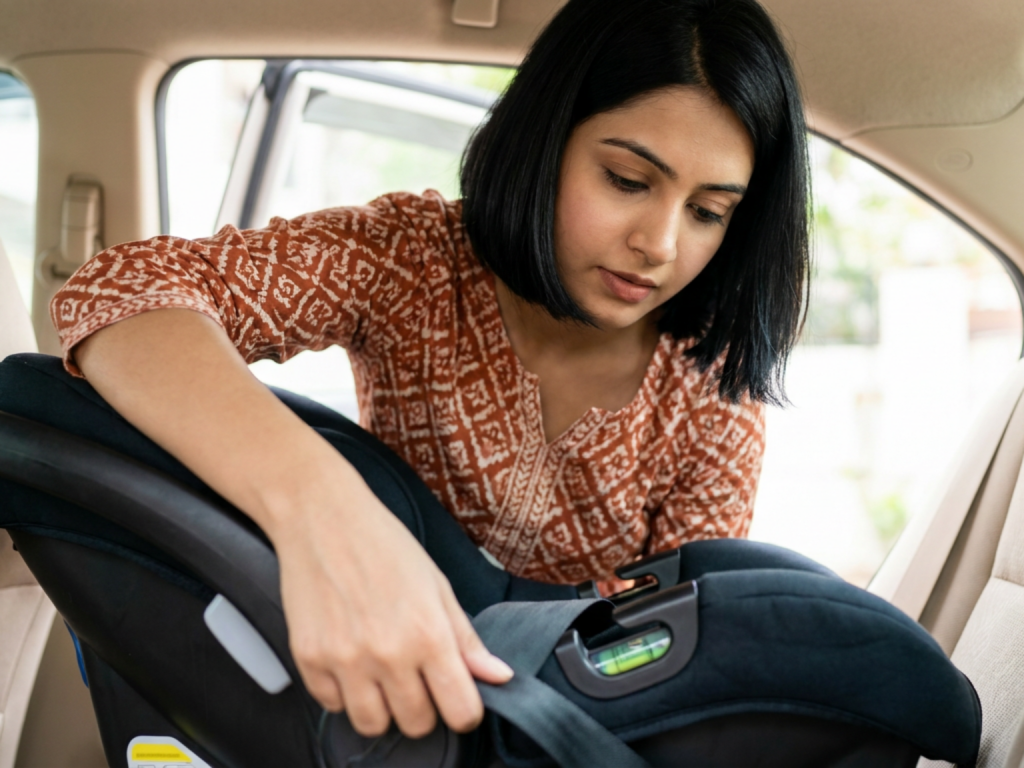
An infant car seat is typically a rear-facing-only seat that attaches to a base installed in the vehicle. Before installation, confirm that the seat is appropriate for your baby’s current weight, length, and age, and that it has not expired, been recalled, or been involved in a crash unless the manufacturer explicitly states continued use is acceptable.
Place the seat in the back seat whenever possible. The back seat is the safest location for children, and rear-facing seats should not be placed in front of an active frontal air bag. Many families prefer the center rear seating position because it can increase distance from side-impact zones, but only use it if your vehicle manual and car seat manual allow a secure installation there. Some vehicles do not allow lower-anchor installation in the center seat, or the seat contour may prevent stable contact.
Gather the car seat manual, your vehicle owner’s manual, and the car seat itself. Look for the labeled belt path on the base; rear-facing belt paths are usually marked differently from forward-facing paths. If you are installing before birth, it is wise to practice with enough time to schedule a professional check.
Choose either lower anchors or the seat belt
Most infant seat bases can be installed using either the LATCH lower anchors or the vehicle seat belt. LATCH stands for Lower Anchors and Tethers for Children. For a rear-facing infant seat, you usually use the lower anchors, not the top tether, unless the car seat manufacturer specifically instructs otherwise. Seat belt installation is equally safe when done correctly.
Do not assume that using both the seat belt and lower anchors together makes the seat safer. In many products, using both is not permitted because the seat has not been tested that way. Choose one installation method unless both the car seat manual and the vehicle manual clearly allow combined use.
- If using lower anchors, attach the connectors to the correct vehicle anchor bars, keeping the strap flat and free of twists.
- If using the seat belt, route the lap-and-shoulder belt or lap-only belt through the rear-facing belt path exactly as shown in the manual.
- Check whether the vehicle belt must be locked by pulling the shoulder belt fully out, switching a latchplate, using a built-in lock-off, or another manufacturer-approved method.
- Observe the lower-anchor weight limits. When a child plus seat exceeds the permitted limit, switch to a seat belt installation if the seat is still appropriate for the child.
Install the base tightly and use the inch test
Set the base flat on the vehicle seat and apply firm pressure while tightening the lower-anchor strap or seat belt. Pressing down where the baby’s bottom would rest, or placing a knee or hand in the base if the manual allows, can help compress the vehicle cushion while you remove slack. Keep your body mechanics safe; postpartum caregivers should avoid strain and ask for help if needed.
After tightening, test the installation at the belt path, not at the far end of the base. Hold the base with your non-dominant hand at the belt path and try to move it side-to-side and front-to-back. The base should move less than one inch in either direction. Some movement at the top of a rear-facing seat is expected; what matters is tightness at the belt path.
If the base moves more than one inch, remove slack again, check that the belt or anchor strap is routed correctly, and confirm the belt is locked if using a seat belt. A common error is testing by pushing hard at the carry handle or top of the carrier, which can make a secure installation look loose. Another common error is routing the belt through the wrong belt path.
Set the correct recline angle
Infant seats require a specific recline angle because babies, especially newborns and preterm infants, have limited head control. If the seat is too upright, the head may flex forward toward the chest. This chin-to-chest position can narrow the upper airway in some infants. If the seat is too reclined, crash protection may be reduced. Use the recline indicator on the seat or base, such as a bubble, line, ball, or color window, and follow the manufacturer’s instructions precisely.
Many bases have adjustable recline feet. If the vehicle seat slope still prevents the correct angle, some manufacturers allow a tightly rolled towel or pool noodle at the vehicle seat crease to improve leveling. Use this only if the car seat manual permits it, and never improvise with bulky objects, pillows, or aftermarket wedges.
For newborns with medical complexity, prematurity, hypotonia, respiratory conditions, or a history of oxygen desaturation, ask the neonatal team, pediatrician, or relevant specialist whether additional discharge testing or positioning advice is needed. This is not about diagnosing a problem at home; it is about matching transport positioning to the baby’s medical context.
Attach the carrier and check the handle position
Once the base is installed, click the infant carrier into the base and pull up on the carrier to confirm it is locked. Listen for the click, but do not rely on sound alone. A carrier that is not fully latched can detach during sudden braking or a crash.
Check the approved carry-handle position for travel. Some infant seats allow the handle to remain upright, while others require it to be behind the seat, forward, or in another locked position. There is no universal rule, so follow the manual for your exact model.
If you use the same carrier with multiple bases or without a base in a rideshare, taxi, or relative’s vehicle, repeat the full installation check each time. Baseless installation can be safe when the manual allows it, but it requires correct seat belt routing, locking, and recline verification at every ride.
Buckle your baby with airway and body safety in mind
Place your baby’s back and bottom fully against the car seat shell. Use careful newborn head and neck support while transferring the baby into the seat, especially during the early weeks when head control is limited. A safe newborn lifting technique can help you avoid sudden head lag while keeping the baby aligned.
For a rear-facing seat, harness straps should come from at or below the baby’s shoulders. Buckle the crotch buckle and chest clip, then tighten until you cannot pinch a horizontal fold of harness webbing at the shoulder. The straps should lie flat, without twists, because twisted straps concentrate force over a smaller area in a crash.
Place the chest clip at armpit level, centered on the chest. Avoid bulky coats, thick bunting, padded inserts, head positioners, strap covers, or other aftermarket products unless they came with the seat or are specifically approved by the manufacturer. Bulky layers compress in a crash, leaving the harness too loose. Instead, dress the baby in thin layers, buckle snugly, and place a blanket over the harness if needed, keeping fabric away from the face.
Build a pre-drive safety routine
A brief routine before every drive reduces the chance of small errors becoming habitual. Confirm that the base still passes the inch test, the carrier is clicked in, the recline indicator is in the permitted zone, the harness is snug, and the chest clip is at armpit level. If another caregiver installed or adjusted the seat, recheck it rather than assuming it stayed correct.
Also keep the car seat for travel, not routine sleep outside the vehicle. If your baby falls asleep in the car, move them to a firm, flat infant sleep surface when you arrive and can do so safely. Car seats are designed for crash protection and transport positioning, not prolonged unsupervised sleep.
Schedule a car seat inspection if you feel uncertain, if your vehicle seat shape makes installation difficult, if the seat repeatedly loosens, or if your baby has medical needs that affect tone, breathing, or positioning. A certified technician can teach you how to install your own seat correctly rather than simply doing it for you.
Safety warnings
- Never place a rear-facing infant seat in front of an active frontal air bag.
- Do not use both lower anchors and the seat belt unless both manuals clearly allow it.
- Do not add unapproved inserts, pillows, head supports, or strap covers to the car seat.
- If the base moves more than one inch at the belt path, reinstall it before travel.
- Seek professional guidance for premature infants or babies with respiratory, neurologic, or tone-related medical concerns.
- Replace or evaluate a car seat after a crash according to the manufacturer’s instructions and applicable safety guidance.
Tools & Assistance
- Read the car seat manual and vehicle owner’s manual together before installing.
- Use a certified Child Passenger Safety Technician inspection station when available.
- Check the seat’s expiration date, recall status, and crash history.
- Practice installation with both lower anchors and the seat belt so you can adapt in different vehicles.
- Keep a simple pre-drive checklist for caregivers who transport the baby.
FAQ
Is LATCH safer than a seat belt for an infant car seat?
No. Lower anchors and seat belts can both be safe when used correctly. The safer option is the one that gives a permitted installation with less than one inch of movement at the belt path.
Can I install an infant car seat in the middle rear seat?
Often yes, but only if your vehicle and car seat manuals allow it and you can achieve a tight installation. Some vehicles do not permit lower-anchor use in the center position.
How tight should the harness be on a newborn?
The harness should be snug enough that you cannot pinch a fold of webbing at the shoulder. Straps should be flat, at or below the shoulders for rear-facing use, and the chest clip should be at armpit level.
Can I use a rolled towel to fix the recline angle?
Only if the car seat manual permits it. Some seats allow a tightly rolled towel or pool noodle at the vehicle seat crease; others require only built-in recline features.
When should I ask for professional help?
Ask for help if the seat will not tighten, the recline angle is difficult to achieve, your baby was premature or medically complex, or you simply want confidence before routine travel.
Sources
- National Highway Traffic Safety Administration — How to Install Rear-Facing Car Seats
- Safe Kids Worldwide — Installing - The Ultimate Car Seat Guide
- Lucie's List — Installing your Infant Car Seat
Disclaimer
This article is for general educational information and does not replace medical care, emergency services, or individualized advice from your pediatrician, neonatal team, car seat manufacturer, or a certified child passenger safety professional.
















Please log in to leave a comment.