
Intro
Routines can look ordinary: breakfast at the same time, a familiar goodbye ritual, homework before play, a bedtime routine that repeats most nights. Yet for children, these repeated patterns are not trivial. They help the developing brain predict what comes next, organize behavior, and feel safer in a world that is still new and often overwhelming.
Families do not need perfect schedules or rigid rules to support healthy development. What matters most is a pattern that is predictable, warm, and responsive. When routines are combined with supportive caregiving, they can strengthen cognitive skills, emotional regulation, social confidence, sleep habits, and school readiness.
Highlights
Predictable routines help children feel secure because they reduce uncertainty and support a sense of control.
Family routines are associated with better self-regulation, social-emotional health, cognitive development, and academic adjustment.
Routines work best when they are warm and flexible, not harsh, punitive, or excessively rigid.
Small routines, such as shared meals, morning checklists, and a calming bedtime routine, can have meaningful developmental benefits.
A sudden loss of functioning, severe sleep problems, or persistent behavioral distress should be discussed with a pediatric or mental health professional.
Routines create safety through predictability
Children develop within repeated experiences. A routine is a predictable sequence of events, such as waking, dressing, eating breakfast, brushing teeth, and leaving for school in roughly the same order each day. This repetition gives a child’s nervous system cues about what to expect. Predictability is especially powerful in early childhood because the prefrontal cortex, which supports planning, impulse control, and flexible thinking, is still maturing.
When a child knows what comes next, the brain can spend less energy scanning for uncertainty and more energy learning, communicating, and cooperating. This does not mean children require a perfectly controlled environment. Rather, consistent patterns provide a safe scaffold. Within that scaffold, children can explore, play, ask questions, and tolerate small frustrations.
Routines also support co-regulation, the process in which an adult helps a child return to a calmer physiological and emotional state. For example, a predictable after-school rhythm of snack, connection, movement, and homework can reduce conflict because the child does not have to negotiate every step from the beginning. Over time, co-regulation becomes internalized as self-regulation.
How routines influence brain development and self-regulation
Self-regulation is the ability to modulate attention, emotion, arousal, and behavior in response to a situation. It is not simply obedience. It reflects developing neural networks involving the prefrontal cortex, limbic system, autonomic nervous system, and sleep-wake regulation. Repeated routines help children practice these regulatory skills in manageable doses.
A morning routine, for instance, requires sequencing, working memory, inhibitory control, and transitions between tasks. A child may learn, “First I get dressed, then I eat, then I pack my bag.” With enough repetition, the sequence becomes less demanding and more automatic. This frees cognitive resources for higher-level learning and social interaction.
Routines can also reduce behavioral problems by lowering the number of unpredictable demands placed on the child. Many meltdowns occur during transitions: leaving the playground, starting homework, ending screen time, or going to bed. A consistent warning, visual schedule, or transition ritual can help the child prepare neurologically and emotionally.
Importantly, routines should not be confused with strict control. Research on family routines emphasizes predictable, supportive structures. Harsh parenting may undermine the benefits of routines because fear and threat activate stress pathways. A routine works best when a child experiences it as safe, understandable, and guided by an adult who remains emotionally available.
Sleep and the bedtime routine
Sleep is one of the clearest ways routines affect child development. Adequate sleep supports memory consolidation, immune function, growth hormone secretion, attention, mood stability, and learning. A consistent bedtime routine helps the body anticipate sleep by pairing repeated cues with decreasing stimulation. Bathing, brushing teeth, reading, quiet conversation, and lights-out in the same order can become a biological and emotional signal that the day is ending.
Evening predictability is particularly useful because tired children often have less capacity for impulse control and frustration tolerance. A calm sequence reduces decision fatigue for both child and caregiver. It can also decrease bedtime resistance because expectations are already known.
Healthy sleep routines usually include a regular sleep-wake schedule, reduced stimulating activities before bed, and a quiet transition from active play to rest. Many families also benefit from a screen-free bedtime routine, because bright light and engaging media can delay sleep onset and increase arousal in some children.
Parents should also know when sleep concerns deserve medical attention. Loud snoring, witnessed pauses in breathing, gasping, persistent daytime sleepiness, severe insomnia, or major behavioral changes may signal sleep-disordered breathing or another health issue. In those situations, a routine may help but should not replace assessment by a pediatric clinician.
Routines support school readiness and academic adjustment
Starting preschool or school requires many developmental skills at once: separating from caregivers, following group instructions, waiting, shifting attention, managing frustration, and interacting with peers. Consistent home routines can act as a bridge between the home environment and the structured expectations of school.
Research has linked regular family routines, including shared meals and consistent bedtimes, with fewer behavior problems and improved adjustment during school transitions. These routines may be especially protective when children face additional stressors, such as economic hardship, rural isolation, parental work instability, or limited access to services.
School-day routines also reduce conflict by making expectations concrete. A child who has a predictable morning plan may arrive at school less rushed and more emotionally settled. An after-school routine can protect time for decompression, movement, food, homework, play, and connection. This matters because many children hold themselves together during the school day and then release stress at home.
Routines can also improve executive functioning through repeated practice. Packing a backpack, checking a folder, placing shoes near the door, and preparing clothes the night before all strengthen planning and organization. These are academic support skills, even though they do not look like formal instruction.
Social-emotional development and family connection
Routines are not only about tasks; they are also about relationships. A shared meal, a goodbye hug, a weekly library visit, or a nightly reading ritual communicates belonging. For a child, these repeated moments can become anchors of identity: “This is what our family does, and I am part of it.”
Social-emotional development depends on repeated experiences of attunement, repair, and trust. Predictable family routines create opportunities for children to practice conversation, turn-taking, empathy, manners, problem-solving, and emotional expression. For example, dinner conversation may teach listening and perspective-taking, while a cleanup routine may teach cooperation and shared responsibility.
Routines also help children understand boundaries. A limit that is repeated calmly is often easier to accept than a limit that appears suddenly. “Screens turn off before dinner” is less personal and less conflict-driven when it is simply the family pattern. This reduces the need for repeated negotiation and can protect the caregiver-child relationship from constant power struggles.
Emotional regulation improves when routines include connection, not just compliance. A child who has predictable moments of warmth may be more able to tolerate necessary limits. The goal is not to eliminate all distress, but to help the child move through distress with support and increasing competence.
Building routines that are flexible, realistic, and child-centered
A useful routine is one the family can actually maintain. It should fit the child’s developmental stage, temperament, neurodevelopmental profile, school demands, caregiver work schedule, cultural values, and household realities. A routine that looks ideal on paper but creates constant stress is unlikely to help.
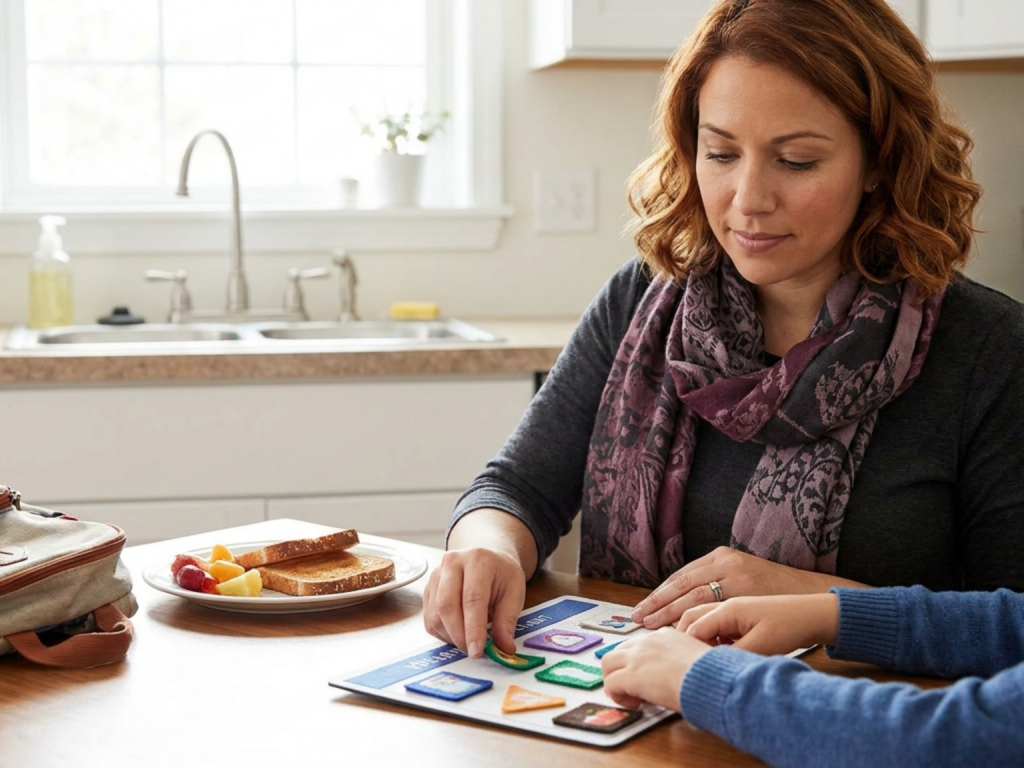
Families can start small. Choose one pressure point, such as mornings, meals, homework, or bedtime. Then identify the sequence of steps and make it visible or repeatable. For younger children, pictures may work better than written lists. For older children, collaborative planning increases buy-in and autonomy.
Helpful routine principles include:
- Keep the sequence predictable, even if exact clock times vary.
- Use simple language and repeat the same cues.
- Build in transition warnings, especially before stopping preferred activities.
- Offer limited choices, such as which pajamas or which book, rather than whether bedtime happens.
- Protect moments of warmth, humor, and repair after conflict.
Flexibility matters. Illness, travel, holidays, family stress, and developmental changes will disrupt routines. The aim is not perfection; it is returning to a familiar rhythm when possible. Children also benefit from learning that routines can bend without disappearing. This supports resilience rather than rigidity.
When routine difficulties may signal a need for support
Many children resist routines at times. Resistance is common during developmental transitions, including toddlerhood, starting school, adolescence, family moves, sibling birth, separation, bereavement, or changes in caregiving. In these periods, routines may need to be simplified and paired with more emotional support.
However, some patterns deserve professional guidance. If a child has persistent sleep disruption, extreme separation distress, aggressive behavior that threatens safety, sudden developmental regression, severe school refusal, prolonged appetite changes, or intense anxiety around transitions, it is wise to consult a pediatrician, child psychologist, developmental specialist, or other qualified healthcare professional.
Children with neurodevelopmental differences may need individualized routines. Some children benefit from visual schedules, sensory supports, occupational therapy strategies, or school-based accommodations. Others may become distressed if routines are too rigid and changes are not prepared in advance. Support should be tailored rather than punitive.
Caregivers deserve support too. Routines are harder to maintain when adults are exhausted, depressed, anxious, working unpredictable hours, or managing financial strain. Asking for help is not a failure. A compassionate plan considers the wellbeing of the whole family system.
When to seek professional advice
- Seek urgent help if a child’s behavior creates immediate risk of harm to self or others.
- Discuss loud snoring, breathing pauses, gasping, or severe daytime sleepiness with a pediatric clinician.
- Consult a professional if routine changes trigger extreme distress, regression, or persistent school refusal.
- Avoid using harsh punishment to enforce routines; it may worsen stress and undermine developmental benefits.
- If caregiver stress is overwhelming, ask a healthcare professional or community service for support.
Tools & Assistance
- Create a simple visual schedule for morning, after school, or bedtime.
- Use a consistent transition phrase, such as “first cleanup, then snack.”
- Plan one daily connection ritual that does not depend on perfect behavior.
- Speak with a pediatrician, school counselor, or child mental health professional if concerns persist.
- Review sleep, nutrition, screen time, and school stress together rather than treating behavior in isolation.
FAQ
Do routines need to happen at the exact same time every day?
Not always. Many children benefit most from a predictable sequence rather than a rigid clock time. Regular sleep and meal timing can help, but flexibility is normal.
What if my child resists every routine?
Start with one small routine, keep steps simple, and add warmth and choices. If resistance is extreme, persistent, or linked with anxiety, sleep problems, or aggression, seek professional guidance.
Can routines become too rigid?
Yes. Routines should provide security, not fear. Children also need practice tolerating manageable changes with adult support.
Are routines helpful for older children and pre-teens?
Yes. Older children still benefit from predictable sleep, homework, screen, meal, and family connection routines, especially when they help design them.
Do routines replace therapy or medical care?
No. Routines can support development, but they do not diagnose or treat medical, sleep, developmental, or mental health conditions.
Sources
- Journal of Family Theory & Review — Routines and child development: A systematic review
- Penn State University — Routine helps children adjust to school, but harsh parenting may undo
- Seattle Children's Hospital — Kids Thrive on Structure and Routines
Disclaimer
This article is for informational purposes only and does not replace medical, developmental, or mental health advice. Consult a qualified healthcare professional for concerns about your child’s sleep, behavior, development, or safety.
















Please log in to leave a comment.