
Intro
Bedtime can be one of the most emotionally charged parts of family life. Children may be tired but still resistant, parents may be depleted, and small disruptions can quickly become nightly patterns. A bedtime routine is not a rigid performance; it is a predictable sequence that helps a child’s brain and body shift from daytime stimulation toward sleep.
For medically literate readers, the value of bedtime routines can be understood through circadian entrainment, conditioned sleep cues, autonomic down-regulation, attachment security, and behavioral consistency. The goal is not to force sleep, but to create conditions that make sleep onset safer, calmer, and more biologically likely.
Highlights
A consistent bedtime routine helps children recognize that sleep is approaching and may reduce bedtime resistance and night waking.
Research links regular bedtime routines in early childhood with better sleep continuity and more favorable social-emotional outcomes.
The most effective routines are usually brief, predictable, low-stimulation, and adapted to the child’s age and temperament.
Sleep difficulties can sometimes reflect medical, developmental, or emotional concerns, so persistent or concerning symptoms deserve professional guidance.
What a bedtime routine is and why it matters
A bedtime routine is a repeated sequence of calming activities that happens in roughly the same order before sleep. It might include bathing, brushing teeth, changing into pajamas, reading, cuddling, a brief song, and a consistent goodnight phrase. The details vary by family, but the clinical principle is the same: predictable cues reduce uncertainty and help the child transition from alert wakefulness to sleep readiness.
Children depend heavily on external structure because executive function, impulse control, and emotional self-regulation are still developing. A routine acts as a form of environmental scaffolding. Instead of asking a young child to suddenly stop playing and sleep, the caregiver provides a gradual neurobehavioral ramp-down. Over time, the sequence itself becomes a conditioned cue: bath means pajamas, pajamas mean story, story means lights out.
Evidence supports this idea. Studies in the first two years of life have found that consistent bedtime routines at 12 months are associated with fewer nighttime waking episodes and fewer sleep problems later in toddlerhood. Other research suggests that toddlers with routines on at least five nights per week show less behavioral dysregulation and fewer internalizing and externalizing difficulties over time. These findings do not mean routines prevent every sleep problem, but they do show that consistency is more than a convenience; it is developmentally meaningful.
How routines support the biology of sleep
Sleep onset depends on several interacting systems. The circadian rhythm, regulated partly by the suprachiasmatic nucleus, helps determine when the brain expects sleep. Homeostatic sleep pressure builds across the day as wakefulness accumulates. A calm bedtime routine supports both processes by reducing arousal at the point when the child’s biology is becoming ready for sleep.
Evening overstimulation can activate the sympathetic nervous system, increasing alertness, motor activity, and emotional reactivity. Bright light, vigorous play, conflict, exciting screen content, and rushed transitions can all delay the shift into parasympathetic dominance. A routine built around low-stress activities helps reduce physiologic arousal. This is especially important for children who are temperamentally intense, sensory-sensitive, anxious, or prone to separation distress at bedtime.
Routines also reduce cognitive load. When a child knows what comes next, fewer negotiations are needed and fewer decisions must be made. This matters because fatigue impairs coping. A predictable bedtime routine does not eliminate protest, but it can make boundaries feel less arbitrary. The routine communicates, calmly and repeatedly, that bedtime is not a surprise and not a punishment.
Parents often ask how long a routine should take. For many children, 20 to 45 minutes is enough. A routine that is too short may feel abrupt, while one that becomes very long may unintentionally reinforce delay tactics. The most important feature is not perfection; it is a repeatable pattern that the family can sustain on ordinary nights.
Core components of an effective routine
Helpful bedtime routines usually include activities from four broad categories: hygiene, nutrition when appropriate, communication, and physical comfort. These categories are practical because they meet basic needs while lowering stimulation.
- Hygiene: bathing or washing, toileting, diapering if relevant, brushing teeth, and changing into sleepwear. These tasks give the evening a concrete structure.
- Nutrition: for some children, a light snack or drink may be part of the routine, especially if dinner was early. Sugary foods, caffeine-containing beverages, and large meals close to bed can interfere with sleep and digestion.
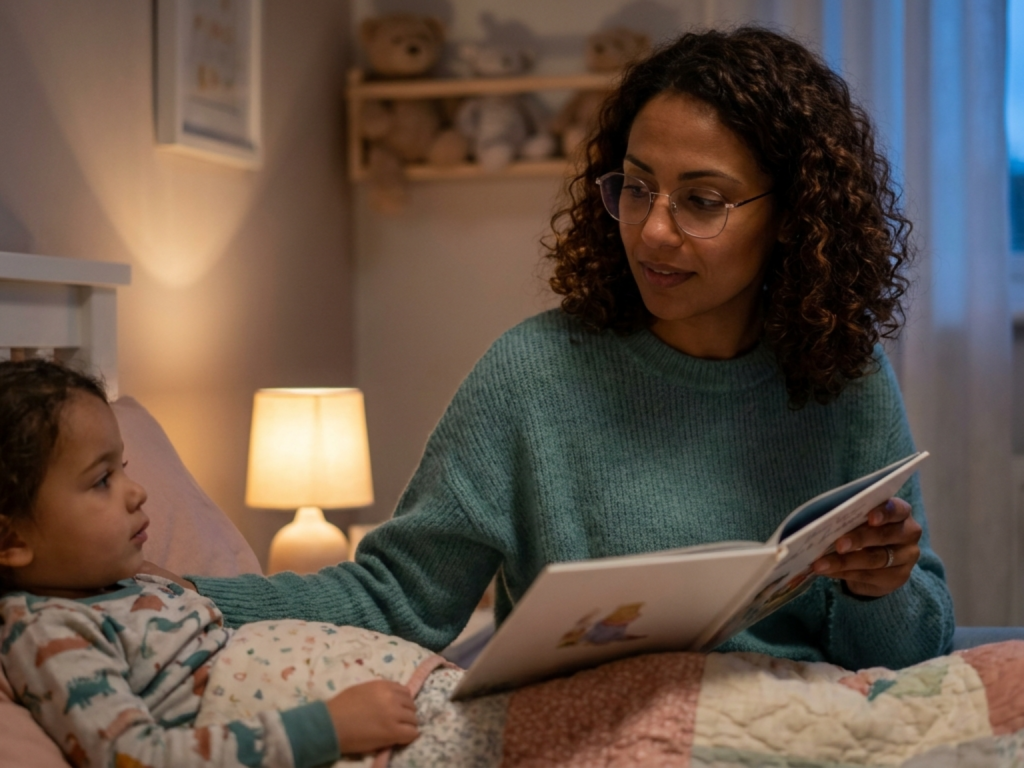
- Communication: reading, storytelling, quiet conversation, or a gratitude ritual can provide connection without high stimulation. Reading is particularly useful because it is predictable, language-rich, and easy to repeat.
- Physical contact: cuddling, gentle massage, rocking for younger children, or a brief goodnight hug can support attachment security and down-regulation.
The order should be simple. A common sequence is: tidy one small item, bath or wash, pajamas, teeth, book, cuddle, lights out. For children who struggle with transitions, a visual schedule can help. Pictures of each step reduce repeated verbal prompting and support autonomy.
It is also useful to separate calming connection from open-ended negotiation. For example, a caregiver might say, “We will read two books, then I will tuck you in.” This provides warmth and structure at the same time. If the child asks for more books, more water, or another trip to the bathroom every night, the caregiver can acknowledge the feeling while returning to the established sequence.
Adapting bedtime routines by age
Bedtime routines change as children mature. Infants need a routine that is brief and sensory-based: dim lights, feeding if developmentally appropriate, diaper change, soft voice, and a safe sleep environment. Caregivers should follow current safe sleep guidance for infants and discuss individualized sleep questions with a pediatric clinician, especially for premature infants or babies with medical complexity.
For toddlers, autonomy becomes central. A toddler bedtime routine often works best when the child has limited choices: which pajamas, which of two books, or which stuffed animal. The boundary remains the same, but the child experiences some control. Toddlers also benefit from consistent timing because late bedtimes can paradoxically worsen hyperactivity and resistance.
Preschool children may develop fears, imagination-driven worries, or requests for repeated reassurance. A preschool sleep schedule example may include a predictable wind-down period, a short discussion of worries earlier in the evening, and a comforting object. Avoid turning bedtime into a prolonged counseling session, because intense emotional processing right at lights out can increase arousal.
School-age children can participate in planning. They may respond well to clocks, checklists, and discussion of how sleep affects learning, mood, immune function, and athletic performance. However, they still need adult support around screens, homework timing, and consistent wake times. Adolescents require a different developmental approach, but the same principles apply: regularity, reduced evening stimulation, and a sleep-conducive environment.
Common bedtime challenges and practical responses
Bedtime resistance is common and does not automatically indicate a disorder. Children may resist because they are overtired, undertired, anxious, overstimulated, seeking connection, testing boundaries, or experiencing a schedule mismatch. The first step is to observe patterns rather than assign blame. A simple sleep diary can track bedtime, lights-out time, sleep onset latency, naps, night wakings, morning wake time, screens, and major stressors.
If a child is not sleepy at bedtime, consider whether the nap is too late, the bedtime is too early, or morning wake time varies widely. If the child becomes wild or tearful at bedtime, overtiredness may be contributing. Small schedule changes should be made cautiously, and families should seek professional advice for persistent insomnia-like patterns.
For repeated call-backs after lights out, a calm and boring response is often more effective than lengthy discussion. The caregiver can briefly return, reassure, and repeat the same phrase. Some families use a “bedtime pass” for one extra request, which helps children learn to prioritize. This should be adapted to the child’s age, anxiety level, and developmental capacity.
Night wakings require a similar lens. Occasional waking is normal because sleep cycles include brief arousals. Problems arise when the child cannot return to sleep without a specific caregiver action that is difficult to sustain. Changing these patterns should be done gradually and compassionately, particularly if the child has anxiety, neurodevelopmental differences, trauma history, or medical conditions.
The sleep environment and evening boundaries
The bedroom environment should support the routine. A cool, quiet, dark or dim room is often helpful. Some children benefit from white noise, especially in noisy homes, but volume should be kept at a safe level and the device placed away from the child’s ears. A night-light can be useful for fear of the dark, but bright light may reduce melatonin signaling in sensitive children.
Screens deserve special attention. Evening screen use can delay sleep through light exposure, emotional stimulation, and displacement of calming activities. Content matters as much as the device: fast-paced, frightening, or highly interactive media can increase arousal. A screen-free bedtime routine is usually easier to maintain if the rule applies predictably and if an appealing replacement, such as reading or audio storytelling, is available.
Boundaries should be kind, brief, and consistent. Children often escalate when rules change unpredictably. If one more story is sometimes allowed after a tantrum but not on other nights, the child learns that protest may be worth trying. This is not manipulation in a moral sense; it is normal learning. Predictable caregiver responses reduce the need for repeated testing.
Parents also need routines that are realistic. A plan that requires unlimited patience, a silent household, or an hour of elaborate rituals may collapse under real-life stress. A sustainable routine is better than an idealized one. If there are multiple caregivers, agreeing on the core sequence and language can reduce confusion for the child.
When bedtime problems may need clinical input
Many bedtime struggles improve with consistency, schedule adjustment, and emotional support. However, some sleep problems warrant medical evaluation. Snoring, gasping, witnessed pauses in breathing, restless sleep with daytime sleepiness, significant behavioral deterioration, chronic insomnia, recurrent painful symptoms, or unusual nocturnal events should be discussed with a pediatrician. Sleep-disordered breathing, reflux, eczema, asthma, iron deficiency, medication effects, anxiety, and neurodevelopmental conditions can all affect sleep.
Caregivers should also seek support if bedtime has become a major source of family distress. Parent exhaustion, postpartum mood symptoms, caregiver depression, high-conflict evenings, or unsafe sleep situations deserve compassionate attention. The solution may involve pediatric care, behavioral sleep counseling, mental health support, or social support rather than simply “trying harder.”
It is important not to use over-the-counter sleep aids, antihistamines, herbal products, or melatonin for a child without guidance from a qualified clinician. Even commonly discussed products can have side effects, dosing concerns, interactions, or uncertain long-term implications. Behavioral and environmental strategies are usually the first foundation, but individualized medical advice is essential when symptoms are persistent, severe, or atypical.
A bedtime routine is best understood as a supportive framework, not a test of parenting. Some children sleep easily; others need more help. Consistency, warmth, and appropriate clinical support can make nights more manageable while protecting the parent-child relationship.
When to seek medical advice
- Talk to a pediatrician if your child snores loudly, gasps, pauses breathing, or has very restless sleep.
- Seek help if sleep problems cause marked daytime sleepiness, learning difficulties, mood changes, or unsafe behavior.
- Do not give melatonin, antihistamines, herbal products, or other sleep aids without professional guidance.
- Consult a clinician if bedtime distress is severe, persistent, or linked with anxiety, trauma, pain, reflux, eczema, asthma, or developmental concerns.
- Urgent medical care is appropriate for breathing difficulty, cyanosis, altered consciousness, or concerning nocturnal events.
Tools & Assistance
- A one-week child sleep diary tracking bedtime, wake time, naps, night wakings, screens, and symptoms
- A simple visual bedtime schedule with pictures of each routine step
- A pediatrician visit for persistent sleep difficulty or possible medical contributors
- A behavioral sleep specialist or child psychologist when anxiety, resistance, or family stress is significant
- A dental checkup if tooth brushing, mouth breathing, or nighttime oral discomfort is a concern
FAQ
How long should a child’s bedtime routine be?
Many children do well with 20 to 45 minutes. The routine should be long enough to calm the child but not so long that it becomes a nightly delay pattern.
Does the routine need to be exactly the same every night?
It does not need to be perfect, but the core order should be predictable most nights. Consistency at least five nights per week has been associated with better outcomes in toddler research.
What if my child cries or protests at bedtime?
Some protest is common. Respond with warmth, check basic needs, keep language brief, and return to the routine. If distress is intense or persistent, seek individualized guidance.
Are screens always harmful before bed?
Not every child responds identically, but screens can increase arousal and delay sleep. A screen-free wind-down is often helpful, especially for children with bedtime resistance.
When should I worry about night waking?
Occasional waking is normal. Recurrent wakings with snoring, breathing pauses, pain, major daytime symptoms, or severe family disruption should be discussed with a healthcare professional.
Sources
- Sleep Journal (Oxford Academic) — Bedtimes, bedtime routines, and children's sleep across the first 2 years of life
- Frontiers in Sleep — Bedtime routines, development, and caregiver educational attainment in toddlers
- Alabama Cooperative Extension System — Importance of Bedtime Routines: Activities that Help Children Sleep
Disclaimer
This article is for general educational purposes only and does not diagnose or treat sleep disorders. Consult a pediatrician or qualified healthcare professional for concerns about your child’s sleep, breathing, behavior, or medication use.

















Please log in to leave a comment.