
Intro
Vision and hearing screening can feel like a small item on a school or well-child checklist, but for a child it can be life-changing. Children often adapt remarkably well to blurred vision or reduced hearing, so concerns may not be obvious until learning, speech, behavior, reading, or social confidence are affected.
Highlights
Screening is designed to identify children who may need a full eye or audiology evaluation; it is not the same as a diagnosis.
Age-appropriate methods matter: preschool children, school-aged children, and children with developmental differences may need different techniques.
A failed or incomplete screen should be followed up promptly, especially when there are speech, learning, balance, or classroom concerns.
School-based screening programs can reduce barriers for families, but medical follow-up remains essential.
Why screening matters in childhood
Vision and hearing are closely tied to a child’s language acquisition, reading readiness, classroom participation, balance, safety, and social interaction. A child who cannot see the board clearly may appear inattentive, avoid reading, or complain of headaches. A child with reduced hearing may miss parts of spoken instructions, rely on visual cues, or be labeled as uncooperative when the real issue is access to sound.
Screening aims to detect possible problems early, before they interfere significantly with development or education. It is especially valuable because children may not know that their sensory experience is different from other people’s. Some children compensate by sitting close to screens, turning one ear toward a speaker, watching faces closely, or memorizing routines. These adaptations can mask an underlying difficulty.
Screening is not diagnostic. A screening result tells clinicians, schools, and families whether a child appears to pass a brief standardized check or should be referred for further evaluation. A diagnostic eye examination, audiologic assessment, or medical evaluation is needed to determine the cause and severity of a problem. This distinction can be reassuring: a referred result does not automatically mean permanent vision or hearing loss, but it does deserve timely follow-up.
When children are screened
Screening schedules vary by country, state, school system, and clinical practice. In general, children are checked repeatedly because vision and hearing can change over time. Newborn hearing screening is typically performed shortly after birth, and periodic objective hearing screening may continue through childhood and adolescence. Vision screening also begins early and becomes more structured as children are able to identify shapes, letters, or symbols reliably.
School-based programs are important because they reach children who might not otherwise receive preventive care. Some public health programs require annual or grade-based screening for preschool and school-aged children. For example, certain state programs specify vision and hearing screening for children aged 3 years and older in preschool, children in early elementary grades, children receiving special education services, and children referred by teachers. Requirements may also specify that screening is performed by trained or certified personnel such as school nurses or technicians.
Children should also be screened or referred outside routine schedules when there are concerns. Developmental surveillance and screening often includes attention to whether a child hears, sees, communicates, plays, and learns as expected. A normal screen from last year should not delay reassessment if new symptoms appear, especially after recurrent ear disease, head trauma, neurologic illness, or a sudden change in school performance.
What vision screening may include
Vision screening methods depend strongly on the child’s age and cooperation. In infants and very young children, clinicians may observe visual behavior, red reflex, ocular alignment, fixation, tracking, and pupil responses. Instrument-based screening, such as photoscreening or autorefraction, may help identify risk factors for amblyopia, significant refractive error, or eye misalignment when a child cannot complete a standard acuity chart.
Preschool and school-aged children may be asked to identify letters, numbers, pictures, or matching symbols at a set distance. Screening may assess monocular visual acuity, meaning each eye is tested separately. This is crucial because one eye can have reduced vision while the child functions well using the other eye. Depending on the setting, screening may also include near vision, color vision, stereopsis, or ocular alignment checks.
A vision screen can suggest issues such as myopia, hyperopia, astigmatism, amblyopia risk, or strabismus, but it does not replace a comprehensive examination by an eye care professional. Children with chronic medical conditions, neurologic disorders, developmental concerns, a family history of significant childhood eye disease, or medications that may affect the eye may need individualized follow-up even if a basic school screen is passed.
What hearing screening may include
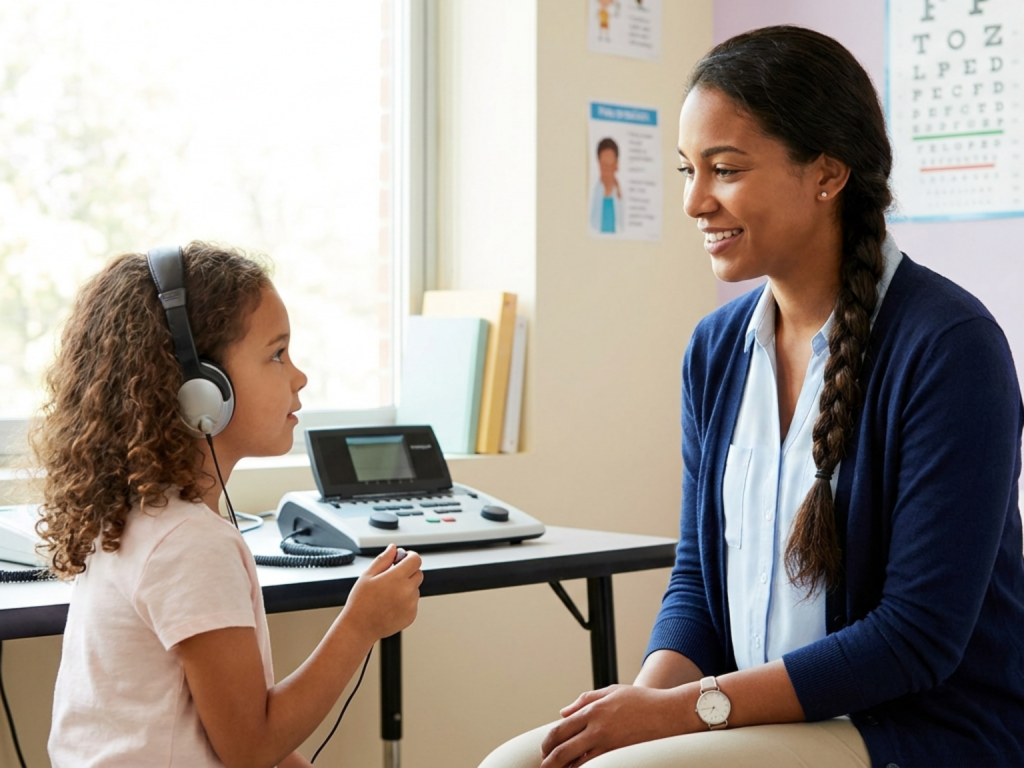
Hearing screening also changes with age. For many school-aged children, pure tone screening is the standard approach. The child wears headphones and responds when tones are heard. Evidence-based childhood hearing screening protocols commonly use frequencies such as 1000, 2000, and 4000 Hz at a screening level of 20 dB HL. These frequencies are important for speech perception, especially in classroom environments where background noise can make listening harder.
For preschool children or children who cannot reliably complete pure tone testing, otoacoustic emissions, often called OAE testing, may be used. OAE screening measures sound generated by the cochlea in response to a stimulus. It is quick and does not require the child to raise a hand or press a button, although the child must usually be reasonably still and quiet.
Tympanometry may be used as a second-stage screen or as part of follow-up. It evaluates how the eardrum moves in response to pressure changes and can suggest middle-ear dysfunction, such as fluid behind the eardrum. Tympanometry does not directly measure hearing sensitivity, but it can help explain why a child may not pass a hearing screen. This is particularly relevant after otitis media with effusion, because persistent fluid behind the eardrum can cause fluctuating conductive hearing difficulty.
Understanding pass, refer, and incomplete results
A “pass” generally means the child responded adequately or the screening device did not detect a referral-level concern on that day. It does not guarantee perfect vision or hearing, and it does not rule out all eye, ear, auditory processing, neurologic, or learning conditions. Parents and teachers should still take functional concerns seriously.
A “refer” or “fail” result means the child should receive further evaluation. It should not be treated as a diagnosis or ignored as “just a school test.” Common reasons for a referred hearing screen include temporary middle-ear fluid, ear canal blockage, difficulty understanding instructions, equipment fit, environmental noise, or true hearing loss. Common reasons for a referred vision screen include refractive error, unequal vision between eyes, poor cooperation, ocular alignment concerns, or amblyopia risk.
An “incomplete” or “unable to screen” result also matters. Some children are tired, anxious, developmentally unable to perform the task, or unable to understand directions in the screening language. Rather than assuming the child is fine, families should ask what repeat screening or alternative method is appropriate. Age-appropriate hearing testing and vision assessment can often be adapted for children with speech delays, autism, intellectual disability, motor differences, or limited attention.
Signs families and teachers may notice
Screening programs work best when combined with careful observation. For possible vision concerns, children may squint, close one eye, tilt the head, lose their place while reading, avoid near work, sit very close to screens, complain of headaches, or show declining interest in books. Some children do not complain; they may simply fatigue quickly or appear frustrated by tasks that require sustained visual attention.
Possible hearing concerns include asking for repetition, turning up volume, not responding when called from another room, misunderstanding questions, delayed speech and language development, unclear articulation, academic difficulties, or seeming unusually tired after school. Listening problems in preschoolers can be subtle because young children may rely heavily on routine, gesture, facial expression, and context.
Urgent medical attention is appropriate for sudden vision loss, sudden hearing loss, severe eye pain, eye injury, new neurologic symptoms, ear drainage with significant pain or fever, or concern for a foreign body or trauma. For non-urgent but persistent concerns, families should contact the child’s pediatrician, an eye care professional, an audiologist, or an ear, nose, and throat specialist as appropriate.
How to prepare a child and what follow-up may involve
Preparation can reduce anxiety and improve accuracy. Explain the screening in simple terms: “You will look at pictures,” or “You will raise your hand when you hear a beep.” For younger children, practicing covering one eye without pressing on it, matching shapes, or wearing headphones briefly can help. Make sure the screener knows if the child has developmental, language, sensory, or behavioral needs.
If a child is referred after a vision screen, follow-up may involve a comprehensive eye examination, refraction, assessment of ocular alignment, and evaluation for amblyopia or eye disease. Treatment decisions might include glasses, patching, vision therapy in selected cases, or medical or surgical care, but only a qualified clinician can recommend what is appropriate.
If a child is referred after a hearing screen, follow-up may include otoscopy, tympanometry, pure tone audiometry, speech testing, OAE testing, or more specialized audiologic assessment. Some children need medical evaluation for middle-ear disease, while others may need monitoring, classroom accommodations, assistive technology, or intervention services. Families should keep copies of screening results and share them with clinicians and schools so that support is coordinated rather than fragmented.
When not to wait
- Seek urgent care for sudden vision loss, sudden hearing loss, severe eye pain, or eye injury.
- Contact a healthcare professional promptly if a child fails a screening or cannot complete it reliably.
- Do not assume behavior or school difficulties are intentional until hearing and vision concerns have been considered.
- Persistent ear fluid, recurrent ear infections, or speech delay should prompt discussion of hearing evaluation.
- A passed school screen does not replace medical evaluation when symptoms or family concerns persist.
Tools & Assistance
- Schedule routine well-child visits and ask when the next vision and hearing screens are due.
- Keep a record of school screening results, referrals, and completed follow-up evaluations.
- Ask the school nurse or screening coordinator what method was used and whether repeat screening is planned.
- Consult a pediatrician, optometrist, ophthalmologist, audiologist, or ENT specialist when concerns persist.
- Request classroom supports while awaiting evaluation if the child is struggling to see or hear instructions.
FAQ
Is a school screening the same as a full eye or hearing exam?
No. Screening identifies children who may need further evaluation. A diagnostic examination by an appropriate professional is needed to determine the cause and treatment options.
Can a child pass screening and still have a problem?
Yes. Screening is brief and may not detect every condition. Persistent symptoms, teacher concerns, speech delay, or academic difficulties should still be discussed with a healthcare professional.
What happens if my child fails a hearing screen after a cold or ear infection?
Temporary middle-ear fluid can affect screening results. The child may need repeat screening, tympanometry, medical evaluation, or audiology follow-up depending on symptoms and local protocols.
How can I help an anxious child cooperate with screening?
Use simple explanations, practice with headphones or picture matching, avoid pressure, and tell the screener about sensory or developmental needs. Alternative methods may be available.
Sources
- American Academy of Audiology — Clinical Practice Guidelines: Childhood Hearing Screening
- Illinois Department of Public Health — Vision & Hearing
- National Institutes of Health / PubMed Central — Vision and Hearing Screening in School Settings: Reducing Barriers to Access
Disclaimer
This article is for general educational purposes only and does not diagnose or treat any condition. Always consult a qualified healthcare professional for concerns about a child’s vision, hearing, development, or screening results.














Please log in to leave a comment.