
Intro
Preschool emotional development is the gradual growth of a child’s ability to recognize feelings, communicate needs, tolerate frustration, form relationships, and recover after distress. Between about 3 and 5 years of age, children are still developing the neural networks that support impulse control, social understanding, language-mediated self-regulation, and flexible problem-solving.
This stage can feel tender and intense for families because emotional growth is not linear. A preschooler may comfort a friend in the morning and then melt down over a broken cracker in the afternoon. That variability is often part of typical development, but persistent or severe concerns deserve thoughtful discussion with a pediatrician, early childhood clinician, or developmental-behavioral specialist.
Highlights
Preschoolers are learning to name emotions, read facial expressions, and match emotional reactions to situations.
Responsive caregiving supports emotional security by validating feelings while helping children practice limits and coping skills.
Social-emotional development is closely tied to school readiness, peer relationships, language, sleep, family stress, and temperament.
Intense emotions are common at this age, but regression, frequent aggression, severe anxiety, or loss of skills should prompt professional guidance.
What emotional development means in preschool
Preschool emotional development includes several overlapping abilities: identifying internal states, using words to describe feelings, managing arousal, seeking comfort appropriately, sharing attention with others, and beginning to understand that other people have thoughts and emotions different from their own. These skills depend on maturation of executive functions, especially inhibitory control, working memory, and cognitive flexibility.
At this age, the limbic system, which helps generate emotional responses, is often more reactive than the prefrontal systems that help organize and pause behavior. This is one reason a preschooler may know a rule but still hit, scream, hide, or run when overwhelmed. The child is not simply choosing chaos; their regulatory capacity is still under construction.
Healthy growth does not mean a child is calm all the time. It means the child is slowly gaining tools: saying “I am mad,” accepting comfort, waiting briefly, repairing after conflict, and recovering from disappointment with less adult support over time. Social-emotional development in children is best understood as a trajectory, not a single milestone.
Typical emotional skills from ages 3 to 5
Many 3-year-olds can label basic emotions such as happy, sad, mad, and scared, especially when adults model the words. They may still confuse similar states, such as frustration and anger, or excitement and anxiety. They often need adults to co-regulate, meaning the adult’s calm voice, predictable actions, and physical presence help the child’s nervous system settle.
By age 4, many children become more skilled at pretend play, turn-taking, and describing simple causes of feelings. They may say, “She is sad because her toy broke,” or “I was scared when it was loud.” They can begin to use basic coping strategies, such as asking for help, holding a comfort object, taking a break, or choosing between two acceptable options.
By age 5, many children can manage small delays, participate in group routines, and use language to negotiate with peers. They may still struggle during transitions, hunger, fatigue, overstimulation, or unfamiliar demands. Preschool tantrums and emotional outbursts can still occur, but the overall pattern should gradually show more recovery, communication, and flexibility.
Why relationships are the main growth environment
Emotional skills are learned in relationships before they are performed independently. Warm, responsive caregiving helps children build a sense of safety, which supports exploration, learning, and self-control. Responsive adults notice the child’s cues, name the feeling, set a clear boundary when needed, and help the child return to connection after distress.
Validation is not the same as permissiveness. A caregiver can say, “You are angry that playtime is over,” while also holding the limit: “I will not let you throw blocks.” This approach teaches that feelings are acceptable, while unsafe behavior still has boundaries. Over time, children internalize the adult’s words and structure as their own self-talk.
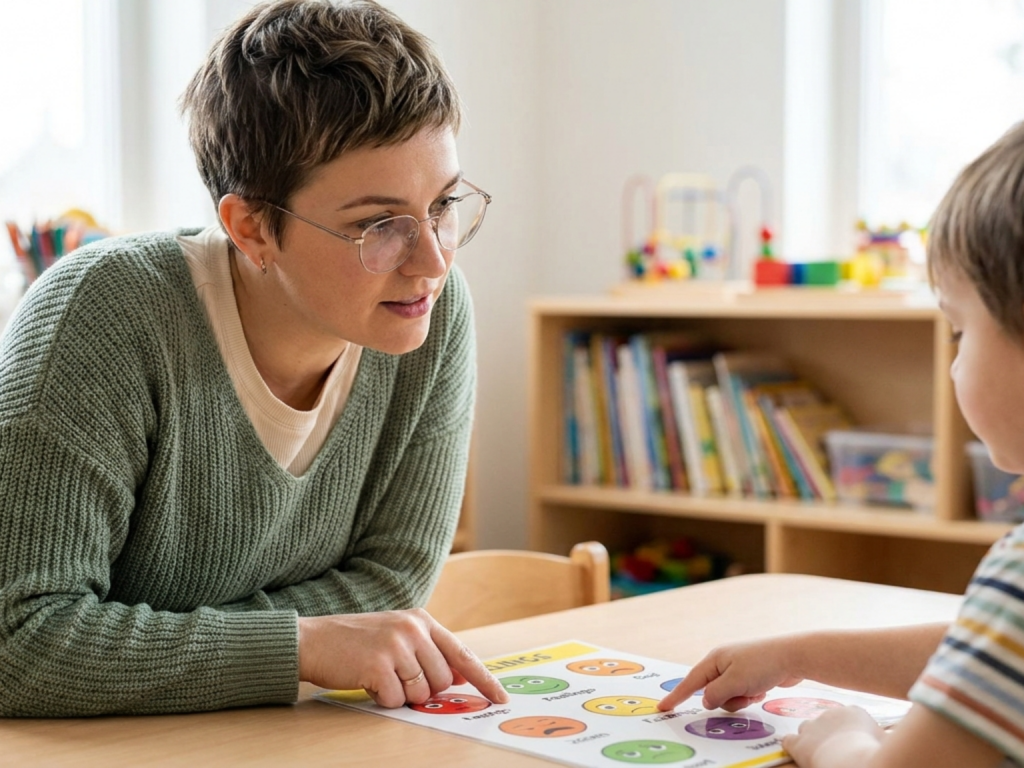
Early childhood classrooms can also provide powerful emotional scaffolding. Teachers often support growth through predictable routines, children’s books about feelings, coached peer problem-solving, specific praise, and planned practice with sharing or waiting. Effective praise is concrete: “You gave Maya a turn with the truck,” is more useful than a vague “good job” because it names the behavior the child can repeat.
Temperament, language, and the brain-body connection
Children differ in temperament, including emotional intensity, adaptability, activity level, sensory sensitivity, and approach to novelty. A cautious child may need longer warm-up time in a new classroom. A highly active child may need more movement before sitting. A child with strong sensory reactivity may become dysregulated by noise, crowded spaces, clothing textures, or bright lights.
Language development strongly affects emotional regulation. When children can explain what they want, what hurts, or what frightened them, they usually need fewer physical or explosive behaviors to communicate distress. Conversely, speech-language delays, hearing concerns, or pragmatic language difficulties can increase frustration and peer conflict. Developmental surveillance and screening can help clarify whether language, motor, sleep, sensory, or social communication factors are contributing.
The body also matters. Hunger, constipation, pain, sleep deprivation, medication effects, allergies, and chronic stress can lower the threshold for emotional overload. A child who appears oppositional may be exhausted, anxious, overstimulated, or unable to understand the demand. Looking for patterns across time of day, setting, sleep, meals, and transitions can make support more precise.
Building emotional regulation without shame
Emotional regulation in early childhood grows through repeated, supported practice. Preschoolers benefit from adults who stay physically safe, emotionally steady, and verbally simple during hard moments. Long explanations usually do not work when a child is highly aroused because the brain is prioritizing survival responses over reasoning.
Helpful strategies include:
- Use brief emotion labels: “You are disappointed” or “That surprised you.”
- Offer limited choices: “Walk to the sink or hop to the sink.”
- Preview transitions with a visual timer, song, or predictable routine.
- Teach coping skills when the child is calm, not during peak distress.
- Repair afterward with short, non-shaming language: “That was hard. We are safe. Next time we can ask for help.”
For repeated conflicts, adults can use a simple functional lens: What happened before the behavior, what did the child do, and what happened afterward? This does not blame the child; it identifies unmet skills or environmental triggers. A child who throws toys every cleanup time may need fewer items out, a visual sequence, adult assistance starting the task, or a transition warning.
Peer relationships, empathy, and early school readiness
Preschool is a major period for learning friendship skills. Children practice entering play, sharing materials, handling rejection, taking turns, and understanding group rules. These tasks require emotional regulation, language, impulse control, and social cognition at the same time, so uneven performance is expected.
Research on preschool social-emotional learning suggests that children do not all follow one uniform profile. Some children may show broad social-emotional competence, some may be socially expressive and engaged, and others may show risk patterns that interfere with readiness for school. This person-centered view is useful because two children with the same outward behavior may need different supports.
Empathy also develops gradually. A preschooler may comfort a crying peer one day and grab a toy the next. Adults can strengthen empathy by narrating visible cues: “He is covering his ears; the sound may feel too loud,” or “She is smiling because you invited her.” Children’s books, puppets, and pretend play allow practice with emotions at a safer distance than real conflict.
School readiness is not just letters and numbers. A child’s ability to separate from caregivers, follow routines, ask for help, recover after mistakes, and participate in group play is central to early learning. When these skills are fragile, support should focus on teaching and accommodations rather than punishment.
When to seek professional guidance
Wide variation is normal, but some patterns deserve timely discussion with a healthcare or early childhood professional. Concerns include frequent aggression that causes injury, persistent self-injury, extreme separation distress that prevents participation, emotional outbursts that are unusually prolonged or escalating, major sleep disruption, loss of previously acquired skills, or limited interest in social interaction.
Professional support is also appropriate when caregivers feel they are walking on eggshells, when preschool behavior disrupts family functioning, or when a child is repeatedly removed from childcare. Evaluation may include medical review, developmental screening, hearing and vision assessment, speech-language evaluation, occupational therapy assessment, or referral to an early childhood mental health clinician.
Seeking help does not mean a child is “bad” or that a parent has failed. It means the adults are gathering information about the child’s nervous system, developmental profile, environment, and relationships. Early support can reduce stress, protect the child’s self-esteem, and help caregivers respond with confidence and consistency.
Seek help promptly if
- Your child loses previously acquired language, social, motor, or self-care skills.
- Emotional outbursts include frequent self-injury, choking attempts, head banging with injury, or threats of serious harm.
- Aggression is escalating, causes injuries, or makes childcare unsafe.
- Anxiety, withdrawal, or sadness persistently interferes with sleep, eating, play, or preschool attendance.
- Caregivers feel unable to keep the child or others safe during emotional episodes.
Tools & Assistance
- Pediatric well-child visit with developmental surveillance
- Early intervention or local preschool special education evaluation
- Speech-language and hearing assessment when communication concerns are present
- Early childhood mental health consultation
- Teacher-caregiver behavior log tracking sleep, meals, transitions, triggers, and recovery
FAQ
Are tantrums normal in preschoolers?
Yes, tantrums can be developmentally typical, especially with fatigue, hunger, transitions, or frustration. Patterns that are very frequent, dangerous, prolonged, or worsening should be discussed with a pediatrician or child development professional.
Should I ignore big feelings?
Ignoring feelings is usually not helpful. It is better to acknowledge the feeling, keep boundaries clear, and avoid giving unsafe behavior extra payoff. Minor attention-seeking behavior may sometimes be handled differently with professional guidance.
Can a preschooler really learn coping skills?
Yes, but skills must be simple and practiced when calm. Breathing, asking for help, using a quiet space, choosing between options, and naming feelings can become useful with repetition and adult support.
How do I know if emotional behavior is related to a developmental delay?
Clues include delayed speech, difficulty understanding directions, sensory distress, poor sleep, limited pretend play, or trouble interacting with peers. A pediatrician can guide screening and referrals.
Sources
- PubMed Central — Social-Emotional Learning Profiles of Preschoolers' Early School Readiness
- Virtual Lab School — Social-Emotional Development: Preschool Children
- National Association for the Education of Young Children — Promoting Young Children's Social and Emotional Health
Disclaimer
This article is for informational purposes only and does not replace medical, developmental, or mental health evaluation. Consult a qualified healthcare professional for concerns about your child’s behavior, safety, development, or emotional well-being.
















Please log in to leave a comment.